Thank you for visiting SNEWPapers!
Sign up free
Letter to Editor
November 7, 1871
Delaware State Journal
Wilmington, New Castle County, Delaware
What is this article about?
Dr. Eldel addresses workingmen in Philadelphia on October 30th, advocating peaceful cooperation against communism and rigid political economy. He promotes beneficial societies, co-operative stores, and banks for self-help, drawing on historical examples like slave emancipation and the Rochdale Society.
Clipping
OCR Quality
95%
Excellent
Full Text
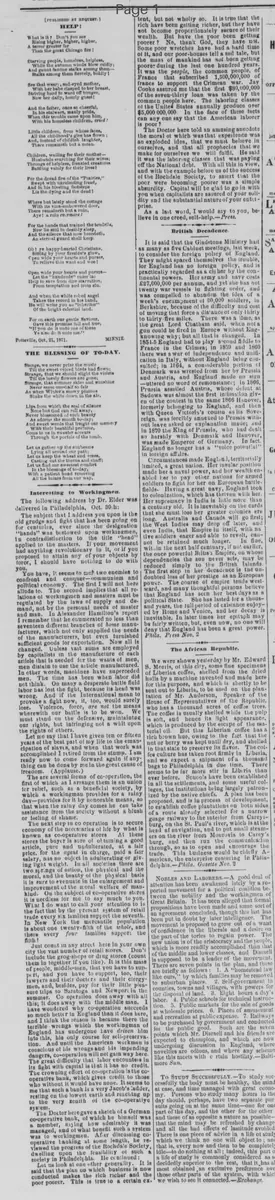
The following address by Dr. Eldel delivered in Philadelphia, Oct. 30th:
The subject that I address you upon is the old grudge and fight that has been going on for centuries, ever since the designation "hands" was bestowed upon workingmen, in contradistinction to the title "head" applied to the masters. If your movement had anything revolutionary in it, or if you proposed to attain any of your objects by force, I should have nothing to do with you.
You have, it seems to me, two enemies to confront and conquer—communism and political economy. The first I will not here allude to. The second implies that all relations of workingmen and masters must be regulated by the laws of supply and demand, not by the personal needs of master and man. In Alexander Hamilton's report I remember that he enumerated no less than seventeen different branches of home manufactures, which not only supplied the needs of the manufacturers, but even furnished sufficient goods for exportation. Now all is changed. "Unless vast sums are employed by capitalists in the manufacture of each article that is needed for the wants of men, men disdain to use the article manufactured. In other words, machines have superseded men. The time has been when labor did not think. On many a desperate battle field labor has lost the fight, because its head was wrong. And if the International mean to provoke a fight now, it, too, would surely lose. Violence, force, are not the means wherewith our battle is to be won. We must stand on the defensive, maintaining our rights, but infringing not a whit upon the rights of others.
Let me say that I have given ten or fifteen years of the best part of my life to the emancipation of slaves, and when that work was accomplished I retired from the stump. I am ready now to come forward again if anything can be done by me in the great cause of freedom. (Applause.)
There are several forms of co-operation, the first of which as I arrange them is an union for relief, such as a beneficial society, by which a workingman provides for a rainy day—provides for it by honorable means, so that when the rainy day comes he can take assistance from the society without a blush or feeling of shame.
The next step in co-operation is to secure economy of the necessaries of life by what is known as co-operative stores. At these stores the buyer is sure of obtaining a good article, pure and undulterated, at a fair price, for the agent in charge, paid a fair salary, has no object in adulterating or giving light weight. In all societies there are two springs of action, the physical and the moral, and the beauty of the physical basis it is sure to evenuate in the enlargement and improvement of the moral welfare of mankind. On the subject of co-operative stores it is needless for me to say much to you. What I do want to call your attention to is the fact that by the present system of retail trade every six families support the seventh. In New York the mercantile population is about one twenty-fifth of the whole, and there every four families support the fifth!
Just count in any street here in your own city the vast number of retail stores. Don't include the grog-shops or drug stores (count them in together if you like). It is this mass of people, middle-men, that you have to support, and you have to support, too, their lawyers and their doctors and their clergymen, and, besides, pay for their little pleasure trips to Saratoga and Newport in the summer. Co-operation does away with all this; it does away with the middle man. I have wondered why co-operation succeeds so much better in England than it does here, and I think the reason is because there the terrible wrongs which the workingman of England has undergone have driven him into this, his only course for self-preservation. And until the American workman is conscious of his wrongs and his impending dangers, co-operation will not gain way here. The great difficulty that labor encounters in its fight with capital is that it has no credit. The crowning effort of co-operation is the co-operative bank, which gives credit to those who without it would have none. It seems to me that such a bank is a very Jacob's ladder, resting on the lowest earth and reaching up to the very zenith of the co-operative system.
The Doctor here gave a sketch of a German co-operative bank, of which he himself was a member, saying how admirably it was managed, and of what benefit such a system was to workingmen. After discussing co-operative Banking at some length, he reviewed the progress of the Rochdale Society, dwelling upon the feasibility of such a society in Philadelphia. He continued:
Let us look at one other generality. It is said that the plan on which business is now conducted makes the rich richer and the poor poorer. This is true to a certain extent, but not wholly so. It is true that the rich have been getting richer, but they have not become proportionately secure of their wealth. But have the poor been getting poorer? No, thank God, they have not. Some poor wretches have had a hard time of it, and our poor-houses tell a sad tale, but the mass of mankind has not been getting poorer during the last one hundred years. It was the people, the common people, of France that subscribed 1,500,000,000 of francs to support the Crimean war. Jay Cooke assured me that the first $80,000,000 of the seven-thirty loan was taken by the common people here. The laboring classes of the United States annually produce over $5,000,000,000. In the face of these facts can any one say that the American laborer is poor?
The Doctor here told an amusing anecdote the moral of which was that experience was an exploded idea, that we must believe in ourselves, and that all prophecies that we make for ourselves we will fulfil. He said it was the laboring classes that was paying off the National debt. With all this in view, and with the example before us of the success of the Rochdale Society, to assert that the poor were becoming poorer was a simple absurdity. Capital will be glad to go in with you when capitalists are assured of your solidity and the substantial nature of your enterprise.
As a last word, I would say to you, believe in one creed, self-help.—Press.
The subject that I address you upon is the old grudge and fight that has been going on for centuries, ever since the designation "hands" was bestowed upon workingmen, in contradistinction to the title "head" applied to the masters. If your movement had anything revolutionary in it, or if you proposed to attain any of your objects by force, I should have nothing to do with you.
You have, it seems to me, two enemies to confront and conquer—communism and political economy. The first I will not here allude to. The second implies that all relations of workingmen and masters must be regulated by the laws of supply and demand, not by the personal needs of master and man. In Alexander Hamilton's report I remember that he enumerated no less than seventeen different branches of home manufactures, which not only supplied the needs of the manufacturers, but even furnished sufficient goods for exportation. Now all is changed. "Unless vast sums are employed by capitalists in the manufacture of each article that is needed for the wants of men, men disdain to use the article manufactured. In other words, machines have superseded men. The time has been when labor did not think. On many a desperate battle field labor has lost the fight, because its head was wrong. And if the International mean to provoke a fight now, it, too, would surely lose. Violence, force, are not the means wherewith our battle is to be won. We must stand on the defensive, maintaining our rights, but infringing not a whit upon the rights of others.
Let me say that I have given ten or fifteen years of the best part of my life to the emancipation of slaves, and when that work was accomplished I retired from the stump. I am ready now to come forward again if anything can be done by me in the great cause of freedom. (Applause.)
There are several forms of co-operation, the first of which as I arrange them is an union for relief, such as a beneficial society, by which a workingman provides for a rainy day—provides for it by honorable means, so that when the rainy day comes he can take assistance from the society without a blush or feeling of shame.
The next step in co-operation is to secure economy of the necessaries of life by what is known as co-operative stores. At these stores the buyer is sure of obtaining a good article, pure and undulterated, at a fair price, for the agent in charge, paid a fair salary, has no object in adulterating or giving light weight. In all societies there are two springs of action, the physical and the moral, and the beauty of the physical basis it is sure to evenuate in the enlargement and improvement of the moral welfare of mankind. On the subject of co-operative stores it is needless for me to say much to you. What I do want to call your attention to is the fact that by the present system of retail trade every six families support the seventh. In New York the mercantile population is about one twenty-fifth of the whole, and there every four families support the fifth!
Just count in any street here in your own city the vast number of retail stores. Don't include the grog-shops or drug stores (count them in together if you like). It is this mass of people, middle-men, that you have to support, and you have to support, too, their lawyers and their doctors and their clergymen, and, besides, pay for their little pleasure trips to Saratoga and Newport in the summer. Co-operation does away with all this; it does away with the middle man. I have wondered why co-operation succeeds so much better in England than it does here, and I think the reason is because there the terrible wrongs which the workingman of England has undergone have driven him into this, his only course for self-preservation. And until the American workman is conscious of his wrongs and his impending dangers, co-operation will not gain way here. The great difficulty that labor encounters in its fight with capital is that it has no credit. The crowning effort of co-operation is the co-operative bank, which gives credit to those who without it would have none. It seems to me that such a bank is a very Jacob's ladder, resting on the lowest earth and reaching up to the very zenith of the co-operative system.
The Doctor here gave a sketch of a German co-operative bank, of which he himself was a member, saying how admirably it was managed, and of what benefit such a system was to workingmen. After discussing co-operative Banking at some length, he reviewed the progress of the Rochdale Society, dwelling upon the feasibility of such a society in Philadelphia. He continued:
Let us look at one other generality. It is said that the plan on which business is now conducted makes the rich richer and the poor poorer. This is true to a certain extent, but not wholly so. It is true that the rich have been getting richer, but they have not become proportionately secure of their wealth. But have the poor been getting poorer? No, thank God, they have not. Some poor wretches have had a hard time of it, and our poor-houses tell a sad tale, but the mass of mankind has not been getting poorer during the last one hundred years. It was the people, the common people, of France that subscribed 1,500,000,000 of francs to support the Crimean war. Jay Cooke assured me that the first $80,000,000 of the seven-thirty loan was taken by the common people here. The laboring classes of the United States annually produce over $5,000,000,000. In the face of these facts can any one say that the American laborer is poor?
The Doctor here told an amusing anecdote the moral of which was that experience was an exploded idea, that we must believe in ourselves, and that all prophecies that we make for ourselves we will fulfil. He said it was the laboring classes that was paying off the National debt. With all this in view, and with the example before us of the success of the Rochdale Society, to assert that the poor were becoming poorer was a simple absurdity. Capital will be glad to go in with you when capitalists are assured of your solidity and the substantial nature of your enterprise.
As a last word, I would say to you, believe in one creed, self-help.—Press.
What sub-type of article is it?
Persuasive
Informative
Reflective
What themes does it cover?
Economic Policy
Social Issues
Morality
What keywords are associated?
Labor Cooperation
Co Operative Stores
Self Help
Workingmen Rights
International Movement
Rochdale Society
Slave Emancipation
Economic Reform
What entities or persons were involved?
Dr. Eldel
Workingmen Of The International
Letter to Editor Details
Author
Dr. Eldel
Recipient
Workingmen Of The International
Main Argument
workingmen should achieve emancipation through peaceful cooperation via beneficial societies, co-operative stores, and banks, emphasizing self-help over violence or revolution, while confronting communism and supply-demand economics.
Notable Details
References Alexander Hamilton's Report On Home Manufactures
Speaker's Involvement In Slave Emancipation
Description Of German Co Operative Bank
Progress Of Rochdale Society
Economic Contributions Of Laboring Classes To National Debt And Loans
Critique Of Retail Trade Middlemen