Thank you for visiting SNEWPapers!
Sign up free
Editorial
April 10, 1790
Gazette Of The United States
New York, New York County, New York
What is this article about?
A conversation between the author and a concerned farmer about fears of oppressive taxes and national debt. The author reassures him that the U.S. debt of 80 million dollars can be managed through population growth, land improvements, and domestic industry, without burdening citizens.
Clipping
OCR Quality
98%
Excellent
Full Text
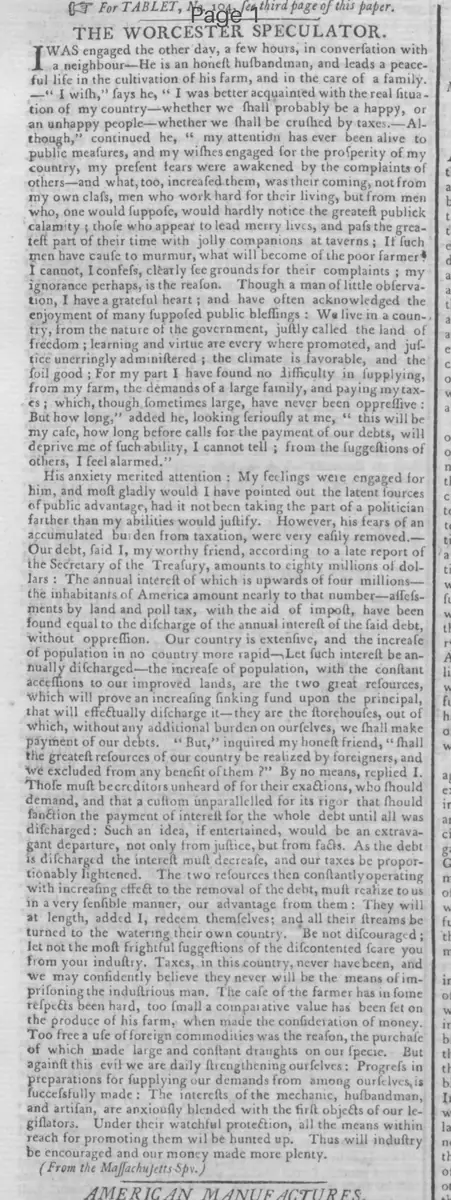
THE WORCESTER SPECULATOR.
WAS engaged the other day, a few hours, in conversation with a neighbour. He is an honest husbandman, and leads a peaceful life in the cultivation of his farm, and in the care of a family.—"I wish," says he, "I was better acquainted with the real situation of my country—whether we shall probably be a happy, or an unhappy people—whether we shall be crushed by taxes.—Although," continued he, "my attention has ever been alive to public measures, and my wishes engaged for the prosperity of my country, my present fears were awakened by the complaints of others—and what, too, increased them, was their coming, not from my own class, men who work hard for their living, but from men who, one would suppose, would hardly notice the greatest public calamity; those who appear to lead merry lives, and pass the greatest part of their time with jolly companions at taverns; If such men have cause to murmur, what will become of the poor farmer? I cannot, I confess, clearly see grounds for their complaints; my ignorance perhaps, is the reason. Though a man of little observation, I have a grateful heart; and have often acknowledged the enjoyment of many supposed public blessings: We live in a country, from the nature of the government, justly called the land of freedom; learning and virtue are every where promoted, and justice unerringly administered; the climate is favorable, and the soil good; For my part I have found no difficulty in supplying, from my farm, the demands of a large family, and paying my taxes; which, though sometimes large, have never been oppressive: But how long," added he, looking seriously at me, "this will be my case, how long before calls for the payment of our debts, will deprive me of such ability, I cannot tell; from the suggestions of others, I feel alarmed."
His anxiety merited attention: My feelings were engaged for him, and most gladly would I have pointed out the latent sources of public advantage, had it not been taking the part of a politician farther than my abilities would justify. However, his fears of an accumulated burden from taxation, were very easily removed.—Our debt, said I, my worthy friend, according to a late report of the Secretary of the Treasury, amounts to eighty millions of dollars: The annual interest of which is upwards of four millions—the inhabitants of America amount nearly to that number—assessments by land and poll tax, with the aid of impost, have been found equal to the discharge of the annual interest of the said debt, without oppression. Our country is extensive, and the increase of population in no country more rapid—Let such interest be annually discharged—the increase of population, with the constant accessions to our improved lands, are the two great resources, which will prove an increasing sinking fund upon the principal, that will effectually discharge it—they are the storehouses, out of which, without any additional burden on ourselves, we shall make payment of our debts. "But," inquired my honest friend, "shall the greatest resources of our country be realized by foreigners, and we excluded from any benefit of them?" By no means, replied I. Those must be creditors unheard of for their exactions, who should demand, and that a custom unparalleled for its rigor that should sanction the payment of interest for the whole debt until all was discharged: Such an idea, if entertained, would be an extravagant departure, not only from justice, but from facts. As the debt is discharged the interest must decrease, and our taxes be proportionably lightened. The two resources then constantly operating with increasing effect to the removal of the debt, must realize to us in a very sensible manner, our advantage from them: They will at length, added I, redeem themselves; and all their streams be turned to the watering their own country. Be not discouraged; let not the most frightful suggestions of the discontented scare you from your industry. Taxes, in this country, never have been, and we may confidently believe they never will be the means of imprisoning the industrious man. The case of the farmer has in some respects been hard, too small a comparative value has been set on the produce of his farm, when made the consideration of money. Too free a use of foreign commodities was the reason, the purchase of which made large and constant draughts on our specie. But against this evil we are daily strengthening ourselves: Progress in preparations for supplying our demands from among ourselves, is successfully made: The interests of the mechanic, husbandman, and artisan, are anxiously blended with the first objects of our legislators. Under their watchful protection, all the means within reach for promoting them will be hunted up. Thus will industry be encouraged and our money made more plenty.
(From the Massachusetts Spy.)
WAS engaged the other day, a few hours, in conversation with a neighbour. He is an honest husbandman, and leads a peaceful life in the cultivation of his farm, and in the care of a family.—"I wish," says he, "I was better acquainted with the real situation of my country—whether we shall probably be a happy, or an unhappy people—whether we shall be crushed by taxes.—Although," continued he, "my attention has ever been alive to public measures, and my wishes engaged for the prosperity of my country, my present fears were awakened by the complaints of others—and what, too, increased them, was their coming, not from my own class, men who work hard for their living, but from men who, one would suppose, would hardly notice the greatest public calamity; those who appear to lead merry lives, and pass the greatest part of their time with jolly companions at taverns; If such men have cause to murmur, what will become of the poor farmer? I cannot, I confess, clearly see grounds for their complaints; my ignorance perhaps, is the reason. Though a man of little observation, I have a grateful heart; and have often acknowledged the enjoyment of many supposed public blessings: We live in a country, from the nature of the government, justly called the land of freedom; learning and virtue are every where promoted, and justice unerringly administered; the climate is favorable, and the soil good; For my part I have found no difficulty in supplying, from my farm, the demands of a large family, and paying my taxes; which, though sometimes large, have never been oppressive: But how long," added he, looking seriously at me, "this will be my case, how long before calls for the payment of our debts, will deprive me of such ability, I cannot tell; from the suggestions of others, I feel alarmed."
His anxiety merited attention: My feelings were engaged for him, and most gladly would I have pointed out the latent sources of public advantage, had it not been taking the part of a politician farther than my abilities would justify. However, his fears of an accumulated burden from taxation, were very easily removed.—Our debt, said I, my worthy friend, according to a late report of the Secretary of the Treasury, amounts to eighty millions of dollars: The annual interest of which is upwards of four millions—the inhabitants of America amount nearly to that number—assessments by land and poll tax, with the aid of impost, have been found equal to the discharge of the annual interest of the said debt, without oppression. Our country is extensive, and the increase of population in no country more rapid—Let such interest be annually discharged—the increase of population, with the constant accessions to our improved lands, are the two great resources, which will prove an increasing sinking fund upon the principal, that will effectually discharge it—they are the storehouses, out of which, without any additional burden on ourselves, we shall make payment of our debts. "But," inquired my honest friend, "shall the greatest resources of our country be realized by foreigners, and we excluded from any benefit of them?" By no means, replied I. Those must be creditors unheard of for their exactions, who should demand, and that a custom unparalleled for its rigor that should sanction the payment of interest for the whole debt until all was discharged: Such an idea, if entertained, would be an extravagant departure, not only from justice, but from facts. As the debt is discharged the interest must decrease, and our taxes be proportionably lightened. The two resources then constantly operating with increasing effect to the removal of the debt, must realize to us in a very sensible manner, our advantage from them: They will at length, added I, redeem themselves; and all their streams be turned to the watering their own country. Be not discouraged; let not the most frightful suggestions of the discontented scare you from your industry. Taxes, in this country, never have been, and we may confidently believe they never will be the means of imprisoning the industrious man. The case of the farmer has in some respects been hard, too small a comparative value has been set on the produce of his farm, when made the consideration of money. Too free a use of foreign commodities was the reason, the purchase of which made large and constant draughts on our specie. But against this evil we are daily strengthening ourselves: Progress in preparations for supplying our demands from among ourselves, is successfully made: The interests of the mechanic, husbandman, and artisan, are anxiously blended with the first objects of our legislators. Under their watchful protection, all the means within reach for promoting them will be hunted up. Thus will industry be encouraged and our money made more plenty.
(From the Massachusetts Spy.)
What sub-type of article is it?
Taxation
Economic Policy
What keywords are associated?
National Debt
Taxation
Population Growth
Sinking Fund
American Industry
Foreign Creditors
Domestic Production
What entities or persons were involved?
Secretary Of The Treasury
Foreign Creditors
Farmers
Legislators
Editorial Details
Primary Topic
Reassurance Against Fears Of National Debt And Oppressive Taxes
Stance / Tone
Optimistic Reassurance
Key Figures
Secretary Of The Treasury
Foreign Creditors
Farmers
Legislators
Key Arguments
National Debt Is 80 Million Dollars With 4 Million Annual Interest
Current Taxes Suffice To Pay Interest Without Oppression
Population Growth And Land Improvements Form A Natural Sinking Fund
Debt Reduction Will Lighten Taxes Over Time
Domestic Industry Progress Reduces Reliance On Foreign Goods
Legislators Promote Interests Of Mechanics, Husbandmen, And Artisans