Thank you for visiting SNEWPapers!
Sign up free
Literary
December 4, 1824
The Ladies' Garland
Harpers Ferry, Jefferson County, West Virginia
What is this article about?
A narrative continues with a walk revealing a Revolutionary War hideout used by marauders. The storyteller recounts the tragic seduction and abandonment of his niece Indiana by the deceitful Alonzo, leading to her ruin, and reflects morally on the vice of seducing innocent women.
Merged-components note: Continuation of serialized fiction 'CAREARE.' across pages, sequential reading order
Clippings
1 of 2
OCR Quality
95%
Excellent
Full Text
CAREARE.
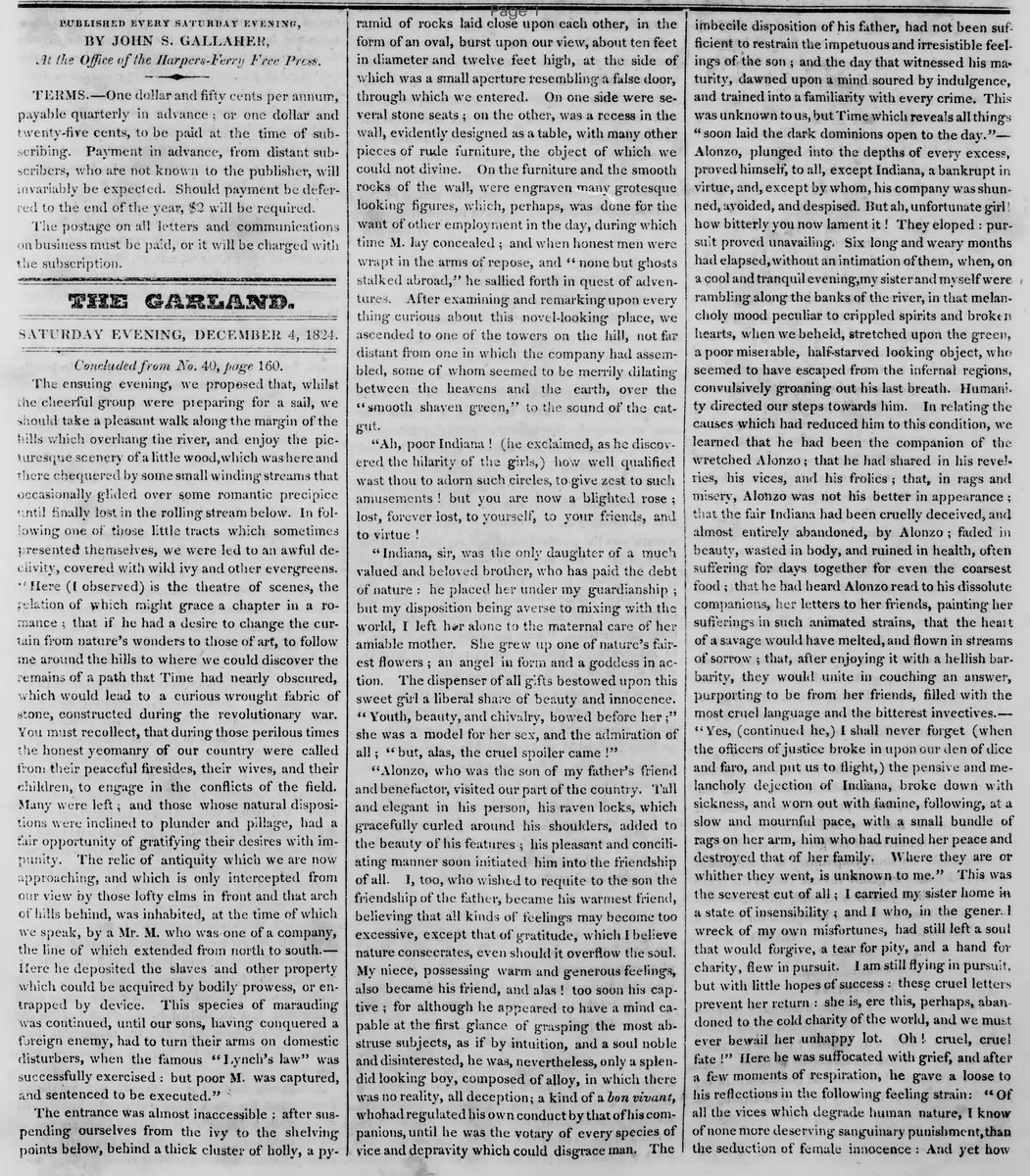
SATURDAY EVENING, DECEMBER 4, 1824.
Concluded from No. 40, page 160.
The ensuing evening, we proposed that, whilst the cheerful group were preparing for a sail, we should take a pleasant walk along the margin of the hills which overhang the river, and enjoy the picturesque scenery of a little wood, which was here and there chequered by some small winding streams that occasionally glided over some romantic precipice until finally lost in the rolling stream below. In following one of those little tracts which sometimes presented themselves, we were led to an awful declivity, covered with wild ivy and other evergreens.
"Here (I observed) is the theatre of scenes, the relation of which might grace a chapter in a romance; that if he had a desire to change the curtain from nature's wonders to those of art, to follow me around the hills to where we could discover the remains of a path that Time had nearly obscured, which would lead to a curious wrought fabric of stone, constructed during the revolutionary war. You must recollect, that during those perilous times the honest yeomanry of our country were called from their peaceful firesides, their wives, and their children, to engage in the conflicts of the field. Many were left; and those whose natural dispositions were inclined to plunder and pillage, had a fair opportunity of gratifying their desires with impunity. The relic of antiquity which we are now approaching, and which is only intercepted from our view by those lofty elms in front and that arch of hills behind, was inhabited, at the time of which we speak, by a Mr. M. who was one of a company, the line of which extended from north to south. Here he deposited the slaves and other property which could be acquired by bodily prowess, or entrapped by device. This species of marauding was continued, until our sons, having conquered a foreign enemy, had to turn their arms on domestic disturbers, when the famous "Lynch's law" was successfully exercised: but poor M. was captured, and sentenced to be executed."
The entrance was almost inaccessible: after suspending ourselves from the ivy to the shelving points below, behind a thick cluster of holly, a pyramid of rocks laid close upon each other, in the form of an oval, burst upon our view, about ten feet in diameter and twelve feet high, at the side of which was a small aperture resembling a false door, through which we entered. On one side were several stone seats; on the other, was a recess in the wall, evidently designed as a table, with many other pieces of rude furniture, the object of which we could not divine. On the furniture and the smooth rocks of the wall, were engraven many grotesque looking figures, which, perhaps, was done for the want of other employment in the day, during which time M. lay concealed; and when honest men were wrapt in the arms of repose, and "none but ghosts stalked abroad," he sallied forth in quest of adventures. After examining and remarking upon every thing curious about this novel-looking place, we ascended to one of the towers on the hill, not far distant from one in which the company had assembled, some of whom seemed to be merrily dilating between the heavens and the earth, over the "smooth shaven green," to the sound of the cat-gut.
"Ah, poor Indiana! (he exclaimed, as he discovered the hilarity of the girls,) how well qualified wast thou to adorn such circles, to give zest to such amusements! but you are now a blighted rose: lost, forever lost, to yourself, to your friends, and to virtue!
"Indiana, sir, was the only daughter of a much valued and beloved brother, who has paid the debt of nature: he placed her under my guardianship; but my disposition being averse to mixing with the world, I left her alone to the maternal care of her amiable mother. She grew up one of nature's fairest flowers; an angel in form and a goddess in action. The dispenser of all gifts bestowed upon this sweet girl a liberal share of beauty and innocence.
"Youth, beauty, and chivalry, bowed before her:"
she was a model for her sex, and the admiration of all; "but, alas, the cruel spoiler came!"
"Alonzo, who was the son of my father's friend and benefactor, visited our part of the country. Tall and elegant in his person, his raven locks, which gracefully curled around his shoulders, added to the beauty of his features; his pleasant and conciliating manner soon initiated him into the friendship of all. I, too, who wished to requite to the son the friendship of the father, became his warmest friend, believing that all kinds of feelings may become too excessive, except that of gratitude, which I believe nature consecrates, even should it overflow the soul. My niece, possessing warm and generous feelings, also became his friend, and alas! too soon his captive; for although he appeared to have a mind capable at the first glance of grasping the most abstruse subjects, as if by intuition, and a soul noble and disinterested, he was, nevertheless, only a splendid looking boy, composed of alloy, in which there was no reality, all deception; a kind of a bon vivant, who had regulated his own conduct by that of his companions, until he was the votary of every species of vice and depravity which could disgrace man. The imbecile disposition of his father, had not been sufficient to restrain the impetuous and irresistible feelings of the son; and the day that witnessed his maturity, dawned upon a mind soured by indulgence, and trained into a familiarity with every crime. This was unknown to us, but Time which reveals all things "soon laid the dark dominions open to the day." Alonzo, plunged into the depths of every excess, proved himself, to all, except Indiana, a bankrupt in virtue, and, except by whom, his company was shunned, avoided, and despised. But ah, unfortunate girl! how bitterly you now lament it! They eloped: pursuit proved unavailing. Six long and weary months had elapsed, without an intimation of them, when, on a cool and tranquil evening, my sister and myself were rambling along the banks of the river, in that melancholy mood peculiar to crippled spirits and broken hearts, when we beheld, stretched upon the green, a poor miserable, half-starved looking object, who seemed to have escaped from the infernal regions, convulsively groaning out his last breath. Humanity directed our steps towards him. In relating the causes which had reduced him to this condition, we learned that he had been the companion of the wretched Alonzo; that he had shared in his revelries, his vices, and his frolics; that, in rags and misery, Alonzo was not his better in appearance; that the fair Indiana had been cruelly deceived, and almost entirely abandoned, by Alonzo; faded in beauty, wasted in body, and ruined in health, often suffering for days together for even the coarsest food; that he had heard Alonzo read to his dissolute companions, her letters to her friends, painting her sufferings in such animated strains, that the heart of a savage would have melted, and flown in streams of sorrow; that, after enjoying it with a hellish barbarity, they would unite in couching an answer, purporting to be from her friends, filled with the most cruel language and the bitterest invectives.
"Yes, (continued he,) I shall never forget (when the officers of justice broke in upon our den of dice and faro, and put us to flight,) the pensive and melancholy dejection of Indiana, broke down with sickness, and worn out with famine, following, at a slow and mournful pace, with a small bundle of rags on her arm, him who had ruined her peace and destroyed that of her family. Where they are or whither they went, is unknown to me." This was the severest cut of all; I carried my sister home in a state of insensibility; and I who, in the general wreck of my own misfortunes, had still left a soul that would forgive, a tear for pity, and a hand for charity, flew in pursuit. I am still flying in pursuit, but with little hopes of success: these cruel letters prevent her return: she is, ere this, perhaps, abandoned to the cold charity of the world, and we must ever bewail her unhappy lot. Oh! cruel, cruel fate!" Here he was suffocated with grief, and after a few moments of respiration, he gave a loose to his reflections in the following feeling strain: "Of all the vices which degrade human nature, I know of none more deserving sanguinary punishment, than the seduction of female innocence: And yet how dreadful is the progress of this vice. Has not bad customs so reconciled many to the once hideous features of this Demon, that it has become quite familiar in their conversation? And those who should ever conceal their connivances beneath the cowl of shame, and display their guilt by blushes of the deepest dye-are prepared to risk, in the field of honor, a life made truly worthless by their depravities, when their claim to the title of gentleman is questioned: who make it their boast at the board of revelry, and esteem the ruin of an unoffending, and, but for them, virtuous female, one of the most brilliant events of their life; whilst the laugh of fools, and the approbation of debauchees, enhance the vile deed in the estimation of the offender. The reflection that the aged parents are forever cast down in sorrow and anguish; that the foul deed is sending fast their gray hairs to the grave; that a brother's or a sister's heart is agonized with grief; that with shame and pity do they look or reflect upon the hapless victim of the profligate, who has heaped undeserved ignominy upon an innocent family, and that too, most probably, under pledges given of the most affected solemnity, and which, though unheeded by the man, are not forgotten by his Creator: or, to heighten the portrait of infamy, consider her friendless and an orphan, cast upon the world, entitled to claim the protection of all, and what does she find? Instead of that liberal and noble feeling which should distinguish man, instead of finding in our sex one to shield her from the storms of adversity--deluded, unfortunate girl! she listens to the supplications of a viper. and is undone forever!
Again: see the harmless female, stalking thro' the streets, with character gone, wasted to a vapor, through infamy; see the face once beautiful, now marred by disease, affecting the smile of gaiety and cheerfulness. Oh! could you hear her sad tale, how would the heart of sympathy feel for her woes; she could tell you, once she enjoyed the blessings of an uncorrupted conscience, once the sunshine of innocence, unclouded by guilt, shed its sweet beams on her footsteps; she could tell you of a broken-hearted parent, unable to survive the ignominy of the child; she could relate to you her sufferings for the necessaries of life; she could tell you of the comparatively trifling shame she had endured at the cheerless blocks of inhospitable doors: and, humiliating to know, could point you to her seducer, revelling in the luxuries attendant upon wealth, or basking in the favors of the great! Poor deluded woman, whilst my soul sympathizes in your misfortunes, and would so gladly restore you to the paths of virtue--with all your shame, with all your sufferings, I would not barter your prospects for those of your destroyer.
HAMLTON.
SATURDAY EVENING, DECEMBER 4, 1824.
Concluded from No. 40, page 160.
The ensuing evening, we proposed that, whilst the cheerful group were preparing for a sail, we should take a pleasant walk along the margin of the hills which overhang the river, and enjoy the picturesque scenery of a little wood, which was here and there chequered by some small winding streams that occasionally glided over some romantic precipice until finally lost in the rolling stream below. In following one of those little tracts which sometimes presented themselves, we were led to an awful declivity, covered with wild ivy and other evergreens.
"Here (I observed) is the theatre of scenes, the relation of which might grace a chapter in a romance; that if he had a desire to change the curtain from nature's wonders to those of art, to follow me around the hills to where we could discover the remains of a path that Time had nearly obscured, which would lead to a curious wrought fabric of stone, constructed during the revolutionary war. You must recollect, that during those perilous times the honest yeomanry of our country were called from their peaceful firesides, their wives, and their children, to engage in the conflicts of the field. Many were left; and those whose natural dispositions were inclined to plunder and pillage, had a fair opportunity of gratifying their desires with impunity. The relic of antiquity which we are now approaching, and which is only intercepted from our view by those lofty elms in front and that arch of hills behind, was inhabited, at the time of which we speak, by a Mr. M. who was one of a company, the line of which extended from north to south. Here he deposited the slaves and other property which could be acquired by bodily prowess, or entrapped by device. This species of marauding was continued, until our sons, having conquered a foreign enemy, had to turn their arms on domestic disturbers, when the famous "Lynch's law" was successfully exercised: but poor M. was captured, and sentenced to be executed."
The entrance was almost inaccessible: after suspending ourselves from the ivy to the shelving points below, behind a thick cluster of holly, a pyramid of rocks laid close upon each other, in the form of an oval, burst upon our view, about ten feet in diameter and twelve feet high, at the side of which was a small aperture resembling a false door, through which we entered. On one side were several stone seats; on the other, was a recess in the wall, evidently designed as a table, with many other pieces of rude furniture, the object of which we could not divine. On the furniture and the smooth rocks of the wall, were engraven many grotesque looking figures, which, perhaps, was done for the want of other employment in the day, during which time M. lay concealed; and when honest men were wrapt in the arms of repose, and "none but ghosts stalked abroad," he sallied forth in quest of adventures. After examining and remarking upon every thing curious about this novel-looking place, we ascended to one of the towers on the hill, not far distant from one in which the company had assembled, some of whom seemed to be merrily dilating between the heavens and the earth, over the "smooth shaven green," to the sound of the cat-gut.
"Ah, poor Indiana! (he exclaimed, as he discovered the hilarity of the girls,) how well qualified wast thou to adorn such circles, to give zest to such amusements! but you are now a blighted rose: lost, forever lost, to yourself, to your friends, and to virtue!
"Indiana, sir, was the only daughter of a much valued and beloved brother, who has paid the debt of nature: he placed her under my guardianship; but my disposition being averse to mixing with the world, I left her alone to the maternal care of her amiable mother. She grew up one of nature's fairest flowers; an angel in form and a goddess in action. The dispenser of all gifts bestowed upon this sweet girl a liberal share of beauty and innocence.
"Youth, beauty, and chivalry, bowed before her:"
she was a model for her sex, and the admiration of all; "but, alas, the cruel spoiler came!"
"Alonzo, who was the son of my father's friend and benefactor, visited our part of the country. Tall and elegant in his person, his raven locks, which gracefully curled around his shoulders, added to the beauty of his features; his pleasant and conciliating manner soon initiated him into the friendship of all. I, too, who wished to requite to the son the friendship of the father, became his warmest friend, believing that all kinds of feelings may become too excessive, except that of gratitude, which I believe nature consecrates, even should it overflow the soul. My niece, possessing warm and generous feelings, also became his friend, and alas! too soon his captive; for although he appeared to have a mind capable at the first glance of grasping the most abstruse subjects, as if by intuition, and a soul noble and disinterested, he was, nevertheless, only a splendid looking boy, composed of alloy, in which there was no reality, all deception; a kind of a bon vivant, who had regulated his own conduct by that of his companions, until he was the votary of every species of vice and depravity which could disgrace man. The imbecile disposition of his father, had not been sufficient to restrain the impetuous and irresistible feelings of the son; and the day that witnessed his maturity, dawned upon a mind soured by indulgence, and trained into a familiarity with every crime. This was unknown to us, but Time which reveals all things "soon laid the dark dominions open to the day." Alonzo, plunged into the depths of every excess, proved himself, to all, except Indiana, a bankrupt in virtue, and, except by whom, his company was shunned, avoided, and despised. But ah, unfortunate girl! how bitterly you now lament it! They eloped: pursuit proved unavailing. Six long and weary months had elapsed, without an intimation of them, when, on a cool and tranquil evening, my sister and myself were rambling along the banks of the river, in that melancholy mood peculiar to crippled spirits and broken hearts, when we beheld, stretched upon the green, a poor miserable, half-starved looking object, who seemed to have escaped from the infernal regions, convulsively groaning out his last breath. Humanity directed our steps towards him. In relating the causes which had reduced him to this condition, we learned that he had been the companion of the wretched Alonzo; that he had shared in his revelries, his vices, and his frolics; that, in rags and misery, Alonzo was not his better in appearance; that the fair Indiana had been cruelly deceived, and almost entirely abandoned, by Alonzo; faded in beauty, wasted in body, and ruined in health, often suffering for days together for even the coarsest food; that he had heard Alonzo read to his dissolute companions, her letters to her friends, painting her sufferings in such animated strains, that the heart of a savage would have melted, and flown in streams of sorrow; that, after enjoying it with a hellish barbarity, they would unite in couching an answer, purporting to be from her friends, filled with the most cruel language and the bitterest invectives.
"Yes, (continued he,) I shall never forget (when the officers of justice broke in upon our den of dice and faro, and put us to flight,) the pensive and melancholy dejection of Indiana, broke down with sickness, and worn out with famine, following, at a slow and mournful pace, with a small bundle of rags on her arm, him who had ruined her peace and destroyed that of her family. Where they are or whither they went, is unknown to me." This was the severest cut of all; I carried my sister home in a state of insensibility; and I who, in the general wreck of my own misfortunes, had still left a soul that would forgive, a tear for pity, and a hand for charity, flew in pursuit. I am still flying in pursuit, but with little hopes of success: these cruel letters prevent her return: she is, ere this, perhaps, abandoned to the cold charity of the world, and we must ever bewail her unhappy lot. Oh! cruel, cruel fate!" Here he was suffocated with grief, and after a few moments of respiration, he gave a loose to his reflections in the following feeling strain: "Of all the vices which degrade human nature, I know of none more deserving sanguinary punishment, than the seduction of female innocence: And yet how dreadful is the progress of this vice. Has not bad customs so reconciled many to the once hideous features of this Demon, that it has become quite familiar in their conversation? And those who should ever conceal their connivances beneath the cowl of shame, and display their guilt by blushes of the deepest dye-are prepared to risk, in the field of honor, a life made truly worthless by their depravities, when their claim to the title of gentleman is questioned: who make it their boast at the board of revelry, and esteem the ruin of an unoffending, and, but for them, virtuous female, one of the most brilliant events of their life; whilst the laugh of fools, and the approbation of debauchees, enhance the vile deed in the estimation of the offender. The reflection that the aged parents are forever cast down in sorrow and anguish; that the foul deed is sending fast their gray hairs to the grave; that a brother's or a sister's heart is agonized with grief; that with shame and pity do they look or reflect upon the hapless victim of the profligate, who has heaped undeserved ignominy upon an innocent family, and that too, most probably, under pledges given of the most affected solemnity, and which, though unheeded by the man, are not forgotten by his Creator: or, to heighten the portrait of infamy, consider her friendless and an orphan, cast upon the world, entitled to claim the protection of all, and what does she find? Instead of that liberal and noble feeling which should distinguish man, instead of finding in our sex one to shield her from the storms of adversity--deluded, unfortunate girl! she listens to the supplications of a viper. and is undone forever!
Again: see the harmless female, stalking thro' the streets, with character gone, wasted to a vapor, through infamy; see the face once beautiful, now marred by disease, affecting the smile of gaiety and cheerfulness. Oh! could you hear her sad tale, how would the heart of sympathy feel for her woes; she could tell you, once she enjoyed the blessings of an uncorrupted conscience, once the sunshine of innocence, unclouded by guilt, shed its sweet beams on her footsteps; she could tell you of a broken-hearted parent, unable to survive the ignominy of the child; she could relate to you her sufferings for the necessaries of life; she could tell you of the comparatively trifling shame she had endured at the cheerless blocks of inhospitable doors: and, humiliating to know, could point you to her seducer, revelling in the luxuries attendant upon wealth, or basking in the favors of the great! Poor deluded woman, whilst my soul sympathizes in your misfortunes, and would so gladly restore you to the paths of virtue--with all your shame, with all your sufferings, I would not barter your prospects for those of your destroyer.
HAMLTON.
What sub-type of article is it?
Prose Fiction
Essay
What themes does it cover?
Moral Virtue
Love Romance
Social Manners
What keywords are associated?
Seduction
Female Innocence
Moral Ruin
Elopement
Revolutionary War
Vice
Deception
Abandonment
What entities or persons were involved?
Hamlton.
Literary Details
Author
Hamlton.
Subject
The Seduction And Ruin Of Female Innocence
Form / Style
Narrative Prose With Moral Reflection
Key Lines
"Of All The Vices Which Degrade Human Nature, I Know Of None More Deserving Sanguinary Punishment, Than The Seduction Of Female Innocence:"
"Ah, Poor Indiana! ... Lost, Forever Lost, To Yourself, To Your Friends, And To Virtue!"
"Youth, Beauty, And Chivalry, Bowed Before Her:" She Was A Model For Her Sex, And The Admiration Of All; "But, Alas, The Cruel Spoiler Came!"