Thank you for visiting SNEWPapers!
Sign up free
Editorial
November 5, 1873
The Fairfield Herald
Winnsboro, Fairfield County, South Carolina
What is this article about?
Editorial criticizes high taxation in South Carolina compared to other states like Tennessee, Ohio, Kentucky, and Missouri, arguing that SC's rates are the highest when accounting for full property assessments. It refutes Gov. Moses' claims and accuses the state government of swindling citizens, especially colored voters.
Clipping
OCR Quality
95%
Excellent
Full Text
Taxation
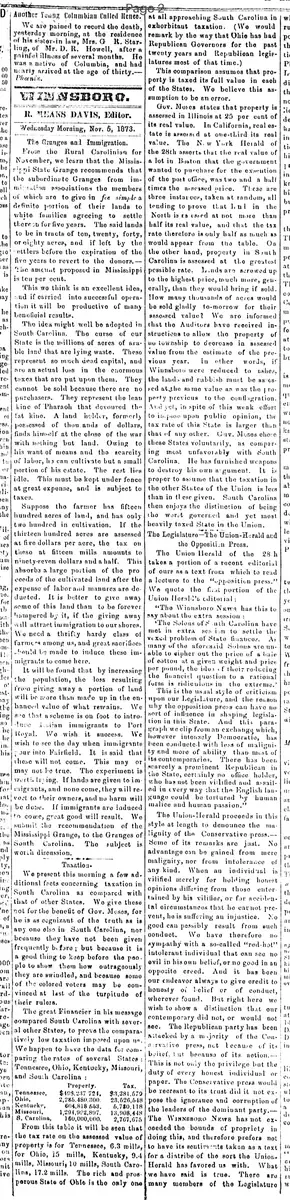
We present this morning a few additional facts concerning taxation in South Carolina as compared with that of other States. We give these not for the benefit of Gov. Moses, for he is as cognizant of the truth as is any one else in South Carolina, nor because they have not been given frequently before; but because it is a good thing to keep before the people to show them how outrageously they are swindled, and because some of the colored voters may be convinced at last of the turpitude of their rulers.
The great Financier in his message compared South Carolina with several other States, to prove the comparatively low taxation imposed upon us. We happen to have the data for comparing the rates of several States: Tennessee, Ohio, Kentucky, Missouri, and South Carolina:
Property. Tax.
Tennessee, $403,237,724. $3,391,679
Ohio, 2,286,480,300. 23,626,618
Kentucky, 604,818,663. 6,780,118
Missouri, 1,294,992,897. 13,908,418
S. Carolina, 160,000,000. 2,767,675
From this table it will be seen that the tax rate on the assessed value of property is for Tennessee, 6.3 mills, for Ohio, 15 mills, Kentucky, 9.4 mills, Missouri, 10 mills, South Carolina, 17.2 mills. The rich and prosperous State of Ohio is the only one at all approaching South Carolina in exorbitant taxation. (We would remark by the way that Ohio has had Republican Governors for the past twenty years and Republican legislatures most of that time.)
This comparison assumes that property is taxed its full value in each of the States. We believe this assumption to be an error.
Gov. Moses states that property is assessed in Illinois at 25 per cent of its real value. In California, real estate is assessed at one-third its real value. The N. Y. Herald of the 28th asserts that the real value of a lot in Boston that the government wanted to purchase for the extension of the post office, was two and a half times the assessed price. These are three instances, taken at random, all tending to prove that land in the North is assessed at not more than half its real value, and that the tax rate therefore is only half as much as would appear from the table. On the other hand, property in South Carolina is assessed at the greatest possible rate. Lands are screwed up to the highest price, much more, generally, than they would bring if sold. How many thousands of acres would be sold gladly to-morrow for their assessed value? We are informed that the Auditors have received instructions to allow the property of no township to decrease in assessed value from the estimate of the previous year. In other words, if Winnsboro were reduced to ashes, the lands and rubbish must be assessed at the same value as was the property previous to the conflagration. And yet, in spite of this weak effort to impose upon public opinion, the tax rate of this State is larger than that of any other. Gov. Moses chose these States voluntarily, as comparing most unfavorably with South Carolina. He has furnished weapons to destroy his own argument. It is proper to assume that the taxation in the other States of the Union is less than in these given. South Carolina then enjoys the distinction of being the worst governed and yet most heavily taxed State in the Union.
We present this morning a few additional facts concerning taxation in South Carolina as compared with that of other States. We give these not for the benefit of Gov. Moses, for he is as cognizant of the truth as is any one else in South Carolina, nor because they have not been given frequently before; but because it is a good thing to keep before the people to show them how outrageously they are swindled, and because some of the colored voters may be convinced at last of the turpitude of their rulers.
The great Financier in his message compared South Carolina with several other States, to prove the comparatively low taxation imposed upon us. We happen to have the data for comparing the rates of several States: Tennessee, Ohio, Kentucky, Missouri, and South Carolina:
Property. Tax.
Tennessee, $403,237,724. $3,391,679
Ohio, 2,286,480,300. 23,626,618
Kentucky, 604,818,663. 6,780,118
Missouri, 1,294,992,897. 13,908,418
S. Carolina, 160,000,000. 2,767,675
From this table it will be seen that the tax rate on the assessed value of property is for Tennessee, 6.3 mills, for Ohio, 15 mills, Kentucky, 9.4 mills, Missouri, 10 mills, South Carolina, 17.2 mills. The rich and prosperous State of Ohio is the only one at all approaching South Carolina in exorbitant taxation. (We would remark by the way that Ohio has had Republican Governors for the past twenty years and Republican legislatures most of that time.)
This comparison assumes that property is taxed its full value in each of the States. We believe this assumption to be an error.
Gov. Moses states that property is assessed in Illinois at 25 per cent of its real value. In California, real estate is assessed at one-third its real value. The N. Y. Herald of the 28th asserts that the real value of a lot in Boston that the government wanted to purchase for the extension of the post office, was two and a half times the assessed price. These are three instances, taken at random, all tending to prove that land in the North is assessed at not more than half its real value, and that the tax rate therefore is only half as much as would appear from the table. On the other hand, property in South Carolina is assessed at the greatest possible rate. Lands are screwed up to the highest price, much more, generally, than they would bring if sold. How many thousands of acres would be sold gladly to-morrow for their assessed value? We are informed that the Auditors have received instructions to allow the property of no township to decrease in assessed value from the estimate of the previous year. In other words, if Winnsboro were reduced to ashes, the lands and rubbish must be assessed at the same value as was the property previous to the conflagration. And yet, in spite of this weak effort to impose upon public opinion, the tax rate of this State is larger than that of any other. Gov. Moses chose these States voluntarily, as comparing most unfavorably with South Carolina. He has furnished weapons to destroy his own argument. It is proper to assume that the taxation in the other States of the Union is less than in these given. South Carolina then enjoys the distinction of being the worst governed and yet most heavily taxed State in the Union.
What sub-type of article is it?
Taxation
Economic Policy
Partisan Politics
What keywords are associated?
South Carolina Taxation
Tax Rates Comparison
Property Assessment
Gov Moses
Republican Government
Colored Voters
Over Taxation
What entities or persons were involved?
Gov. Moses
South Carolina
Tennessee
Ohio
Kentucky
Missouri
Illinois
California
Boston
Editorial Details
Primary Topic
High Taxation In South Carolina Compared To Other States
Stance / Tone
Critical Of South Carolina Government And High Taxes
Key Figures
Gov. Moses
South Carolina
Tennessee
Ohio
Kentucky
Missouri
Illinois
California
Boston
Key Arguments
South Carolina's Tax Rate Is 17.2 Mills, Higher Than Tennessee (6.3), Ohio (15), Kentucky (9.4), Missouri (10)
Property In Other States Assessed Below Real Value, Making Effective Tax Rates Lower
South Carolina Property Over Assessed, Even After Disasters Like Winnsboro Fire
Gov. Moses' Comparison Backfires, Proving Sc Worst Taxed State
Aim To Inform People And Colored Voters Of Rulers' Turpitude