Thank you for visiting SNEWPapers!
Sign up free
Editorial
April 13, 1840
Vermont Watchman And State Journal
Montpelier, Washington County, Vermont
What is this article about?
Editorial supports Whig Senators' backing of treasury note bill as indication of unity for administration in potential war with Britain over boundary question. Argues war demands national solidarity, opposition should advise not obstruct, and expresses confidence in incoming President Harrison.
Clipping
OCR Quality
98%
Excellent
Full Text
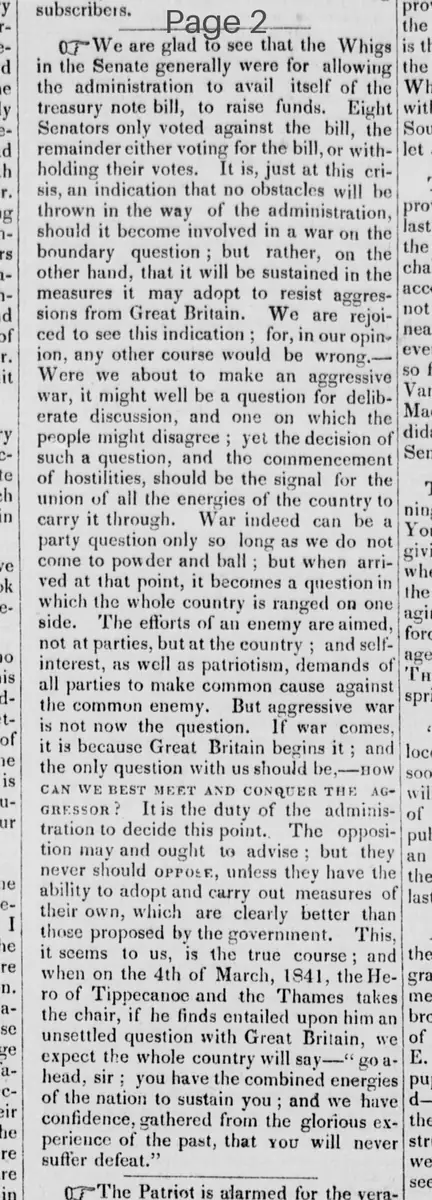
We are glad to see that the Whigs in the Senate generally were for allowing the administration to avail itself of the treasury note bill, to raise funds. Eight Senators only voted against the bill, the remainder either voting for the bill, or withholding their votes.
It is, just at this crisis, an indication that no obstacles will be thrown in the way of the administration, should it become involved in a war on the boundary question; but rather, on the other hand, that it will be sustained in the measures it may adopt to resist aggressions from Great Britain. We are rejoiced to see this indication; for, in our opinion, any other course would be wrong.
Were we about to make an aggressive war, it might well be a question for deliberate discussion, and one on which the people might disagree; yet the decision of such a question, and the commencement of hostilities, should be the signal for the union of all the energies of the country to carry it through. War indeed can be a party question only so long as we do not come to powder and ball: but when arrived at that point, it becomes a question in which the whole country is ranged on one side. The efforts of an enemy are aimed, not at parties, but at the country: and self-interest, as well as patriotism, demands of all parties to make common cause against the common enemy.
But aggressive war is not now the question. If war comes, it is because Great Britain begins it: and the only question with us should be,—now CAN WE BEST MEET AND CONQUER THE AGGRESSOR? It is the duty of the administration to decide this point. The opposition may and ought to advise: but they never should oppose, unless they have the ability to adopt and carry out measures of their own, which are clearly better than those proposed by the government. This, it seems to us, is the true course; and when on the 4th of March, 1841, the Hero of Tippecanoe and the Thames takes the chair, if he finds entailed upon him an unsettled question with Great Britain, we expect the whole country will say—"go ahead, sir: you have the combined energies of the nation to sustain you; and we have confidence, gathered from the glorious experience of the past, that you will never suffer defeat."
It is, just at this crisis, an indication that no obstacles will be thrown in the way of the administration, should it become involved in a war on the boundary question; but rather, on the other hand, that it will be sustained in the measures it may adopt to resist aggressions from Great Britain. We are rejoiced to see this indication; for, in our opinion, any other course would be wrong.
Were we about to make an aggressive war, it might well be a question for deliberate discussion, and one on which the people might disagree; yet the decision of such a question, and the commencement of hostilities, should be the signal for the union of all the energies of the country to carry it through. War indeed can be a party question only so long as we do not come to powder and ball: but when arrived at that point, it becomes a question in which the whole country is ranged on one side. The efforts of an enemy are aimed, not at parties, but at the country: and self-interest, as well as patriotism, demands of all parties to make common cause against the common enemy.
But aggressive war is not now the question. If war comes, it is because Great Britain begins it: and the only question with us should be,—now CAN WE BEST MEET AND CONQUER THE AGGRESSOR? It is the duty of the administration to decide this point. The opposition may and ought to advise: but they never should oppose, unless they have the ability to adopt and carry out measures of their own, which are clearly better than those proposed by the government. This, it seems to us, is the true course; and when on the 4th of March, 1841, the Hero of Tippecanoe and the Thames takes the chair, if he finds entailed upon him an unsettled question with Great Britain, we expect the whole country will say—"go ahead, sir: you have the combined energies of the nation to sustain you; and we have confidence, gathered from the glorious experience of the past, that you will never suffer defeat."
What sub-type of article is it?
War Or Peace
Foreign Affairs
Partisan Politics
What keywords are associated?
Boundary Question
War With Britain
National Unity
Whig Support
Treasury Note Bill
Harrison
What entities or persons were involved?
Whigs In The Senate
Administration
Great Britain
Hero Of Tippecanoe And The Thames
Editorial Details
Primary Topic
Support For Administration In Potential War With Britain Over Boundary Question
Stance / Tone
Supportive Of National Unity And Administration
Key Figures
Whigs In The Senate
Administration
Great Britain
Hero Of Tippecanoe And The Thames
Key Arguments
Whigs Support Treasury Note Bill For Funds
Indication Of No Obstacles To Administration In War
War Requires Union Of All Country Energies
Opposition Should Advise But Not Oppose Unless Better Measures
Confidence In Harrison To Handle British Question