Thank you for visiting SNEWPapers!
Sign up free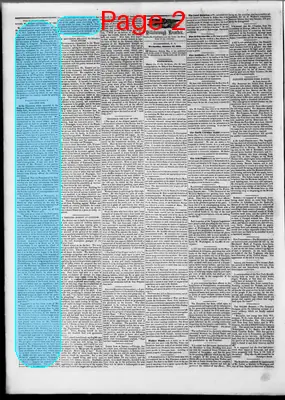
Editorial
January 27, 1858
The Hillsborough Recorder
Hillsboro, Orange County, North Carolina
What is this article about?
Editorial praises the Union newspaper for citing Daniel Webster's views on neutrality laws in defense of suppressing General Walker's illegal expedition to Nicaragua, contrasts 1850 Senate debate on Cuba filibustering, argues Webster's interpretation justifies presidential action against such violations, and anticipates congressional support for national good faith against filibustering.
Clipping
OCR Quality
98%
Excellent
Full Text
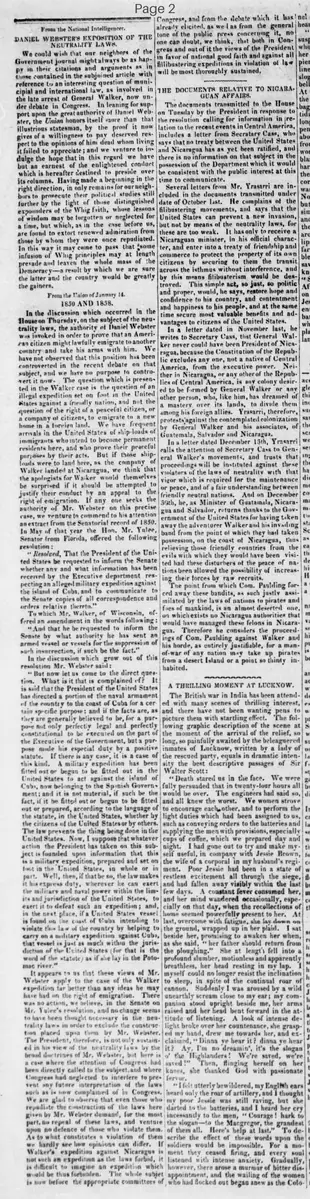
DANIEL WEBSTER'S EXPOSITION OF THE NEUTRALITY LAWS.
We could wish that our neighbors of the Government journal might always be as happy in their citations and arguments as in those contained in the subjoined article with reference to an interesting question of municipal and international law, as involved in the late arrest of General Walker, now under debate in Congress. In leaning or supporting upon the great authority of Daniel Webster, the Union honors itself more than that illustrious statesman, by the proof it now gives of a willingness to pay deserved respect to the opinions of him dead whom living it failed to appreciate; and we venture to indulge the hope that in this regard we have but an earnest of the enlightened conduct which is hereafter destined to preside over its columns. Having made a beginning in the right direction, it only remains for our neighbors to prosecute their political studies still further by the light of those distinguished expounders of the Whig faith, whose lessons of wisdom may be forgotten or neglected for a time, but which, as in the case before us, are found to extort renewed admiration from those by whom they were once repudiated. In this way it may come to pass that some infusion of Whig principles may at length pervade and leaven the whole mass of the Democracy—a result by which we are sure the latter and the country would be greatly the gainers.
From the Union of January 14.
1850 AND 1858.
In the discussion which occurred in the House on Thursday, on the subject of the neutrality laws, the authority of Daniel Webster was invoked in order to prove that an American citizen might lawfully emigrate to another country and take his arms with him. We have not observed that this position has been controverted in the recent debate on that subject, and we have no purpose to controvert it now. The question which is presented in the Walker case is the question of an illegal expedition set on foot in the United States against a friendly nation, and not the question of the right of a peaceful citizen, or a company of citizens, to emigrate to a new home in a foreign land. We have frequent arrivals in the United States of ship-loads of immigrants who intend to become permanent residents here, and who prove their peaceful purposes by their acts. But if those ship-loads were to land here, as the company of Walker landed at Nicaragua, we think that the apologists for Walker would themselves be surprised if it should be attempted to justify their conduct by an appeal to the right of emigration. If any one seeks the authority of Mr. Webster on this precise case, we venture to commend to his attention an extract from the Senatorial record of 1850. In May of that year the Hon. Mr. Yulee, Senator from Florida, offered the following resolution:
"Resolved, That the President of the United States be requested to inform the Senate whether any and what information has been received by the Executive department respecting an alleged military expedition against the island of Cuba, and to communicate to the Senate copies of all correspondence and orders relative thereto."
To which Mr. Walker, of Wisconsin, offered an amendment in the words following:
"And that he be requested to inform the Senate by what authority he has sent an armed vessel or vessels for the suppression of such insurrection, if such be the fact."
In the discussion which grew out of this resolution Mr. Webster said:
"But now let us come to the direct question. What is it that is complained of? It is said that the President of the United States has directed a portion of the naval armament of the country to the coast of Cuba for a certain specific purpose: and if the facts are, as they are generally believed to be, for a purpose not only perfectly legal and perfectly constitutional to be executed on the part of the Executive of the Government, but a purpose made his especial duty by a positive statute. If there is any case, it is a case of this kind. A military expedition has been fitted out or begun to be fitted out in the United States to act against the island of Cuba, now belonging to the Spanish Government; and it is not material, if such be the fact, if it be fitted out or begun to be fitted out or prepared, according to the language of the statute, in the United States, whether by the citizens of the United States or by others. The law prevents the thing being done in the United States. Now, I suppose that whatever action the President has taken on this subject is founded upon information that this is a military expedition, prepared and set on foot in the United States, in whole or in part. Well, then, if that be so, the law makes it his express duty, wherever he can exert the military and naval power within the limits and jurisdiction of the United States, to exert it to defeat such an expedition; and in the next place, if a United States vessel is found on the coast of Cuba intending to violate this law of the country by helping to carry on a military expedition against Cuba, that vessel is just as much within the jurisdiction of the United States (for that is the word of the statute) as if she lay in the Potomac river."
It appears to us that these views of Mr. Webster apply to the case of the Walker expedition far better than any ideas he may have had on the right of emigration. There was no action, we believe, in the Senate on Mr. Yulee's resolution, and no change seems to have been thought necessary in the neutrality laws in order to exclude the construction placed upon them by Mr. Webster. The President, therefore, is not only sustained in his view of the neutrality laws by the broad doctrines of Mr. Webster, but here is a case where the attention of Congress had been directly called to the subject, and where Congress had neglected to interfere to prevent any future interpretation of the laws such as is now complained of in Congress. We are glad to observe that even those who repudiate the construction of the laws here given by Mr. Webster demand, for the most part, no repeal of these laws, and venture upon no defence of those who violate them. As to what constitutes a violation of them we hardly see how opinions can differ. If Walker's expedition against Nicaragua is not such an expedition as the laws forbid, it is difficult to imagine an expedition which would be thus forbidden. The whole subject is now before the appropriate committees of Congress, and from the debate which it has already elicited, as well as from the general tone of the public press concerning it, no one can doubt, we think, that both in Congress and out of it the views of the President in favor of national good faith and against all filibustering expeditions in violation of law will be most thoroughly sustained.
We could wish that our neighbors of the Government journal might always be as happy in their citations and arguments as in those contained in the subjoined article with reference to an interesting question of municipal and international law, as involved in the late arrest of General Walker, now under debate in Congress. In leaning or supporting upon the great authority of Daniel Webster, the Union honors itself more than that illustrious statesman, by the proof it now gives of a willingness to pay deserved respect to the opinions of him dead whom living it failed to appreciate; and we venture to indulge the hope that in this regard we have but an earnest of the enlightened conduct which is hereafter destined to preside over its columns. Having made a beginning in the right direction, it only remains for our neighbors to prosecute their political studies still further by the light of those distinguished expounders of the Whig faith, whose lessons of wisdom may be forgotten or neglected for a time, but which, as in the case before us, are found to extort renewed admiration from those by whom they were once repudiated. In this way it may come to pass that some infusion of Whig principles may at length pervade and leaven the whole mass of the Democracy—a result by which we are sure the latter and the country would be greatly the gainers.
From the Union of January 14.
1850 AND 1858.
In the discussion which occurred in the House on Thursday, on the subject of the neutrality laws, the authority of Daniel Webster was invoked in order to prove that an American citizen might lawfully emigrate to another country and take his arms with him. We have not observed that this position has been controverted in the recent debate on that subject, and we have no purpose to controvert it now. The question which is presented in the Walker case is the question of an illegal expedition set on foot in the United States against a friendly nation, and not the question of the right of a peaceful citizen, or a company of citizens, to emigrate to a new home in a foreign land. We have frequent arrivals in the United States of ship-loads of immigrants who intend to become permanent residents here, and who prove their peaceful purposes by their acts. But if those ship-loads were to land here, as the company of Walker landed at Nicaragua, we think that the apologists for Walker would themselves be surprised if it should be attempted to justify their conduct by an appeal to the right of emigration. If any one seeks the authority of Mr. Webster on this precise case, we venture to commend to his attention an extract from the Senatorial record of 1850. In May of that year the Hon. Mr. Yulee, Senator from Florida, offered the following resolution:
"Resolved, That the President of the United States be requested to inform the Senate whether any and what information has been received by the Executive department respecting an alleged military expedition against the island of Cuba, and to communicate to the Senate copies of all correspondence and orders relative thereto."
To which Mr. Walker, of Wisconsin, offered an amendment in the words following:
"And that he be requested to inform the Senate by what authority he has sent an armed vessel or vessels for the suppression of such insurrection, if such be the fact."
In the discussion which grew out of this resolution Mr. Webster said:
"But now let us come to the direct question. What is it that is complained of? It is said that the President of the United States has directed a portion of the naval armament of the country to the coast of Cuba for a certain specific purpose: and if the facts are, as they are generally believed to be, for a purpose not only perfectly legal and perfectly constitutional to be executed on the part of the Executive of the Government, but a purpose made his especial duty by a positive statute. If there is any case, it is a case of this kind. A military expedition has been fitted out or begun to be fitted out in the United States to act against the island of Cuba, now belonging to the Spanish Government; and it is not material, if such be the fact, if it be fitted out or begun to be fitted out or prepared, according to the language of the statute, in the United States, whether by the citizens of the United States or by others. The law prevents the thing being done in the United States. Now, I suppose that whatever action the President has taken on this subject is founded upon information that this is a military expedition, prepared and set on foot in the United States, in whole or in part. Well, then, if that be so, the law makes it his express duty, wherever he can exert the military and naval power within the limits and jurisdiction of the United States, to exert it to defeat such an expedition; and in the next place, if a United States vessel is found on the coast of Cuba intending to violate this law of the country by helping to carry on a military expedition against Cuba, that vessel is just as much within the jurisdiction of the United States (for that is the word of the statute) as if she lay in the Potomac river."
It appears to us that these views of Mr. Webster apply to the case of the Walker expedition far better than any ideas he may have had on the right of emigration. There was no action, we believe, in the Senate on Mr. Yulee's resolution, and no change seems to have been thought necessary in the neutrality laws in order to exclude the construction placed upon them by Mr. Webster. The President, therefore, is not only sustained in his view of the neutrality laws by the broad doctrines of Mr. Webster, but here is a case where the attention of Congress had been directly called to the subject, and where Congress had neglected to interfere to prevent any future interpretation of the laws such as is now complained of in Congress. We are glad to observe that even those who repudiate the construction of the laws here given by Mr. Webster demand, for the most part, no repeal of these laws, and venture upon no defence of those who violate them. As to what constitutes a violation of them we hardly see how opinions can differ. If Walker's expedition against Nicaragua is not such an expedition as the laws forbid, it is difficult to imagine an expedition which would be thus forbidden. The whole subject is now before the appropriate committees of Congress, and from the debate which it has already elicited, as well as from the general tone of the public press concerning it, no one can doubt, we think, that both in Congress and out of it the views of the President in favor of national good faith and against all filibustering expeditions in violation of law will be most thoroughly sustained.
What sub-type of article is it?
Foreign Affairs
Legal Reform
Partisan Politics
What keywords are associated?
Neutrality Laws
Daniel Webster
Walker Expedition
Filibustering
Cuba
Nicaragua
Congress Debate
What entities or persons were involved?
Daniel Webster
General Walker
President Of The United States
Mr. Yulee
Mr. Walker Of Wisconsin
Union Journal
Editorial Details
Primary Topic
Daniel Webster's Views On Neutrality Laws Applied To General Walker's Expedition
Stance / Tone
Supportive Of Neutrality Laws Enforcement And Presidential Action Against Filibustering
Key Figures
Daniel Webster
General Walker
President Of The United States
Mr. Yulee
Mr. Walker Of Wisconsin
Union Journal
Key Arguments
Neutrality Laws Prohibit Military Expeditions Fitted Out In The Us Against Friendly Nations
Webster's 1850 Senate Remarks Justify Presidential Use Of Naval Power To Suppress Such Expeditions
Walker's Nicaragua Expedition Violates Neutrality Laws, Unlike Peaceful Emigration
Congress Has Not Altered Laws Despite Past Debates, Sustaining Webster's Interpretation
Public And Congressional Opinion Supports Enforcement Against Filibustering