Thank you for visiting SNEWPapers!
Sign up free
Alexandria Advertiser And Commercial Intelligencer
Alexandria, Virginia
What is this article about?
An American opinion piece expresses concern over France's cession of Louisiana from Spain, highlighting threats to U.S. navigation rights on the Mississippi River, commercial interests, and potential for French intrigue and colonization that could undermine American sovereignty and economy.
Clipping
OCR Quality
Full Text
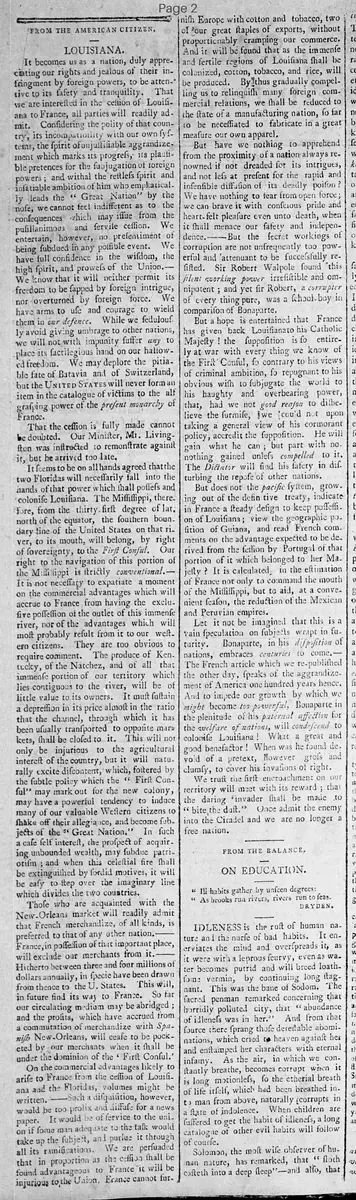
LOUISIANA.
It becomes us as a nation, duly appreciating our rights and jealous of their infringement by foreign powers, to be attentive to its safety and tranquility. That we are interested in the cession of Louisiana to France, all parties will readily admit. Considering the polity of that country, its incompatibility with our own system, the spirit of unjustifiable aggrandizement which marks its progress,—its plausible pretences for the subjugation of foreign powers; and withal the restless spirit and insatiable ambition of him who emphatically leads the "Great Nation" by the nose, we cannot feel indifferent as to the consequences which may issue from the pusillanimous and servile cession. We entertain, however, no presentiment of being subdued in any possible event. We have full confidence in the wisdom, the high spirit, and prowess of the Union.—We know that it will neither permit its freedom to be sapped by foreign intrigue, nor overturned by foreign force. We have arms to use and courage to wield them in our defence. While we sedulously avoid giving umbrage to other nations, we will not with impunity suffer any to place its sacrilegious hand on our hallowed freedom. We may deplore the pitiable fate of Batavia and of Switzerland, but the United States will never form an item in the catalogue of victims to the grasping power of the present monarchy of France.
That the cession is fully made cannot be doubted. Our Minister, Mr. Livingston was instructed to remonstrate against it, but he arrived too late.
It seems to be on all hands agreed that the two Floridas will necessarily fall into the hands of that power which shall possess and colonize Louisiana. The Mississippi, therefore, from the thirty-first degree of latitude north of the equator, the southern boundary line of the United States on that river, to its mouth, will belong, by right of sovereignty, to the First Consul. Our right to the navigation of this portion of the Mississippi is strictly conventional.—It is not necessary to expatiate a moment on the commercial advantages which will accrue to France from having the exclusive possession of the outlet of this immense river, nor of the advantages which will most probably result from it to our western citizens. They are too obvious to require comment. The produce of Kentucky, of the Natchez, and of all that immense portion of our territory which lies contiguous to the river, will be of little value to its Owners. It must sustain a depression in its price almost in the ratio that the channel, through which it has usually been transported to opposite markets, shall be closed to it. This will not only be injurious to the agricultural interest of the country, but it will naturally excite discontent, which, fostered by the subtle policy which the "First Consul" may mark out for the new colony, may have a powerful tendency to induce many of our valuable Western citizens to shake off their allegiance, and become subjects of the "Great Nation." In such a case self interest, the prospect of acquiring unbounded wealth, may subdue patriotism; and when this celestial fire shall be extinguished by sordid motives, it will be easy to step over the imaginary line which divides the two countries.
Those who are acquainted with the New-Orleans market will readily admit that French merchandize, of all kinds, is preferred to that of any other nation. France, in possession of that important place, will exclude our merchants from it.—Hitherto between three and four millions of dollars annually, in specie have been drawn from thence to the U. States. This will, in future find its way to France. So far our circulating medium may be abridged; and the profits, which have accrued from a commutation of merchandize with Spanish New-Orleans, will cease to be pocketed by our merchants when it shall be under the dominion of the 'First Consul.'
On the commercial advantages likely to arise to France from the cession of Louisiana and the Floridas, volumes might be written. —Such a disquisition, however, would be too prolix and diffuse for a news paper. It would be of service to the union if some man adequate to the task would take up the subject, and pursue it through all its ramifications. We are persuaded injurious to the Union, France cannot sur-found advantageous to France it will be that in proportion as the cession shall be furnish Europe with cotton and tobacco, two of our great staples of exports, without proportionably cramping our commerce. And it will be found that as the immense and fertile regions of Louisiana shall be colonized, cotton, tobacco, and rice, will be produced. By-thus gradually compelling us to relinquish many foreign commercial relations, we shall be seduced to the state of a manufacturing nation, so far to be necessitated to fabricate in a great measure our own apparel.
But have we nothing to apprehend from the proximity of a nation always renowned if not dreaded for its intrigues, and not less at present for the rapid and insensible diffusion of its deadly poison? We have nothing to fear from open force; we can brave it with conscious pride and heart-felt pleasure even unto death, when it shall menace our safety and independence.—But the secret workings of corruption are not unfrequently too powerful and 'attenuant to be successfully resisted. Sir Robert Walpole found this silent working power irresistible and omnipotent; and yet Sir Robert, a corrupter of every thing pure, was a school-boy in comparison of Bonaparte.
But a hope is entertained that France has given back Louisiana to his Catholic Majesty! the supposition is so entirely at war with every thing we know of the First' Consul, so contrary to his views of criminal ambition, so repugnant to his obvious wish to subjugate the world to his haughty and overbearing power, that, had we not good reason to disbelieve the surmise, we should not upon taking a general view of his cormorant policy, accredit the supposition. He will gain what he can; but part with nothing gained unless compelled to it. The Dictator will find his safety in disturbing the repose of other nations.
But does not the pacific system, growing out of the definitive treaty, indicate in France a steady design to keep possession of Louisiana; view the geographic position of Guiana, and read French comments on the advantage expected to be derived from the session by Portugal of that portion of it which belonged to her Majesty? It is calculated, in the estimation of France not only to command the mouth of the Mississippi, but to aid, at a convenient season, the reduction of the Mexican and Peruvian empires.
Let it not be imagined that this is a vain speculation on subjects wrapt in futurity. Bonaparte, in his disposition of nations, embraces centuries to come.—The French article which we re-published the other day, speaks of the aggrandizement of America one hundred years hence. And to impede our growth by which we might become too powerful, Bonaparte in the plenitude of his paternal affection for the welfare of nations. will condescend to colonise Louisiana! What a great and good benefactor! When was he found devoid of a pretext, however gross and clumsy, to cover his invasions of right.
We trust the first encroachment on our territory will meet with its reward; that the daring 'invader shall be made to "bite the dust." Once admit the enemy into the Citadel and we are no longer a free nation.
What sub-type of article is it?
What keywords are associated?
What entities or persons were involved?
Where did it happen?
Foreign News Details
Primary Location
Louisiana
Key Persons
Outcome
cession of louisiana to france completed; u.s. minister arrived too late to remonstrate; potential loss of mississippi navigation rights and commercial advantages; risk of western discontent and french intrigue.
Event Details
The article discusses the recent cession of Louisiana from Spain to France, expressing U.S. concerns over French ambitions, loss of Mississippi River access, economic impacts on western trade, exclusion of U.S. merchants from New Orleans, and potential for French colonization leading to intrigue and threats to American sovereignty.