Thank you for visiting SNEWPapers!
Sign up free
The Charleston Daily News
Charleston, Charleston County, South Carolina
What is this article about?
Account of Charleston fire companies Vigilant and Washington visiting Savannah, GA, for May 1 Fire Department anniversary: arrival, welcoming speeches, grand parade, engine trials with prizes, dinners, excursions, balls, and triumphant return to Charleston.
Clipping
OCR Quality
Full Text
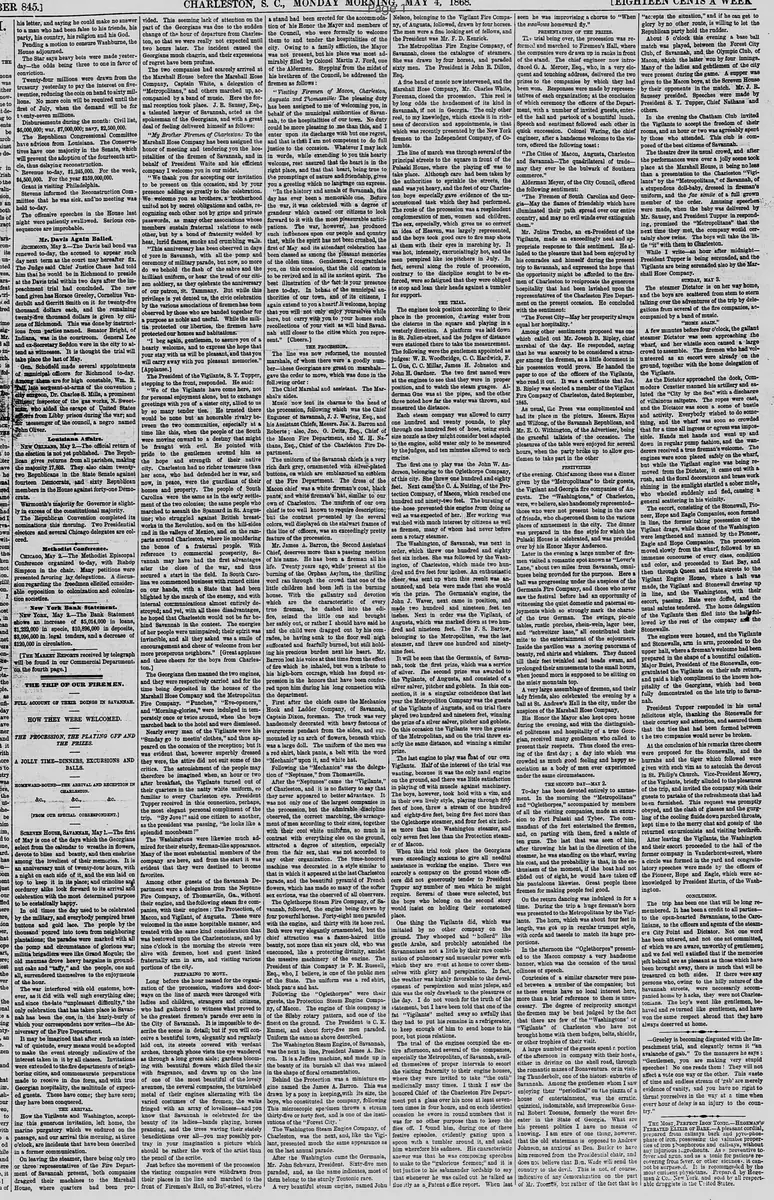
FULL ACCOUNT OF THEIR DOINGS IN SAVANNAH.
HOW THEY WERE WELCOMED.
THE PROCESSION, THE PLAYING OFF AND THE PRIZES.
A JOLLY TIME - DINNERS, EXCURSIONS AND BALLS.
ROUTE HOME - THE ARRIVAL AND RECEPTION IN CHARLESTON.
[FROM OUR SPECIAL CORRESPONDENT.]
SCREVEN HOUSE, SAVANNAH, May 1. - The first of May is one of the days which the Georgians select from the calendar to wreathe in flowers, devote to bliss and beauty, and then enshrine among the loveliest of their memories. It is an anniversary unit of twenty-four hours, with a night on each side of it, and the sun laid on top to keep it in its place; and crinoline and corduroy alike look forward to its arrival and celebration with the most determined purpose to be ecstatically happy.
In old times the day used to be celebrated by the military, and everybody perspired brass buttons and gold lace. The people by the thousands poured into town from neighboring plantations; the parades were marked with all the pomp and circumstance of glorious war; militia brigadiers were like Grand Moguls; the old mammas drove heavy bargains in ground-nut cake and "taffy," and the people, one and all, surrendered themselves to the enjoyments of the hour.
The war interfered with old customs, however, as it did with well nigh everything else; and since the date "unpleasant difficulty," the only celebration that has taken place in Savannah has been the one, in the hurly-burly of which your correspondent now writes - the Anniversary of the Fire Department.
It may be imagined that after such an interval of quietude, every means would be adopted to make the event strongly indicative of the interest taken in it by all classes. Invitations were extended to the fire departments of neighboring cities, and commensurate preparations made to receive in due form, and with true Georgian hospitality, the multitude of expected guests. These have come; they have seen; they have been conquered.
THE ARRIVAL.
How the Vigilants and Washington, accepting this generous invitation, left home, the marine purgatory which we endured on the passage, and our arrival this morning, at three o'clock, are incidents that have been described in a former communication.
On leaving the steamer, there being only two or three representatives of the Fire Department of Savannah present, both companies dragged their machines to the Marshall House, where quarters had been provided. This seeming lack of attention on the part of the Georgians was due to the sudden change of the hour of departure from Charleston, so that we were really not expected until two hours later. The incident caused the Georgians much chagrin, and their expressions of regret have been profuse.
The two companies had scarcely arrived at the Marshall House before the Marshall Hose Company, Captain White, a delegation of "Metropolitans," and others marched up, accompanied by a band of music. Here the formal reception took place. J. R. Saussy, Esq., a talented lawyer of Savannah, acted as the spokesman of the Georgians, and with a great deal of feeling delivered himself as follows:
"My Brother Firemen of Charleston: To the Marshall Hose Company has been assigned the honor of meeting and tendering you the hospitalities of the firemen of Savannah, and in behalf of President White and his efficient company I welcome you in our midst.
"We thank you for accepting our invitation to be present on this occasion, and by your presence adding so greatly to the celebration. We welcome you as brothers, a brotherhood united not by secret obligations and oaths, recognizing each other not by grips and private passwords, as many other associations whose members sustain fraternal relations to each other, but by a bond of fraternity welded by heat, lurid flames, smoke and crumbling walls.
"This anniversary has been observed in days of yore in Savannah, with all the pomp and ceremony of military parade, but now, no more do we behold the flash of the sabre and the brilliant uniform, or hear the tread of our citizen soldiery, as they celebrate the anniversary of our patron, St. Tammany. But while this privilege is yet denied us, the civic celebration by the various associations of firemen has been observed by those who are banded together for a purpose as noble and useful. While the militia protected our liberties, the firemen have protected our homes and habitations.
"I beg again, gentlemen, to assure you of a hearty welcome, and to express the hope that your stay with us will be pleasant, and that you will carry away with you pleasant memories."
[Applause.]
The President of the Vigilants, S. Y. Tupper, stepping to the front, responded. He said:
"We of the Vigilants have come here, not for personal enjoyment alone, but to exchange greetings with you of a sister city, allied to us by so many tender ties. He trusted there would be none but an honorable rivalry between the two communities, especially at a time like this, when the people of the South were moving onward to a destiny that might be fraught with evil. He pointed with pride to the gentlemen around him as the hope and strength of their native city. Charleston had no richer treasures than her sons, who had defended her in war, and now, in peace, were the guardians of their homes and property. The people of South Carolina were the same as in the early settlement of the two colonies; the same people who marched to assault the Spaniard in St. Augustine; who struggled against British breastworks in the Revolution, and on the hill-sides and in the valleys of Mexico, and on the ramparts around Charleston, where lie mouldering the bones of a fraternal people. With reference to commercial prosperity, Savannah may have had the first advantages after the close of the war, and thus secured a start in the field. In South Carolina we commenced business with ruined cities on our hands, with a State that had been blighted by the march of the enemy, and with internal communications almost entirely destroyed; and yet, with all these disadvantages, he hoped that Charleston would not be far behind Savannah in the contest. The energies of her people were unimpaired; their spirit was invincible, and all they asked was a smile of encouragement and cheer of welcome from her more prosperous neighbors."
[Great applause and three cheers for the boys from Charleston.]
The Georgians then manned the two engines, and they were respectively carried and for the time being deposited in the houses of the Marshall Hose Company and the Metropolitan Fire Company. "Punches," "Eye-openers," and "Morning-glories," were indulged in temperately once or twice around, when the boys marched back to the hotel and were dismissed.
Nearly every man of the Vigilants wore his "Sunday go to meeting clothes," and thus appeared on the occasion of the reception; but it was evident that, however superbly dressed they were, the attire did not suit some of the critics. The astonishment of the people may therefore be imagined when, an hour or two after breakfast, the Vigilants turned out of their quarters in the natty white uniform, so familiar to every Charleston eye. President Tupper received in this connection, perhaps, the most elegant personal compliment of the trip. "By Jove!" said one citizen to another, as the president was passing, "he looks like a splendid moonbeam!"
The Washingtons were likewise much admired for their sturdy, fireman-like appearance. Many of the most substantial members of the company are here, and from the start it was evident that they were destined to become favorites.
Among other guests of the Savannah Department were a delegation from the Neptune Fire Company, of Thomasville, Ga., without their engine, and the following steam fire companies, with their engines: The Protection, of Macon, and Vigilant, of Augusta. These were welcomed in the same hospitable manner, and treated with the same kind consideration that was bestowed upon the Charlestonians, and by nine o'clock in the morning the streets were alive with firemen, host and guest linked fraternally arm in arm, and visiting various portions of the city.
PREPARING TO MOVE.
Long before the hour named for the organization of the procession, windows and doorways on the line of march were thronged with ladies and children, strangers and citizens, who had gathered to witness what proved to be the greatest firemen's parade ever seen in the City of Savannah. It is impossible to describe the scene in detail; but if you will conceive a beautiful town, elegantly and regularly laid out, its streets covered with verdant arches, through whose vista the eye wandered as through a long green aisle; gardens blooming with beautiful flowers which filled the air with fragrance, and drawn up on the line of one of the most beautiful of the lovely avenues, the several companies, the burnished metal of their engines alternating with the varied costumes of the firemen; the walks fringed with an array of loveliness - and you know that Savannah is celebrated for the beauty of its ladies - bands playing, horses prancing, and the trees waving their stately benedictions over all - you may possibly portray in your imagination a picture which should be rather the work of the artist than the pencil of the scribe.
Just before the movement of the procession the visiting companies were withdrawn from their places in the line and marched to the front of Firemen's Hall, on Bull-street, where a stand had been erected for the accommodation of his Honor the Mayor and members of the Council, who were formally to welcome them to and tender the hospitalities of the city. Owing to a family affliction, the Mayor was not present, but his place was most admirably filled by Colonel Martin J. Ford, one of the Aldermen. Stepping from the midst of his brethren of the Council, he addressed the firemen as follows:
"Visiting Firemen of Macon, Charleston, Augusta and Thomasville: The pleasing duty has been assigned to me of welcoming you, in behalf of the municipal authorities of Savannah, to the hospitalities of our town. No duty could be more pleasing to me than this, and I enter upon its discharge with but one regret, and that is that I am not competent to do full justice to the occasion. Whatever I may lack in words, while extending to you this hearty welcome, rest assured that the heart is in the right place, and that that heart, being true to the promptings of nature and friendship, gives you a greeting which no language can express.
"In the history and annals of Savannah, this day has ever been a memorable one. Before the war, it was celebrated with a degree of grandeur which caused our citizens to look forward to it with the most pleasurable anticipations. The war, however, has produced such influences upon our people and country that, while the spirit has not been crushed, the first of May and its attendant celebration has been classed as among the pleasant memories of the olden time. Gentlemen, I congratulate you, on this occasion, that the old custom is to be revived and in all its ancient spirit. The best illustration of the fact is your presence here to-day. In behalf of the municipal authorities of our town, and of its citizens, I again extend to you a heartfelt welcome, hoping that you will not only enjoy yourselves while here, but carry with you to your homes such recollections of your visit as will bind Savannah still closer to the cities which you represent."
[Cheers.]
THE PROCESSION.
The line was now reformed, the mounted marshals, of whom there were a goodly number - these Georgians are great on marshals - gave the order to move, which was done in the following order:
The Chief Marshal and assistant.
The Marshal's aides.
Music now lent its charms to the head of the procession, following which was the Chief Engineer of Savannah, J. J. Waring, Esq., and his Assistant Chiefs, Messrs. Jas. A. Barron and Roberts; also, Jno. G. Deitz, Esq., Chief of the Macon Fire Department, and M. H. Nathans, Esq., Chief of the Charleston Fire Department.
The uniform of the Savannah chiefs is a very rich dark grey, ornamented with silver-plated buttons, on which are emblazoned an emblem of the Fire Department. The dress of the Macon chief was a white fireman's coat, black pants, and white fireman's hat, similar to our own of Charleston. The uniform of our own chief is too well known to require description; but the contrast presented by the several colors, well displayed on the stalwart frames of this line of officers, was an exceedingly pretty feature of the procession.
Mr. James A. Barron, the Second Assistant Chief, deserves more than a passing mention of his name. He has been a fireman all his life. Twenty years ago, while present at the burning of the Orphan Asylum, the thrilling word ran through the crowd that one of the little children had been left in the burning house. With the gallantry and devotion which are the characteristic of every true fireman, he dashed into the edifice, seized the little one and brought her safely out, or rather I should have said he and the child were dragged out by his comrades, he having sunk to the floor well nigh suffocated and fearfully burned, but still holding his precious burden next his heart. Mr. Barron lost his voice at that time from the effect of fire which he inhaled, but won a tribute to his high-born courage, which has found expression in the honors that have been conferred upon him during his long connection with the department.
First after the chiefs came the Mechanics Hook and Ladder Company, of Savannah, Captain Dixon, foreman. The truck was very handsomely decorated with heavy festoons of evergreens pendant from the sides, and surmounted by an arch of flowers, beneath which was a large doll. The uniform of the men was a red shirt, black pants, a belt with the word "Mechanic" upon it, and white hat.
Following the "Mechanics" was the delegation of "Neptunes," from Thomasville.
After the "Neptunes" came the "Vigilants," of Charleston, and it is no flattery to say that they never appeared to better advantage. It was not only one of the largest companies in the procession, but the admirable discipline observed, the correct marching, the arrangement of men according to their sizes, together with their cool white uniforms, so much in contrast with everything else on the ground, attracted a degree of attention, especially from the fair sex, that was not accorded to any other organization. The time-honored machine was decorated in a style similar to that in which it appeared at the last Charleston parade, and the beautiful pyramid of French flowers, which has made so many of the softer sex envious, was the observed of all observers.
The Oglethorpe Steam Fire Company, of Savannah, followed, the engine being drawn by four powerful horses. Forty-eight men paraded with the engine, and thirty with its hose reel. Both were very elegantly ornamented, but the chief attraction was a flaxen-haired little beauty, not more than six years old, who was ensconced, like a protecting divinity, amidst the massive machinery of the engine. The President of this Company is P. M. Russell, Esq., who, I believe, is one of the public men of the State. The uniform was a red shirt, black pants and hat.
Following the "Oglethorpes" were their guests, the Protection Steam Engine Company, of Macon. The engine of this company is of the Silsby rotary pattern, and one of the finest on the ground. The President is C. K. Emmel, and about forty-five men paraded. Uniform the same as above described.
The Washington Steam Engine, of Savannah, was the next in line. President James A. Barron. It is a Jeffers machine, and made up in the beauty of its burnish all that was missed in the shape of floral ornamentation.
Behind the Protection was a miniature engine named the James A. Barron. This was drawn by a pony in keeping with its size, the boys, who constituted the company, following. This microscopic specimen throws a stream thirty-five or forty feet, and is one of the institutions of the "Forest City."
The Washington Steam Engine Company, of Charleston, was the next, and, like the Vigilant, presented much the same appearance as on the last annual parade.
After the Washington came the Germania, Mr. John Schwarz, President. Sixty-five men paraded, and, as the name indicates, most of them belong to the sturdy Teutonic race.
A very beautiful steam engine, named John Nelson, belonging to the Vigilant Fire Company, of Augusta, followed, drawn by four horses. The men were a fine looking set of fellows, and the President was Mr. F. D. Kenrick.
The Metropolitan Fire Engine Company, of Savannah, closes the catalogue of steamers. She was drawn by four horses, and paraded sixty men. The President is John R. Dillon, Esq.
A fine band of music now intervened, and the Marshall Hose Company, Mr. Charles White, Foreman, closed the procession. This reel is by long odds the handsomest of its kind in Savannah, if not in Georgia. The only other reel, to my knowledge, which excels it in richness of decoration and appointments, is that which was recently presented by the New York firemen to the Independent Company, of Columbia.
The line of march was through several of the principal streets to the square in front of the Pulaski House, where the playing off was to take place. Although care had been taken by the authorities to sprinkle the streets, the sand was yet heavy, and the feet of our Charleston boys especially gave evidence of the unaccustomed task which they had performed.
The route of the procession was a resplendent conglomeration of men, women and children. The sex, especially, which gives us so correct an idea of Heaven, was largely represented, and the boys took good care to fire map shots at them with their eyes in marching by. It was hot, intensely, excruciatingly hot, and the men perspired like ice pitchers in July. In fact, several along the route of procession, contrary to the discipline sought to be enforced, were so fatigued that they were obliged to stop and lean their heads against a tumbler for support.
THE TRIAL.
The engines took position according to their place in the procession, drawing water from the cisterns in the square and playing in a westerly direction. A platform was laid down in St. Julien-street, and the judges of distance were stationed there to take the measurement. The following were the gentlemen appointed as judges: W. B. Woodbridge, C. C. Hardwick, F. L. Gue, C. C. Millar, James H. Johnston and John H. Gardner. The two first named were at the engines to see that they were in proper position, and to watch the steam gauges. Alderman Gue was at the pipes, and the other three noted how far the water was thrown, and measured the distance.
Each steam company was allowed to carry one hundred and twenty pounds, to play through one hundred feet of hose, using such size nozzle as they might consider best adapted to the engine, solid water only to be measured by the judges, and ten minutes allowed to each engine.
The first one to play was the John W. Anderson, belonging to the Oglethorpe Company, of this city. She threw one hundred and eighty feet. Next came the C. A. Nutting, of the Protection Company, of Macon, which reached one hundred and ninety-two feet. The bursting of the hose prevented this engine from doing as well as was expected of her. Her working was watched with much interest by citizens as well as firemen, many of whom had never before seen a rotary steamer.
The Washington, of Savannah, was next in order, which threw one hundred and eighty feet six inches. She was followed by the Washington, of Charleston, which made two hundred and five feet four inches. An enthusiastic cheer was sent up when this result was announced, and bets were made that she would win the prize. The Germania's engine, the John J. Waver, next came in position, and made two hundred and nineteen feet ten inches. Next in order was the Vigilant, of Augusta, which was marked down at two hundred and nineteen feet. The F. S. Bartow, belonging to the Metropolitan, was the last steamer, and threw one hundred and ninety-nine feet.
It will be seen that the Germania, of Savannah, took the first prize, which was a service of silver. The second prize was awarded to the Vigilants, of Augusta, and consisted of a silver salver, pitcher and goblets. In this connection, it is a singular coincidence that last year the Metropolitan Company was the guests of the Vigilants of Augusta, and on trial there played two hundred and nineteen feet, winning the prize of a silver salver, pitcher and goblets. On this occasion the Vigilants were the guests of the Metropolitan, and on the trial threw exactly the same distance, and winning a similar prize.
The last engine to play was that of our own Vigilants. Half of the interest of the trial was wanting, because it was the only hand engine on the ground, and there was little satisfaction in playing off with muscle against machinery. The boys, however, took hold with a vim, and in their own lively style, playing through fifty feet of hose, threw a stream of one hundred and eighty-five feet, being five feet more than the Oglethorpe steamer, and four feet six inches more than the Washington steamer, and only seven feet less than the Protection steamer of Macon.
When this trial took place the Georgians were exceedingly anxious to give all needful assistance in working the engine. There was scarcely a company on the ground whose officers did not generously tender to President Tupper any number of men which he might require. Several of these were selected, but the boys who belong on the second story would insist on holding their accustomed place.
One thing the Vigilants did, which was imitated by no other company on the ground. They whooped and "hollered" like gentle Arabs, and probably astonished the Savannians not a little by their rare combination of pulmonary and muscular power with which they are wont at home to cover themselves with glory and perspiration. In fact, the weather was highly favorable to the development of perspiration and mint juleps, and this was the only drawback to the pleasures of the day. I do not vouch for the truth of the statement, but I have been told that one of the fat "Vigilants" melted away so awfully that they had to put his remains in a refrigerator, to keep enough of him to send home to his poor, but pious relations.
The trial of the engines occupied the entire afternoon, and several of the companies, especially the Metropolitan, of Savannah, availed themselves of proper intervals to escort the visiting fraternity to their engine houses, where they were invited to take "the oath" medicinally many times. I think I saw the honored Chief of the Charleston Fire Department put a glass over his nose at least seventeen times in four hours, and on each identical occasion he swore in round numbers that it was for no other purpose than to keep the flies off. I found him, during one of these festive episodes, evidently gazing upon a spoon with a tumbler around it, and asked him wherefore his sadness. His characteristic answer was that he was composing speeches to make to the "glorious firemen;" and it is but justice to his salamander lordship to say that whenever he was called out he talked as fluently as a Patent office report. When last seen he was improvising a chorus to "When the swallows homeward fly."
PRESENTATION OF THE PRIZES.
The trial being over, the procession was reformed and marched to Firemen's Hall, where the companies were drawn up in ranks in front of the stand. The chief engineer now introduced G. A. Mercer, Esq., who, in a very eloquent and touching address, delivered the two prizes to the companies by which they had been won. Responses were made by representatives of each organization; at the conclusion of which ceremony the officers of the Department, with a number of invited guests, entered the hall and partook of a bountiful lunch. Speech and sentiment followed each other in quick succession. Colonel Waring, the chief engineer, after a handsome welcome to the visitors, offered the following toast:
"The Cities of Macon, Augusta, Charleston and Savannah - The quadrilateral of trade - may they ever be the bulwark of Southern commerce."
Alderman Meyer, of the City Council, offered the following sentiment:
"The Firemen of South Carolina and Georgia - May the flames of friendship which have illuminated their path spread over our entire country, and may no evil winds ever extinguish them."
Mr. Julius Trescot, an ex-President of the Vigilants, made an exceedingly neat and appropriate response to this sentiment. He alluded to the pleasure that had been enjoyed by his comrades and himself during the present trip to Savannah, and expressed the hope that the opportunity might be afforded to the firemen of Charleston to reciprocate the generous hospitality that had been lavished upon the representatives of the Charleston Fire Department on the present occasion. He concluded with the sentiment:
"The Forest City - May her prosperity always equal her hospitality."
Among other sentiments proposed was one which called out Mr. Joseph B. Ripley, chief marshal of the day. He responded, saying that he was scarcely to be considered a stranger among the firemen, as a little document in his possession would prove. He handed the paper to one of the officers of the Vigilants, who read it out. It was a certificate that Jos. B. Ripley was elected a member of the Vigilant Fire Company of Charleston, dated September, 1845.
As usual, the Press was complimented and had its place in the picture. Messrs. Hayes and Wilfong, of the Savannah Republican, and Mr. E. O. Withington, of the Advertiser, being the graceful talkists of the occasion. The pleasures of the table were enjoyed for several hours, when the party broke up to allow gentlemen to take part in the other FESTIVITIES of the evening. Chief among these was a dinner given by the "Metropolitans" to their guests, the Vigilant and Georgia fire companies of Augusta. The "Washingtons," of Charleston, were, we believe, also handsomely represented - those who were not present being in the care of friends, who chaperoned them to the various places of amusement in the city. The dinner was prepared in the fine style for which the Pulaski House is celebrated, and was presided over by his Honor Mayor Anderson.
Later in the evening a large number of firemen visited a romantic spot known as "Lover's Lane," about two miles from Savannah, omnibuses being provided for the purpose. Here a ball was progressing under the auspices of the Germania Fire Company, and those who never saw the festival before had an opportunity of witnessing the quiet domestic and paternal enjoyments which so strongly mark the character of the true German. The swings, pic-nic tables, rustic porches, rhein-wein, lager beer, and "schweitzer kase," all contributed their mite to the entertainment of the sojourners. Inside the pavilion was a moving panorama of beauty, red shirts and whiskers. They danced till their feet twinkled and heads swam, and prolonged their amusements to the small hours, when jocund morn is supposed to be sitting on the misty mountain top.
A very large assemblage of firemen, and their lady friends, also celebrated the evening by a ball at St. Andrew's Hall in the city, under the auspices of the Marshall Hose Company. His Honor the Mayor also kept open house during the evening, and with the distinguished politeness and hospitality of a true Georgian, received many gentlemen who called to present their respects. Thus closed the evening of the first day; a day into which was crowded as much good feeling and happy association as a body of men ever experienced under the same circumstances.
THE SECOND DAY - MAY 2.
To-day has been devoted entirely to amusement. In the morning the "Metropolitans" and "Oglethorpes," accompanied by members of all the visiting companies, made an excursion to Fort Pulaski and Tybee. The commandant of the fort entertained the firemen, and, on parting with them, fired a salute of ten guns. The last that was seen of him after throwing his hat in the direction of the steamer, he was standing on the wharf, waving his coat, and the probability is that, in the enthusiasm of the moment, if the boat had not glided out of sight, he would have taken off his pantaloons likewise. Great people these firemen for making people feel good.
On the return dancing was indulged in for a time. During the trip a huge fireman's horn was presented to the Metropolitans by the Vigilants. The horn, which was about four feet in length, was got up in regular trumpet style, with cords and tassels to match its huge proportions.
In the afternoon the "Oglethorpes" presented to the Macon company a very handsome banner, which was the occasion of the usual oiliness of speech.
Courtesies of a similar character were passed between a number of the companies; but as these events have no local interest here, more than a brief reference to them is unnecessary. The degree of reciprocity amongst the firemen may be best judged by the fact that there are few of the "Washingtons" or "Vigilants" of Charleston who have not brought home with them badges, belts, shields, or other trophies of their visit.
A large number of the guests spent a portion of the afternoon in company with their hosts, either in driving on the shell road, through the romantic mazes of Bonaventure, or in visiting Thunderbolt, one of the historic suburbs of Savannah. Among the gentlemen whom I saw enjoying their "periodical" on the piazza of a house of entertainment, was the erratic, quizzical, indomitable, and irrepressible General Robert Toombs, formerly the worst fire-eater in the State of Georgia. What are his present politics I have no means of knowing. I am sure of one thing, however, that the old statesman is opposed to Andrew Johnson, as anxious as Ben. Butler to have him removed from the Presidential chair, and does not believe that Ben. Wade will send the country to the devil. This is not, of course, indicative of any demoralization on the part of Mr. Toombs, but rather of the fact that he "accepts the situation," and if he can get to glory by no other route, is willing to let the Republican party hold the rudder.
About 5 o'clock this evening a base ball match was played, between the Forest City Club, of Savannah, and the Olympic Club, of Macon, which the latter won by four innings. Many of the ladies and gentlemen of the city were present during the game. A supper was given to the Macon boys, at the Screven House by their opponents in the match. Mr. J. R. Saussy presided. Speeches were made by President S. Y. Tupper, Chief Nathans and others.
In the evening the Chatham Club invited the Vigilants to accept the freedom of their rooms, and an hour or two was agreeably spent by those who attended. This club is composed of the best citizens of Savannah, a
The theatre drew its usual crowd, and after the performances were over a jolly scene took place at the Marshall House, it being no less than a presentation to the Charleston "Vigilants" by the "Metropolitans," of Savannah, of a stupendous doll-baby, dressed in fireman's uniform, and the fac simile of a fullgrown member of the order.
Amusing speeches were made, when the baby was delivered by Mr. Saussy, and President Tupper in responding, promised the "Metropolitans" that the next time they met, the company would certainly show twins. The boys will take the little "it" with them to Charleston.
While I write an hour after midnight - President Tupper is being serenaded, and the Vigilants are being serenaded also by the Marshall Hose Company.
SUNDAY, MAY 3.
The steamer Dictator is on her way home, and the boys are scattered from stem to stern talking over the adventures of the trip by delegations from several of the fire companies, accompanied by a band of music.
"HOME AGAIN."
A few minutes before four o'clock, the gallant steamer Dictator was seen approaching the wharf, and her whistle soon caused a large crowd to assemble. The firemen who had volunteered as an escort were already on the ground, together with the home delegation of the Vigilants.
As the Dictator approached the dock, Commodore Coxetter manned his artillery and saluted the "City by the Sea" with a discharge of villainous saltpetre. The ropes were cast, and activity. Everybody wished to do something, and the wharf was soon so crowded that for a time all ingress or egress was impossible. Hands met hands and went up and down in regular pump fashion, and the wanderers received a true fireman's welcome. The engines were soon placed safely on the wharf, but while the Vigilant engine was being removed from the Dictator, it came out with a rush, and the floral decorations and brass work shining in the sunlight startled a sober mule, who wheeled suddenly and fled, causing a general scattering in his vicinity.
The escort, consisting of the Stonewall, Pioneer, Hope and Eagle Companies, soon formed in line, the former taking possession of the Vigilant drags, while those of the Washington were lengthened and manned by the Pioneer, Eagle and Hope Companies. The procession moved slowly from the wharf, followed by an immense concourse of every class, condition and color, and proceeded to East Bay, and then through Queen and State streets to the Vigilant Engine House, where a halt was made, the Vigilant and Stonewall drawing up in line, and the Washingtons, with their escort, passing. Hats were doffed, and the usual salutes tendered. The home delegation of the Vigilants then filed into the hall followed by the rest of the company and the Stonewalls.
The engines were housed, and the Vigilants and Stonewalls, arm in arm, proceeded to the upper hall, where a fireman's welcome had been prepared in the shape of a bountiful collation.
Major Buist, President of the Stonewalls, congratulated the Vigilants on their safe return, and paid a high compliment to the known hospitality of the Georgians, which had been fully demonstrated on the late trip to Savannah.
President Tupper responded in his usual felicitous style, thanking the Stonewalls for their courtesy and attention, and assured them that the ties that had been formed between the two companies would never be broken.
At the conclusion of his remarks three cheers were proposed for the Stonewalls, and the hurrahs and the tiger which followed were given with such vim as to astonish the devout in St. Philip's Church. Vice-President Mowry, of the Vigilants, briefly alluded to the pleasures of the trip, and invited the company with their guests to partake of the refreshments that had been furnished. This request was promptly obeyed, and the clash of glasses and the gurgling of the cooling fluids down parched throats, kept time to the merry chat and gossip of the returned excursionists and visiting brethren.
After leaving the Vigilants, the Washington and their escort proceeded to the hall of the former company in Vanderhorst-street, where a circle was formed in the yard and congratulatory speeches were made by the officers of the Pioneer, Hope and Eagle, which were acknowledged by President Martin, of the Washington.
CONCLUSION.
The trip has been one that will be long remembered. It has been a credit to all parties - to the open-hearted Savannians, to the Carolinians, to the officers and agents of the steamers City Point and Dictator. Not one word has been uttered, and not one act committed, of which we are aware, unworthy of gentlemen; and we feel well satisfied that if the memories left behind are as pleasant as those which have been brought away, there is much that will be treasured on both sides. If there were any persons who, owing to the hilly nature of the Savannah streets, were necessarily accompanied home by hacks, they were not Charlestonians. The boys went like gentlemen, behaved and returned like gentlemen, and have won the same respect abroad that they have always deserved at home.
-Greeley is becoming disgusted with the Impeachment trial, and elegantly terms it "an avalanche of gab." To the managers he says: "Gentlemen, you are making very stupid speeches! No one reads them! They will not affect a vote one way or the other. This waste of time and endless stream of 'gab' are merely evidence of vanity, and you have no right to thrust yourselves in the way at a time when every hour of delay is an injury to the country."
The Most Perfect Iron Tonic. - Hegeman's Ferrated Elixir of Bark. - A pleasant cordial, prepared from calisaya bark and pyro-phosphate of iron, possessing the valuable properties of iron phosphorous and calisaya, without any injurious ingredients. As a preventive to fever and ague, and as a tonic for patients recovering from fever, or other sickness, it cannot be surpassed. It is recommended by the most eminent physicians. Prepared by Hegeman & Co., New York, and sold by all respectable druggists in the United States.
What sub-type of article is it?
What themes does it cover?
What keywords are associated?
What entities or persons were involved?
Where did it happen?
Story Details
Key Persons
Location
Savannah, Georgia; Charleston, South Carolina
Event Date
May 1
Story Details
Charleston Vigilant and Washington fire companies travel to Savannah for post-war Fire Department anniversary revival; welcomed with speeches emphasizing brotherhood and Southern recovery; participate in grand parade, engine trials (Washington wins second prize, Vigilant excels with hand engine); enjoy dinners, excursions to Fort Pulaski and Tybee, balls, baseball; return home to enthusiastic reception.