Thank you for visiting SNEWPapers!
Sign up free
Literary Cadet And Rhode Island Statesman
Providence, Providence County, Rhode Island
What is this article about?
A concluding critique of a book review, highlighting its absurdities, invented words like 'industrial,' odd phrases such as 'gazing habits,' hyperbolic praise for Roger Williams, and overzealous support for the Rhode-Island Historical Society, arguing it lacks merit and connection to the subject book.
Merged-components note: These components continue the article 'A REVIEW REVIEWED'; merged based on sequential reading order and shared topic of literary criticism.
Clipping
OCR Quality
Full Text
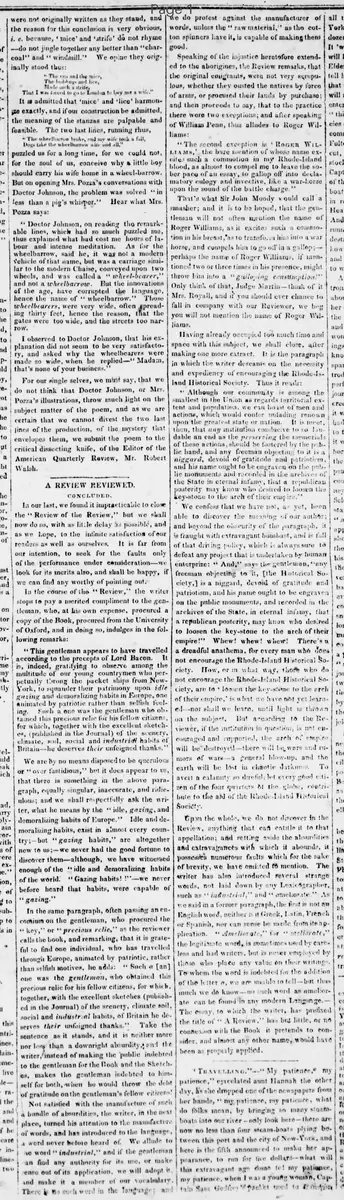
CONCLUDED.
In our last, we found it impracticable to close the " Review of the Review," but we shall now do so, with as little delay as possible, and as we hope, to the infinite satisfaction of our readers as well as ourselves.
It is far from our intention, to seek for the faults only of the performance under consideration—we look for its merits also, and shall be happy, if we can find any worthy of pointing out.
In the course of the " Review," the writer stops to pay a merited compliment to the gentleman, who, at his own expense, procured a copy of the Book, procured from the University of Oxford, and in doing so, indulges in the following remarks:
" This gentleman appears to have travelled according to the precepts of Lord Bacon. It is, indeed, gratifying to observe among the multitude of our young countrymen who perpetually throng the packet ships from New-York, to squander their patrimony upon idle gazing and demoralizing habits in Europe, one animated by patriotic rather than selfish feeling.
Such a one was the gentleman who obtained this precious relic for his fellow citizens, for which, together with the excellent sketches, (published in the Journal) of the scenery, climate, soil, social and industrial habits of Britain—he deserves their unfeigned thanks."
We are by no means disposed to be querulous or " over fastidious," but it does appear to us, that there is something in the above paragraph, equally singular, inaccurate, and ridiculous; and we shall respectfully ask the writer, what he means by the " idle, gazing, and demoralizing habits of Europe."
Idle and demoralizing habits, exist in almost every country;—but "gazing habits," are altogether new to us;—we never had the good fortune to discover them—although, we have witnessed enough of the "idle and demoralizing habits of the world."
"Gazing habits!!"—we never before heard that habits, were capable of " gazing.'"
In the same paragraph, often passing an encomium on the gentleman, who procured the "key," or "precious relic," as the reviewer calls the book, and remarking, that it is grateful to find one individual, who has travelled through Europe, animated by patriotic, rather than selfish motives, he adds:
Such a one was the gentleman, who obtained this precious relic for his fellow citizens, for which, together, with the excellent sketches (published in the Journal) of the scenery, climate soil. social and industrial habits, of Britain he deserves their unfeigned thanks."
Take the sentence as it stands, and it is neither more nor less than a downright absurdity,: and the writer, instead of making the public indebted to the gentleman for the Book and the Sketches, makes the gentleman indebted to himself for both, —when he would throw the debt of gratitude on the gentleman's fellow citizens!
Not satisfied with the manufacture of such a bundle of absurdities, the writer, in the next place, turned his attention to the manufacture of words, and has introduced to the language, a word never before heard of. We allude to the word "industrial," and if the gentleman can find any authority for its use, or make sense out of its application, we will adopt it. and make it a member of our vocabulary.
we do protest against the manufacturer of words, unless the " raw material," as the cotton spinners have it. is capable of making them good.
Speaking of the injustice heretofore extended to the aborigines, the Review remarks, that the original emigrants, were not very scrupulous, whether they ousted the natives by force of arms, or procured their lands by purchase; and then proceeds to say, that to the practice there were two exceptions; and after speaking of William Penn, thus alludes to Roger Williams:
"The second exception is 'Roger Williams,' the bare mention of whose name excites such a commotion in my Rhode-Island blood, as almost to compel me to leave the sober pace of an essay, to gallop off' into declamatory eulogy and invective, like a war-horse upon the sound of the battle charge."
That's what Sir John Moody would call 'a smasher; and it is to be hoped, that the gentleman will not often mention the name of Roger Williams, as it excites such a commotion in his breast." as to transform him into a war horse, and compels him to go off in a gallop;— perhaps the name of Roger Williams, if mentioned two or three times in his presence, might throw him into a "gallooping consumption!"
Only think of that, Judge Martin—think of it Mrs. Royall, and if you should ever chance to fall in company with our Reviewer, we beg you will not mention the name of Roger Williams.
Having already occupied too much time and space with this subject, we shall close, after making one more extract. It is the paragraph in which the writer descants on the necessity and expediency of encouraging the Rhode-Island Historical Society. Thus it reads:
"Although our community is among the smallest in the Union as regards territorial extent and population, we can boast of men and actions, which would confer unfading renown upon the greatest state or nation. It is meet, then, that any institution conducive to so laudable an end as the preserving the memorials of these actions, should be fostered by the public hand, and any freeman objecting to it is a niggard, devoid of gratitude and patriotism. and his name ought to be engraven on the public monuments and recorded in the archives of the State in eternal infamy, that a republican posterity may know who desired to loosen the key-stone to the arch of their empire.''
We confess that we have not, as yet, been able to discover the meaning of our author; and beyond the obscurity of the paragraph, it is fraught with extravagant bombast, and is full of that driving policy, which is always sure to defeat any project that is undertaken by human enterprize: " And," says the gentleman, "any freeman objecting to it, [the Historical Society,] is a niggard, devoid of gratitude and patriotism, and his name ought to be engraven on the public monuments, and recorded in the archives of the State, in eternal infamy, that a republican posterity, may know who desired to loosen the key-stone to the arch of their empire!" Whew! whew! whew! There's a dreadful anathema, for every man who does not encourage the Rhode-Island Historical Society.
How, or in what way. those who do not encourage the Rhode-Island Historical Society, are to ' loosen the key-stone to the arch of their empire,' is what we have not yet learned.—nor shall we learn, until light is thrown on the subject. But according to the Reviewer, if the institution in question, is not encouraged and supported, the arch of empire will be "destroyed—there will be wars and rumors of wars—a general blow-up. and the earth will be lost in chaotic darkness. To avert a calamity so dreadful, let every good citizen of the four quarters of the globe, contribute to the aid of the Rhode-Island Historical Society.
Upon the whole. we do not discover in the Review, anything that can entitle it to that appellation; and setting aside the absurdities and extravagances with which it abounds. it possesses numerous faults which for the sake of brevity, we have omitted to mention. The writer has also introduced several strange words. not laid down by any Lexicographer, such as " industrial," and " ameliorate" As we said in a former paragraph, the first is not an English word, neither is it Greek, Latin, French or Spanish, nor can sense be made from its application. "Ameliorate," for "meliorate," the legitimate word, is sometimes used by careless and bad writers. but is never employed by those who place any value on their writings.
To whom the word is indebted for the addition of the letter a, we are unable to tell—but thus much we do know—no such word as ameliorate can be found in any modern Language.— The essay, to which the writer, has prefixed the title of "A Review," has but little, or no connexion with the Book it pretends to consider, and almost any other name, would have been as properly applied.
What sub-type of article is it?
What themes does it cover?
What keywords are associated?
What entities or persons were involved?
Where did it happen?
Story Details
Key Persons
Location
Rhode Island
Story Details
The article critiques a previous review of a book procured from Oxford University, pointing out absurdities in phrasing like 'gazing habits,' linguistic inventions such as 'industrial,' exaggerated reactions to Roger Williams, and bombastic advocacy for the Rhode-Island Historical Society, deeming the review poorly connected to the book.