Thank you for visiting SNEWPapers!
Sign up free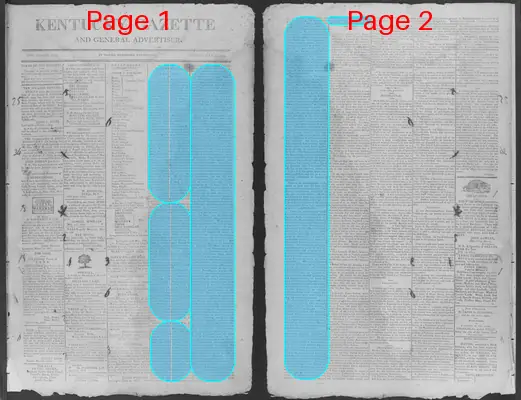
Editorial
July 12, 1803
Kentucky Gazette And General Advertiser
Lexington, Fayette County, Kentucky
What is this article about?
Doctor Parr's effusive praise of Edmund Burke's eloquence, erudition, and character, contrasting him favorably with Lord Chatham and ancient orators like Demosthenes and Cicero, emphasizing Burke's literary depth and lasting written legacy.
Merged-components note: This is a continuation of an opinionated essay praising Edmund Burke's eloquence, spanning across pages; relabeled to editorial as it fits opinion pieces better than literary.
Clippings
1 of 2
OCR Quality
98%
Excellent
Full Text
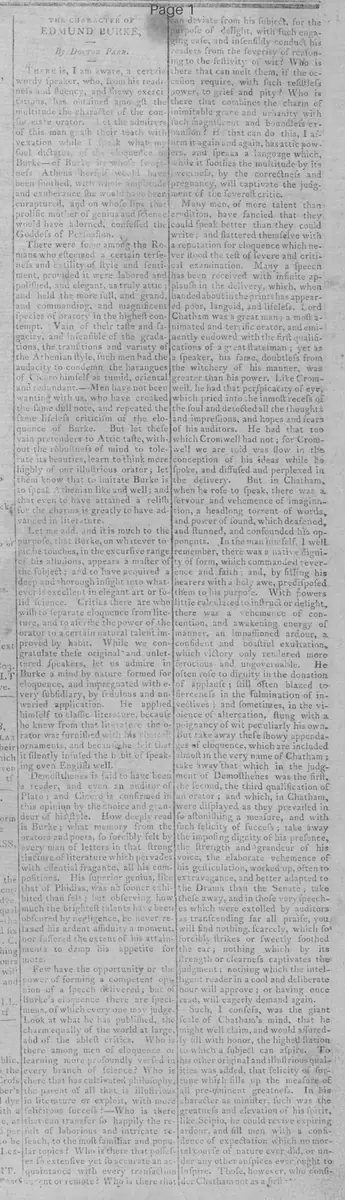
THE CHARACTER OF
EDMUND BURKE,
By
DOCTOR PARR.
There is, I am aware, a certain wordy speaker, who, from his readiness and fluency, and showy exertions, has obtained amongst the multitude the character of the consummate orator. Let the admirers of this man gnash their teeth with vexation while I speak what my soul dictates, of the eloquence of Burke—of Burke by whose sweetness Athens herself would have been soothed, with whose amplitude and exuberance she would have been enraptured, and on whose lips that prolific mother of genius and science would have adorned, confessed the Goddess of Persuasion.
There were some among the Romans who esteemed a certain terseness and exility of style and sentiment, provided it were labored and polished, and elegant, as truly attic; and held the more full, and grand, and commanding, and magnificent species of oratory in the highest contempt. Vain of their taste and sagacity, and insensible of the gradations, the transitions and variety of the Athenian style, such men had the audacity to condemn the harangues of Cicero himself as tumid, oriental and redundant. Men have not been wanting with us, who have croaked the same dull note, and repeated the same lifeless criticism of the eloquence of Burke. But let these vain pretenders to Attic taste, without the robustness of mind to tolerate its beauties, learn to think more highly of our illustrious orator; let them know that to imitate Burke is to speak Athenian like and well; and that even to have attained a relish for the charms is greatly to have advanced in literature.
Let me add, and it is much to the purpose, that Burke, on whatever topic he touches, in the excursive range of his allusions, appears a master of the subject; and to have acquired a deep and thorough insight into whatever is excellent in elegant art or solid science. Critics there are who wish to separate eloquence from literature, and to ascribe the power of the orator to a certain natural talent improved by habit. While we congratulate these original and unlettered speakers, let us admire in Burke a mind by nature formed for eloquence, and impregnated with every subsidiary, by studious and unwaried application.
He applied himself to classic literature, because he knew from that literature the orator was furnished with his choicest ornaments, and because he felt that it silently infused the habit of speaking even English well.
Demosthenes is said to have been a reader, and even an auditor of Plato; and Cicero is confirmed in this opinion by the choice and grandeur of his style. How deeply read is Burke; what memory from the orators and poets, so forcibly felt by every man of letters in that strong tincture of literature which pervades with essential fragrance, all his compositions. His superior genius, like that of Phidias, was no sooner exhibited than felt; but observing how much the brightest talents have been obscured by negligence, he never relaxed his ardent assiduity a moment. nor suffered the extent of his attainments to damp his appetite for more.
Few have the opportunity or the power of forming a competent opinion of a speech delivered; but of Burke's eloquence there are specimens, of which every one may judge. Look at what he has published, the charm equally of the world at large, and of the ablest critics. Who is there among men of eloquence or learning more profoundly versed in every branch of science? Who is there that has cultivated philosophy. the parent of all that is illustrious in literature or exploit, with more felicitous success? Who is there that can transfer so happily the result of laborious and intricate research, to the most familiar and popular topics? Who is there that possesses so extensive yet so accurate an acquaintance with every transaction present or remote? Who is there that can deviate from his subject. for the purpose of delight, with such engaging ease, and insensibly conduct his readers from the severity of reasoning to the festivity of wit? Who is there that can melt them, if the occasion require, with such resistless power, to grief and pity? Who is there that combines the charm of inimitable grace and urbanity with such magnificent and boundless expansion? He that can do this, I affirm it again and again, has attic powers, and speaks a language which, while it soothes the multitude by its sweetness, by the correctness and pregnancy, will captivate the judgment of the severest critic.
Many men, of more talent than erudition, have fancied that they could speak better than they could write; and flattered themselves with a reputation for eloquence which never stood the test of severe and critical examination. Many a speech has been received with infinite applause in the delivery, which, when handed about in the prints has appeared poor, languid, and lifeless. Lord Chatham was a great man; a most animated and terrific orator, and eminently endowed with the first qualifications of a great statesman; yet as a speaker, his fame, doubtless from the witchery of his manner, was greater than his power. Like Cromwell, he had that perspicacity of eye, which pried into the inmost recess of the soul and detected all the thoughts and impressions, and hopes and fears of his auditors. He had that too which Cromwell had not: for Cromwell we are told was slow in the conception of his ideas while he spoke, and diffused and perplexed in the delivery. But in Chatham, when he rose to speak, there was a fervour and vehemence of imagination, a headlong torrent of words, and power of sound, which deafened. and stunned, and confounded his opponents. In the man himself, I well remember, there was a native dignity of form, which commanded reverence and faith; and, by filling his hearers with a holy awe, predisposed them to his purpose. With powers little calculated to instruct or delight, there was a vehemence of contention, and awakening energy of manner, an impassioned ardour, a confident and boastful exultation. which victory only rendered more ferocious and ungovernable. He often rose to dignity in the donation of applause; still often blazed to fierceness in the fulmination of invectives ; and sometimes, in the violence of altercation, stung with a poignancy of wit peculiarly his own.
But take away these showy appendages of eloquence, which are included almost in the very name of Chatham; take away that which in the judgment of Demosthenes was the first. the second, the third qualification of an orator ; and which, in Chatham, were displayed as they prevailed in so astonishing a measure, and with such felicity of success ; take away the imposing dignity of his presence, the strength and grandeur of his voice, the elaborate vehemence of his gesticulation, worked up, often to extravagance, and better adapted to the Drama than the Senate : take these away, and in those very speeches which were extolled by auditors as transcending far all praise, you will find nothing, scarcely, which so forcibly strikes or sweetly soothes the ear; nothing which by its strength or clearness captivates the judgment; nothing which the intelligent reader in a cool and deliberate hour will approve; or having once read, will eagerly demand again.
Such, I confess, was the giant scale of Chatham's mind, that he might well claim, and would assuredly fill with honor, the highest station to which a subject can aspire. To his other original and illustrious qualities was added, that felicity of fortune which fills up the measure of all pre-eminent greatness. In his character as minister, such was the greatness and elevation of his spirit. like Scipio, he could revive expiring ardour. and fill men with a confidence of expectation which no mortal course of nature ever did, or under any other auspices ever ought to inspire. Those, however, who consider Chatham not as a first-
but as another Demosthenes, are greatly deceived. In Demosthenes with a dignity which has scarcely been equalled, was combined a sangfroid and coolness which can never be surpassed. He who aspires only to be rapid, vehement and sonorous, without descending to plain narrative, cool statement, close argument, sacrifices reason to passion, and touches on the precints of a frantic eloquence. It was the lot of Chatham to owe whatever he possessed to a genius exercised by practice alone. The consequence was natural. With infinite fluency and animation he insured the fate of Gallia, and while breathing consuming fire as a speaker, all the force and all the blaze of his eloquence was extinguished upon paper.
Far different Burke. To wing his flight to the sublime of eloquence, he has called in the labours of the closet. Burke would not that the fame of his powers should be circumscribed within the same poor limits that bound life; nor has he feared, most certainly he has not shunned, that solemn sentence which posterity, who "extenuate nothing nor set down ought in malice," will hereafter pronounce upon his genius.
There are many, I know, who, though well convinced that the pen is the instructor of the tongue, and perfectly able to treat any subject upon paper with infinite correctness and art, yet when drawn from the shade of studious retirement into action, are not only incapable of delivering with clearness what they have very justly conceived, but exhibit the spectacle of absolute haplessness and fatuity. But Burke, though fully satisfied that nothing contributes more to good speaking than good writing, is equally prepared for both. The same powerful mind, the same divine and inextinguishable ardour which fires him in the senate, animates him in the solitude of composition; nor need he blush to say of his speeches what Thucydides had affirmed of his elaborate history. "I give it to the public as an everlasting possession, and not as a contentious instrument of temporary applause."
There is an unwillingness in the world to show that the same man has excelled in various pursuits; but Burke's compositions, diversified as they are in their nature, yet each excelling in its kind, who does not read with instruction and delight? I have hitherto surveyed the merits of the orator; let us now view him as a critic and philosopher.
Criticism, which others would have been content to study as they found it, Burke has enlarged by his discoveries, illustrated by his multifarious learning, and treated with all the graces of a style most elegant and refined, yet not polished into insipidity by too curious a care. Often has it been lamented that the language of philosophers is usually so crabbed and uncouth as to deter readers of taste from the perusal of their labours. It fell to Burke by his purity and grace to purge off this inveterate rust, and to adapt to the knottiest and the subtlest disquisitions such a flowing ease, fertility and lustre of style, as the world had never witnessed.
With such illustrious proofs of his own powers, he has at once, by his precepts and example, instructed others to excel; for whether he luxuriates in speeches replete with the choicest phraseology and happiest periods, or bends his keen and subtle intelligence, or critical disquisition, such is the felicity of his labours, that he at once quickens the sagacity of his readers, while he stores their memory and fertilizes their fancy with invigorating and varied information.
On the morals of a man most conspicuously endowed with the more amiable and the severe virtues, I hold it needless to descant. The unspotted innocence, the firm integrity of Burke, want no emblazoning; and if he is accustomed to exact a rigorous account of the moral conduct of others, it is justified in one who shuns not the most inquisitorial scrutiny into his own.
I know what unsafe and treacherous ground I tread. Objectors, I am aware, are not wanting, who will exclaim, that I have lavished praise with too prodigal a hand—that I have been hurried away by my love and admiration of the man. I care not. The tribute I have paid him is little to his deserts—and would to God, that this little had come from any one who could more suitably have expanded and adorned it! This however I deliberately and steadily affirm—that of all other men who are, or who ever have been, eminent for energy and splendor of eloquence, or for skill and grace in composition, there is not one, who, in genius and erudition, in philanthropy or piety, or in any of the qualities of a wise and good man, surpasses Burke.
EDMUND BURKE,
By
DOCTOR PARR.
There is, I am aware, a certain wordy speaker, who, from his readiness and fluency, and showy exertions, has obtained amongst the multitude the character of the consummate orator. Let the admirers of this man gnash their teeth with vexation while I speak what my soul dictates, of the eloquence of Burke—of Burke by whose sweetness Athens herself would have been soothed, with whose amplitude and exuberance she would have been enraptured, and on whose lips that prolific mother of genius and science would have adorned, confessed the Goddess of Persuasion.
There were some among the Romans who esteemed a certain terseness and exility of style and sentiment, provided it were labored and polished, and elegant, as truly attic; and held the more full, and grand, and commanding, and magnificent species of oratory in the highest contempt. Vain of their taste and sagacity, and insensible of the gradations, the transitions and variety of the Athenian style, such men had the audacity to condemn the harangues of Cicero himself as tumid, oriental and redundant. Men have not been wanting with us, who have croaked the same dull note, and repeated the same lifeless criticism of the eloquence of Burke. But let these vain pretenders to Attic taste, without the robustness of mind to tolerate its beauties, learn to think more highly of our illustrious orator; let them know that to imitate Burke is to speak Athenian like and well; and that even to have attained a relish for the charms is greatly to have advanced in literature.
Let me add, and it is much to the purpose, that Burke, on whatever topic he touches, in the excursive range of his allusions, appears a master of the subject; and to have acquired a deep and thorough insight into whatever is excellent in elegant art or solid science. Critics there are who wish to separate eloquence from literature, and to ascribe the power of the orator to a certain natural talent improved by habit. While we congratulate these original and unlettered speakers, let us admire in Burke a mind by nature formed for eloquence, and impregnated with every subsidiary, by studious and unwaried application.
He applied himself to classic literature, because he knew from that literature the orator was furnished with his choicest ornaments, and because he felt that it silently infused the habit of speaking even English well.
Demosthenes is said to have been a reader, and even an auditor of Plato; and Cicero is confirmed in this opinion by the choice and grandeur of his style. How deeply read is Burke; what memory from the orators and poets, so forcibly felt by every man of letters in that strong tincture of literature which pervades with essential fragrance, all his compositions. His superior genius, like that of Phidias, was no sooner exhibited than felt; but observing how much the brightest talents have been obscured by negligence, he never relaxed his ardent assiduity a moment. nor suffered the extent of his attainments to damp his appetite for more.
Few have the opportunity or the power of forming a competent opinion of a speech delivered; but of Burke's eloquence there are specimens, of which every one may judge. Look at what he has published, the charm equally of the world at large, and of the ablest critics. Who is there among men of eloquence or learning more profoundly versed in every branch of science? Who is there that has cultivated philosophy. the parent of all that is illustrious in literature or exploit, with more felicitous success? Who is there that can transfer so happily the result of laborious and intricate research, to the most familiar and popular topics? Who is there that possesses so extensive yet so accurate an acquaintance with every transaction present or remote? Who is there that can deviate from his subject. for the purpose of delight, with such engaging ease, and insensibly conduct his readers from the severity of reasoning to the festivity of wit? Who is there that can melt them, if the occasion require, with such resistless power, to grief and pity? Who is there that combines the charm of inimitable grace and urbanity with such magnificent and boundless expansion? He that can do this, I affirm it again and again, has attic powers, and speaks a language which, while it soothes the multitude by its sweetness, by the correctness and pregnancy, will captivate the judgment of the severest critic.
Many men, of more talent than erudition, have fancied that they could speak better than they could write; and flattered themselves with a reputation for eloquence which never stood the test of severe and critical examination. Many a speech has been received with infinite applause in the delivery, which, when handed about in the prints has appeared poor, languid, and lifeless. Lord Chatham was a great man; a most animated and terrific orator, and eminently endowed with the first qualifications of a great statesman; yet as a speaker, his fame, doubtless from the witchery of his manner, was greater than his power. Like Cromwell, he had that perspicacity of eye, which pried into the inmost recess of the soul and detected all the thoughts and impressions, and hopes and fears of his auditors. He had that too which Cromwell had not: for Cromwell we are told was slow in the conception of his ideas while he spoke, and diffused and perplexed in the delivery. But in Chatham, when he rose to speak, there was a fervour and vehemence of imagination, a headlong torrent of words, and power of sound, which deafened. and stunned, and confounded his opponents. In the man himself, I well remember, there was a native dignity of form, which commanded reverence and faith; and, by filling his hearers with a holy awe, predisposed them to his purpose. With powers little calculated to instruct or delight, there was a vehemence of contention, and awakening energy of manner, an impassioned ardour, a confident and boastful exultation. which victory only rendered more ferocious and ungovernable. He often rose to dignity in the donation of applause; still often blazed to fierceness in the fulmination of invectives ; and sometimes, in the violence of altercation, stung with a poignancy of wit peculiarly his own.
But take away these showy appendages of eloquence, which are included almost in the very name of Chatham; take away that which in the judgment of Demosthenes was the first. the second, the third qualification of an orator ; and which, in Chatham, were displayed as they prevailed in so astonishing a measure, and with such felicity of success ; take away the imposing dignity of his presence, the strength and grandeur of his voice, the elaborate vehemence of his gesticulation, worked up, often to extravagance, and better adapted to the Drama than the Senate : take these away, and in those very speeches which were extolled by auditors as transcending far all praise, you will find nothing, scarcely, which so forcibly strikes or sweetly soothes the ear; nothing which by its strength or clearness captivates the judgment; nothing which the intelligent reader in a cool and deliberate hour will approve; or having once read, will eagerly demand again.
Such, I confess, was the giant scale of Chatham's mind, that he might well claim, and would assuredly fill with honor, the highest station to which a subject can aspire. To his other original and illustrious qualities was added, that felicity of fortune which fills up the measure of all pre-eminent greatness. In his character as minister, such was the greatness and elevation of his spirit. like Scipio, he could revive expiring ardour. and fill men with a confidence of expectation which no mortal course of nature ever did, or under any other auspices ever ought to inspire. Those, however, who consider Chatham not as a first-
but as another Demosthenes, are greatly deceived. In Demosthenes with a dignity which has scarcely been equalled, was combined a sangfroid and coolness which can never be surpassed. He who aspires only to be rapid, vehement and sonorous, without descending to plain narrative, cool statement, close argument, sacrifices reason to passion, and touches on the precints of a frantic eloquence. It was the lot of Chatham to owe whatever he possessed to a genius exercised by practice alone. The consequence was natural. With infinite fluency and animation he insured the fate of Gallia, and while breathing consuming fire as a speaker, all the force and all the blaze of his eloquence was extinguished upon paper.
Far different Burke. To wing his flight to the sublime of eloquence, he has called in the labours of the closet. Burke would not that the fame of his powers should be circumscribed within the same poor limits that bound life; nor has he feared, most certainly he has not shunned, that solemn sentence which posterity, who "extenuate nothing nor set down ought in malice," will hereafter pronounce upon his genius.
There are many, I know, who, though well convinced that the pen is the instructor of the tongue, and perfectly able to treat any subject upon paper with infinite correctness and art, yet when drawn from the shade of studious retirement into action, are not only incapable of delivering with clearness what they have very justly conceived, but exhibit the spectacle of absolute haplessness and fatuity. But Burke, though fully satisfied that nothing contributes more to good speaking than good writing, is equally prepared for both. The same powerful mind, the same divine and inextinguishable ardour which fires him in the senate, animates him in the solitude of composition; nor need he blush to say of his speeches what Thucydides had affirmed of his elaborate history. "I give it to the public as an everlasting possession, and not as a contentious instrument of temporary applause."
There is an unwillingness in the world to show that the same man has excelled in various pursuits; but Burke's compositions, diversified as they are in their nature, yet each excelling in its kind, who does not read with instruction and delight? I have hitherto surveyed the merits of the orator; let us now view him as a critic and philosopher.
Criticism, which others would have been content to study as they found it, Burke has enlarged by his discoveries, illustrated by his multifarious learning, and treated with all the graces of a style most elegant and refined, yet not polished into insipidity by too curious a care. Often has it been lamented that the language of philosophers is usually so crabbed and uncouth as to deter readers of taste from the perusal of their labours. It fell to Burke by his purity and grace to purge off this inveterate rust, and to adapt to the knottiest and the subtlest disquisitions such a flowing ease, fertility and lustre of style, as the world had never witnessed.
With such illustrious proofs of his own powers, he has at once, by his precepts and example, instructed others to excel; for whether he luxuriates in speeches replete with the choicest phraseology and happiest periods, or bends his keen and subtle intelligence, or critical disquisition, such is the felicity of his labours, that he at once quickens the sagacity of his readers, while he stores their memory and fertilizes their fancy with invigorating and varied information.
On the morals of a man most conspicuously endowed with the more amiable and the severe virtues, I hold it needless to descant. The unspotted innocence, the firm integrity of Burke, want no emblazoning; and if he is accustomed to exact a rigorous account of the moral conduct of others, it is justified in one who shuns not the most inquisitorial scrutiny into his own.
I know what unsafe and treacherous ground I tread. Objectors, I am aware, are not wanting, who will exclaim, that I have lavished praise with too prodigal a hand—that I have been hurried away by my love and admiration of the man. I care not. The tribute I have paid him is little to his deserts—and would to God, that this little had come from any one who could more suitably have expanded and adorned it! This however I deliberately and steadily affirm—that of all other men who are, or who ever have been, eminent for energy and splendor of eloquence, or for skill and grace in composition, there is not one, who, in genius and erudition, in philanthropy or piety, or in any of the qualities of a wise and good man, surpasses Burke.
What sub-type of article is it?
Literary Criticism
Biographical Praise
What keywords are associated?
Edmund Burke
Eloquence
Oratory
Literature
Philosophy
Criticism
Lord Chatham
Attic Style
What entities or persons were involved?
Edmund Burke
Doctor Parr
Lord Chatham
Demosthenes
Cicero
Editorial Details
Primary Topic
Praise Of Edmund Burke's Eloquence, Erudition, And Moral Character
Stance / Tone
Highly Laudatory And Admiring
Key Figures
Edmund Burke
Doctor Parr
Lord Chatham
Demosthenes
Cicero
Key Arguments
Burke's Eloquence Combines Sweetness, Amplitude, And Attic Style Surpassing Critics' Narrow Tastes
Burke Masters Subjects Through Deep Insight Into Arts And Sciences
Burke's Written Works Endure Beyond Oral Delivery, Unlike Chatham's
Burke Excels As Critic And Philosopher With Elegant, Accessible Style
Burke Embodies Unspotted Innocence And Firm Integrity