Thank you for visiting SNEWPapers!
Sign up free
The National Intelligencer And Washington Advertiser
Washington, District Of Columbia
What is this article about?
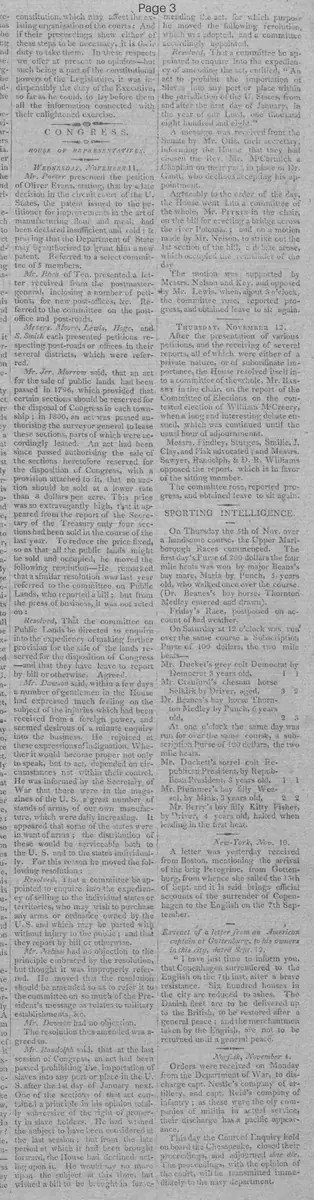
Proceedings of the U.S. House of Representatives on November 11-12, 1807, including petitions on patents, post offices, public lands sales, arms distribution, slave importation amendment, chaplain appointment, Potomac bridge bill debate, and contested election of William M'Creery.
Merged-components note: These two components continue the congressional proceedings report from Wednesday, November 11, to Thursday, November 12, on the same page 3. Merged as a single coherent unit of domestic news.
Clipping
OCR Quality
Full Text
HOUSE OF REPRESENTATIVES.
WEDNESDAY, NOVEMBER 11.
Mr. Porter presented the petition of Oliver Evans, stating, that by a late decision in the circuit court of the U. States, the patent issued to the petitioner for improvements in the art of manufacturing flour and meal, had been declared insufficient and void; & praying that the Department of State may be authorised to grant him a new patent. Referred to a select committee of 5 members.
Mr. Rhea of Ten. presented a letter received from the postmaster-general, inclosing a number of petitions, for new post-offices, &c. Referred to the committee on the post-office and post-roads.
Messrs. Moore, Lewis, Hoge, and S. Smith each presented petitions respecting post-roads or offices in their several districts, which were referred.
Mr. Jer. Morrow said, that an act for the sale of public lands had been passed in 1796, which provided that certain sections should be reserved for the disposal of Congress in each township; in 1800, an act was passed authorising the surveyor general to lease these sections, parts of which were accordingly leased. An act had been since passed authorising the sale of the sections heretofore reserved for the disposition of Congress, with a provision attached to it, that no section should be sold at a lower rate than 8 dollars per acre. This price was so extravagantly high, that it appeared from the report of the Secretary of the Treasury only four sections had been sold in the course of the last year. To reduce the price fixed, so as that all the public lands might be sold and occupied, he moved the following resolution—He remarked that a similar resolution was last year referred to the committee on Public Lands, who reported a bill; but from the press of business, it was not acted on:
Resolved, That the committee on Public Lands be directed to enquire into the expediency of making further provision for the sale of the lands reserved for the disposition of Congress—and that they have leave to report by bill or otherwise. Agreed.
Mr. Dawson said, within a few days a number of gentlemen in the House had expressed much feeling on the subject of the injuries which had been received from a foreign power, and seemed desirous of a minute enquiry into the business. He rejoiced at these expressions of indignation. Whether it would become proper not only to speak, but to act, depended on circumstances not within their control. He was informed by the Secretary of War that there were in the magazines of the U. S. a great number of stands of arms, of our own manufacture, which were daily increasing. It appeared that some of the states were in want of arms; the distribution of these would be serviceable both to the U. S. and to the states individually. For this reason he moved the following resolution:
Resolved, That a committee be appointed to enquire into the expediency of selling to the individual states or territories, who may wish to purchase any arms or ordnance owned by the U. S. and which may be parted with without injury to the public; and that they report by bill or otherwise
Mr. Nelson had no objection to the principle embraced by the resolution, but thought it was improperly referred. He moved that the resolution should be amended so as to refer it to the committee on so much of the President's message as relates to military establishments, &c.
Mr. Dawson had no objection.
The resolution thus amended was agreed to.
Mr. Randolph said, that at the last session of Congress, an act had been passed prohibiting the importation of slaves into any port or place in the U. S. after the 1st day of January next. One of the sections of that act contained a principle in his opinion totally subversive of the right of property in slave holders. He had wished the subject to have been considered at the last session; but from the late period at which it had been brought forward, the House had declined acting upon it. He would say no more upon the subject at this time, but wished a bill to be brought in for amending the act. For which purpose
he moved the following resolution, which was adopted, and a committee accordingly appointed.
Resolved, That a committee be appointed to enquire into the expediency of amending the act, entitled, "An act to prohibit the importation of Slaves into any port or place within the jurisdiction of the U. States, from and after the first day of January, in the year of our Lord, one thousand eight hundred and eight."
A message was received from the Senate by Mr. Otis, their secretary, informing the House that they had chosen the Rev. Mr. M'Cormick a Chaplain on their part; in place of Dr. Gantt, who declines accepting his appointment.
Agreeably to the order of the day, the House went into a committee of the whole, Mr. Pitkin in the chair, on the bill for erecting a bridge across the river Potomac; and on a motion made by Mr. Nelson, to strike out the 1st section of the bill, a debate arose, which occupied the remainder of the day.
The motion was supported by Messrs. Nelson and Key, and opposed by Mr. Lewis, when, about 5 o'clock, the committee rose, reported progress, and obtained leave to sit again.
THURSDAY, NOVEMBER 12.
After the presentation of various petitions, and the receiving of several reports, all of which were either of a private nature, or of subordinate importance, the House resolved itself into a committee of the whole, Mr. Bassett in the chair, on the report of the Committee of Elections on the contested election of William M'Creery, when a long and interesting debate ensued, which was continued until the usual hour of adjournment.
Messrs. Findley, Sturges, Smilie, J. Clay, and Fisk advocated; and Messrs. Sawyer, Randolph, & D. R. Williams opposed the report, which is in favor of the sitting member.
The committee rose, reported progress, and obtained leave to sit again.
What sub-type of article is it?
What keywords are associated?
What entities or persons were involved?
Domestic News Details
Event Date
Wednesday, November 11 And Thursday, November 12
Key Persons
Event Details
The House considered petitions on patents, post offices and roads, public lands sales, arms sales to states, amendment to slave importation act, Senate's chaplain appointment, Potomac bridge bill debate on November 11; on November 12, debated contested election of William M'Creery.