Thank you for visiting SNEWPapers!
Sign up free
Alexandria Gazette & Daily Advertiser
Alexandria, Virginia
What is this article about?
Reports from Gibraltar detail the outbreak of a constitutional revolution in Andalusia, Spain, led by Gen. Quiroga, capturing key sites near Cadiz without violence and expecting to seize the city, with widespread support and desertions from royal forces.
Clipping
OCR Quality
Full Text
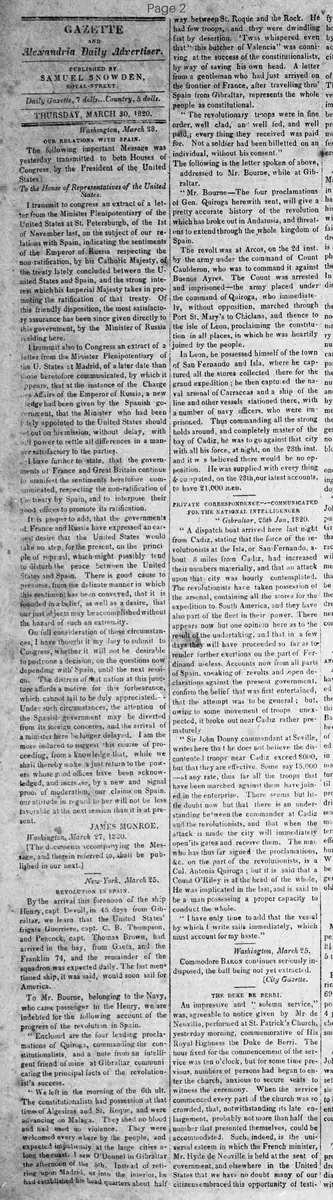
REVOLUTION IN SPAIN.
By the arrival this forenoon of the ship Henry, capt Devoll, in 45 days from Gibraltar, we learn that the United States' frigate Guerriere, capt. C. B. Thompson, and Peacock, capt. Thomas Brown, had arrived in the bay, from Gaeta, and the Franklin 74, and the remainder of the squadron was expected daily. The last mentioned ship, it was said, would soon sail for America.
To Mr. Bourne, belonging to the Navy, who came passenger in the Henry, we are indebted for the following account of the progress of the revolution in Spain.
"Enclosed are the four leading proclamations of Quiroga, commanding the constitutionalists, and a note from an intelligent friend of mine at Gibraltar communicating the principal facts of the revolutionist's success.
"We left in the morning of the 6th ult. The constitutionalists had possession at that time of Algesiras and St. Roque, and were advancing on Malaga. They shed no blood and had used no violence. They were welcomed everywhere by the people, and expected impatiently at the large cities along the coast. I saw O'Donnel in Gibraltar the afternoon of the 5th. Instead of retiring upon Madrid, or into the interior, he had established his head quarters about half way between St. Roque and the Rock. He had few troops, and they were dwindling fast by desertion. 'Twas whispered even that this butcher of Valencia was conniving at the success of the constitutionalists, by way of saving his own head. A letter from a gentleman who had just arrived on the frontier of France, after travelling thro' Spain from Gibraltar, represents the whole people as constitutional.
"The revolutionary troops were in fine order, well clad, and well fed, and well paid.; every thing they received was paid for. Not a soldier had been billetted on an individual, without his consent."
The following is the letter spoken of above, addressed to Mr. Bourne, while at Gibraltar.
"Mr. Bourne—The four proclamations of Gen. Quiroga herewith sent, will give a pretty accurate history of the revolution which has broke out in Andalusia, and threatens to extend through the whole kingdom of Spain.
The revolt was at Arcos, on the 2d inst. by the army under the command of Count Calderon, who was to command it against Buenos Ayres. The Count was arrested and imprisoned—the army placed under the command of Quiroga, who immediately, without opposition, marched through Port St. Mary's to Chiclana, and thence to the isle of Leon, proclaiming the constitution in all places, in which he was heartily joined by the people.
In Leon, he possessed himself of the town of San Fernando and Isla, where he captured all the stores collected there for the grand expedition; he then captured the naval arsenal of Carraccas and a ship of the line and other vessels stationed there, with a number of navy officers, who were imprisoned. Thus commanding all the strong holds around, and completely master of the bay of Cadiz, he was to go against that city with all his force, at night, on the 28th inst. and it was believed there would be no opposition. He was supplied with every thing necessary, and computed, on the 28th, our latest accounts, to have 21,000 men.
PRIVATE CORRESPONDENCE—COMMUNICATED FOR THE NATIONAL INTELLIGENCER
Gibraltar, 25th Jan, 1820.
A dispatch boat arrived here last night from Cadiz, stating that the force of the revolutionists at the Isla, or San Fernando, about 8 miles from Cadiz, had increased their numbers materially, and that an attack upon that city was hourly contemplated. The revolutionists have taken possession of the arsenal, containing all the stores for the expedition to South America, and they have also part of the fleet in their power. There appears now but one opinion here as to the result of the undertaking, and that in a few days they will have proceeded so far as to render further exertions on the part of Ferdinand useless. Accounts now from all parts of Spain, speaking of revolts and open declarations against the present government, confirm the belief that was first entertained, that the attempt was to be general; but, owing to some movement of troops unexpected, it broke out near Cadiz rather prematurely.
Sir John Downy commandant at Seville, writes here that he does not believe the discontented troops near Cadiz exceed 8000, but that they are effective. Some say 15,000—at any rate, thus far all the troops that have been marched against them have joined in the enterprise. There seems but little doubt now but that there is an understanding between the commander at Cadiz and the revolutionists, and that when the attack is made the city will immediately open its gates and receive them. The man who has thus far signed the proclamations, &c. on the part of the revolutionists, is a Col. Antonio Quiroga; but it is said that a Count O'Riley is at the head of the whole. He was implicated in the last, and is said to be a man possessing a proper capacity to conduct the whole.
I have only time to add that the vessel by which I write sails immediately, which must account for my haste."
What sub-type of article is it?
What keywords are associated?
What entities or persons were involved?
Where did it happen?
Foreign News Details
Primary Location
Andalusia, Spain
Event Date
Revolt Began 2d Inst., As Of 25th Jan 1820
Key Persons
Outcome
no blood shed or violence used; constitutionalists captured stores, arsenal, vessels, and officers without opposition; revolutionists numbered 21,000 men by 28th inst., expected to take cadiz without resistance; widespread desertions and public support; revolution spreading across spain.
Event Details
The revolution broke out in Andalusia on January 2, 1820, at Arcos, where troops under Count Calderon arrested him and placed themselves under Gen. Quiroga, proclaiming the constitution. They marched to Chiclana, Isle of Leon, San Fernando, Isla, capturing naval arsenal at Carraccas, a ship of the line, other vessels, and stores for South America expedition. By January 6, they held Algesiras and St. Roque, advancing on Malaga, welcomed by people. O'Donnel's forces dwindling by desertion near Gibraltar. Planned night attack on Cadiz on January 28, believed no opposition. Revolution expected to extend kingdom-wide, rendering King Ferdinand's efforts useless.