Thank you for visiting SNEWPapers!
Sign up free
Vermont Phœnix
Brattleboro, Bellows Falls, Ludlow, Windham County, Windsor County, Vermont
What is this article about?
Rev. Dr. Stiles Ely describes the boiler explosion on steamboat Flora on the Ohio River, 30 miles below Cincinnati, on Nov. 18, 1836, scalding many passengers including himself unharmed; deaths include Mr. McLaughlin, Mr. Myrick, waiter Moses, and later Hon. George L. Kinnard, with graphic accounts of injuries and spiritual reflections.
Clipping
OCR Quality
Full Text
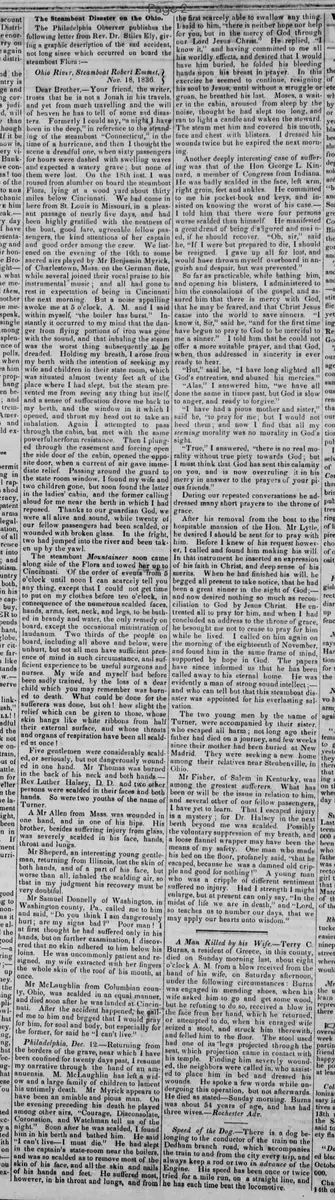
The Philadelphia Observer publishes the following letter from Rev. Dr. Stiles Ely, giving a graphic description of the sad accident, not long since which occurred on board the steamboat Flora :—
Ohio River, Steamboat Robert Emmet, Nov. 18, 1836.
Dear Brother,—Your friend, the writer, trusts that he is not a Jonah in his travels. and yet from much travelling and the will of heaven he has to tell of some sad disasters. Formerly I could say, "a night I have been in the deep," in reference to the stranding of the steamboat "Connecticut," in the time of a hurricane, and then I thought the scene a dreadful one, when sixty passengers for hours were dashed with swelling waves and expected a watery grave; but none of them were lost. On the 18th inst. I was roused from slumber on board the steamboat Flora, lying at a wood yard about thirty miles below Cincinnati. We had come in here from St. Louis in Missouri, in a pleasant passage of nearly five days, and had been highly gratified with the neatness of the boat, good fare, agreeable fellow passengers, the kind attentions of her captain and good order among the crew. We listened on the evening of the 16th to some sacred airs played by Mr Benjamin Myrick, of Charlestown, Mass. on the German flute, while several joined their vocal praise to his instrumental music : and all had gone to rest in expectation of being in Cincinnati the next morning. But a noise appalling awoke me at 5 o'clock, A. M. and I said within myself, "the boiler has burst." Instantly it occurred to my mind that the danger from flying portions of iron was gone with the sound, and that inhaling the steam was the worst thing subsequently to be dreaded. Holding my breath, I arose from my berth with the intention of seeking my wife and children in their state room, which was situated almost twenty feet aft of the place where I had slept, but the steam prevented me from seeing any thing but itself. and a sense of suffocation drove me back to my berth. and the window in it which I opened, and thrust my head out to take an inhalation. Again I attempted to pass through the cabin, but met with the same powerful aeriform resistance. Then I plunged through the casement and forcing open the side door of the cabin, opened the opposite door, when a current of air gave immediate relief. Passing around the guard to the state room window, I found my wife and two children gone, but soon found the latter in the ladies' cabin, and the former calling aloud for me near the berth in which I had reposed. Thanks to our guardian God, we were all alive and sound, while twenty of our fellow passengers had been scalded, or wounded with broken glass. In the fright, two had jumped into the river and been taken up by the yawl. The steamboat Mountaineer soon came along side of the Flora and towed her up to Cincinnati. Of the order of events from 5 o'clock until noon I can scarcely tell you any thing, except that I could not get time to put on my clothes before ten o'clock, in consequence of the numerous scalded faces, hands, arms, feet, neck, and legs, to be bathed in brandy and water, the only remedy on board, except the occasional ministration of laudanum. Two thirds of the people on board, including all above and below, were unhurt, but not all men have sufficient presence of mind in such circumstance, and sufficient experience to be useful surgeons and nurses. My wife and myself had before been sadly trained, by the loss of a dear child which you may remember was burned to death. What could be done for the sufferers was done, but oh! how slight the relief which can be given to those, whose skin hangs like white ribbons from half their external surface, and whose throats and organs of respiration have been all scalded at once! Five gentlemen were considerably scalded, or seriously, but not dangerously wounded in one hand. Mr Thomas was burned in the back of his neck and both hands.—Rev Luther Halsey, D. D. and two other persons were scalded in their faces and both hands. So were two youths of the name of Turner. A Mr Allen from Mass. was wounded in one hand, and in one of his hips. His brother, besides suffering injury from glass, was severely scalded in his face, hands, throat and lungs. Mr Sheperd, an interesting young gentleman, returning from Illinois, lost the skin of both hands, and of a part of his face, but worse than all, inhaled the scalding air, so that in my judgment his recovery must be very doubtful. Mr Samuel Donnelly of Washington, in Washington county, Pa., called me to him and said, "Do you think I am dangerously hurt; are my signs bad?" Poor man! I at first thought he had suffered only in his hands, but on further examination, I discovered that no skin adhered to him below his loins. He was uncommonly patient and resigned, my wife extracted with her fingers the whole skin of the roof of his mouth, at once. Mr McLaughlin from Columbian county, Ohio, was scalded in an equal manner, and died soon after he was landed at Cincinnati. After the accident happened, he called me to him and begged that I would pray for him, for soul and body, but especially for the former, for said he "I can't live."
Philadelphia, Dec. 12.—Returning from the borders of the grave, near which I have been confined for twenty days past, I resume my narrative through the hand of an amanuensis. M. McLaughlin has left a widow and a large family of children to lament his untimely death. Mr Myrick appears to have been an amiable and pious man. On the evening preceding his death he played among other airs, "Courage, Disconsolate, Coronation, and Watchman tell us of the night." Soon after he was scalded, I found him in his berth and bathed him. He said "I can't live—I must die." He had slept in the captain's state-room near the boilers, and was so scalded as to remove most of the skin of his face, and all the skin and nails of his hands and feet. He suffered most, however, in his throat and lungs, and from the first scarcely able to swallow any thing I said to him, "there is neither hope nor help for you, but in the mercy of God through our Lord Jesus Christ." He replied, "I know it," and having committed to me all his worldly effects, and desired that I would have him buried, he folded his bleeding hands upon his breast in prayer. In this exercise he seemed to continue, resigning his soul to Jesus, until without a struggle or groan, he breathed his last. Moses, a waiter in the cabin, aroused from sleep by the noise, thought he had slept too long, and ran to light a candle and waken the steward. The steam met him and covered his mouth, face and chest with blisters. I dressed his wounds twice but he expired the next morning. Another deeply interesting case of suffering was that of the Hon George L. Kinnard, a member of Congress from Indiana. He was badly scalded in the face, left arm, right groin, feet and ankles. He committed to me his pocket-book and keys, and insisted on knowing the worst of his case.—I told him that there were four persons worse scalded than himself. He manifested a great dread of being disfigured and maimed, if he should recover. "Oh, sir," said he, "If I were but prepared to die, I should be resigned. I gave up all for lost, and would have thrown myself overboard in anguish and despair, but was prevented." So far as practicable, while bathing him, and opening his blisters, I administered to him the consolations of the gospel, and assured him that there is mercy with God, that he may be feared, and that Christ Jesus came into the world to save sinners. "I know it, Sir." said he, "and for the first time have begun to pray to God to be merciful to me a sinner." I told him that he could not offer a more suitable prayer, and that God, when thus addressed in sincerity is ever ready to hear. "But," said he, "I have long slighted all God's entreaties, and abused his mercies." "Alas." I answered him, "we have all done the same in times past, but God is slow to anger, and ready to forgive." "I have had a pious mother and sister," said he, "to pray for me: but I would not heed them: and now I find that all my seeming morality was no morality in God's sight." "True." I answered, "there is no real morality without true piety towards God; but I must think that God has sent this calamity on you, and is now overruling it in his mercy in answer to the prayers of your pious friends." During our repeated conversations he addressed many short prayers to the throne of grace. After his removal from the boat to the hospitable mansion of the Hon. Mr Lytle, he desired I should be sent for to pray with him. Before I knew of his request however, I called and found him making his will. In that instrument he inserted an expression of his faith in Christ, and deep sense of his merits. When he had finished his will, he begged all present to take notice, that he had been a great sinner in the sight of God;—and now desired nothing so much as reconciliation to God by Jesus Christ. He entreated all to pray for him, and when I had concluded an address to the throne of grace, he besought me not to cease to pray for him while he lived. I called on him again on the morning of the eighteenth of November, and found him in the same frame of mind, supported by hope in God. The papers have since informed us that he has been called away to his eternal home. He was evidently a man of strong sound intellect ;—and who can tell but that this steamboat disaster was appointed for his everlasting salvation. The two young men by the name of Turner, were accompanied by their sister, who escaped all harm; not long ago their father had died on a journey, and few weeks since their mother had been buried at New Madrid. They were seeking a new home among their relatives near Steubenville, in Ohio. Mr Fisher, of Salem in Kentucky, was among the greatest sufferers. What has been or will be the issue in relation to him, and several other of our fellow passengers, I have yet to learn. That I escaped injury is a mystery ; for Dr. Halsey in the next berth beyond me was scalded. Possibly the voluntary suppression of my breath, and a loose flannel wrapper may have been the means of my safety. One man who made his bed on the floor, profanely said, "that he escaped, because he was a damned old cripple and good for nothing!" A young man who was a cripple of different sentiment suffered no injury. Had I strength I might enlarge, but at present can only say, "In the midst of life we are in death," and "Lord, so teach us to number our days, that we may apply our hearts unto wisdom."
What sub-type of article is it?
What keywords are associated?
What entities or persons were involved?
Where did it happen?
Domestic News Details
Primary Location
Ohio River, Thirty Miles Below Cincinnati
Event Date
November 18, 1836
Key Persons
Outcome
twenty passengers scalded or wounded; two jumped into river and rescued; deaths: mr mclaughlin, mr myrick, moses; hon george l. kinnard died later; many severe injuries including skin loss, inhalation of steam; boat towed to cincinnati by mountaineer.
Event Details
Boiler burst at 5 A.M. on steamboat Flora at wood yard 30 miles below Cincinnati, releasing scalding steam that injured passengers; Rev. Dr. Stiles Ely escaped unharmed and assisted victims; graphic accounts of injuries and spiritual consolations provided to dying.