Thank you for visiting SNEWPapers!
Sign up free
Norfolk Gazette And Publick Ledger
Norfolk, Virginia
What is this article about?
Reports on anticipated British ministerial changes: Mr. Dundas to succeed Castlereagh, Earl of Harrowby to foreign office, Mr. Perceval to treasury. Lord Grenville declines invitation to join new administration, clarifying it was for co-operation in forming one, not accession to existing. Prince of Wales maintains neutrality.
Clipping
OCR Quality
Full Text
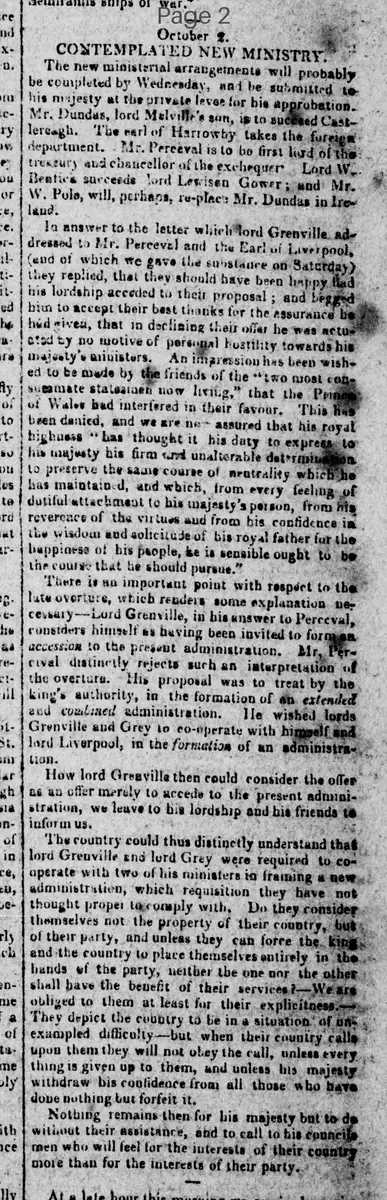
CONTEMPLATED NEW MINISTRY.
The new ministerial arrangements will probably be completed by Wednesday, and be submitted to his majesty at the private levee for his approbation. Mr. Dundas, Lord Melville's son, is to succeed Castlereagh. The Earl of Harrowby takes the foreign department. Mr. Perceval is to be first lord of the treasury and chancellor of the exchequer. Lord W. Bentinck succeeds Lord Leveson Gower; and Mr. W. Pole, will, perhaps, replace Mr. Dundas in Ireland.
In answer to the letter which Lord Grenville addressed to Mr. Perceval and the Earl of Liverpool, (end of which we gave the substance on Saturday) they replied, that they should have been happy had his lordship acceded to their proposal; and begged him to accept their best thanks for the assurance he had given, that in declining their offer he was actuated by no motive of personal hostility towards his majesty's ministers. An impression has been wished to be made by the friends of the two most consummate statesmen now living, that the Prince of Wales had interfered in their favour. This has been denied, and we are now assured that his royal highness 'has thought it his duty to express to his majesty his firm and unalterable determination to preserve the same course of neutrality which he has maintained, and which, from every feeling of dutiful attachment to his majesty's person, from his reverence of the virtues and from his confidence in the wisdom and solicitude of his royal father for the happiness of his people, he is sensible ought to be the course that he should pursue.'
There is an important point with respect to the late overture, which renders some explanation necessary--Lord Grenville, in his answer to Perceval, considers himself as having been invited to form an accession to the present administration. Mr. Perceval distinctly rejects such an interpretation of the overture. His proposal was to treat by the king's authority, in the formation of an extended and combined administration. He wished Lords Grenville and Grey to co-operate with himself and Lord Liverpool, in the formation of an administration.
How Lord Grenville then could consider the offer as an offer merely to accede to the present administration, we leave to his lordship and his friends to inform us.
The country could thus distinctly understand that Lord Grenville and Lord Grey were required to co-operate with two of his ministers in framing [a] new administration, which requisition they have not thought proper to comply with. Do they consider themselves not the property of their country, but of their party, and unless they can force the king and the country to place themselves entirely in the hands of the party, neither the one nor the other shall have the benefit of their services? We are obliged to them at least for their explicitness. They depict the country to be in a situation of unexampled difficulty--but when their country calls upon them they will not obey the call, unless every thing is given up to them, and unless his majesty withdraw his confidence from all those who have done nothing but forfeit it.
Nothing remains then for his majesty but to depend without their assistance, and to call to his council men who will feel for the interests of their country more than for the interests of their party.
What sub-type of article is it?
What keywords are associated?
What entities or persons were involved?
Foreign News Details
Event Date
October 2.
Key Persons
Outcome
new ministry arrangements to be completed by wednesday and submitted to the king; lord grenville and lord grey decline to co-operate in forming an extended administration.
Event Details
Anticipated changes include Mr. Dundas succeeding Castlereagh, Earl of Harrowby taking foreign department, Mr. Perceval becoming first lord of the treasury and chancellor of the exchequer, Lord W. Bentinck succeeding Lord Leveson Gower, and Mr. W. Pole possibly replacing Mr. Dundas in Ireland. Correspondence between Lord Grenville, Mr. Perceval, and Earl of Liverpool reveals declined proposal for co-operation in forming a new administration, not accession to the existing one. Prince of Wales affirms neutrality. Editorial commentary criticizes Grenville and Grey for prioritizing party over country.