Thank you for visiting SNEWPapers!
Sign up free
The Arkansas Farmer
Little Rock, Pulaski County, Arkansas
What is this article about?
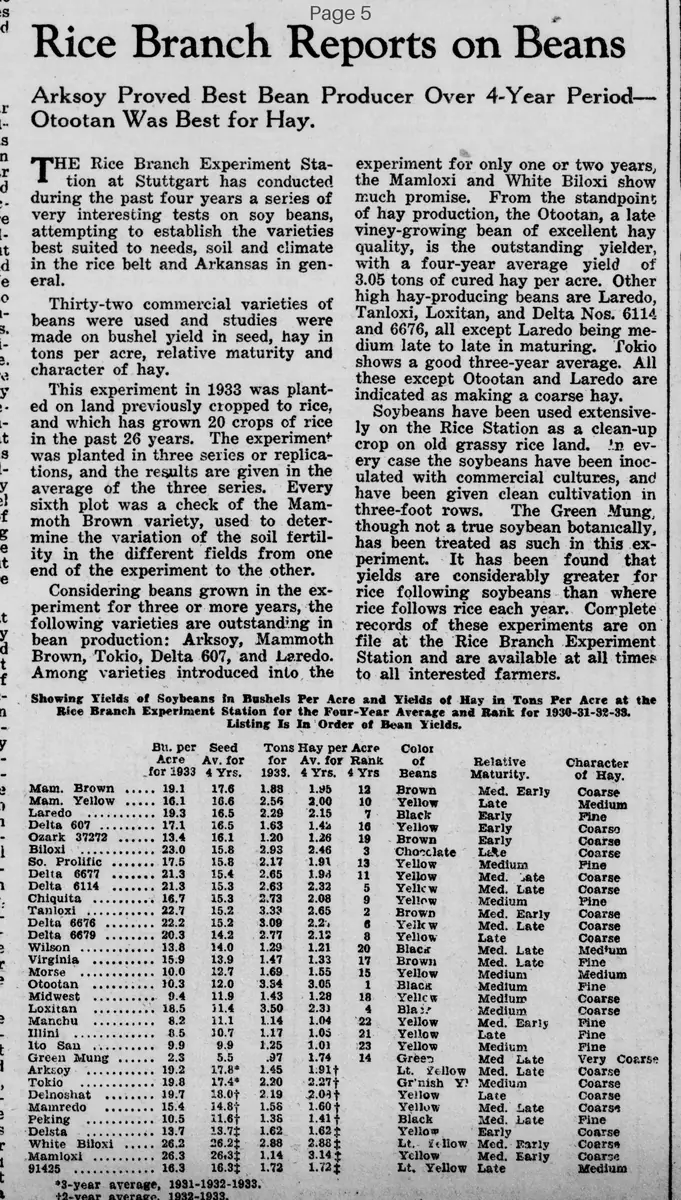
Rice Branch Experiment Station in Stuttgart, Arkansas, conducted four-year tests on 32 soybean varieties to determine best suited for rice belt soil and climate, reporting yields for 1933 and averages, with Arksoy top for beans and Otootan for hay.
Merged-components note: Merged soybean yield and characteristics tables with the Rice Branch bean report as the tables provide the experimental data referenced in the text
Clipping
OCR Quality
Full Text
| Bu. per | Seed | Tons | Hay per | Acre | |
| Acre | Av. for | for | Av. for | Ran | |
| for 1933 | 4 Yrs. | 1933. | 4 Yrs. | 4 Yrs | |
| Mam. Brown | 19.1 | 17.6 | 1.83 | 1.95 | 12 |
| Mam. Yellow | 16.1 | 16.6 | 2.56 | 2.00 | 10 |
| Laredo | 19.3 | 16.5 | 2.29 | 2.15 | 7 |
| Delta 607 | 17.1 | 16.5 | 1.63 | 1.42 | 16 |
| Ozark 37272 | 13.4 | 16.1 | 1.20 | 1.26 | 19 |
| Biloxi | 23.0 | 15.8 | 2.93 | 2.46 | 3 |
| So. Prolific | 17.5 | 15.8 | 2.17 | 1.91 | 13 |
| Delta 6677 | 21.3 | 15.4 | 2.65 | 1.93 | 11 |
| Delta 6114 | 21.3 | 15.3 | 2.63 | 2.32 | 5 |
| Chiquita | 16.7 | 15.3 | 2.73 | 2.08 | 9 |
| Tanloxi | 22.7 | 15.2 | 3.33 | 2.65 | 2 |
| Delta 6676 | 22.2 | 15.2 | 3.09 | 2.21 | 6 |
| Delta 6679 | 20.3 | 14.2 | 2.77 | 2.12 | 8 |
| Wilson | 13.8 | 14.0 | 1.29 | 1.21 | 20 |
| Virginia | 15.9 | 13.9 | 1.47 | 1.33 | 17 |
| Morse | 10.0 | 12.7 | 1.69 | 1.55 | 15 |
| Otootan | 10.3 | 12.0 | 3.54 | 3.05 | 1 |
| Midwest | 9.4 | 11.9 | 1.43 | 1.28 | 18 |
| Loxitan | 18.5 | 11.4 | 3.50 | 2.31 | 4 |
| Manchu | 8.2 | 11.1 | 1.14 | 1.04 | 22 |
| Illini | 8.5 | 10.7 | 1.17 | 1.05 | 21 |
| Ito San | 9.9 | 9.9 | 1.25 | 1.01 | 23 |
| Green Mung | 2.3 | 5.5 | .97 | 1.74 | 14 |
| Arksoy | 19.2 | 17.8* | 1.45 | 1.91 $ \dagger $ | |
| Tokio | 19.8 | 17.4* | 2.20 | 2.27 $ \dagger $ | |
| Delnoshat | 19.7 | 18.0 $ \dagger $ | 2.19 | 2.03 $ \dagger $ | |
| Mamredo | 15.4 | 14.8 $ \dagger $ | 1.56 | 1.60 $ \dagger $ | |
| Peking | 10.5 | 11.6 $ \dagger $ | 1.36 | 1.41 $ \dagger $ | |
| Delsta | 13.7 | 13.7 $ \dagger $ | 1.62 | 1.62 $ \dagger $ | |
| White Biloxi | 26.2 | 26.2 $ \dagger $ | 2.88 | 2.88 $ \dagger $ | |
| Mamloxi | 26.3 | 26.3 $ \dagger $ | 1.14 | 3.14 $ \dagger $ | |
| 91425 | 16.3 | 16.3 $ \dagger $ | 1.72 | 1.72 $ \dagger $ |
| of | Relative | Character |
| Beans | Maturity. | of Hay. |
| Brown | Med. Early | Coarse |
| Yellow | Late | Medium |
| Black | Early | Fine |
| Yellow | Early | Coarse |
| Brown | Early | Coarse |
| Chocolate | Late | Coarse |
| Yellow | Medium | Fine |
| Yellow | Med. Late | Coarse |
| Yellow | Med. Late | Coarse |
| Yellow | Medium | Fine |
| Brown | Med. Early | Coarse |
| Yellow | Med. Late | Coarse |
| Yellow | Late | Coarse |
| Black | Med. Late | Medium |
| Brown | Med. Late | Fine |
| Yellow | Medium | Medium |
| Black | Medium | Fine |
| Yellow | Medium | Coarse |
| Black | Medium | Coarse |
| Yellow | Medium | Fine |
| Yellow | Medium | Fine |
| Green | Med. Late | Very Coarse |
| Lt. Yellow | Med. Late | Coarse |
| Gr'nish Y' | Medium | Coarse |
| Yellow | Late | Coarse |
| Yellow | Late | Coarse |
| Yellow | Med. Late | Fine |
| Black | Med. Late | Coarse |
| Yellow | Early | Coarse |
| Lt. Yellow | Med. Early | Coarse |
| Yellow | Med. Early | Coarse |
| Lt. Yellow | Late | Medium |
Rice Branch
Reports on Beans
Arksoy Proved Best Bean Producer Over 4-Year Period-
Otootan Was Best for Hay.
THE Rice Branch Experiment Station
at Stuttgart has conducted
during the past four years a series of
very interesting tests on soy beans,
attempting to establish the varieties
best suited to needs, soil and climate
in the rice belt and Arkansas in general.
Thirty-two commercial varieties of
beans were used and studies
were
made on bushel yield in seed, hay in
tons per acre, relative maturity and
character of hay.
This experiment in 1933 was planted
on land previously cropped to rice,
and which has grown 20 crops of rice
in the past 26 years. The experiment
was planted in three series or replications,
and the results are given in the
average of the three series. Every
sixth plot was a check of the Mammoth
Brown variety, used to determine
the variation of the soil fertility
in the different fields from one
end of the experiment to the other.
Considering beans grown in the experiment
for three or more years, the
following varieties are outstanding in
bean production: Arksoy, Mammoth
Brown, Tokio, Delta 607, and Laredo.
Among varieties introduced into the
experiment for only one or two years,
the Mamloxi and White Biloxi show
much promise. From the standpoint
of hay production, the Otootan, a late
viney-growing bean of excellent hay
quality, is the outstanding yielder,
with a four-year average yield of
3.05 tons of cured hay per acre. Other
high hay-producing beans are Laredo,
Tanloxi, Loxitan, and Delta Nos. 6114
and 6676, all except Laredo being medium
late to late in maturing. Tokio
shows a good three-year average. All
these except Otootan and Laredo are
indicated as making a coarse hay.
Soybeans have been used extensively
on the Rice Station as a clean-up
crop on old grassy rice land. In every
case the soybeans have been inoculated
with commercial cultures, and
have been given clean cultivation in
three-foot rows.
The Green Mung,
though not a true soybean botanically,
has been treated as such in this experiment.
It has been found that
yields are considerably greater for
rice following soybeans—than where
rice follows rice each year. Complete
records of these experiments are on
file at the Rice Branch Experiment
Station and are available at all times
to all interested farmers.
What sub-type of article is it?
What keywords are associated?
Where did it happen?
Domestic News Details
Primary Location
Stuttgart
Event Date
During The Past Four Years
Event Details
The Rice Branch Experiment Station at Stuttgart conducted tests on 32 commercial soybean varieties over four years to determine best suited for rice belt soil and climate in Arkansas. Studies included bushel yield in seed, hay in tons per acre, relative maturity, and character of hay. In 1933, planted on land with 20 prior rice crops. Outstanding bean producers over three or more years: Arksoy, Mammoth Brown, Tokio, Delta 607, Laredo. Promising new: Mamloxi, White Biloxi. Top hay producer: Otootan with 3.05 tons per acre average. Other high hay: Laredo, Tanloxi, Loxitan, Delta 6114, 6676, Tokio. Soybeans used as clean-up crop on rice land, inoculated and cultivated in three-foot rows. Rice yields greater following soybeans than continuous rice.