Thank you for visiting SNEWPapers!
Sign up free
Alexandria Daily Advertiser
Alexandria, Virginia
What is this article about?
James Madison's letter to James Monroe provides instructions for negotiating a treaty with Britain, covering neutral rights, blockades, impressments, contraband, and trade with hostile colonies, emphasizing key U.S. interests in diplomacy and maritime affairs.
Clipping
OCR Quality
Full Text
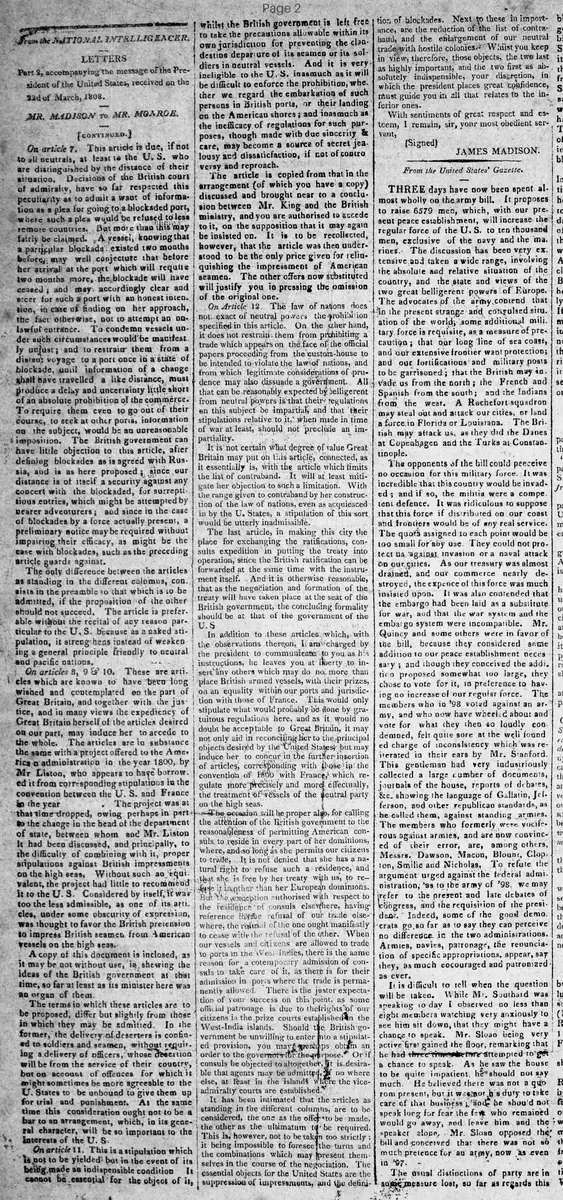
LETTERS
Part II, accompanying the message of the President of the United States, received on the 22d of March, 1808.
MR. MADISON TO MR. MONROE.
[Continued]
On article 7. This article is due, if not to all neutrals, at least to the U. S. who are distinguished by the distance of their situation. Decisions of the British court of admiralty, have so far respected this peculiarity as to admit a want of information as a plea for going to a blockaded port, where such a plea would be refused to less remote countries. But more than this may fairly be claimed. A vessel, knowing that a particular blockade existed two months before may well conjecture that before her arrival at the port which will require two months more, the blockade will have ceased; and may, accordingly clear and enter for such a port with an honest intention, in case of finding on her approach, the fact otherwise, not to attempt an unlawful entrance. To condemn vessels under such circumstances would be manifestly unjust; and to restrain them from a distant voyage to a port once in a state of blockade, until information of a change shall have travelled a like distance, must produce a delay and uncertainty little short of an absolute prohibition of the commerce. To require them even to go out of their course, to seek at other ports, information on the subject, would be an unreasonable imposition. The British government can have little objection to this article, after defining blockades as is agreed with Russia, and is as here proposed; since our distance is of itself a security against any concert with the blockaded, for surreptitious entries, which might be attempted by nearer adventurers; and since in the case of blockades by a force actually present, a preliminary notice may be required without impairing their efficacy, as might be the case with blockades, such as the preceding article guards against.
The only difference between the articles as standing in the different columns, consists in the preamble to that which is to be admitted, if the proposition of the other should not succeed. The article is preferable without the recital of any reason particular to the U. S. because as a naked stipulation, it strengthens instead of weakening a general principle friendly to neutral and pacific nations.
3. On articles 8, 9 & 10. These are articles which are known to have been long wished and contemplated on the part of Great Britain, and together with the justice, and in many views the expediency to Great Britain herself of the articles desired on our part, may induce her to accede to the whole. The articles are in substance the same with a project offered to the American administration in the year 1800, by Mr. Liston, who appears to have borrowed it from corresponding stipulations in the convention between the U. S. and France in the year 1778. The project was at that time dropped, owing perhaps in part to the change in the head of the department of state, between whom and Mr. Liston it had been discussed, and principally, to the difficulty of combining with it, proper stipulations against British impressments on the high seas. Without such an equivalent, the project had little to recommend it to the U. S. Considered by itself, it was the less admissible, as one of its articles, under some obscurity of expression, was thought to favor the British pretension to impress British seamen from American vessels on the high seas.
A copy of this document is enclosed, as it may be not without use, in shewing the ideas of the British government at that time, so far at least as its minister here was an organ of them.
The terms in which these articles are to be proposed, differ but slightly from those in which they may be admitted. In the former, the delivery of deserters is confined to soldiers and seamen, without requiring a delivery of officers, whose desertion will be from the service of their country, but on account of offences for which it might sometimes be more agreeable to the U. States to be unbound to give them up for trial and punishment. At the same time this consideration ought not to be a bar to an arrangement, which, in its general character, will be so important to the interests of the U. S.
On article 11. This is a stipulation which is not to be yielded but in the event of its being made an indispensable condition. It cannot be essential for the object of it, whilst the British government is left free to take the precautions allowable within its own jurisdiction for preventing the clandestine departure of its seamen or its soldiers in neutral vessels. And it is very ineligible to the U. S. inasmuch as it will be difficult to enforce the prohibition, whether we regard the embarkation of such persons in British ports, or their landing on the American shores; and inasmuch as the inefficacy of regulations for such purposes, though made with due sincerity & care, may become a source of secret jealousy and dissatisfaction, if not of controversy and reproach.
The article is copied from that in the arrangement (of which you have a copy) discussed and brought near to a conclusion between Mr. King and the British ministry, and you are authorised to accede to it, on the supposition that it may again be insisted on. It is to be recollected, however, that the article was then understood to be the only price given for relinquishing the impressment of American seamen. The other offers now substituted will justify you in pressing the omission of the original one.
On Article 12. The law of nations does not exact of neutral powers the prohibition specified in this article. On the other hand, it does not restrain them from prohibiting a trade which appears on the face of the official papers proceeding from the custom-house to be intended to violate the laws of nations, and from which legitimate considerations of prudence may also dissuade a government. All that can be reasonably expected by belligerent from neutral powers is that their regulations on this subject be impartial, and that their stipulations relative to it, when made in time of war at least, should not preclude an impartiality.
It is not certain what degree of value Great Britain may put on this article, connected, as it essentially is, with the article which limits the list of contraband. It will at least mitigate her objection to such a limitation. With the range given to contraband by her construction of the law of nations, even as acquiesced in by the U. States, a stipulation of this sort would be utterly inadmissible.
The last article, in making this city the place for exchanging the ratifications, consults expedition in putting the treaty into operation, since the British ratification can be forwarded at the same time with the instrument itself. And it is otherwise reasonable, that as the negociation and formation of the treaty will have taken place at the seat of the British government, the concluding formality should be at that of the government of the U. S.
In addition to these articles which, with the observations thereon, I am charged by the president to communicate to you as his instructions, he leaves you at liberty to insert any others which may do no more than place British armed vessels, with their prizes, on an equality within our ports and jurisdiction with those of France. This would only stipulate what would probably be done by gratuitous regulations here, and as it would no doubt be acceptable to Great Britain, it may not only aid in reconciling her to the principal objects desired by the United States; but may induce her to concur in the further insertion of articles, corresponding with those in the convention of 1778 with France, which regulate more precisely and more effectually, the treatment of vessels of the neutral party on the high seas.
The occasion will be proper also, for calling the attention of the British government to the reasonableness of permitting American consuls to reside in every part of her dominions, where, and so long as she permits our citizens to trade. It is not denied that she has a natural right to refuse such a residence, and that she is free by her treaty with us, to refuse it in other than her European dominions. But the exception authorised with respect to the residence of consuls elsewhere, having reference to the refusal of our trade elsewhere, the refusal of the one ought manifestly to cease with the refusal of the other. When our vessels and citizens are allowed to trade to ports in the West-Indies, there is the same reason for a cotemporary admission of consuls to take care of it, as there is for their admission in ports where the trade is permanently allowed. There is the juster expectation of your success on this point, as some official patronage is due to the rights of our citizens in the prize courts established in the West-India islands. Should the British government be unwilling to enter into a stipulated provision, you may perhaps obtain an order to the governors for the purpose. Or if consuls be objected to altogether, it is desirable that agents may be admitted, no where else, at least in the islands where the vice-admiralty courts are established.
It has been intimated that the articles as standing in the different columns, are to be considered, the one as the offer to be made, the other as the ultimatum to be required. This is, however, not to be taken too strictly; it being impossible to foresee the turns and the combinations which may present themselves in the course of the negociation. The essential objects for the United States are the suppression of impressments, and the definition of blockades. Next to these in importance, are the reduction of the list of contraband, and the enlargement of our neutral trade with hostile colonies. Whilst you keep in view, therefore, those objects, the two last as highly important, and the two first as absolutely indispensable, your discretion, in which the president places great confidence, must guide you in all that relates to the inferior ones.
With sentiments of great respect and esteem, I remain, sir, your most obedient servant,
(Signed)
JAMES MADISON.
What sub-type of article is it?
What keywords are associated?
What entities or persons were involved?
Where did it happen?
Foreign News Details
Primary Location
Great Britain
Event Date
22d Of March, 1808
Key Persons
Outcome
instructions for treaty negotiations on neutral rights, blockades, impressments, contraband, and trade; essential u.s. objectives include suppressing impressments and defining blockades.
Event Details
James Madison provides detailed instructions to James Monroe for negotiating a treaty with the British government, discussing specific articles on blockades (Article 7), delivery of deserters (Articles 8-10), prohibitions on military embarkations (Article 11), trade regulations (Article 12), ratification exchange, equality of armed vessels, and consul residences in British dominions including the West Indies.