Thank you for visiting SNEWPapers!
Sign up free
National Gazette
Philadelphia, Philadelphia County, Pennsylvania
What is this article about?
Thomas Paine's letter to Henry Dundas defends 'Rights of Man' against parliamentary accusations of sedition. He contrasts representative government in America, which fosters prosperity with low taxes, against England's hereditary system, excessive taxation, and proposes reforms for tax relief and poor support.
Merged-components note: This is a continuation of Thomas Paine's letter to Dundas across pages 1 and 2; the content is an opinion piece signed by Paine, fitting editorial better than foreign_news.
Clippings
1 of 2
OCR Quality
Full Text
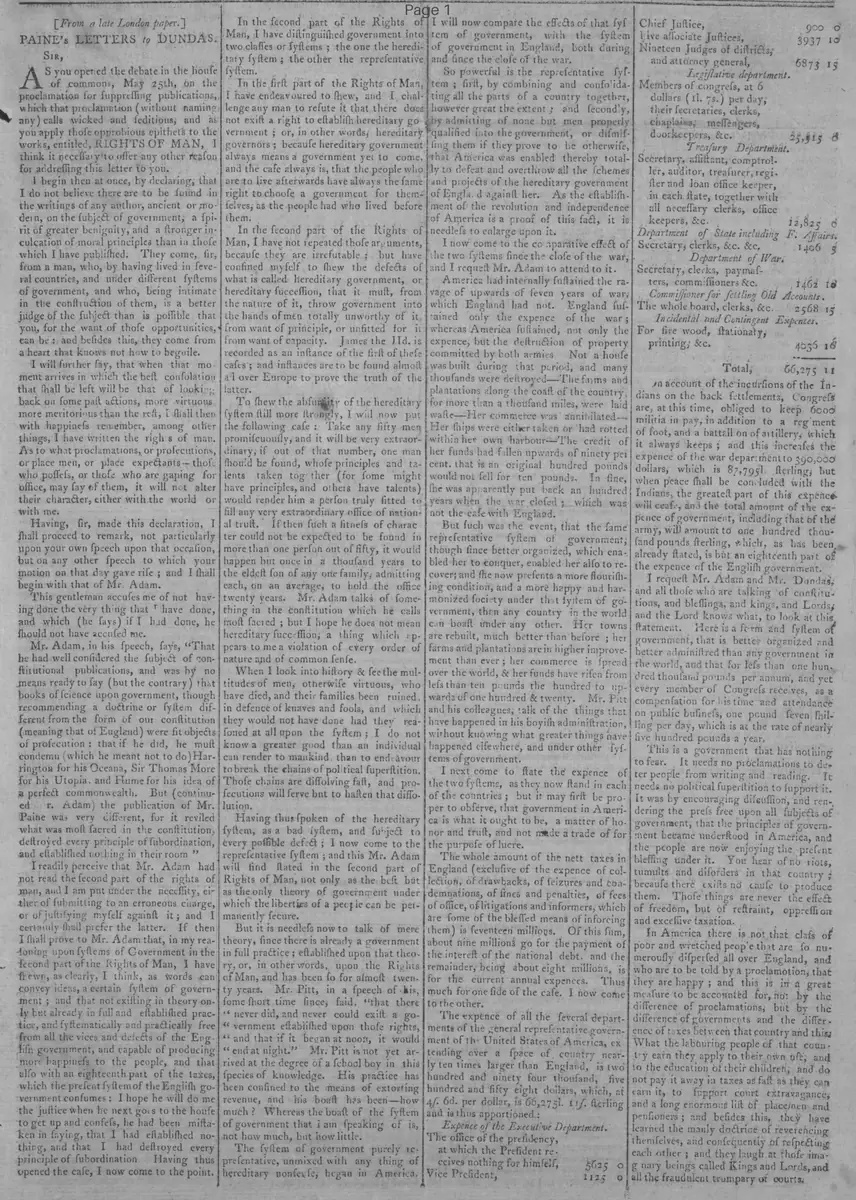
PAINE's LETTERS to DUNDAS.
SIR,
As you opened the debate in the house of commons, May 25th, on the proclamation for suppressing publications, which that proclamation (without naming any) calls wicked and seditious; and as you apply those opprobrious epithets to the works, entitled, RIGHTS OF MAN, I think it necessary to offer any other reason for addressing this letter to you.
I begin then at once, by declaring, that I do not believe there are to be found in the writings of any author, ancient or modern, on the subject of government, a spirit of greater benignity, and a stronger inculcation of moral principles than in those which I have published. They come, sir, from a man, who, by having lived in several countries, and under different systems of government, and who, being intimate in the construction of them, is a better judge of the subject than is possible that you, for the want of those opportunities, can be: and besides this, they come from a heart that knows not how to beguile.
I will further say, that when that moment arrives in which the best consolation that shall be left will be that of looking back on some past actions, more virtuous and more meritorious than the rest, I shall then with happiness remember, among other things, I have written the rights of man.
As to what proclamations, or prosecutions, or place men, or place expectants—those who possess, or those who are gaping for office, may say of them, it will not alter their character, either with the world or with me.
Having, sir, made this declaration, I shall proceed to remark, not particularly upon your own speech upon that occasion, but on any other speech to which your motion on that day gave rise; and I shall begin with that of Mr. Adam.
This gentleman accuses me of not having done the very thing that I have done, and which (he says) if I had done, he should not have accused me.
Mr. Adam, in his speech, says, "That he had well considered the subject of constitutional publications, and was by no means ready to say (but the contrary) that books of science upon government, though recommending a doctrine or system different from the form of our constitution (meaning that of England) were fit objects of prosecution: that if he did, he must condemn (which he meant not to do) Harrington for his Oceana, Sir Thomas More for his Utopia, and Hume for his idea of a perfect commonwealth." But (continued Mr. Adam) the publication of Mr. Paine was very different, for it reviled what was most sacred in the constitution, destroyed every principle of subordination, and established nothing in their room.
I readily perceive that Mr. Adam had not read the second part of the rights of man, and I am put under the necessity, either of submitting to an erroneous charge, or of justifying myself against it; and I certainly shall prefer the latter. If then I shall prove to Mr. Adam that, in my reasoning upon systems of Government in the second part of the Rights of Man, I have shown, as clearly, I think, as words can convey ideas, a certain system of government; and that not existing in theory only but already in full and established practice, and systematically and practically free from all the vices and defects of the English government, and capable of producing more happiness to the people, and that also with an eighteenth part of the taxes, which the present system of the English government consumes: I hope he will do me the justice when he next goes to the house to get up and confess, he had been mistaken in saying, that I had established nothing, and that I had destroyed every principle of subordination. Having thus opened the case, I now come to the point.
In the second part of the Rights of Man, I have distinguished government into two classes or systems; the one the hereditary system; the other the representative system.
In the first part of the Rights of Man, I have endeavoured to show, and I challenge any man to refute it that there does not exist a right to establish hereditary government; or, in other words; hereditary governors; because hereditary government always means a government yet to come, and the case always is, that the people who are to live afterwards have always the same right to choose a government for themselves, as the people had who lived before them.
In the second part of the Rights of Man, I have not repeated those arguments, because they are irrefutable: but have confined myself to show the defects of what is called hereditary government, or hereditary succession, that it must, from the nature of it, throw government into the hands of men totally unworthy of it, from want of principle, or unfitted for it from want of capacity. James the IId. is recorded as an instance of the first of these cases; and instances are to be found almost all over Europe to prove the truth of the latter.
To show the absurdity of the hereditary system still more strongly, I will now put the following case: Take any fifty men promiscuously, and it will be very extraordinary, if out of that number, one man should be found, whose principles and talents taken together (for some might have principles, and others have talents) would render him a person truly fitted to fill any very extraordinary office of national trust. If then such an instance of character could not be expected to be found in more than one person out of fifty, it would happen but once in a thousand years to the eldest son of any one family, admitting each, on an average, to hold the office twenty years. Mr. Adam talks of something in the constitution which he calls most sacred; but I hope he does not mean hereditary succession; a thing which appears to me a violation of every order of nature and of common sense.
When I look into history & see the multitudes of men, otherwise virtuous, who have died, and their families been ruined, in defence of knaves and fools, and which they would not have done had they reasoned at all upon the system; I do not know a greater good than an individual can render to mankind, than to endeavour to break the chains of political superstition. Those chains are dissolving fast, and prosecutions will serve but to hasten that dissolution.
Having thus spoken of the hereditary system, as a bad system, and subject to every possible defect; I now come to the representative system; and this Mr. Adam will find stated in the second part of Rights of Man, not only as the best but as the only theory of government under which the liberties of a people can be permanently secure.
But it is needless now to talk of mere theory, since there is already a government in full practice; established upon that theory, or, in other words, upon the Rights of Man, and has been so for almost twenty years. Mr. Pitt, in a speech of his some short time since, said, "that there never did, and never could exist a government established upon those rights, and that if it began at noon, it would end at night." Mr. Pitt is not yet arrived at the degree of a school boy in this species of knowledge. His practice has been confined to the means of extorting revenue, and his boast has been—how much? Whereas the boast of the system of government that I am speaking of is, not how much, but how little.
The system of government purely representative, unmixed with any thing of hereditary nonsense, began in America.
I will now compare the effects of that system of government, with the system of government in England, both during and since the close of the war.
So powerful is the representative system; first, by combining and consolidating all the parts of a country together, however great the extent; and secondly, by admitting of none but men properly qualified into the government, or dismissing them if they prove to be otherwise, that America was enabled thereby totally to defeat and overthrow all the schemes and projects of the hereditary government of England against her. As the establishment of the revolution and independence of America is a proof of this fact, it is needless to enlarge upon it.
I now come to the comparative effect of the two systems since the close of the war, and I request Mr. Adam to attend to it.
America had internally sustained the ravages of upwards of seven years of war, which England had not. England sustained only the expense of the war; whereas America sustained, not only the expense, but the destruction of property committed by both armies. Not a house was built during that period, and many thousands were destroyed. The farms and plantations along the coast of the country, for more than a thousand miles, were laid waste—Her commerce was annihilated—Her ships were either taken or had rotted within her own harbour—The credit of her funds had fallen upwards of ninety per cent. that is an original hundred pounds would not sell for ten pounds. In fine, she was apparently put back an hundred years when the war closed; which was not the case with England.
But such was the event, that the same representative system of government; though since better organized, which enabled her to conquer, enabled her also to recover; and she now presents a more flourishing condition, and a more happy and harmonized society under that system of government, than any country in the world can boast under any other. Her towns are rebuilt, much better than before: her farms and plantations are in higher improvement than ever; her commerce is spread over the world, & her funds have risen from less than ten pounds the hundred to upwards of one hundred & twenty. Mr. Pitt and his colleagues, talk of the things that have happened in his boyish administration, without knowing what greater things have happened elsewhere, and under other systems of government.
I next come to state the expense of the two systems, as they now stand in each of the countries; but it may first be proper to observe, that government in America is what it ought to be, a matter of honor and trust, and not made a trade of for the purpose of lucre.
The whole amount of the net taxes in England (exclusive of the expense of collection, of drawbacks, of seizures and condemnations, of fines and penalties, of fees of office, of litigations and informers, which are some of the blessed means of enforcing them) is seventeen millions. Of this sum, about nine millions go for the payment of the interest of the national debt, and the remainder, being about eight millions, is for the current annual expenses. Thus much for one side of the case. I now come to the other.
The expense of all the several departments of the general representative government of the United States of America, extending over a space of country nearly ten times larger than England, is two hundred and ninety four thousand, five hundred and fifty eight dollars, which, at 4s. 6d. per dollar, is 66,275l. 11s. sterling and is thus apportioned:
Expense of the Executive Department.
The office of the presidency, at which the President receives nothing for himself, 56250
Vice President, 1125
Chief Justice, five associate Justices. 3937.10
Nineteen Judges of districts; and attorney general, 6373.13
Legislative department.
Members of congress, at 6 dollars (£1 7s.) per day; their secretaries, clerks, chaplains, messengers, doorkeepers, &c.: 25,315
Treasury Department.
Secretary, assistant; comptroller, auditor, treasurer; register and loan office keeper, in each state; together with all necessary clerks, office keepers, &c. 12,825
Department of State including Foreign Affairs.
Secretary; clerks, &c. &c, 1406.5
Department of War
Secretary; clerks, paymasters, commissioners &c. 1462.10
Commissioner for settling Old Accounts.
The whole board, clerks, &c. 2568.15
Incidental and Contingent Expenses.
For fire wood, stationery, printing; &c. 4535.6
Total; 66,275 11
In account of the incursions of the Indians on the back settlements, Congress are, at this time, obliged to keep 6000 militia in pay, in addition to a regiment of foot, and a battalion of artillery, which it always keeps; and this increases the expense of the war department to 390,000 dollars, which is 87,791l. sterling, but when peace shall be concluded with the Indians, the greatest part of this expense will cease. and the total amount of the expense of government, including that of the army, will amount to one hundred thousand pounds sterling, which, as has been already stated, is but an eighteenth part of the expense of the English government.
I request Mr. Adam and Mr. Dundas, and all those who are talking of constitutions, and blessings, and kings, and Lords, and the Lord knows what, to look at this statement. Here is a form and system of government, that is better organized and better administered than any government in the world, and that for less than one hundred thousand pounds per annum, and yet every member of Congress receives, as a compensation for his time and attendance on public business, one pound seven shillings per day, which is at the rate of nearly five hundred pounds a year.
This is a government that has nothing to fear. It needs no proclamations to deter people from writing and reading. It needs no political superstition to support it. It was by encouraging discussion, and rendering the press free upon all subjects of government, that the principles of government became understood in America, and the people are now enjoying the present blessing under it. You hear of no riots, tumults and disorders in that country; because there exists no cause to produce them. Those things are never the effect of freedom, but of restraint, oppression and excessive taxation.
In America there is not that class of poor and wretched people that are so numerously dispersed all over England, and who are to be told by a proclamation, that they are happy; and this is in a great measure to be accounted for, not by the difference of proclamations, but by the difference of governments and the difference of taxes between that country and this. What the labouring people of that country earn they apply to their own use; and to the education of their children; and do not pay it away in taxes as fast as they can earn it, to support court extravagance, and a long enormous list of placemen and pensioners; and besides this, they have learned the manly doctrine of reverencing themselves, and consequently of respecting each other; and they laugh at those imaginary beings called Kings and Lords, and all the fraudulent trumpery of courts.
When placemen and pensioners, or those who expect to be such, are lavish in praise of a government, it is not a sign of its being a good one. The pension-list alone in England (see Sir John Sinclair's history of the revenue, page 6 of the appendix) is one hundred and seven thousand four hundred and four pounds, which is more than the expenses of the whole government of America amounts to. And I am now more convinced than before, that the offer that was made to me of a thousand pounds, for the copy-right of the second part of the Rights of Man, together with the remaining copy-right of the first part, was to have effected, by a quick suppression, what is now attempted to be done by a prosecution. The connection which the person who made that offer, has with the King's printing-office, may furnish part of the means of enquiring into this affair, when the ministry shall please to bring their prosecution to issue. But to return to my subject.
I have said in the second part of Rights of Man and I repeat it here, that the service of any man, whether called King, President, Senator, Legislator, or anything else, cannot be worth more to any country, in the regular routine of office, than ten thousand pounds per annum. We have a better man in America, and more of a gentleman than any king I ever knew of, who does not occasion even half that expense; for though the salary is fixed at 25,000 dollars he does not accept it; and it is only the incidental expenses are paid out of it. The name by which a man is called, is, of itself, but an empty thing. It is worth and character alone which can render him valuable, for without these, kings, lords, and presidents, are but jingling names.
But without troubling myself about constitutions of government, I have shown in the second part of Rights of Man, that an alliance may be formed between England, France, and America, and that the expenses of government in England may be put back to one million and a half, viz.
Civil expense of government. 500,000
Army 500,000
Navy 500,000
1,500,000
And even this sum is fifteen times greater than the expenses of government are in America; and it is also greater than the whole peace establishment of England amounted to about an hundred years ago.
So much has the weight and oppression of taxes increased since the revolution, and especially since the year 1714.
To show that the sum of 500,000l. is sufficient to defray all the civil expenses of government, I have, in that work, annexed the following estimate for any country of the same extent as England.
In the first place, 300 representatives, fairly elected, are sufficient for all the purposes to which legislation can apply, and preferable to a larger number.
If then an allowance, at the rate of 500l. per an. be made to every representative, deducting for non-attendance the expense, if the whole number attended six months, each year would be 75,000
The official departments could not possibly exceed the following number with the salaries annexed, viz.
Three officers at 10,000l. each, 30,000
Ten do. at 5,000l. each, 50,000
Twenty do. at 2,000l each, 40,000
Forty do. at 1,000l. each, 40,000
Two hundred do. at 500l. each, 100,000
Three hundred do at 200l. each, 60,000
Five hundred do. at 100l. each, 50,000
Seven hundred do.at 75l. each, 52,500
L497,500
If a nation choose, it might deduct four per cent. from all the offices, and make one of twenty thousand pounds per annum, and style the person who should fill it, King or Majesty, or Madjesty, or give him any other title.
Taking, however, this sum of one million and a half, as an abundant supply for all the expenses of government under any form whatever, there will remain a surplus of nearly six million and a half out of the present taxes, after paying the interest of the national debt; and I have shown in the second part of the Rights of Man, what appears to me the best mode of applying the surplus money; for I am now speaking of expenses and savings, and not of systems of government.
I have in the first place estimated the poor rates at two millions annually, and a effectual plan would be to abolish the poor rates entirely (which would be a saving of two millions to the house keepers) and to remit four million out of the surplus taxes to the poor to be paid to them in money, in proportion to the number of children in each family, and the number of aged persons.
I have estimated the number of persons of both sexes in England of fifty years of age and upwards at 420,000, and have taken one third of this number, viz. 140,000 to be poor people.
To save long calculations, I have taken 70,000 of them to be upwards of 50 years of age, and under 60; and the other to be 60 years, and upwards: and to allow 6 pounds per an. to the former class, and 10 pounds per an. to the latter. The expense of which will be.
70,000 persons at 6l. per an. 420,000
Do. do. at 10l per an. 700,000
£1,120,000
There will then remain of the four millions, 2,880,000. I have stated two different methods of appropriating this money. The one is, to pay it in proportion to the number of children in each family, at the rate of 3 or 4 pounds per annum for each child; the other is, to apportion it according to the expense of living in different countries; but in either of these cases it would, together with the allowance to be made to the aged, completely take off taxes from one third of all the families in England, besides relieving all the other families from the burthen of poor rates.
The whole number of families in England, allotting five souls to each family, is 1,400,000. of which I take one third, viz. 466,666 to be poor families, who now pay four million of taxes, and that the poorest pays at least four guineas a year; and that the other thirteen millions are paid by the other two thirds. The plan, therefore, as stated in the work, is, 1st. to remit or repay, as is already stated, this sum of four millions to the poor, because it is impossible to separate them from the others in the present mode of collecting taxes on articles of consumption; and, 2d. to abolish the poor rates, the house and window light tax, and to change the commutation tax into a progressive tax, on large estates, the particulars of all which are set forth in the work, and to which I desire Mr. Adam to refer for particulars. I shall here content myself with saying, that, to a town of the population of Manchester, it will make a difference in its favor, compared with the present state of things, of upwards of 5,000 pounds annually, and so in proportion to all other places throughout the nation. This, certainly, is of more consequence, than that the same sums should be collected to be afterwards spent by riotous and profligate courtiers, and in nightly revels at the Star and Garter tavern, Pall Mall.
I will conclude this part of my letter with an extract from the second part of Rights of Man which Mr. Dundas (a man rolling in luxury at the expense of the nation) has branded with the epithet of "wicked."
"By the operation of this plan, the poor laws, those instruments of civil torture, will be superceded, and the wasteful expense of litigation prevented. The hearts of the humane will not be shocked by ragged and hungry children, and persons of seventy and eighty years of age begging for bread. The dying poor will not be dragged from place to place, to breathe their last, as a reprieve of parish upon parish. Widows will have a maintenance for their children, and not be carted away on the death of their husbands, like culprits and criminals, and children will no longer be considered as increasing the distresses of their parents. The haunts of the wretched will be known, because it will be to their advantage, and the number of petty crimes, the offspring of poverty and distress, will be lessened. The poor, as well as the rich, will then be interested in the support of government, and the cause and apprehension of riots and tumults will cease. Ye who sit in ease, and solace yourselves in plenty, and such there are in Turkey and Russia, as well as in England, and who say to yourselves, are we not well off? Have ye thought of these things? When ye do, ye will cease to speak and feel for yourselves alone."
Rights of Man. Part II. page 136.
After this remission of four millions be made, and the poor rates and house and window light tax be abolished, and the commutation tax changed, there will still remain nearly one million and a half of surplus taxes; and as, by an alliance between England, France and America, armies and navies will, in a great measure, be rendered unnecessary, and as men, who have either been brought up in, or long habituated to, those lines of life, are still citizens of a nation in common with the rest, and have a right to participate in all plans of national benefit, it is stated in that work (Rights of Man, part II.) to apply annually 507,000l. out of the surplus taxes to this purpose, in the following manner:
To 15,000 disbanded soldiers 3s. per week, clear of deductions, during life 117,000
Additional pay to the remaining soldiers per annum 19,500
To the officers of the disbanded corps, during life, the same sum of 117,000
To 15,000 disbanded sailors, 3s. per week during life 117,000
Additional pay to remaining sailors 19,500
To the officers of the disbanded part of the navy, during life 117,000
£507,000
The limits to which it is proper to confine this letter, will not admit of my entering into further particulars. I address it to Mr. Dundas; because he took the lead in the debate, and he wishes, I suppose, to appear conspicuous; but the purport of it is to justify myself from the charge which Mr. Adam has made.
This gentleman, as has been observed in the beginning of this letter, considers the writings of Harrington, More, and Hume, as justifiable and legal publications, because they reasoned by comparison, though in so doing they showed plans and systems of government, not only different from, but preferable to, that of England; and he accuses me of endeavoring to confuse, instead of producing a system in the room of that which I had reasoned against; whereas the fact is, that I have not only reasoned by comparison of the representative system against the hereditary system, but I have gone further; for I have produced an instance of a government established entirely on the representative system, under which greater happiness is enjoyed, much fewer taxes required, and much higher credit is established, than under the system of government in England. The funds in England have risen since the war only, from 54l. to 91l. and they have been down, since the proclamation, to 87l. whereas the funds in America rose in the mean time from 10l. to 120l.
His charge against me of "destroying every principle of subordination," is equally as groundless, which even a single paragraph from the work will prove, and which I shall here quote:
"Formerly, when divisions arose respecting governments, recourse was had to the sword, and a civil war ensued. That savage custom is exploded by the new system, and recourse is had to a national convention. Discussion, and the general will, arbitrates the question, and to this, private opinion yields with a good grace, and order is preserved uninterrupted."—Rights of Man, Part II. p. 173.
That two different charges should be brought at the same time, the one by a member of the legislature, for not doing a certain thing, and the other by the attorney-general for doing it, is a strange jumble of contradictions. I have now justified myself, or the work rather, against the first, by stating the case in this letter, and the justification of the other will be undertaken in its proper place. But in any case the work will go on.
I shall now conclude this letter, with saying, that the only objection I found against the plan, and principles contained in the second part of the Rights of Man when I had written the book, was, that they would beneficially interest at least ninety-nine persons out of every hundred throughout the nation, and therefore would not leave sufficient room for men to act from the direct and disinterested principle of honor; but the prosecution now commenced has fortunately removed that objection, and the approvers and protectors of that work now feel the immediate impulse of honor, added to that of national interest.
I am, Mr. Dundas,
Not your obedient humble servant,
But the contrary,
THOMAS PAINE.
What sub-type of article is it?
What keywords are associated?
What entities or persons were involved?
Editorial Details
Primary Topic
Defense Of Rights Of Man And Advocacy For Representative Government Over Hereditary Systems
Stance / Tone
Strongly Pro Representative Government, Critical Of English Hereditary System And Taxation
Key Figures
Key Arguments