Thank you for visiting SNEWPapers!
Sign up free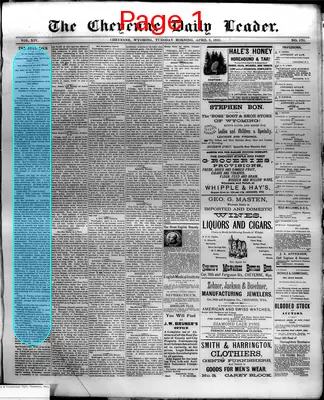
Story
April 5, 1881
The Cheyenne Daily Leader
Cheyenne, Laramie County, Wyoming
What is this article about?
U.S. Senate in Washington on April 4 deadlock continues with refusal to enter executive session (29-25 vote); heated debate between Senators Johnston and Dawes on Riddleberger, Mahone, Virginia elections, and debt; Saulsbury appeals to Republicans to respect President Garfield's nominations.
Clipping

OCR Quality
98%
Excellent
Full Text
THE DEADLOCK In the Senate Continues.
Garfield Firm; He Will Not be Anybody's Clerk.
Gen. James and the Star Routes.
The Fate of the World's Fair to be Decided Soon.
A Sensation in Plymouth Church.
Hiram Price for Commissioner of Indian Affairs.
The Missouri River Rising—Great Damage at Vermillion, Dakota.
The Endless Discussion.
Washington, April 4.—The senate, by a vote of 29 to 25, refused to go into executive session. Johnston quoted from Riddleberger's paper, the Virginian, to prove that Riddleberger was a democrat as well as Mahone, and from the Riddleberger bill to show that the republicans were supporting a man who had announced in that bill that the adoption of the 13th, 14th and 15th amendments was equal, in its terrible effect, to the war. He went minutely into the debt question, contending that the democrats in failing to pay interest did not intend to repudiate. Answering Dawes, he said he agreed with Mahone in holding that West Virginia ought to pay a third of the debt. He asked Dawes when in Virginia anybody waded through blood to the ballot box.
Dawes said that the Mississippi plea was a general term—specific names were attached to different southern states. In one state it took the form of blood; in another, tissue ballots; in another, forging returns; in Virginia, opposition to "vagabond" suffrage, so called. Had the senator forgotten that the army had been called at Petersburg to suppress violence? Did he pretend that nobody got hurt there in the vain attempt to assert his right as a voter?
Johnston said that the charge of smothering the republican vote in Virginia was absolutely false. If any tissue ballots had been used it was in Mahone's district. He asked Dawes if he didn't get those tissue ballots from Mahone's district.
Dawes said: No; from Norfolk.
After a little badinage, Johnston continued vindicating the funding democrats.
At the conclusion of Johnston's speech Saulsbury appealed to the republicans to ground the weapons of rebellion against its own administration. If any man needed pity and commiseration, it was the president of the United States, who had been treated with such marked disrespect by his own friends. Perhaps the president, now in the White House, was saying that there were some in this chamber from whom he had not expected any better treatment, because he had antagonized them and their third term ran in the Chicago convention; but then there was the senator from Ohio whom he had nominated for the presidency—why did he sit in silence and refuse to consider the nominations? The president might be saying: There's the senator from Massachusetts (Hoar)—he sat with me on the electoral commission, and is privy to all secrets I am a party to, and I did not expect this from him. Then there is the vice president, whose name has been inscribed with mine and whose image is stuck up beside my own in almost every junk shop; he ought not to have turned his heel on me, and yet he will not give any respect to my messages. He (Saulsbury) appealed to the republicans to march up to duty and help save the president of their choice.
Dawes called attention to the fact that the last effort made to go into executive session had been rebuked by an emphatic majority of the senate. It had not been defeated by a tie vote, but by a number of votes, and it was the senate that the senator from Delaware was quarreling with, not the republican side.
Jones, of Florida, denied the statement made on Friday by Logan that political outrages were perpetrated in Florida.
Harris moved to lay the resolution on the table, yeas 23, nays 27.
Roll call followed roll call in quick succession on dilatory motions.
Dawes inquired as to when the democrats would permit a vote to be taken on the resolution, being always met with the response, "On the first Monday in December."
Finally, Dawes, remarking that it had become evident that the majority of the senate was opposed to postponing consideration of this resolution, and expressing the hope that the minority would come to-morrow prepared to stay till the will of the majority was obeyed, moved to adjourn. Agreed to, and the senate adjourned.
Garfield Firm; He Will Not be Anybody's Clerk.
Gen. James and the Star Routes.
The Fate of the World's Fair to be Decided Soon.
A Sensation in Plymouth Church.
Hiram Price for Commissioner of Indian Affairs.
The Missouri River Rising—Great Damage at Vermillion, Dakota.
The Endless Discussion.
Washington, April 4.—The senate, by a vote of 29 to 25, refused to go into executive session. Johnston quoted from Riddleberger's paper, the Virginian, to prove that Riddleberger was a democrat as well as Mahone, and from the Riddleberger bill to show that the republicans were supporting a man who had announced in that bill that the adoption of the 13th, 14th and 15th amendments was equal, in its terrible effect, to the war. He went minutely into the debt question, contending that the democrats in failing to pay interest did not intend to repudiate. Answering Dawes, he said he agreed with Mahone in holding that West Virginia ought to pay a third of the debt. He asked Dawes when in Virginia anybody waded through blood to the ballot box.
Dawes said that the Mississippi plea was a general term—specific names were attached to different southern states. In one state it took the form of blood; in another, tissue ballots; in another, forging returns; in Virginia, opposition to "vagabond" suffrage, so called. Had the senator forgotten that the army had been called at Petersburg to suppress violence? Did he pretend that nobody got hurt there in the vain attempt to assert his right as a voter?
Johnston said that the charge of smothering the republican vote in Virginia was absolutely false. If any tissue ballots had been used it was in Mahone's district. He asked Dawes if he didn't get those tissue ballots from Mahone's district.
Dawes said: No; from Norfolk.
After a little badinage, Johnston continued vindicating the funding democrats.
At the conclusion of Johnston's speech Saulsbury appealed to the republicans to ground the weapons of rebellion against its own administration. If any man needed pity and commiseration, it was the president of the United States, who had been treated with such marked disrespect by his own friends. Perhaps the president, now in the White House, was saying that there were some in this chamber from whom he had not expected any better treatment, because he had antagonized them and their third term ran in the Chicago convention; but then there was the senator from Ohio whom he had nominated for the presidency—why did he sit in silence and refuse to consider the nominations? The president might be saying: There's the senator from Massachusetts (Hoar)—he sat with me on the electoral commission, and is privy to all secrets I am a party to, and I did not expect this from him. Then there is the vice president, whose name has been inscribed with mine and whose image is stuck up beside my own in almost every junk shop; he ought not to have turned his heel on me, and yet he will not give any respect to my messages. He (Saulsbury) appealed to the republicans to march up to duty and help save the president of their choice.
Dawes called attention to the fact that the last effort made to go into executive session had been rebuked by an emphatic majority of the senate. It had not been defeated by a tie vote, but by a number of votes, and it was the senate that the senator from Delaware was quarreling with, not the republican side.
Jones, of Florida, denied the statement made on Friday by Logan that political outrages were perpetrated in Florida.
Harris moved to lay the resolution on the table, yeas 23, nays 27.
Roll call followed roll call in quick succession on dilatory motions.
Dawes inquired as to when the democrats would permit a vote to be taken on the resolution, being always met with the response, "On the first Monday in December."
Finally, Dawes, remarking that it had become evident that the majority of the senate was opposed to postponing consideration of this resolution, and expressing the hope that the minority would come to-morrow prepared to stay till the will of the majority was obeyed, moved to adjourn. Agreed to, and the senate adjourned.
What sub-type of article is it?
Historical Event
What themes does it cover?
Betrayal
Justice
Moral Virtue
What keywords are associated?
Senate Deadlock
Riddleberger Debate
Virginia Politics
Executive Session
Political Betrayal
What entities or persons were involved?
Johnston
Dawes
Saulsbury
Riddleberger
Mahone
Hoar
Jones Of Florida
Harris
Logan
Garfield
Where did it happen?
Washington
Story Details
Key Persons
Johnston
Dawes
Saulsbury
Riddleberger
Mahone
Hoar
Jones Of Florida
Harris
Logan
Garfield
Location
Washington
Event Date
April 4
Story Details
The Senate refuses to enter executive session by a vote of 29 to 25, leading to prolonged debate on political issues including Riddleberger's Democratic ties, Virginia voting violence, debt funding, and appeals to Republicans to support the President's nominations amid deadlock.