Thank you for visiting SNEWPapers!
Sign up free
Nashville Union And American
Nashville, Davidson County, Tennessee
What is this article about?
L. A. Robertson responds to an article by Mrs. D. H. McGavock in the Union and American, defending her negative stance in a debate at the Woman's Bible Mission of Nashville on whether M.E. Church South law allows societies to send missionary funds directly to special enterprises without regular church apportionment. She argues the recent Board of Missions action, influenced by Dr. D. C. Kelley, violates organic church law, quoting Article XV, and warns it undermines laymen's rights and church integrity.
Clipping
OCR Quality
Full Text
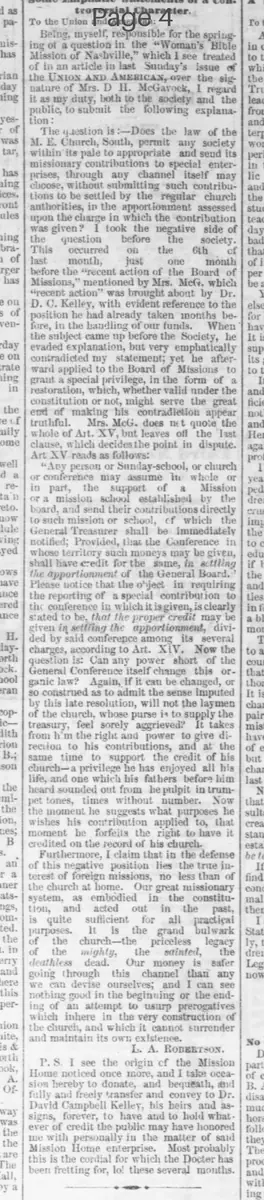
The question is:-Does the law of the M. E. Church, South, permit any society within its pale to appropriate and send its missionary contributions to special enterprises, through any channel itself may choose, without submitting such contributions to be settled by the regular church authorities, in the apportionment assessed upon the charge in which the contribution was given? I took the negative side of the question before the society.
This occurred on the 6th of last month, just one month before the "recent action of the Board of Missions," mentioned by Mrs. McG. which "recent action" was brought about by Dr. D. C. Kelley, with evident reference to the position he had already taken months before, in the handling of our funds. When the subject came up before the Society, he evaded explanation, but very emphatically contradicted my statement; yet he afterward applied to the Board of Missions to grant a special privilege, in the form of a restoration, which, whether valid under the constitution or not, might serve the great end of making his contradiction appear truthful. Mrs. McG. does not quote the whole of Art. XV, but leaves out the last clause, which decides the point in dispute. Art XV reads as follows: "Any person or Sunday-school, or church or conference may assume in whole or in part, the support of a Mission or a mission school established by the board, and send their contributions directly to such mission or school, (of which the General Treasurer shall be immediately notified; Provided, that the Conference in whose territory such moneys may be given, shall have credit for the same, in settling the apportionment of the General Board." Please notice that the object in requiring the reporting of a special contribution to the conference in which it is given, is clearly stated to be, that the proper credit may be given in settling the apportionment, divided by said conference among its several charges, according to Art. XIV. Now the question is: Can any power short of the General Conference itself change this organic law? Again, if it can be changed, or so construed as to admit the sense imputed by this late resolution, will not the laymen of the church, whose purse is to supply the treasury, feel sorely aggrieved? It takes from him the right and power to give direction to his contributions, and at the same time to support the credit of his church-a privilege he has enjoyed all his life, and one which his fathers before him heard sounded out from the pulpit in trumpet tones, times without number. Now the moment he suggests what purposes he wishes his contribution applied to, that moment he forfeits the right to have it credited on the record of his church. Furthermore, I claim that in the defense of this negative position lies the true interest of foreign missions, no less than of the church at home. Our great missionary system, as embodied in the constitution, and acted out in the past. is quite sufficient for all practical purposes. It is the grand bulwark of the church-the priceless legacy of the mighty, the sainted, the deathless dead. Our money is safer going through this channel than any we can devise ourselves; and I can see nothing good in the beginning or the ending of an attempt to usurp prerogatives which inhere in the very construction of the church, and which it cannot surrender and maintain its own existence.
L. A. ROBERTSON.
P. S. I see the origin of the Mission Home noticed once more, and I take occasion hereby to donate, and bequeath, and fully and freely transfer and convey to Dr. David Campbell Kelley, his heirs and assigns, forever, to have and to hold whatever of credit the public may have honored me with personally in the matter of said Mission Home enterprise. Most probably this is the cordial for which the Doctor has been fretting for, lo! these several months.
What sub-type of article is it?
What themes does it cover?
What keywords are associated?
What entities or persons were involved?
Letter to Editor Details
Author
L. A. Robertson
Main Argument
the m.e. church south law requires missionary contributions to be handled through regular church authorities for proper apportionment credit, and the recent board of missions action allowing direct special enterprise funding violates this organic law, undermining laymen's rights and church integrity.
Notable Details