Thank you for visiting SNEWPapers!
Sign up free
The Washington Critic
Washington, District Of Columbia
What is this article about?
Alem Mitchell, an informer against illegal liquor sellers, faced trial for perjury after testifying against John J. Johnson for unlicensed bar operation. Mitchell later retracted via affidavit, claiming mistake. Conflicting witness testimonies emerged, and the perjury charge was dismissed as it occurred in the affidavit, not court testimony. The case drew interest from saloon-keepers due to its impact on pending appeals.
Clipping
OCR Quality
Full Text
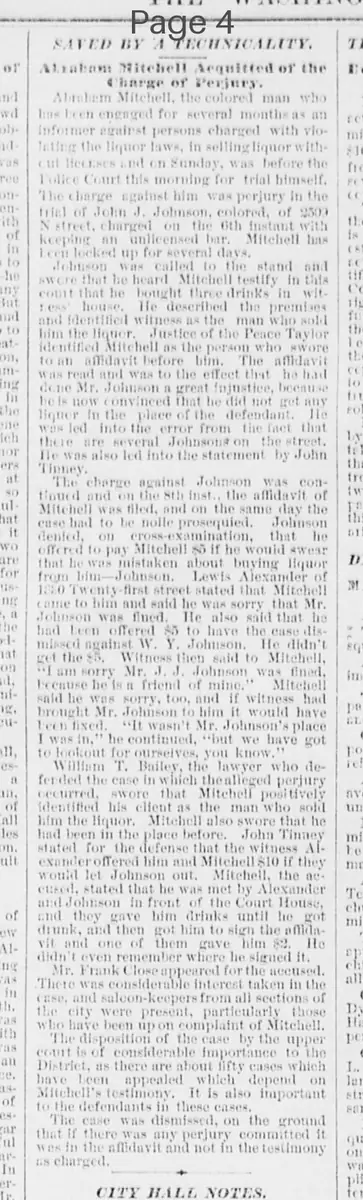
Alem Mitchell, the colored man who has been engaged for several months as an informer against persons charged with violating the higher laws, in selling liquor without license and on Sunday, was before the Police Court this morning for trial himself. The charge against him was perjury in the trial of John J. Johnson, colored, of 850 N street, charged on the 6th instant with keeping an unlicensed bar. Mitchell has been locked up for several days.
Johnson was called to the stand and swore that he heard Mitchell testify in this court that he bought three drinks in witness' house. He described the premises and identified witness as the man who sold him the liquor. Justice of the Peace Taylor identified Mitchell as the person who swore to an affidavit before him. The affidavit was read and was to the effect that he had done Mr. Johnson a great injustice, because he is now convinced that he did not get any liquor in the place of the defendant. He was led into the error from the fact that there are several Johnsons on the street. He was also led into the statement by John Tinney.
The charge against Johnson was continued and on the 8th inst., the affidavit of Mitchell was filed, and on the same day the case had to be nolle prossed. Johnson denied, on cross-examination, that he offered to pay Mitchell $5 if he would swear that he was mistaken about buying liquor from him. Johnson.
Lewis Alexander of 120 Twenty-first street stated that Mitchell came to him and said he was sorry that Mr. Johnson was fined. He also said that he had been offered $5 to have the case dismissed against W. Y. Johnson. He didn't get the $5. Witness then said to Mitchell "I am sorry Mr. J. J. Johnson was fined, because he is a friend of mine." Mitchell said he was sorry, too, and if witness had brought Mr. Johnson to him it would have been fixed. "It wasn't Mr. Johnson's place I was in," he continued, "but we have got to look out for ourselves, you know."
William T. Bailey, the lawyer, who defended the case in which the alleged perjury occurred, swore that Mitchell positively identified his client as the man who sold him the liquor. Mitchell also swore that he had been in the place before.
John Tinney stated for the defense that the witness, Alexander, offered him and Mitchell $10 if they would let Johnson out.
Mitchell, the accused, stated that he was met by Alexander and Johnson in front of the Court House, and they gave him drinks until he got drunk, and then got him to sign the affidavit and one of them gave him $2. He didn't even remember where he signed it.
Mr. Frank Close appeared for the accused. There was considerable interest taken in the case, as all saloon-keepers from all sections of the city were present, particularly those who have been up on complaint of Mitchell. The disposition of the case by the upper court is of considerable importance to the District, as there are about fifty cases which have been appealed which depend on Mitchell's testimony. It is also important to the defendants in these cases.
The case was dismissed, on the ground that if there was any perjury committed it was in the affidavit and not in the testimony as charged.
What sub-type of article is it?
What themes does it cover?
What keywords are associated?
What entities or persons were involved?
Where did it happen?
Story Details
Key Persons
Location
Police Court, Washington D.C.
Event Date
6th And 8th Instant
Story Details
Alem Mitchell, an informer on liquor law violations, was tried for perjury after testifying that John J. Johnson sold him liquor without license. Mitchell later filed an affidavit retracting the testimony, claiming confusion with another Johnson and influence from John Tinney, leading to Johnson's case dismissal. Conflicting accounts from witnesses including Lewis Alexander, William T. Bailey, and Tinney emerged regarding bribes and identification. The perjury charge against Mitchell was dismissed as the falsehood was in the affidavit, not testimony.