Thank you for visiting SNEWPapers!
Sign up free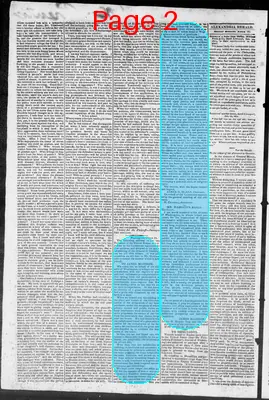
Story
March 17, 1817
The Alexandria Herald
Alexandria, Virginia
What is this article about?
On March 10, citizens of Washington, via committee chairman James H. Blake, present an address to retiring President James Madison, praising his leadership during war, urbanity, and contributions to the city's stability. Madison replies, expressing gratitude and hopes for the city's prosperity.
Clipping
OCR Quality
98%
Excellent
Full Text
Washington, March 10.
The following address to the late President of the United States, was reported by the Committee appointed for that purpose, and adopted at the general meeting of the citizens of Washington on the 27th ultimo. It was presented on the 6th inst. to Mr. Madison, who returned the answer which is subjoined.
TO JAMES MADISON
We come, sir, on behalf of the citizens of Washington, to mingle our congratulations with our regrets at your political retirement;—congratulations that spring from our participation as Americans in the untarnished glory that accompanies you—regrets that flow from feelings alive to the loss we are so soon to experience. At this event, as citizens of a great community, we feel a pride only surpassed by our affection as men.
When we behold you succeeding to the place and honors of the illustrious author of the declaration of our independence, under the auspices of whose private virtues and public duties our local institutions were devised, we felt more poignantly the extent of our loss from the uncertainty that always hangs over the future. We had found in him the enlightened friend of a place, which, amidst all the vicissitudes of its fortunes, he continued, with the great man who founded it, to consider the key stone of the union.
In him, too, we had found one, who spread a charm over society, by the urbanity, the hospitality, the kindness of his private life.
What then was our satisfaction on realising, in his friend and successor, a like devotion to principle, softened by the same urbanity, the same hospitality, the same kindness, and permit us, as we hope without wounding female delicacy, to add, irradiated by a grace and benevolence that have inspired universal respect and friendship.
We shall never forget that, when our city felt the tempest of war, it was your wisdom and firmness that repaired the breach, and from the causes that menaced its ruin, extracted the elements of its stability and expansion. May you long continue, yourself happy, to behold, in the prosperity of others, the attestations of your virtues, and especially to find in every heart in Washington a sanctuary of gratitude!
Bound to the union by ties indissoluble, we trust, as they are sacred, we cannot let this occasion pass without contrasting, for a moment, the past and present state of our country. At the time you were called to the executive chair, the sky not only lowered, but the storm had already burst upon us. The world was in chaos, and violence and injustice busy in the work of destruction. At that crisis, no one could feel the weight of responsibility more than you did, or the obligations of that duty, which, while it vigorously asserted a nation's rights, abstained from wantonly endangering its vital interests. You had participated largely in forming that Constitution under which we had flourished, and must have been fully sensible of the solemnity of an untried appeal which might prematurely expose it to fatal perils. But the appeal became necessary, and it was made. Its fruits are a solid peace, a name among the nations of the earth, a self respect founded upon justice and conscious strength, and, above all, a conviction that our liberties can never be lost so long as that charter endures, which, formed by the first talents, is now cemented by the best blood of our country. At that era our rights were trampled upon—they are now respected; our property was plundered—it is now without danger spread over the globe; our martial character drooped—it is now elevated; our navy had gathered an ephemeral laurel—it is now crowned with immortal honor. Power and national glory, Sir, have often been acquired by the sword; but rarely without the sacrifice of civil or political liberty. It is here pre-eminently, that the righteous triumph of the one, under the smiles of Heaven, secures the other.
When we reflect that this sword was drawn under your guidance, we cannot resist offering you our own, as well as a Nation's thanks, for the vigilance with which you have restrained it within its proper limits; the energy with which you have directed it to its proper objects, and the safely with which you have wielded an armed force of fifty thousand men, aided by an annual disbursement of many millions, without infringing a political, civil, or religious right.
We remain, with the highest respect and regard,
JAMES H. BLAKE, Chairman,
On behalf of the Committee appointed by the general meeting of the citizens.
H. Carroll, Secretary
MR. MADISON'S REPLY.
Gentlemen,
I am much indebted to the citizens of Washington, in whose behalf you speak, for the expressions of regard and respect addressed to me. These sentiments are the more valuable to me, as my long residence among them has made me well acquainted with their many titles to my esteem, at the same time that it has enabled them to mark more particularly the course of my public and personal conduct. Their partiality has greatly overrated both: but they do no more than justice to my honest zeal in the service of my country, and to my friendly dispositions towards this city and its inhabitants. I have ever regarded the selection for the National Metropolis, made by its great Founder, as propitious to the national welfare; and although I could not rival my immediate predecessor in the aids he afforded, I was not less sincere in my desires for its growth and improvement. The ultimate good flowing from the disaster which at one moment clouded its prospects, is a gratifying compensation to those on whom it fell; and is among the proofs of that spirit in the American people, as a free people, which, rising above adverse events, and even converting them into sources of advantage, is the true safeguard against dangers of every sort.
On the point of a final departure from Washington, I pray its citizens to be assured, that every expression of their kindness will be held in lively remembrance, with cordial wishes for their collective prosperity and individual happiness.
JAMES MADISON.
James H. Blake, Esq, and the other gentlemen of the committee on behalf of the citizens of Washington.
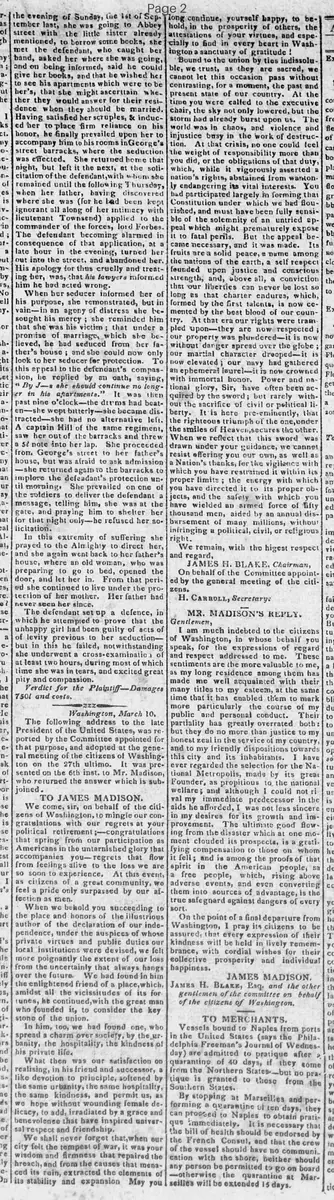
The following address to the late President of the United States, was reported by the Committee appointed for that purpose, and adopted at the general meeting of the citizens of Washington on the 27th ultimo. It was presented on the 6th inst. to Mr. Madison, who returned the answer which is subjoined.
TO JAMES MADISON
We come, sir, on behalf of the citizens of Washington, to mingle our congratulations with our regrets at your political retirement;—congratulations that spring from our participation as Americans in the untarnished glory that accompanies you—regrets that flow from feelings alive to the loss we are so soon to experience. At this event, as citizens of a great community, we feel a pride only surpassed by our affection as men.
When we behold you succeeding to the place and honors of the illustrious author of the declaration of our independence, under the auspices of whose private virtues and public duties our local institutions were devised, we felt more poignantly the extent of our loss from the uncertainty that always hangs over the future. We had found in him the enlightened friend of a place, which, amidst all the vicissitudes of its fortunes, he continued, with the great man who founded it, to consider the key stone of the union.
In him, too, we had found one, who spread a charm over society, by the urbanity, the hospitality, the kindness of his private life.
What then was our satisfaction on realising, in his friend and successor, a like devotion to principle, softened by the same urbanity, the same hospitality, the same kindness, and permit us, as we hope without wounding female delicacy, to add, irradiated by a grace and benevolence that have inspired universal respect and friendship.
We shall never forget that, when our city felt the tempest of war, it was your wisdom and firmness that repaired the breach, and from the causes that menaced its ruin, extracted the elements of its stability and expansion. May you long continue, yourself happy, to behold, in the prosperity of others, the attestations of your virtues, and especially to find in every heart in Washington a sanctuary of gratitude!
Bound to the union by ties indissoluble, we trust, as they are sacred, we cannot let this occasion pass without contrasting, for a moment, the past and present state of our country. At the time you were called to the executive chair, the sky not only lowered, but the storm had already burst upon us. The world was in chaos, and violence and injustice busy in the work of destruction. At that crisis, no one could feel the weight of responsibility more than you did, or the obligations of that duty, which, while it vigorously asserted a nation's rights, abstained from wantonly endangering its vital interests. You had participated largely in forming that Constitution under which we had flourished, and must have been fully sensible of the solemnity of an untried appeal which might prematurely expose it to fatal perils. But the appeal became necessary, and it was made. Its fruits are a solid peace, a name among the nations of the earth, a self respect founded upon justice and conscious strength, and, above all, a conviction that our liberties can never be lost so long as that charter endures, which, formed by the first talents, is now cemented by the best blood of our country. At that era our rights were trampled upon—they are now respected; our property was plundered—it is now without danger spread over the globe; our martial character drooped—it is now elevated; our navy had gathered an ephemeral laurel—it is now crowned with immortal honor. Power and national glory, Sir, have often been acquired by the sword; but rarely without the sacrifice of civil or political liberty. It is here pre-eminently, that the righteous triumph of the one, under the smiles of Heaven, secures the other.
When we reflect that this sword was drawn under your guidance, we cannot resist offering you our own, as well as a Nation's thanks, for the vigilance with which you have restrained it within its proper limits; the energy with which you have directed it to its proper objects, and the safely with which you have wielded an armed force of fifty thousand men, aided by an annual disbursement of many millions, without infringing a political, civil, or religious right.
We remain, with the highest respect and regard,
JAMES H. BLAKE, Chairman,
On behalf of the Committee appointed by the general meeting of the citizens.
H. Carroll, Secretary
MR. MADISON'S REPLY.
Gentlemen,
I am much indebted to the citizens of Washington, in whose behalf you speak, for the expressions of regard and respect addressed to me. These sentiments are the more valuable to me, as my long residence among them has made me well acquainted with their many titles to my esteem, at the same time that it has enabled them to mark more particularly the course of my public and personal conduct. Their partiality has greatly overrated both: but they do no more than justice to my honest zeal in the service of my country, and to my friendly dispositions towards this city and its inhabitants. I have ever regarded the selection for the National Metropolis, made by its great Founder, as propitious to the national welfare; and although I could not rival my immediate predecessor in the aids he afforded, I was not less sincere in my desires for its growth and improvement. The ultimate good flowing from the disaster which at one moment clouded its prospects, is a gratifying compensation to those on whom it fell; and is among the proofs of that spirit in the American people, as a free people, which, rising above adverse events, and even converting them into sources of advantage, is the true safeguard against dangers of every sort.
On the point of a final departure from Washington, I pray its citizens to be assured, that every expression of their kindness will be held in lively remembrance, with cordial wishes for their collective prosperity and individual happiness.
JAMES MADISON.
James H. Blake, Esq, and the other gentlemen of the committee on behalf of the citizens of Washington.
What sub-type of article is it?
Historical Event
Biography
Personal Triumph
What themes does it cover?
Bravery Heroism
Triumph
Providence Divine
What keywords are associated?
Presidential Retirement
War Of 1812
Citizens Address
Madison Reply
Washington Dc
National Glory
What entities or persons were involved?
James Madison
James H. Blake
H. Carroll
Where did it happen?
Washington
Story Details
Key Persons
James Madison
James H. Blake
H. Carroll
Location
Washington
Event Date
March 10
Story Details
Citizens of Washington address retiring President Madison, praising his succession from Jefferson, leadership in the War of 1812, urbanity, and national achievements leading to peace and respect. Madison replies thanking them and expressing well-wishes for the city.