Thank you for visiting SNEWPapers!
Sign up free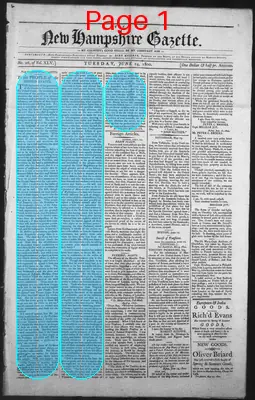
Editorial
June 24, 1800
The New Hampshire Gazette
Portsmouth, Rockingham County, New Hampshire
What is this article about?
An anonymous editorial from the Commercial Gazette calls on Americans to rally behind President John Adams for re-election, extolling his revolutionary and governmental achievements while decrying Thomas Jefferson, Jacobins, and foreign influences as threats to virtue, religion, and national stability. It urges vigilance against factional plots.
Clipping
OCR Quality
95%
Excellent
Full Text
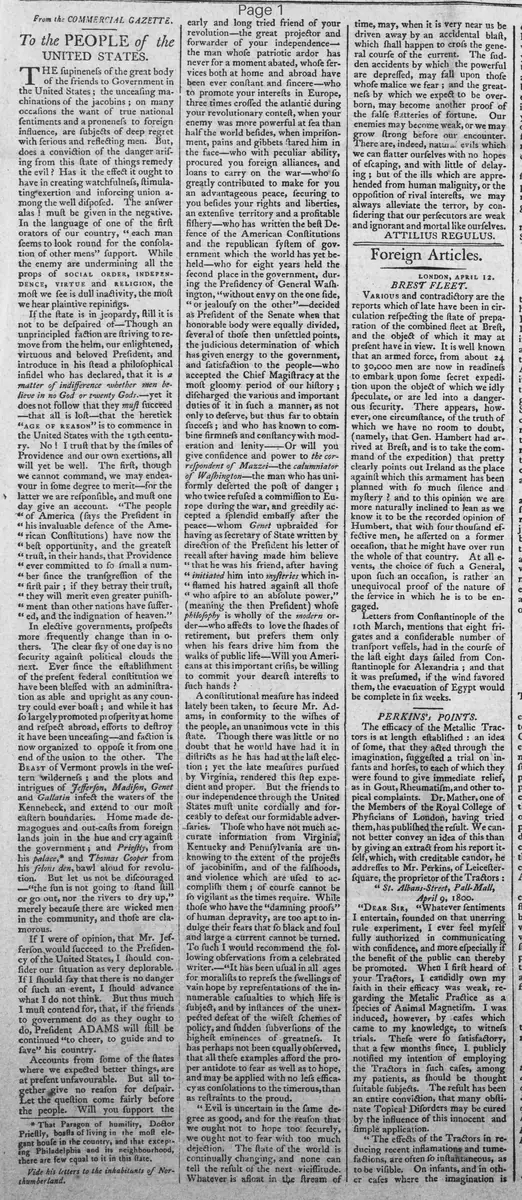
From the COMMERCIAL GAZETTE.
To the PEOPLE of the UNITED STATES.
The opinions of the great body of the friends to Government in the United States; the unceasing machinations of the jacobins; on many occasions the want of true national sentiments and a proneness to foreign influence, are subjects of deep regret with serious and reflecting men. But, does a conviction of the danger arising from this state of things remedy the evil? Has it the effect it ought to have in creating watchfulness, stimulating exertion and enforcing union among the well disposed. The answer alas! must be given in the negative.
In the language of one of the first orators of our country, "each man seems to look round for the consolation of other mens' support. While the enemy are undermining all the props of SOCIAL ORDER, INDEPENDENCE, VIRTUE and RELIGION, the most we see is dull inactivity, the most we hear plaintive repinings.
If the state is in jeopardy, it is not to be despaired of—Though an unprincipled faction are striving to remove from the helm, our enlightened, virtuous and beloved President, and introduce in his stead a philosophical infidel who has declared, that it is a matter of indifference whether men believe in no God or twenty Gods.—yet it does not follow that they must succeed—that all is lost—that the heretic "AGE OF REASON" is to commence in the United States with the 19th century. No! I trust that by the smiles of Providence and our own exertions, all will yet be well. The first, though we cannot command, we may endeavor in some degree to merit—for the latter we are responsible, and must one day give an account. "The people of America (says the President in his invaluable defence of the American Constitutions) have now the best opportunity, and the greatest trust, in their hands, that Providence ever committed to so small a number since the transgression of the first pair; if they betray their trust, they will merit even greater punishment than other nations have suffered, and the indignation of heaven."
In elective governments, prospects more frequently change than in others. The clear sky of one day is no security against political clouds the next. Ever since the establishment of the present federal constitution we have been blessed with an administration as able and upright as any country could ever boast; and while it has so largely promoted prosperity at home and respect abroad, efforts to destroy it have been unceasing—and faction is now organized to oppose it from one end of the union to the other. The Beast of Vermont prowls in the western wilderness; and the plots and intrigues of Jefferson, Madison, Genet and Gallatin infect the waters of the Kennebeck, and extend to our most eastern boundaries. Home made demagogues and out-casts from foreign lands join in the hue and cry against the government; and Priestley, from his palace,* and Thomas Cooper from his felons den, bawl aloud for revolution. But let us not be discouraged—"the sun is not going to stand still or go out, nor the rivers to dry up," merely because there are wicked men in the community, and those are clamorous.
If I were of opinion, that Mr. Jefferson would succeed to the Presidency of the United States, I should consider our situation as very deplorable. If I should say that there is no danger of such an event, I should advance what I do not think. But thus much I must contend for, that, if the friends to government do as they ought to do, President ADAMS will still be continued "to cheer, to guide and to save" his country.
Accounts from some of the states where we expected better things, are at present unfavourable. But all together give no reason for despair. Let the question come fairly before the people. Will you support the early and long tried friend of your revolution—the great projector and forwarder of your independence—the man whose patriotic ardor has never for a moment abated, whose services both at home and abroad have been ever constant and sincere—who to promote your interests in Europe, three times crossed the atlantic during your revolutionary contest, when your enemy was more powerful at sea than half the world besides, when imprisonment, pains and gibbets stared him in the face—who with peculiar ability, procured you foreign alliances, and loans to carry on the war—who so greatly contributed to make for you an advantageous peace, securing to you besides your rights and liberties, an extensive territory and a profitable fishery—who has written the best Defence of the American Constitutions and the republican system of government which the world has yet beheld—who for eight years held the second place in the government, during the Presidency of General Washington, "without envy on the one side, or jealousy on the other"—decided as President of the Senate when that honorable body were equally divided, several of those then unsettled points, the judicious determination of which has given energy to the government, and satisfaction to the people—who accepted the Chief Magistracy at the most gloomy period of our history; discharged the various and important duties of it in such a manner, as not only to deserve, but thus far to obtain success; and who has known to combine firmness and constancy with moderation and lenity—Or will you give confidence and power to the correspondent of Mazzei—the calumniator of Washington—the man who has uniformly deserted the post of danger; who twice refused a commission to Europe during the war, and greedily accepted a splendid embassy after the peace—whom Genet upbraided for having as secretary of State written by direction of the President his letter of recall after having made him believe "that he was his friend, after having initiated him into mysteries which inflamed his hatred against all those who aspire to an absolute power," (meaning the then President) whose philosophy is wholly of the modern order—who affects to love the shades of retirement, but prefers them only when his fears drive him from the walks of public life—Will you Americans at this important crisis, be willing to commit your dearest interests to such hands?
A constitutional measure has indeed lately been taken, to secure Mr. Adams, in conformity to the wishes of the people, an unanimous vote in this state. Though there was little or no doubt that he would have had it in districts as he has had at the last election; yet the late measures pursued by Virginia, rendered this step expedient and proper. But the friends to our independence through the United States must unite cordially and forcibly to defeat our formidable adversaries. Those who have not much accurate information from Virginia, Kentucky and Pennsylvania are unknowing to the extent of the projects of jacobinis, and of the falsehoods, and violence which are used to accomplish them; of course cannot be so vigilant as the times require. While those who have the "damning proofs" of human depravity, are too apt to indulge their fears that so black and foul and large a current cannot be turned. To such I would recommend the following observations from a celebrated writer. "It has been usual in all ages for moralists to repress the swellings of vain hope by representations of the innumerable casualties to which life is subject, and by instances of the unexpected defeat of the wisest schemes of policy, and sudden subversions of the highest eminences of greatness. It has perhaps not been equally observed, that all these examples afford the proper antidote to fear as well as to hope, and may be applied with no less efficacy as consolations to the timorous, than as restraints to the proud.
"Evil is uncertain in the same degree as good, and for the reason that we ought not to hope too securely, we ought not to fear with too much dejection. The state of the world is continually changing, and none can tell the result of the next vicissitude. Whatever is afloat in the stream of time, may, when it is very near us be driven away by an accidental blast, which shall happen to cross the general course of the current. The sudden accidents by which the powerful are depressed, may fall upon those whose malice we fear; and the greatness by which we expect to be overborne, may become another proof of the false flatteries of fortune. Our enemies may become weak, or we may grow strong before our encounter. There are, indeed, natural evils which we can flatter ourselves with no hopes of escaping, and with little of delay. ing; but of the ills which are apprehended from human malignity, or the opposition of rival interests, we may always alleviate the terror, by considering that our persecutors are weak and ignorant and mortal like ourselves.
ATTILIUS REGULUS.
To the PEOPLE of the UNITED STATES.
The opinions of the great body of the friends to Government in the United States; the unceasing machinations of the jacobins; on many occasions the want of true national sentiments and a proneness to foreign influence, are subjects of deep regret with serious and reflecting men. But, does a conviction of the danger arising from this state of things remedy the evil? Has it the effect it ought to have in creating watchfulness, stimulating exertion and enforcing union among the well disposed. The answer alas! must be given in the negative.
In the language of one of the first orators of our country, "each man seems to look round for the consolation of other mens' support. While the enemy are undermining all the props of SOCIAL ORDER, INDEPENDENCE, VIRTUE and RELIGION, the most we see is dull inactivity, the most we hear plaintive repinings.
If the state is in jeopardy, it is not to be despaired of—Though an unprincipled faction are striving to remove from the helm, our enlightened, virtuous and beloved President, and introduce in his stead a philosophical infidel who has declared, that it is a matter of indifference whether men believe in no God or twenty Gods.—yet it does not follow that they must succeed—that all is lost—that the heretic "AGE OF REASON" is to commence in the United States with the 19th century. No! I trust that by the smiles of Providence and our own exertions, all will yet be well. The first, though we cannot command, we may endeavor in some degree to merit—for the latter we are responsible, and must one day give an account. "The people of America (says the President in his invaluable defence of the American Constitutions) have now the best opportunity, and the greatest trust, in their hands, that Providence ever committed to so small a number since the transgression of the first pair; if they betray their trust, they will merit even greater punishment than other nations have suffered, and the indignation of heaven."
In elective governments, prospects more frequently change than in others. The clear sky of one day is no security against political clouds the next. Ever since the establishment of the present federal constitution we have been blessed with an administration as able and upright as any country could ever boast; and while it has so largely promoted prosperity at home and respect abroad, efforts to destroy it have been unceasing—and faction is now organized to oppose it from one end of the union to the other. The Beast of Vermont prowls in the western wilderness; and the plots and intrigues of Jefferson, Madison, Genet and Gallatin infect the waters of the Kennebeck, and extend to our most eastern boundaries. Home made demagogues and out-casts from foreign lands join in the hue and cry against the government; and Priestley, from his palace,* and Thomas Cooper from his felons den, bawl aloud for revolution. But let us not be discouraged—"the sun is not going to stand still or go out, nor the rivers to dry up," merely because there are wicked men in the community, and those are clamorous.
If I were of opinion, that Mr. Jefferson would succeed to the Presidency of the United States, I should consider our situation as very deplorable. If I should say that there is no danger of such an event, I should advance what I do not think. But thus much I must contend for, that, if the friends to government do as they ought to do, President ADAMS will still be continued "to cheer, to guide and to save" his country.
Accounts from some of the states where we expected better things, are at present unfavourable. But all together give no reason for despair. Let the question come fairly before the people. Will you support the early and long tried friend of your revolution—the great projector and forwarder of your independence—the man whose patriotic ardor has never for a moment abated, whose services both at home and abroad have been ever constant and sincere—who to promote your interests in Europe, three times crossed the atlantic during your revolutionary contest, when your enemy was more powerful at sea than half the world besides, when imprisonment, pains and gibbets stared him in the face—who with peculiar ability, procured you foreign alliances, and loans to carry on the war—who so greatly contributed to make for you an advantageous peace, securing to you besides your rights and liberties, an extensive territory and a profitable fishery—who has written the best Defence of the American Constitutions and the republican system of government which the world has yet beheld—who for eight years held the second place in the government, during the Presidency of General Washington, "without envy on the one side, or jealousy on the other"—decided as President of the Senate when that honorable body were equally divided, several of those then unsettled points, the judicious determination of which has given energy to the government, and satisfaction to the people—who accepted the Chief Magistracy at the most gloomy period of our history; discharged the various and important duties of it in such a manner, as not only to deserve, but thus far to obtain success; and who has known to combine firmness and constancy with moderation and lenity—Or will you give confidence and power to the correspondent of Mazzei—the calumniator of Washington—the man who has uniformly deserted the post of danger; who twice refused a commission to Europe during the war, and greedily accepted a splendid embassy after the peace—whom Genet upbraided for having as secretary of State written by direction of the President his letter of recall after having made him believe "that he was his friend, after having initiated him into mysteries which inflamed his hatred against all those who aspire to an absolute power," (meaning the then President) whose philosophy is wholly of the modern order—who affects to love the shades of retirement, but prefers them only when his fears drive him from the walks of public life—Will you Americans at this important crisis, be willing to commit your dearest interests to such hands?
A constitutional measure has indeed lately been taken, to secure Mr. Adams, in conformity to the wishes of the people, an unanimous vote in this state. Though there was little or no doubt that he would have had it in districts as he has had at the last election; yet the late measures pursued by Virginia, rendered this step expedient and proper. But the friends to our independence through the United States must unite cordially and forcibly to defeat our formidable adversaries. Those who have not much accurate information from Virginia, Kentucky and Pennsylvania are unknowing to the extent of the projects of jacobinis, and of the falsehoods, and violence which are used to accomplish them; of course cannot be so vigilant as the times require. While those who have the "damning proofs" of human depravity, are too apt to indulge their fears that so black and foul and large a current cannot be turned. To such I would recommend the following observations from a celebrated writer. "It has been usual in all ages for moralists to repress the swellings of vain hope by representations of the innumerable casualties to which life is subject, and by instances of the unexpected defeat of the wisest schemes of policy, and sudden subversions of the highest eminences of greatness. It has perhaps not been equally observed, that all these examples afford the proper antidote to fear as well as to hope, and may be applied with no less efficacy as consolations to the timorous, than as restraints to the proud.
"Evil is uncertain in the same degree as good, and for the reason that we ought not to hope too securely, we ought not to fear with too much dejection. The state of the world is continually changing, and none can tell the result of the next vicissitude. Whatever is afloat in the stream of time, may, when it is very near us be driven away by an accidental blast, which shall happen to cross the general course of the current. The sudden accidents by which the powerful are depressed, may fall upon those whose malice we fear; and the greatness by which we expect to be overborne, may become another proof of the false flatteries of fortune. Our enemies may become weak, or we may grow strong before our encounter. There are, indeed, natural evils which we can flatter ourselves with no hopes of escaping, and with little of delay. ing; but of the ills which are apprehended from human malignity, or the opposition of rival interests, we may always alleviate the terror, by considering that our persecutors are weak and ignorant and mortal like ourselves.
ATTILIUS REGULUS.
What sub-type of article is it?
Partisan Politics
Moral Or Religious
What keywords are associated?
Adams Election
Anti Jefferson
Jacobin Threat
Federalist Unity
Political Vigilance
American Virtue
Revolutionary Service
Presidential Support
What entities or persons were involved?
President Adams
Thomas Jefferson
James Madison
Edmond Genet
Albert Gallatin
Joseph Priestley
Thomas Cooper
George Washington
Jacobins
Editorial Details
Primary Topic
Support For President Adams Against Jefferson And Jacobins In The Election
Stance / Tone
Strongly Pro Adams And Anti Jacobin, Exhorting Unity And Vigilance
Key Figures
President Adams
Thomas Jefferson
James Madison
Edmond Genet
Albert Gallatin
Joseph Priestley
Thomas Cooper
George Washington
Jacobins
Key Arguments
Friends To Government Must Unite To Prevent Jefferson's Election
Adams Has Proven Patriotic Service In Revolution, Diplomacy, And Presidency
Jefferson Is A Philosophical Infidel And Deserter Of Duty
Jacobins Undermine Social Order, Independence, Virtue, And Religion
Factional Plots Extend Across The Union But Can Be Defeated With Exertion
Elective Governments Allow Changing Prospects; Do Not Despair
Adams Defended American Constitutions And Promoted Prosperity
Critics Like Priestley And Cooper Call For Revolution
Virginia, Kentucky, Pennsylvania Show Jacobin Influence But People Can Choose Wisely
Evil From Human Malignity Is Uncertain; Enemies May Weaken