Thank you for visiting SNEWPapers!
Sign up free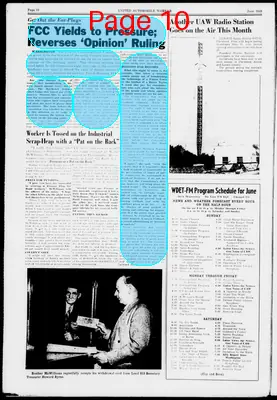
Story
June 1, 1949
United Automobile Worker
Detroit, Wayne County, Michigan
What is this article about?
FCC reverses 1941 Mayflower ruling under industry pressure, permitting station owners to editorialize on air; labor protests bias, Commissioner Frieda Hennock dissents citing unenforceable fairness requirements amid slanted broadcasts.
Clipping
OCR Quality
98%
Excellent
Full Text
Get Out the Ear-Plugs
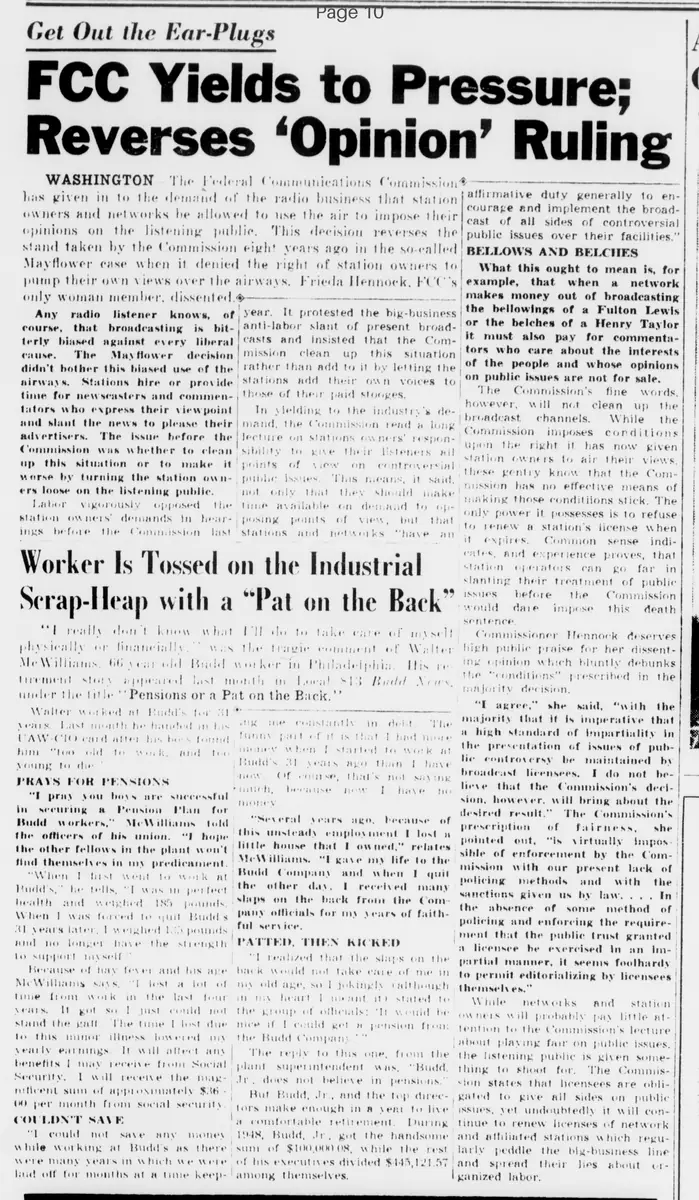
FCC Yields to Pressure;
Reverses Opinion Ruling
WASHINGTON—The Federal Communications Commission has given in to the demand of the radio business that station owners and networks be allowed to use the air to impose their opinions on the listening public. This decision reverses the stand taken by the Commission eight years ago in the so-called Mayflower case when it denied the right of station owners to pump their own views over the airways. Frieda Hennock, FCC's only woman member, dissented.
Any radio listener knows, of course, that broadcasting is bitterly biased against every liberal cause. The Mayflower decision didn't bother this biased use of the airways. Stations hire or provide time for newscasters and commentators who express their viewpoint and slant the news to please their advertisers. The issue before the Commission was whether to clean up this situation or to make it worse by turning the station owners loose on the listening public.
Labor vigorously opposed the station owners' demands in hearings before the Commission last year. It protested the big-business anti-labor slant of present broadcasts and insisted that the Commission clean up this situation rather than add to it by letting the stations add their own voices to those of their paid stooges.
In yielding to the industry's demand, the Commission read a long lecture on stations owners' responsibility to give their listeners all points of view on controversial public issues. This means, it said, not only that they should make time available on demand to opposing points of view, but that stations and networks "have an affirmative duty generally to encourage and implement the broadcast of all sides of controversial public issues over their facilities."
What this ought to mean is, for example, that when a network makes money out of broadcasting the bellowings of a Fulton Lewis or the belches of a Henry Taylor it must also pay for commentators who care about the interests of the people and whose opinions on public issues are not for sale.
The Commission's fine words, however, will not clean up the broadcast channels. While the Commission imposes conditions upon the right it has now given station owners to air their views, these gently know that the Commission has no effective means of making those conditions stick. The only power it possesses is to refuse to renew a station's license when it expires. Common sense indicates, and experience proves, that station operators can go far in slanting their treatment of public issues before the Commission would dare impose this death sentence.
Commissioner Hennock deserves high public praise for her dissenting opinion which bluntly debunks the "conditions" prescribed in the majority decision.
"I agree," she said, "with the majority that it is imperative that a high standard of impartiality in the presentation of issues of public controversy be maintained by broadcast licensees. I do not believe that the Commission's decision, however, will bring about the desired result." The Commission's prescription of fairness, she pointed out, "is virtually impossible of enforcement by the Commission with our present lack of policing methods and with the sanctions given us by law. . . . In the absence of some method of policing and enforcing the requirement that the public trust granted a licensee be exercised in an impartial manner, it seems foolhardy to permit editorializing by licensees themselves."
When networks and station owners will probably pay little attention to the commission's lecture about playing fair on public issues, the listening public is given something to shoot for. The Commission states that licensees are obligated to give all sides on public issues, yet undoubtedly it will continue to renew licenses of network and affiliated stations which regularly peddle the big-business line and spread their lies about organized labor.
FCC Yields to Pressure;
Reverses Opinion Ruling
WASHINGTON—The Federal Communications Commission has given in to the demand of the radio business that station owners and networks be allowed to use the air to impose their opinions on the listening public. This decision reverses the stand taken by the Commission eight years ago in the so-called Mayflower case when it denied the right of station owners to pump their own views over the airways. Frieda Hennock, FCC's only woman member, dissented.
Any radio listener knows, of course, that broadcasting is bitterly biased against every liberal cause. The Mayflower decision didn't bother this biased use of the airways. Stations hire or provide time for newscasters and commentators who express their viewpoint and slant the news to please their advertisers. The issue before the Commission was whether to clean up this situation or to make it worse by turning the station owners loose on the listening public.
Labor vigorously opposed the station owners' demands in hearings before the Commission last year. It protested the big-business anti-labor slant of present broadcasts and insisted that the Commission clean up this situation rather than add to it by letting the stations add their own voices to those of their paid stooges.
In yielding to the industry's demand, the Commission read a long lecture on stations owners' responsibility to give their listeners all points of view on controversial public issues. This means, it said, not only that they should make time available on demand to opposing points of view, but that stations and networks "have an affirmative duty generally to encourage and implement the broadcast of all sides of controversial public issues over their facilities."
What this ought to mean is, for example, that when a network makes money out of broadcasting the bellowings of a Fulton Lewis or the belches of a Henry Taylor it must also pay for commentators who care about the interests of the people and whose opinions on public issues are not for sale.
The Commission's fine words, however, will not clean up the broadcast channels. While the Commission imposes conditions upon the right it has now given station owners to air their views, these gently know that the Commission has no effective means of making those conditions stick. The only power it possesses is to refuse to renew a station's license when it expires. Common sense indicates, and experience proves, that station operators can go far in slanting their treatment of public issues before the Commission would dare impose this death sentence.
Commissioner Hennock deserves high public praise for her dissenting opinion which bluntly debunks the "conditions" prescribed in the majority decision.
"I agree," she said, "with the majority that it is imperative that a high standard of impartiality in the presentation of issues of public controversy be maintained by broadcast licensees. I do not believe that the Commission's decision, however, will bring about the desired result." The Commission's prescription of fairness, she pointed out, "is virtually impossible of enforcement by the Commission with our present lack of policing methods and with the sanctions given us by law. . . . In the absence of some method of policing and enforcing the requirement that the public trust granted a licensee be exercised in an impartial manner, it seems foolhardy to permit editorializing by licensees themselves."
When networks and station owners will probably pay little attention to the commission's lecture about playing fair on public issues, the listening public is given something to shoot for. The Commission states that licensees are obligated to give all sides on public issues, yet undoubtedly it will continue to renew licenses of network and affiliated stations which regularly peddle the big-business line and spread their lies about organized labor.
What sub-type of article is it?
Historical Event
What themes does it cover?
Justice
Deception
Moral Virtue
What keywords are associated?
Fcc Reversal
Radio Editorializing
Media Bias
Mayflower Case
Frieda Hennock Dissent
What entities or persons were involved?
Frieda Hennock
Fulton Lewis
Henry Taylor
Where did it happen?
Washington
Story Details
Key Persons
Frieda Hennock
Fulton Lewis
Henry Taylor
Location
Washington
Story Details
The FCC reverses its eight-year-old Mayflower decision, allowing radio station owners and networks to express opinions on air despite existing biases; labor opposes, and Commissioner Hennock dissents, arguing enforcement of fairness is impossible.