Thank you for visiting SNEWPapers!
Sign up free
The Daily Madisonian
Washington, District Of Columbia
What is this article about?
Detailed account of U.S. Congress proceedings on Feb. 6, 1843: Senate handles memorials on finance and infrastructure, debates Oregon bill and Exchequer; House presents state resolutions on laws and banks, advances bills on Kendall relief, bridges, salaries, navy pay cuts, and hospitals.
Clipping
OCR Quality
Full Text
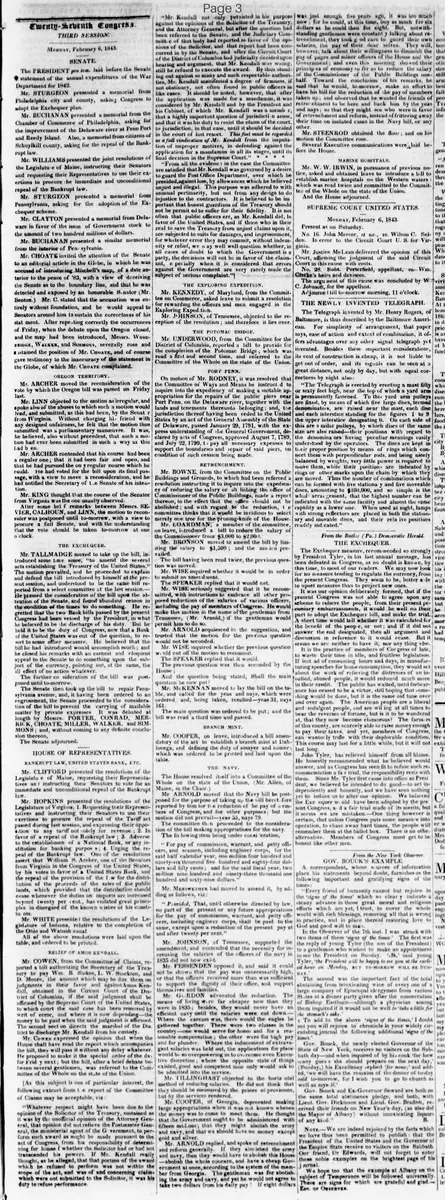
THIRD SESSION.
Monday, February 6, 1843.
SENATE
The PRESIDENT pro tem. laid before the Senate statement of the annual expenditures of the War Department for 1842.
Mr. STURGEON presented a memorial from Philadelphia city and county, asking Congress to adopt the Exchequer plan.
Mr. BUCHANAN presented a memorial from the Chamber of Commerce of Philadelphia, asking for the improvement of the Delaware river at Penn Port and Reedy Island. Also, a memorial from citizens of Schuylkill county, asking for the repeal of the Bankrupt law.
Mr. WILLIAMS presented the joint resolutions of the Legislature of Maine, instructing their Senators and requesting their Representatives to use their exertions to procure the immediate and unconditional repeal of the Bankrupt law.
Mr. STURGEON presented a memorial from Pennsylvania, asking for the adoption of the Exchequer scheme.
Mr. CLAYTON presented a memorial from Delaware in favor of the issue of Government stock to the amount of two hundred millions of dollars.
Mr. BUCHANAN presented a similar memorial from the interior of Pennsylvania.
Mr. CHOATE invited the attention of the Senate to an editorial article in the Globe, in which he was accused of introducing Mitchell's map, of a date anterior to the peace of '83, with a view of deceiving the Senate as to the boundary line, and that he was detected and exposed by an honorable Senator (Mr. Benton.) Mr. C. stated that the accusation was entirely without foundation, and he would appeal to Senators around him to sustain the correctness of his statement. After repeating correctly the occurrences of Friday, when the debate upon the Oregon closed, and the map had been introduced, Messrs. WOODBRIDGE, WALKER, and SIMMONS, severally rose and sustained the position of Mr. Choate, and of course gave testimony to the inaccuracy of the statement in the Globe, of which Mr. Choate complained.
OREGON TERRITORY.
Mr. ARCHER moved the reconsideration of the vote by which the Oregon bill was passed on Friday last.
Mr. LINN objected to the motion as irregular, and spoke also of the abuses to which such a motion would lead, and submitted, as this had been, by the Senator from Virginia. Without charging his friend with any designed unfairness, he felt that the motion thus submitted was a parliamentary manoeuvre. It was, he believed, also without precedent, that such a motion had ever been submitted in such a way as this had been.
Mr. ARCHER contended that his course had been a regular one; that it had been fair and open, and that he had pursued the only regular course which he could. He had voted for the bill upon its final passage, with a view to move a reconsideration, and he had notified the Secretary of the Senate of his intention.
Mr. KING thought that the course of the Senator from Virginia was the one usually observed.
After some brief remarks between Messrs. SEVIER, CALHOUN, and LINN, the motion to reconsider was postponed until to-morrow, with a view to procure a full Senate, and with the understanding that the vote should be taken to-morrow at one o'clock.
THE EXCHEQUER.
Mr. TALLMADGE moved to take up the bill introduced some time since, "to amend the several acts establishing the Treasury of the United States."
The motion prevailed, and he proceeded to explain and defend the bill introduced by himself at the present session, and understood to be the same bill reported from a select committee at the last session.
He pressed the consideration of the bill upon the attention of the Senate, and found abundant reason in the condition of the times to do something. He regretted that the two Bank bills passed by the present Congress had been vetoed by the President, in what he believed to be the discharge of his duty. But he held it to be the duty of Congress, now that a Bank of the United States was out of the question, to resort to some other measure. He believed that the bill he had introduced would accomplish much; and he closed his remarks with an earnest and eloquent appeal to the Senate to do something upon the subject of the currency, pointing out, at the same time, the ill effect of no action whatever.
The further consideration of the bill was postponed until to-morrow.
The Senate then took up the bill to repair Pennsylvania avenue, and, it having been ordered to an engrossment, the Senate proceeded to the consideration of the bill to prevent the carrying of mailable matter by private expresses. It was debated at length by Messrs. PORTER, CONRAD, MERRICK, CHOATE, MILLER, WALKER, and SIMMONS; and, without coming to any definite conclusion thereon,
The Senate adjourned.
HOUSE OF REPRESENTATIVES.
BANKRUPT LAW, UNITED STATES BANK, ETC.
Mr. CLIFFORD presented the resolutions of the Legislature of Maine, requesting their Representatives and instructing their Senators to vote for an immediate and unconditional repeal of the Bankrupt law.
Mr. HOPKINS presented the resolutions of the Legislature of Virginia; 1. Requesting their Representatives and instructing their Senators to use their exertions to procure the repeal of the Tariff act passed during last session, and expressing their opposition to any tariff not solely for revenue; 2. In favor of a repeal of the Bankrupt law; 3. Adverse to the establishment of a National Bank, or any institution for banking purposes; 4. Urging the repeal of the Bankrupt law. One of the resolutions assert that William S. Archer, one of the Senators from Virginia in the Congress of the United States, by his votes in favor of a United States Bank, and the repeal of the provision of the law for the distribution of the proceeds of the sales of the public lands, which provided that the distribution should cease whenever the duties on imports are increased beyond twenty per cent., has violated great principles in disregard of the known wishes of his constituents.
Mr. WHITE presented the resolutions of the Legislature of Indiana, relative to the completion of the Ohio and Wabash canal.
All of the above resolutions were laid upon the table, and ordered to be printed.
RELIEF OF AMOS KENDALL.
Mr. COWEN, from the Committee of Claims, reported a bill authorizing the Secretary of the Treasury to pay Wm. B. Stokes, L. W. Stockton, and D. Moore, the amount which may be due them on judgments in their favor and against Amos Kendall, obtained in the Circuit Court of the District of Columbia, if the said judgments shall be affirmed by the Supreme Court of the United States, to which court the said case has been removed by writ of error, and where it is now depending—the money to be paid when the said judgment is affirmed.
The second section directs the marshal of the District to discharge Mr. Kendall from his custody.
Mr. Cowen expressed the opinion that when the House shall have read the report which accompanies the bill, they will pass it without any delay whatever.
He proposed to make it the special order of the day for Friday next; but the bill, after a brief debate between several gentlemen, was referred to the Committee of the Whole on the state of the Union.
[As this subject is one of particular interest, the following extract from the report of the Committee of Claims may be acceptable, viz:
"Whatever respect might have been due to the opinion of the Solicitor of the Treasury, sustained as it was by the unofficial opinion of the Attorney General, that opinion did not relieve the Postmaster General, the ministerial agent of the Government, to perform such award as might be made pursuant to the act of Congress, from his responsibility of determining for himself whether the Solicitor had or had not transcended his powers. If Mr. Kendall really thought, as he alleged, that that portion of the award which he refused to perform was not within the scope of the act, and was of and concerning claims which were not submitted to the Solicitor, it was his duty to refuse performance.
"Mr. Kendall not only persisted in his purpose against the opinions of the Solicitor of the Treasury and the Attorney General, but after the question had been referred to the Senate, and the Judiciary Committee of that body had reported in favor of the opinions of the Solicitor, and that report had been concurred in by the Senate, and after the Circuit Court of the District of Columbia had judicially decided upon hearing and argument, that Mr. Kendall was wrong, still he refused to execute the award. By thus standing out against so many and such respectable authorities, Mr. Kendall manifested a degree of firmness, if not obstinacy, not often found in public officers in like cases. It should be noted, however, that after the application was made for a mandamus, it was considered by Mr. Kendall and by the President and his Cabinet, of which Mr. Kendall was a member, that a highly important question of jurisdiction arose, and that it was his duty to resist the claim of the court to jurisdiction, in that case, until it should be decided in the court of last resort. This fact must be regarded as a full vindication of Mr. Kendall from the imputation of improper motives, in defending against the application for a mandamus in all its stages, until its final decision in the Supreme Court."
"From all the evidence in the case the Committee are satisfied that Mr. Kendall was governed by a desire to guard the Post Office Department, over which he presided, against loss, by allowances which he believed unjust and illegal. This purpose was adhered to with unusual pertinacity, but not from any design to do injustice to the contractors. It is believed to be important that honest guardians of the Treasury should not be permitted to suffer for their fidelity. It is not often that public officers err, as Mr. Kendall did, in favor of the United States, and if those who in their zeal to save the Treasury from unjust claims upon it, are subjected to suits for damages, and imprisonment, for whatever error they may commit, without indemnity or relief, we may well question whether, in all cases of doubt to which the Government is a party, the decisions will not be in favor of the claimant, especially when it is considered that errors against the Government are very rarely made the subject of serious complaint."]
THE EXPLORING EXPEDITION.
Mr. KENNEDY, of Maryland, from the Committee on Commerce, asked leave to submit a resolution for rewarding the officers and men engaged in the Exploring Expedition.
Mr. JOHNSON, of Tennessee, objected to the reception of the resolution; and therefore it lies over.
THE POTOMAC BRIDGE.
Mr. UNDERWOOD, from the Committee for the District of Columbia, reported a bill to provide for the completion of the Potomac Bridge; which was read a first and second time, and referred to the Committee of the Whole on the state of the Union.
PORT PENN.
On motion of Mr. RODNEY, it was resolved that the Committee of Ways and Means be instructed to inquire into the expediency of making a suitable appropriation for the repairs of the public piers near Port Penn, on the Delaware river, together with the lands and tenements thereunto belonging; and, the jurisdiction thereof having been ceded to the United States by an act of the General Assembly of the State of Delaware, passed January 29, 1791, with the express understanding of the General Government, declared by acts of Congress, approved August 7, 1789 and July 22, 1790, to pay all necessary expenses to support the boundaries and repair of said piers, on condition of such cession being made.
RETRENCHMENT.
Mr. BOWNE, from the Committee on the Public Buildings and Grounds, to which had been referred a resolution instructing it to inquire into the expediency of reducing the salary or abolishing the office of Commissioner of the Public Buildings, made a report thereon, to the effect that the office should not be abolished; and with regard to the reduction, the committee thinks that it would be invidious to select merely one tree for the pruning-knife of the House.
Mr. BOARDMAN, a member of the committee, on leave, introduced a bill to reduce the salary of the Commissioner from $3,000 to $2,000.
Mr. BRONSON moved to amend the bill by limiting the salary to $1,500; and the motion prevailed.
The bill having been read twice, the previous question was moved.
Mr. WISE inquired whether it would be in order to submit an amendment.
The SPEAKER replied that it would not.
Mr. WISE seriously suggested that it be recommitted, with instructions to embrace all other proposed reductions of the salaries of various officers, including the pay of members of Congress. He would make this motion in the name of the gentleman from Tennessee, (Mr. Arnold,) if the gentleman would permit him to do so.
Mr. ARNOLD acquiesced in the suggestion, and trusted that the motion for the previous question would not be seconded.
Mr. WISE inquired whether the previous question would cut off the motion to recommit.
The SPEAKER replied that it would.
The previous question was then seconded by the House;
And the question being stated, Shall the main question be now put?
Mr. McKENNAN moved to lay the bill on the table, and called for the yeas and nays, which were ordered and, being taken, resulted—yeas 31, nays 161.
The main question was ordered to be put; and the bill was read a third time and passed.
BRANCH MINT.
Mr. COOPER, on leave, introduced a bill amendatory of the act to establish a branch mint at Dahlonega, and defining the duty of assayer and coiner; which was ordered to be printed and laid upon the table.
THE NAVY.
The House resolved itself into a Committee of the Whole on the state of the Union, (Mr. Allen, of Maine, in the Chair.)
Mr. ARNOLD moved that the Navy bill be postponed for the purpose of taking up the bill heretofore reported by him for the reduction of the pay of members of Congress, and for other purposes; but the motion did not prevail—yeas 55, nays 79.
The committee then proceeded to the consideration of the bill making appropriations for the navy.
The following item being under consideration,
"For pay of commission, warrant, and petty officers, and seamen, including engineer corps, for the said half calendar year, one million four hundred and ninety-six thousand five hundred and eighty-four dollars and fifty cents; and for the said fiscal year, two million nine hundred and ninety-three thousand one hundred and sixty-nine dollars."
Mr. Merriwether had moved to amend it, by adding as follows, viz:
"Provided, That, until otherwise directed by law, no part of the present or any future appropriations for the pay of commission, warrant, and petty officers, including engineer corps, shall be paid to the same, except upon a reduction of the present pay at and after twenty per cent."
Mr. JOHNSON, of Tennessee, supported the amendment, and contended that the necessity for increasing the salaries of the officers of the navy in 1835 did not now exist.
Mr. FESSENDEN opposed it, and said it could not be shown that the pay was unnecessarily high, or that the officers received more than was sufficient to support the dignity of their office, and support themselves and families.
Mr. GURDON advocated the reduction. The means of living were far cheaper now than they were in 1835; besides, they would never have an efficient navy until the salaries were cut down. Where the carcass was, there would the eagles be gathered together. There were two classes in the country—one would serve for honor and for a reasonable compensation; the other were for high pay and for plunder. Where the inducement of extravagant salaries was held out, the applications for place would be so overpowering as to overcome even Executive discretion; where the opposite state of things existed, good and competent men only would ask to be admitted into the service.
Mr. TILLINGHAST objected to the horizontal method of reducing salaries. He did not think that they should be measured by the prices of provisions, but by the services rendered.
Mr. COOPER, of Georgia, deprecated making large appropriations when it was not known whence the money was to come to meet them. He thought that the Government ought to be administered with fifteen millions; that they might abolish the army and navy, and that we should have no money except gold and silver.
Mr. ARNOLD replied, and spoke of retrenchment and reform generally. If they abolished the army and navy, then they would have to abolish this House—abolish the whole concern, and have a cheap Government at once, according to the system of the member from Georgia. The gentleman was for abolishing the army and navy, and yet he would not agree to take two dollars from his daily pay! If eight dollars was just enough five years ago, it was too much now; for he could, at this time, buy as much for six dollars as he could then for eight. But, notwithstanding gentlemen were constantly talking about retrenchment, they took good care to guard their own salaries, the pay of their dear selves. They will, however, talk about their willingness to diminish the pay of pages and minor officers of the House and the Government; and even this morning showed their principles of economy so far as to reduce the salary of the Commissioner of the Public Buildings one-half. Toward the conclusion of his remarks, he said that he would, to-morrow, make an effort to have his bill for the reduction of the pay of members taken up; and observed that he wanted the friends of retrenchment to be here and back him by the yeas and nays; so that they might see who were in favor of retrenchment and reform, instead of frittering away their time on isolated cases in the Navy bill, or any other.
Mr. STEENROD obtained the floor; and on his motion the Committee rose.
Several Executive communications were laid before the House.
MARINE HOSPITALS.
Mr. W. W. IRWIN, in pursuance of previous notice, asked and obtained leave to introduce a bill to establish marine hospitals on the Western waters; which was read twice and committed to the Committee of the Whole on the state of the Union.
And the House adjourned.
What sub-type of article is it?
What keywords are associated?
What entities or persons were involved?
Where did it happen?
Domestic News Details
Primary Location
Washington
Event Date
Monday, February 6, 1843
Key Persons
Event Details
Proceedings of the Twenty-Seventh Congress, Third Session, in the Senate and House of Representatives. Senate: Presentation of memorials on Exchequer plan, Delaware river improvements, repeal of Bankrupt law; debate on Oregon Territory bill reconsideration; discussion of Exchequer bill; consideration of bills on Pennsylvania avenue repair and mailable matter. House: Presentation of resolutions from Maine, Virginia, Indiana on Bankrupt law, Tariff, National Bank; bill for relief of Amos Kendall; resolutions on Exploring Expedition rewards; bill for Potomac Bridge completion; inquiry into Port Penn repairs; report on Public Buildings Commissioner salary reduction to $1,500; bill on branch mint at Dahlonega; debate on Navy appropriations with proposed pay reduction; bill on marine hospitals.