Thank you for visiting SNEWPapers!
Sign up free
Editorial
January 10, 1803
Jenks' Portland Gazette. Maine Advertiser
Portland, Cumberland County, Maine
What is this article about?
Editorial from New York Herald critiquing President Jefferson's message on French and British trade duties, arguing for stronger U.S. policy and defending existing discriminating duties against repeal proposals by Smith and Giles.
Clipping
OCR Quality
95%
Excellent
Full Text
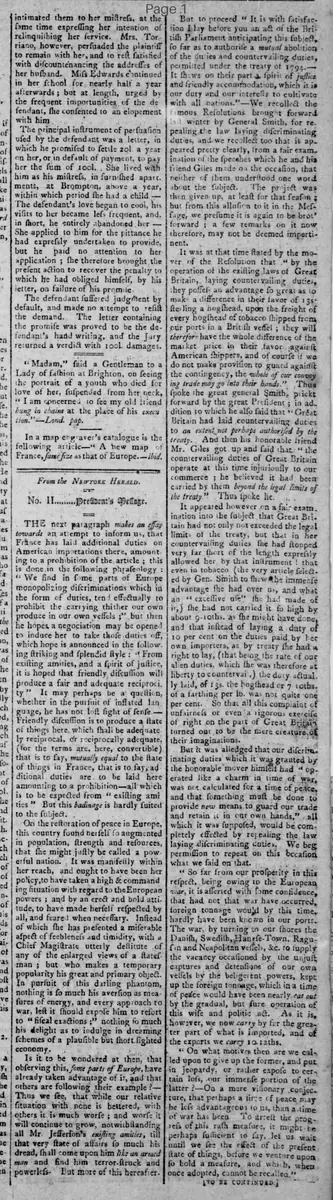
From the New York Herald.
No. II.... President's Message.
THE next paragraph makes an essay towards an attempt to inform us, that France has laid additional duties on American importations there, amounting to a prohibition of the article; this is done in the following phraseology:
"We find in some parts of Europe monopolizing discriminations which in the form of duties, tend effectually to prohibit the carrying thither our own produce in our own vessels;" but then he hopes a negociation may be opened to induce her to take those duties off, which hope is announced in the following striking and splendid style: "From existing amities, and a spirit of justice, it is hoped that friendly discussion will produce a fair and adequate reciprocity" It may perhaps be a question, whether in the pursuit of inflated language, he has not lost sight of sense.—Friendly discussion is to produce a state of things here, which shall be adequately reciprocal, or reciprocally adequate. (for the terms are, here, convertible) that is to say, mutually equal to the state of things in France, that is to say, additional duties are to be laid here amounting to a prohibition—all which is to be expected from "existing amities" But this badinage is hardly suited to the subject.
On the restoration of peace in Europe, this country found herself so augmented in population, strength and resources, that she might justly be called a powerful nation. It was manifestly within her reach, and ought to have been her policy, to have taken a high & commanding situation with regard to the European powers; and by an erect and bold attitude, to have made herself respected by all, and feared when necessary. Instead of which she has presented a miserable aspect of feebleness and timidity, with a Chief Magistrate utterly destitute of any of the enlarged views of a statesman; but who makes a temporary popularity his great and primary object. In pursuit of this darling phantom, nothing is so much his aversion as measures of energy, and every approach to war, lest it should expose him to resort to "fiscal exactions:" nothing so much his delight as to indulge in dreaming schemes of a plausible but short-sighted economy.
Is it to be wondered at then, that observing this, some parts of Europe, have already taken advantage of it, and that others are following their example?—Thus we see, that while our relative situation with none is bettered, with others it is much worse; and worse it will continue to grow, notwithstanding all Mr. Jefferson's existing amities, till that very state of affairs so much his dread, shall come upon him like an armed man and find him terror-struck and powerless. But more of this hereafter.
But to proceed "It is with satisfaction I lay before you an act of the British Parliament anticipating this subject, so far as to authorize a mutual abolition of the duties and countervailing duties, permitted under the treaty of 1794.—It shews on their part a spirit of justice and friendly accommodation, which it is our duty and our interests to cultivate with all nations." We recollect the famous Resolutions brought forward last winter by General Smith, for repealing the law laying discriminating duties. and we recollect too that it appeared pretty clearly, from a fair examination of the speeches which he and his friend Giles made on the occasion, that neither of them understood one word about the subject. The project was then given up, at least for that season but from this allusion to it in the Message, we presume it is again to be brought forward; a few remarks on it now therefore, may not be deemed impertinent.
It was at that time stated by the mover of the Resolution that "by the operation of the existing laws of Great Britain, laying countervailing duties, they seek an advantage so great as to make a difference in their favor of 13s. sterling a hogshead, upon the freight of every hogshead of tobacco shipped from our ports in a British vessel; they will therefore have the whole difference of the market price in their favor. against American shippers, and of course if we do not make provision to guard against the contingency, the whole of our carrying trade may go into their hands." Thus spoke the great general Smith, picked forward by the great President; in addition to which he also said that "Great Britain had laid countervailing duties to an extent not perhaps authorized by the treaty. And then his honorable friend Mr. Giles got up and said that. "the countervailing duties of Great Britain operate at this time injuriously to our commerce ; he believed it had been carried by them beyond the legal limits of the treaty." Thus spoke he.
It appeared however on a fair examination into the subject that Great Britain had not only not exceeded the legal limits of the treaty, but that in her countervailing duties she had stopped very far short of the length expressly allowed her by that instrument! that even in tobacco (the very article elected by Gen. Smith to shew he immense advantage she had over us, and what an "excessive use" the had made of it, ) she had not carried it so high by about 9-10ths. as he might have done, and that instead of laying a duty of 10 per cent on the duties paid by her own importers, as by treaty she had a right to lay, (that being the rate of our alien duties, which she was therefore at liberty to countervail,) the duty actually laid, of 1 3s. the hogshead or 7/10ths. of a farthing per lb. was not quite one per cent.. So that all this complaint of unfairness or even a rigorous exercise of right on the part of Great Britain turned out to be the mere creature of their imaginations.
But it was alledged that our discriminating duties which it was granted by the honorable mover himself had "operated like a charm in time of war, was not calculated for a time of peace, and that something must be done to provide new means to guard our trade and retain it in our own hands," all which it was supposed, would be completely effected by repealing the law laying discriminating duties. We beg permission to repeat on this occasion what we said on that.
"So far from our prosperity in this respect, being owing to the European war, it is asserted with some confidence, that had not that war have occurred, foreign tonnage would by this time hardly have been known in our ports. The war, by turning to our shores the Danish, Swedish, Hanse-Town, Ragusa in and Neapolitan vessels, &c. to supply the vacancy occasioned by the unjust captures and detentions of our own vessels by the belligerent powers, kept up the foreign tonnage, which in a time of peace would have been nearly cut out by the gradual, but sure operation of this wise and politic act. As it is. however, we now carry by far the greater part of what is imported, and of the exports we carry 10/12ths.
On what motives then are we called upon to give up the former, and put in jeopardy, or rather expose to certain loss, our immense portion of the latter -On a mere visionary conjecture, that perhaps a time of peace may be less advantageous to us, than a time of war has been. To arrest the progress of this rash measure, it might perhaps be sufficient to say. let us wait until we see the effect of the present, state of things, before we venture upon so bold a measure, and which, when once adopted, cannot be recalled."
TO BE CONTINUED.
No. II.... President's Message.
THE next paragraph makes an essay towards an attempt to inform us, that France has laid additional duties on American importations there, amounting to a prohibition of the article; this is done in the following phraseology:
"We find in some parts of Europe monopolizing discriminations which in the form of duties, tend effectually to prohibit the carrying thither our own produce in our own vessels;" but then he hopes a negociation may be opened to induce her to take those duties off, which hope is announced in the following striking and splendid style: "From existing amities, and a spirit of justice, it is hoped that friendly discussion will produce a fair and adequate reciprocity" It may perhaps be a question, whether in the pursuit of inflated language, he has not lost sight of sense.—Friendly discussion is to produce a state of things here, which shall be adequately reciprocal, or reciprocally adequate. (for the terms are, here, convertible) that is to say, mutually equal to the state of things in France, that is to say, additional duties are to be laid here amounting to a prohibition—all which is to be expected from "existing amities" But this badinage is hardly suited to the subject.
On the restoration of peace in Europe, this country found herself so augmented in population, strength and resources, that she might justly be called a powerful nation. It was manifestly within her reach, and ought to have been her policy, to have taken a high & commanding situation with regard to the European powers; and by an erect and bold attitude, to have made herself respected by all, and feared when necessary. Instead of which she has presented a miserable aspect of feebleness and timidity, with a Chief Magistrate utterly destitute of any of the enlarged views of a statesman; but who makes a temporary popularity his great and primary object. In pursuit of this darling phantom, nothing is so much his aversion as measures of energy, and every approach to war, lest it should expose him to resort to "fiscal exactions:" nothing so much his delight as to indulge in dreaming schemes of a plausible but short-sighted economy.
Is it to be wondered at then, that observing this, some parts of Europe, have already taken advantage of it, and that others are following their example?—Thus we see, that while our relative situation with none is bettered, with others it is much worse; and worse it will continue to grow, notwithstanding all Mr. Jefferson's existing amities, till that very state of affairs so much his dread, shall come upon him like an armed man and find him terror-struck and powerless. But more of this hereafter.
But to proceed "It is with satisfaction I lay before you an act of the British Parliament anticipating this subject, so far as to authorize a mutual abolition of the duties and countervailing duties, permitted under the treaty of 1794.—It shews on their part a spirit of justice and friendly accommodation, which it is our duty and our interests to cultivate with all nations." We recollect the famous Resolutions brought forward last winter by General Smith, for repealing the law laying discriminating duties. and we recollect too that it appeared pretty clearly, from a fair examination of the speeches which he and his friend Giles made on the occasion, that neither of them understood one word about the subject. The project was then given up, at least for that season but from this allusion to it in the Message, we presume it is again to be brought forward; a few remarks on it now therefore, may not be deemed impertinent.
It was at that time stated by the mover of the Resolution that "by the operation of the existing laws of Great Britain, laying countervailing duties, they seek an advantage so great as to make a difference in their favor of 13s. sterling a hogshead, upon the freight of every hogshead of tobacco shipped from our ports in a British vessel; they will therefore have the whole difference of the market price in their favor. against American shippers, and of course if we do not make provision to guard against the contingency, the whole of our carrying trade may go into their hands." Thus spoke the great general Smith, picked forward by the great President; in addition to which he also said that "Great Britain had laid countervailing duties to an extent not perhaps authorized by the treaty. And then his honorable friend Mr. Giles got up and said that. "the countervailing duties of Great Britain operate at this time injuriously to our commerce ; he believed it had been carried by them beyond the legal limits of the treaty." Thus spoke he.
It appeared however on a fair examination into the subject that Great Britain had not only not exceeded the legal limits of the treaty, but that in her countervailing duties she had stopped very far short of the length expressly allowed her by that instrument! that even in tobacco (the very article elected by Gen. Smith to shew he immense advantage she had over us, and what an "excessive use" the had made of it, ) she had not carried it so high by about 9-10ths. as he might have done, and that instead of laying a duty of 10 per cent on the duties paid by her own importers, as by treaty she had a right to lay, (that being the rate of our alien duties, which she was therefore at liberty to countervail,) the duty actually laid, of 1 3s. the hogshead or 7/10ths. of a farthing per lb. was not quite one per cent.. So that all this complaint of unfairness or even a rigorous exercise of right on the part of Great Britain turned out to be the mere creature of their imaginations.
But it was alledged that our discriminating duties which it was granted by the honorable mover himself had "operated like a charm in time of war, was not calculated for a time of peace, and that something must be done to provide new means to guard our trade and retain it in our own hands," all which it was supposed, would be completely effected by repealing the law laying discriminating duties. We beg permission to repeat on this occasion what we said on that.
"So far from our prosperity in this respect, being owing to the European war, it is asserted with some confidence, that had not that war have occurred, foreign tonnage would by this time hardly have been known in our ports. The war, by turning to our shores the Danish, Swedish, Hanse-Town, Ragusa in and Neapolitan vessels, &c. to supply the vacancy occasioned by the unjust captures and detentions of our own vessels by the belligerent powers, kept up the foreign tonnage, which in a time of peace would have been nearly cut out by the gradual, but sure operation of this wise and politic act. As it is. however, we now carry by far the greater part of what is imported, and of the exports we carry 10/12ths.
On what motives then are we called upon to give up the former, and put in jeopardy, or rather expose to certain loss, our immense portion of the latter -On a mere visionary conjecture, that perhaps a time of peace may be less advantageous to us, than a time of war has been. To arrest the progress of this rash measure, it might perhaps be sufficient to say. let us wait until we see the effect of the present, state of things, before we venture upon so bold a measure, and which, when once adopted, cannot be recalled."
TO BE CONTINUED.
What sub-type of article is it?
Trade Or Commerce
Foreign Affairs
Economic Policy
What keywords are associated?
Trade Duties
Discriminating Duties
Countervailing Duties
Jefferson Message
British Treaty
American Commerce
Tobacco Freight
What entities or persons were involved?
Jefferson
General Smith
Giles
France
Great Britain
British Parliament
Editorial Details
Primary Topic
Critique Of Jefferson's Trade Policy With France And Britain
Stance / Tone
Critical Of Jefferson's Timidity And Supportive Of Maintaining Discriminating Duties
Key Figures
Jefferson
General Smith
Giles
France
Great Britain
British Parliament
Key Arguments
France's Duties Prohibit American Imports, Jefferson's Hope For Reciprocity Is Naive
U.S. Should Adopt Bold Policy Towards Europe Instead Of Feebleness
Britain's Countervailing Duties Are Within Treaty Limits And Not Excessive
Repealing Discriminating Duties Would Harm U.S. Carrying Trade
Discriminating Duties Have Secured U.S. Trade Even In Peace
Wait To Assess Current Trade Situation Before Changes