Thank you for visiting SNEWPapers!
Sign up free
The Providence Journal, And Town And Country Advertiser
Providence, Providence County, Rhode Island
What is this article about?
European dispatches to October 6 show renewed hopes for continental peace at the Congress of Luneville, with Joseph Bonaparte representing France. Austria faces demands for key fortresses; Russia supports Germanic integrity. Britain shows no signs of relenting.
Clipping
OCR Quality
Full Text
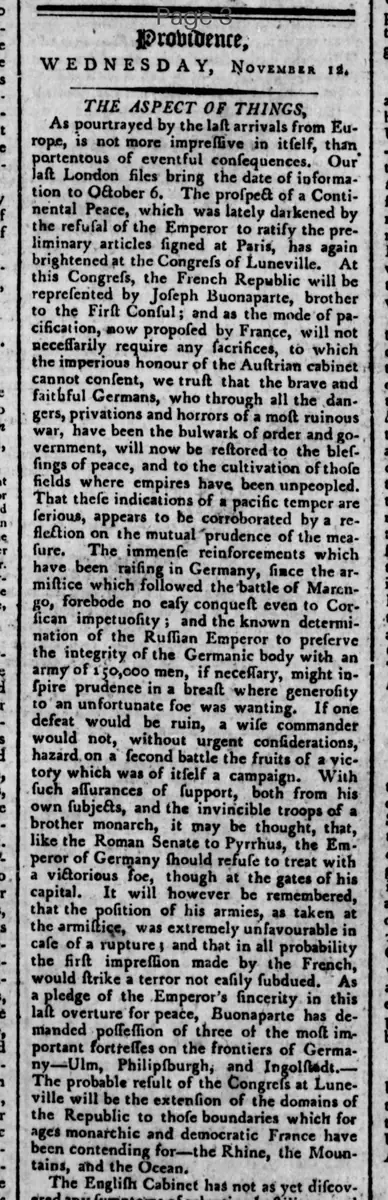
THE ASPECT OF THINGS,
As pourtrayed by the last arrivals from Europe, is not more impressive in itself, than portentous of eventful consequences. Our last London files bring the date of information to October 6. The prospect of a Continental Peace, which was lately darkened by the refusal of the Emperor to ratify the preliminary articles signed at Paris, has again brightened at the Congress of Luneville. At this Congress, the French Republic will be represented by Joseph Buonaparte, brother to the First Consul; and as the mode of pacification, now proposed by France, will not necessarily require any sacrifices, to which the imperious honour of the Austrian cabinet cannot consent, we trust that the brave and faithful Germans, who through all the dangers, privations and horrors of a most ruinous war, have been the bulwark of order and government, will now be restored to the blessings of peace, and to the cultivation of those fields where empires have been unpeopled.
That these indications of a pacific temper are serious, appears to be corroborated by a reflection on the mutual prudence of the measure. The immense reinforcements which have been raising in Germany, since the armistice which followed the battle of Marengo, forebode no easy conquest even to Corsican impetuosity; and the known determination of the Russian Emperor to preserve the integrity of the Germanic body with an army of 120,000 men, if necessary, might inspire prudence in a breast where generosity to an unfortunate foe was wanting. If one defeat would be ruin, a wise commander would not, without urgent considerations, hazard, on a second battle the fruits of a victory which was of itself a campaign. With such assurances of support, both from his own subjects, and the invincible troops of a brother monarch, it may be thought, that, like the Roman Senate to Pyrrhus, the Emperor of Germany should refuse to treat with a victorious foe, though at the gates of his capital. It will however be remembered, that the position of his armies, as taken at the armistice, was extremely unfavourable in case of a rupture; and that in all probability the first impression made by the French, would strike a terror not easily subdued. "As a pledge of the Emperor's sincerity in this last overture for peace, Buonaparte has demanded possession of three of the most important fortresses on the frontiers of Germany—Ulm, Philipsburgh, and Ingolstadt."
The probable result of the Congress at Luneville will be the extension of the domains of the Republic to those boundaries which for ages monarchic and democratic France have been contending for—the Rhine, the Mountains, and the Ocean.
The English Cabinet has not as yet discovered any symptoms of relenting hostility: and there is not the thinnest shadow of a reason to presume that Great-Britain will have any connection with the Congress at Luneville, other than the influence of her example, and the valour of her arms.
What sub-type of article is it?
What keywords are associated?
What entities or persons were involved?
Where did it happen?
Foreign News Details
Primary Location
Luneville
Event Date
October 6
Key Persons
Outcome
extension of the domains of the republic to the rhine, the mountains, and the ocean; demand for possession of ulm, philipsburgh, and ingolstadt
Event Details
Prospect of Continental Peace brightens at Congress of Luneville, represented by Joseph Buonaparte for French Republic. Emperor refused preliminary articles at Paris but now proposes pacification without sacrifices to Austrian honor. Reinforcements in Germany and Russian support with 120,000 men noted. Probable result: French boundaries to Rhine, Mountains, Ocean. English Cabinet shows no relenting.