Thank you for visiting SNEWPapers!
Sign up free
Literary
August 11, 1866
The Columbian
Bloomsburg, Columbia County, Pennsylvania
What is this article about?
Humorous essay satirizing 19th-century women's bonnet and hat fashions, contrasting historical styles like 'coal-scuttle' with modern diminutive designs such as 'Mandarin', 'Tarte', and 'Clarisse', while noting the role of hairpieces like the chignon and the extravagance of feathers and flowers.
Clipping
OCR Quality
95%
Excellent
Full Text
HATS AND BONNETS.
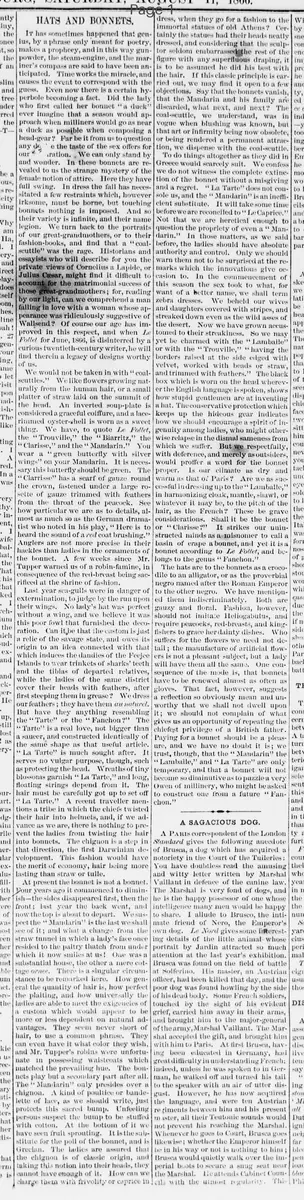
It has sometimes happened that genius, by a phrase only meant for poetry, makes a prophecy, and in this way gunpowder, the steam-engine, and the mariner's compass are said to have been anticipated. Time works the miracle, and causes the event to correspond with the guess. Even now there is a certain hyperbole becoming a fact. Did the lady who first called her bonnet "a duck" ever imagine that a season would approach when milliners would go as near a duck as possible when composing a head-gear? Far be it from us to question any decoration. We can only stand by and wonder. In these bonnets are revealed to us the strange mystery of the female notion of attire. Here they have full swing. In dress the fall has necessitated a few restraints which, however irksome, must be borne, but touching bonnets nothing is imposed. And so their variety is infinite, and their name legion. We turn back to the portraits of our great-grandmothers, or to their fashion-books, and find that a "coal-scuttle" was the rage. Historians and essayists who will describe for you the private views of Cornelius a Lapide, or Julius Caesar, might find it difficult to account for the matrimonial success of those great-grandmothers; for, reading by our light, can we comprehend a man falling in love with a woman whose appearance was ridiculously suggestive of Wallsend? Of course our age has improved in this respect, and when Le Follet for June, 1866, is disinterred by a curious twentieth-century writer, he will find therein a legacy of designs worthy of us.
We would not be taken in with "coal scuttles." We like flowers growing naturally from the human hair, or a small platter of straw laid on the summit of the head. An inverted soup-plate is considered a graceful coiffure, and a lace-rimmed oyster-shell is worn as a sweet thing. We have, to quote Le Follet, the "Trouville," the "Biarritz," the "Clarisse," and the "Mandarin." You wear a "green butterfly with silver wings" on your Mandarin. It is necessary this butterfly should be green. The "Clarisse" has a scarf of gauze round the crown, fastened under a large rosette of gauze trimmed with feathers from the throat of the peacock. See how particular we are as to details, almost as much so as the German dramatist who noted in his play, "Here is to be heard the sound of a red coat brushing." Anglers are not more precise in their hackles than ladies in the ornaments of the bonnet. A few weeks since Mr. Tupper warned us of a robin-famine, in consequence of the red-breast being sacrificed at the shrine of fashion. Last year sea-gulls were in danger of extermination, to judge by the run upon their wings. No lady's hat was perfect without a wing, and we believe it was this poor fowl that furnished the decoration. Can it be that the custom is just a relic of the savage state, and owes its origin to an idea connected with that which induces the dandies of the Feejee Islands to wear trinkets of sharks' teeth and the tibias of departed relatives, while the ladies of the same district cover their heads with feathers, after first steeping them in grease? We dress our feathers; they have them au naturel.
But have they anything resembling the "Tarte" or the "Fanchon?" The "Tarte" is a real love, not bigger than a saucer, and constructed identically of the same shape as that useful article. "La Tarte" is much sought after. It serves no vulgar purpose, though, such as protecting the head. Wreaths of tiny blossoms garnish "La Tarte," and long, floating strings depend from it. The hair must be carefully got up to set off "La Tarte." A recent traveller mentions a tribe in which the chiefs twisted their hair into helmets, and, if we advance as we are, there is nothing to prevent the ladies from twisting the hair into bonnets. The chignon is a step in that direction, the first Darwinian development. This fashion would have the merit of economy, hair being more lasting than straw or tulle.
At present the bonnet is not a bonnet. Four years ago it commenced to diminish—the sides disappeared first, then the front; last year the back went, and now the top is about to depart. We suspect the "Mandarin" is the last we shall see of it; and what a change from the straw tunnel in which a lady's face once resided to the paltry thatch from under which it now smiles at us! One was a substantial house, the other a mere cottage orné. There is a singular circumstance to be remarked here. How general the quantity of hair is, how perfect the plaiting, and how universally the ladies are able to meet the exigencies of a custom which would appear to be more or less dependent on natural advantages. They seem never short of hair, to use a common phrase. They can even have it what color they wish, and Mr. Tupper's robins were unfortunate in possessing waistcoats which matched the prevailing hue. The bonnets play but a secondary part after all. The "Mandarin" only presides over a chignon. A kind of poultice or bandalette of lace, as we should write, just protects this sacred bump. Unfeeling persons suspect the bump to be stuffed with cotton. At the bottom of it we have seen fruit sprouting. It is the substitute for the poll of the bonnet, and is Grecian. The ladies are assured that the chignon is of classic origin, and taking this notion into their heads, they cannot have enough of it. How can we charge them with frivolity or caprice in dress, when they go for a fashion to the immortal statues of old Athens? Certainly the statues had their heads neatly dressed, and considering that the sculptor seldom embarrassed the rest of the figure with any superfluous draping, it is to be assumed he did his best with the hair. If this classic principle is carried out, we may find it open to a few objections. Say that the bonnets vanish that the Mandarin and his family are discarded, what next, and next? The coal-scuttle, we understand, was in vogue when blushing was known, but that art or infirmity being now obsolete, or being rendered a permanent attraction, we dispense with the coal-scuttle. To do things altogether as they did in Greece would scarcely suit. We confess we do not witness the complete extinction of the bonnet without a misgiving and a regret. "La Tarte" does not console us, and the "Mandarin" is an inefficient substitute. It will take some time before we are reconciled to "Le Caprice."
Not that we are heretical enough to question the propriety of even a "Mandarin." In those matters, as we said before, the ladies should have absolute authority and control. Only we should warn them not to be surprised at the remarks which the innovations give occasion to. In the commencement of this season the sex took to what, for want of a better name, we shall term zebra dresses. We beheld our wives and daughters covered with stripes, and streaked down even as the wild asses of the desert. Now we have grown accustomed to their streakiness. So we may yet be charmed with the "Lamballe" or with the "Trouville," having the borders raised at the side edged with velvet, worked with beads or straw, and trimmed with feathers. The black box which is worn on the head wherever the English language is spoken, shows how stupid gentlemen are at inventing a hat. The conservative protection which keeps up the hideous gear indicates how we should encourage a spirit of ingenuity among ladies, who might otherwise relapse in the dismal sameness from which we suffer. But we respectfully, with deference, and merely as outsiders, would proffer a word for the bonnet proper. Is our climate as dry and warm as that of Paris? Are we as successful in dressing up to the "Lamballe," in harmonizing cloak, mantle, shawl, or whatever it may be, to the pitch of the hair, as the French? These be grave considerations. Shall it be the bonnet or "Clarisse?" It strikes our uninstructed minds as a misnomer to call a basin of crape a bonnet, and yet it is a bonnet according to Le Follet, and belongs to the genus "Fanchon."
The hats are to the bonnets as a crocodile to an alligator, or as the proverbial negro named after the Roman Emperor to the other negro. We have mentioned them indiscriminately. Both are gauzy and floral. Fashion, however, should not imitate Heliogabalus, and require peacocks, red-breasts, and kingfishers to grace her dainty dishes. Who suffers for the flowers we need not detail; the manufacture of artificial flowers is not a pleasant subject, but a lady will have them all the same. One consequence of the mode is, that bonnets have to be renewed almost as often as gloves. That fact, however, suggests a reflection so obviously mean and unworthy that we shall not dwell upon it; we should not complain of what gives us an opportunity of repeating the chiefest privilege of a British father. Paying for a bonnet should be a pleasure, and we have no doubt it is; we trust, though, that the "Mandarin" the "Lamballe," and "La Tarte" are only temporary, and that a bonnet will not become so diminutive as to puzzle a very Owen of millinery, who might be asked to construct one from a future "Fanchon."
It has sometimes happened that genius, by a phrase only meant for poetry, makes a prophecy, and in this way gunpowder, the steam-engine, and the mariner's compass are said to have been anticipated. Time works the miracle, and causes the event to correspond with the guess. Even now there is a certain hyperbole becoming a fact. Did the lady who first called her bonnet "a duck" ever imagine that a season would approach when milliners would go as near a duck as possible when composing a head-gear? Far be it from us to question any decoration. We can only stand by and wonder. In these bonnets are revealed to us the strange mystery of the female notion of attire. Here they have full swing. In dress the fall has necessitated a few restraints which, however irksome, must be borne, but touching bonnets nothing is imposed. And so their variety is infinite, and their name legion. We turn back to the portraits of our great-grandmothers, or to their fashion-books, and find that a "coal-scuttle" was the rage. Historians and essayists who will describe for you the private views of Cornelius a Lapide, or Julius Caesar, might find it difficult to account for the matrimonial success of those great-grandmothers; for, reading by our light, can we comprehend a man falling in love with a woman whose appearance was ridiculously suggestive of Wallsend? Of course our age has improved in this respect, and when Le Follet for June, 1866, is disinterred by a curious twentieth-century writer, he will find therein a legacy of designs worthy of us.
We would not be taken in with "coal scuttles." We like flowers growing naturally from the human hair, or a small platter of straw laid on the summit of the head. An inverted soup-plate is considered a graceful coiffure, and a lace-rimmed oyster-shell is worn as a sweet thing. We have, to quote Le Follet, the "Trouville," the "Biarritz," the "Clarisse," and the "Mandarin." You wear a "green butterfly with silver wings" on your Mandarin. It is necessary this butterfly should be green. The "Clarisse" has a scarf of gauze round the crown, fastened under a large rosette of gauze trimmed with feathers from the throat of the peacock. See how particular we are as to details, almost as much so as the German dramatist who noted in his play, "Here is to be heard the sound of a red coat brushing." Anglers are not more precise in their hackles than ladies in the ornaments of the bonnet. A few weeks since Mr. Tupper warned us of a robin-famine, in consequence of the red-breast being sacrificed at the shrine of fashion. Last year sea-gulls were in danger of extermination, to judge by the run upon their wings. No lady's hat was perfect without a wing, and we believe it was this poor fowl that furnished the decoration. Can it be that the custom is just a relic of the savage state, and owes its origin to an idea connected with that which induces the dandies of the Feejee Islands to wear trinkets of sharks' teeth and the tibias of departed relatives, while the ladies of the same district cover their heads with feathers, after first steeping them in grease? We dress our feathers; they have them au naturel.
But have they anything resembling the "Tarte" or the "Fanchon?" The "Tarte" is a real love, not bigger than a saucer, and constructed identically of the same shape as that useful article. "La Tarte" is much sought after. It serves no vulgar purpose, though, such as protecting the head. Wreaths of tiny blossoms garnish "La Tarte," and long, floating strings depend from it. The hair must be carefully got up to set off "La Tarte." A recent traveller mentions a tribe in which the chiefs twisted their hair into helmets, and, if we advance as we are, there is nothing to prevent the ladies from twisting the hair into bonnets. The chignon is a step in that direction, the first Darwinian development. This fashion would have the merit of economy, hair being more lasting than straw or tulle.
At present the bonnet is not a bonnet. Four years ago it commenced to diminish—the sides disappeared first, then the front; last year the back went, and now the top is about to depart. We suspect the "Mandarin" is the last we shall see of it; and what a change from the straw tunnel in which a lady's face once resided to the paltry thatch from under which it now smiles at us! One was a substantial house, the other a mere cottage orné. There is a singular circumstance to be remarked here. How general the quantity of hair is, how perfect the plaiting, and how universally the ladies are able to meet the exigencies of a custom which would appear to be more or less dependent on natural advantages. They seem never short of hair, to use a common phrase. They can even have it what color they wish, and Mr. Tupper's robins were unfortunate in possessing waistcoats which matched the prevailing hue. The bonnets play but a secondary part after all. The "Mandarin" only presides over a chignon. A kind of poultice or bandalette of lace, as we should write, just protects this sacred bump. Unfeeling persons suspect the bump to be stuffed with cotton. At the bottom of it we have seen fruit sprouting. It is the substitute for the poll of the bonnet, and is Grecian. The ladies are assured that the chignon is of classic origin, and taking this notion into their heads, they cannot have enough of it. How can we charge them with frivolity or caprice in dress, when they go for a fashion to the immortal statues of old Athens? Certainly the statues had their heads neatly dressed, and considering that the sculptor seldom embarrassed the rest of the figure with any superfluous draping, it is to be assumed he did his best with the hair. If this classic principle is carried out, we may find it open to a few objections. Say that the bonnets vanish that the Mandarin and his family are discarded, what next, and next? The coal-scuttle, we understand, was in vogue when blushing was known, but that art or infirmity being now obsolete, or being rendered a permanent attraction, we dispense with the coal-scuttle. To do things altogether as they did in Greece would scarcely suit. We confess we do not witness the complete extinction of the bonnet without a misgiving and a regret. "La Tarte" does not console us, and the "Mandarin" is an inefficient substitute. It will take some time before we are reconciled to "Le Caprice."
Not that we are heretical enough to question the propriety of even a "Mandarin." In those matters, as we said before, the ladies should have absolute authority and control. Only we should warn them not to be surprised at the remarks which the innovations give occasion to. In the commencement of this season the sex took to what, for want of a better name, we shall term zebra dresses. We beheld our wives and daughters covered with stripes, and streaked down even as the wild asses of the desert. Now we have grown accustomed to their streakiness. So we may yet be charmed with the "Lamballe" or with the "Trouville," having the borders raised at the side edged with velvet, worked with beads or straw, and trimmed with feathers. The black box which is worn on the head wherever the English language is spoken, shows how stupid gentlemen are at inventing a hat. The conservative protection which keeps up the hideous gear indicates how we should encourage a spirit of ingenuity among ladies, who might otherwise relapse in the dismal sameness from which we suffer. But we respectfully, with deference, and merely as outsiders, would proffer a word for the bonnet proper. Is our climate as dry and warm as that of Paris? Are we as successful in dressing up to the "Lamballe," in harmonizing cloak, mantle, shawl, or whatever it may be, to the pitch of the hair, as the French? These be grave considerations. Shall it be the bonnet or "Clarisse?" It strikes our uninstructed minds as a misnomer to call a basin of crape a bonnet, and yet it is a bonnet according to Le Follet, and belongs to the genus "Fanchon."
The hats are to the bonnets as a crocodile to an alligator, or as the proverbial negro named after the Roman Emperor to the other negro. We have mentioned them indiscriminately. Both are gauzy and floral. Fashion, however, should not imitate Heliogabalus, and require peacocks, red-breasts, and kingfishers to grace her dainty dishes. Who suffers for the flowers we need not detail; the manufacture of artificial flowers is not a pleasant subject, but a lady will have them all the same. One consequence of the mode is, that bonnets have to be renewed almost as often as gloves. That fact, however, suggests a reflection so obviously mean and unworthy that we shall not dwell upon it; we should not complain of what gives us an opportunity of repeating the chiefest privilege of a British father. Paying for a bonnet should be a pleasure, and we have no doubt it is; we trust, though, that the "Mandarin" the "Lamballe," and "La Tarte" are only temporary, and that a bonnet will not become so diminutive as to puzzle a very Owen of millinery, who might be asked to construct one from a future "Fanchon."
What sub-type of article is it?
Essay
Satire
What themes does it cover?
Social Manners
What keywords are associated?
Bonnets
Hats
Fashion
Millinery
Chignon
Coal Scuttle
Mandarin
Tarte
Satire
Ladies Attire
Literary Details
Title
Hats And Bonnets.
Key Lines
Did The Lady Who First Called Her Bonnet "A Duck" Ever Imagine That A Season Would Approach When Milliners Would Go As Near A Duck As Possible When Composing A Head Gear?
We Turn Back To The Portraits Of Our Great Grandmothers, Or To Their Fashion Books, And Find That A "Coal Scuttle" Was The Rage.
The "Tarte" Is A Real Love, Not Bigger Than A Saucer, And Constructed Identically Of The Same Shape As That Useful Article.
At Present The Bonnet Is Not A Bonnet. Four Years Ago It Commenced To Diminish—The Sides Disappeared First, Then The Front; Last Year The Back Went, And Now The Top Is About To Depart.
Paying For A Bonnet Should Be A Pleasure, And We Have No Doubt It Is; We Trust, Though, That The "Mandarin" The "Lamballe," And "La Tarte" Are Only Temporary...