Thank you for visiting SNEWPapers!
Sign up free
Domestic News
January 16, 1845
Indiana State Sentinel
Indianapolis, Marion County, Indiana
What is this article about?
Detailed report of Indiana Legislature sessions from January 10-13, 1845, covering debates, votes on bills related to public lands, canals, railroads, taxes, appropriations, judicial nominations, and adjournments in House and Senate.
Clipping
OCR Quality
95%
Excellent
Full Text
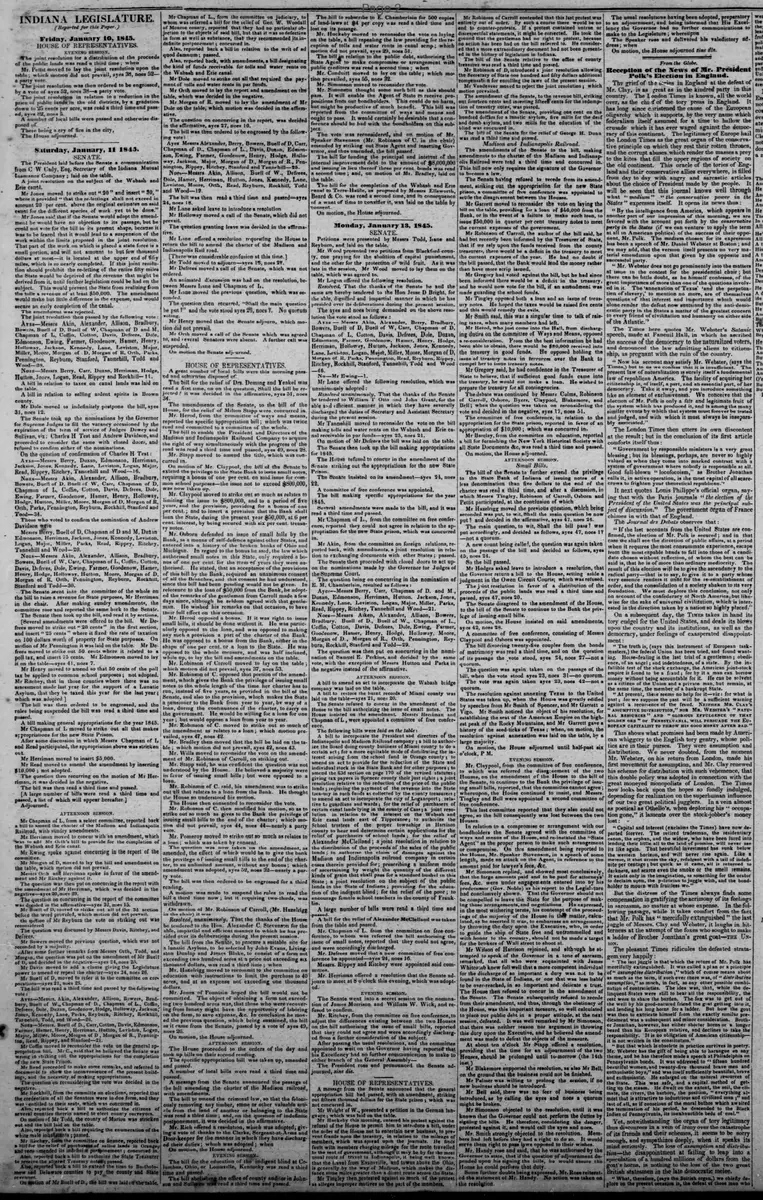
INDIANA LEGISLATURE.
(Reported for this Paper.)
Friday, January 10, 1845.
HOUSE OF REPRESENTATIVES
EVENING SESSION.
The joint resolution for a distribution of the proceeds of the public lands was read a third time; when Mr. Pettit moved to lay the joint resolution upon the table; which motion did not prevail, ayes 38, noes 52—a party vote.
The joint resolution was then ordered to be engrossed, by a vote of ayes 52, noes 38—a party vote.
The joint resolution in relation to a reduction in the price of public lands in the old districts, by a gradation down to 25 cents per acre, was read a third time and passed, ayes 52, noes 5.
A number of local bills were passed and otherwise disposed of.
There being a cry of fire in the city, the House adjourned.
Saturday, January 11, 1845.
SENATE.
The President laid before the Senate a communication from C. W. Cady, Esq., Secretary of the Indiana Mutual Insurance Company; laid on the table.
A joint resolution on the subject of the Wabash and Erie canal.
Mr. Jones moved to strike out '20' and insert '30,' where it provided 'that the re-lettings shall not exceed in amount 20 per cent. above the original estimates on said canal for the different species of work yet to be done.'
Mr. Jones said that if the Senate would adopt the amendment he would have no objection to its passage, but he could not vote for the bill in its present shape, because it was to be feared that it would lead to a suspension of the work within the limits proposed in the joint resolution. That part of the work on which is placed a state force is a small portion, and will not amount to but a few thousand dollars at most—it is located at the upper end of fifty miles, which is so nearly completed. If this joint resolution should prohibit the re-letting of the entire fifty miles the State would be deprived of the revenue that might be derived from it, until further legislation could be had on the subject. This would prevent the State from realizing from the tolls a revenue of at least $50,000. The amendment would make but little difference in the expense, and would secure an early completion of the canal.
The amendment was rejected.
The joint resolution then passed by the following vote:
Ayes—Messrs. Akin, Alexander, Allison, Bradbury, Bowers, Buell of D., Buell of W., Chapman of D. and M., Chapman of L., Coffin, Cotton, Davis, Defrees, Dole, Edmonson, Ewing, Farmer, Goodenow, Hamer, Henry, Holloway, Jackson, Kennedy, Lane, Leviston, Major, Miller, Moore, Morgan of D., Morgan of R., Orth, Parks, Pennington, Reyburn, Stanford, Tannehill, Todd and Wood—39.
Noes—Messrs. Berry, Carr, Duzan, Herriman, Hodge, Hutton, Jones, Logan, Read, Rippey and Rockhill—11.
A bill in relation to taxes on canal lands was laid on the table.
A bill in relation to selling ardent spirits in Brown county.
Mr. Dole moved to indefinitely postpone the bill, ayes 31, noes 12.
The Senate took up the nominations by the Governor for Supreme Judges to fill the vacancy occasioned by the expiration of the term of service of Judges Dewey and Sullivan, viz: Charles H. Test and Andrew Davidson, and proceeded to consider the same with closed doors, and refused to confirm either of the nominations.
On the question of confirmation of Charles H. Test:
Ayes—Messrs. Berry, Duzan, Edmonson, Herriman, Jackson, Jones, Kennedy, Lane, Leviston, Logan, Major, Read, Rippey, Ritchey, Tannehill and Wood—16.
Noes—Messrs. Akin, Alexander, Allison, Bradbury, Bowers, Buell of D., Buell of W., Carr, Chapman of D., Chapman of L., Coffin, Cotton, Davis, Defrees, Dole, Ewing, Farmer, Goodenow, Hamer, Henry, Holloway, Hodge, Hutton, Miller, Moore, Morgan of D., Morgan of R., Orth, Parks, Pennington, Reyburn, Rockhill, Stanford and Todd—34.
Those who voted to confirm the nomination of Andrew Davidson were:
Messrs. Berry, Buell of D., Chapman of D. and M., Duzan, Edmonson, Herriman, Jackson, Jones, Kennedy, Leviston, Logan, Major, Miller, Parks, Read, Rippey, Ritchey, Tannehill and Wood—20.
Noes—Messrs. Akin, Alexander, Allison, Bradbury, Bowers, Buell of W., Carr, Chapman of L., Coffin, Cotton, Davis, Defrees, Dole, Ewing, Farmer, Goodenow, Hamer, Henry, Hodge, Holloway, Hutton, Moore, Morgan of D., Morgan of R., Orth, Pennington, Reyburn, Rockhill, Stanford and Todd—30.
The Senate went into the committee of the whole on the bill to raise a revenue for State purposes, Mr. Herriman in the chair. After making sundry amendments, the committee rose and reported the same back to the Senate.
The Senate then took up the bill, and read it by sections.
Several amendments were offered to the bill. Mr. Defrees moved to strike out '20 cents' in the first section, and insert '25 cents' where it fixed the rate of taxation on $100 worth of property for State purposes. On motion of Mr. Pennington it was laid on the table. Mr. Defrees moved to strike out 50 cents where it related to a poll tax, and insert 75 cents. Mr. Edmonson moved to lay it on the table—ayes 41, noes 7.
Mr. Henry moved to amend so that 50 cents of the poll tax be applied to common school purposes; not adopted.
Mr. Ritchey, that in those counties where there was no assessment made last year for the support of a Lunatic Asylum, that they be taxed this year for the last year; which was adopted.
The bill was then ordered to be engrossed, and the rules being suspended the bill was read a third time and passed.
A bill making general appropriations for the year 1845.
Mr. Chapman of L. moved to strike out all that makes appropriations for the new State Prison.
After some discussion in which Messrs. Chapman of L. and Read participated, the appropriation above was stricken out.
Mr. Herriman moved to insert $5,000.
Mr. Read moved to amend the amendment by inserting $10,000; not adopted.
The question then recurring on the motion of Mr. Herriman, it was decided in the negative.
The bill was then read a third time and passed.
A large number of bills were read a third time and passed, a list of which will appear hereafter.
Adjourned.
AFTERNOON SESSION.
Mr. Chapman of L., from a select committee, reported back a bill to amend the charter of the Madison and Indianapolis Railroad, with sundry amendments.
Mr. Herriman moved to concur with an amendment, which was to add Mr. Orth's bill to provide for the completion of the Wabash and Erie canal.
Mr. Ewing spoke against concurring in the report of the committee.
Mr. Morgan of D. moved to lay the bill and amendment on the table, which motion did not prevail.
Messrs. Orth and Herriman spoke in favor of the amendment and Mr. Ritchey against it.
The question was then put on concurring in the report with the amendment of Mr. Herriman, which was decided in the negative—ayes 20, noes 29.
The question on concurring in the report of the committee was decided in the affirmative—ayes 32, noes 15.
Mr. Buell of D. moved to strike out all of the 3d section before the word 'provided,' which motion did not prevail.
On motion of Mr. Reyburn the vote on striking out was reconsidered.
The question was discussed by Messrs. Davis, Ritchey, and Defrees.
Mr. Bowers moved the previous question, which was not seconded by a majority.
After some further remarks from Messrs. Orth, Todd, and Morgan, the question was put on the amendment of Mr. Buell of D., and decided in the negative—ayes 24, noes 25.
Mr. Davis moved to add a clause giving the Legislature power to amend or repeal the charter—ayes 24, noes 26.
Mr. Buell of D. moved to refer it to the committee on corporations—ayes 21, noes 28.
The bill was read a third time by the following vote:
Ayes—Messrs. Akin, Alexander, Allison, Bowers, Bradbury, Buell of W., Chapman of D., Chapman of L., Coffin, Defrees, Dole, Duzan, Goodenow, Hodge, Holloway, Jackson, Jones, Kennedy, Lane, Parks, Reyburn, Ritchey, Rockhill, Tannehill, Todd, and Wood—26.
Noes—Messrs. Buell of D., Carr, Cotton, Davis, Edmonson, Farmer, Hamer, Henry, Herriman, Hutton, Leviston, Logan, Major, Miller, Moore, Morgan of D., Morgan of R., Pennington, Read, Rippey, and Stanford—21.
Mr. Coffin moved to reconsider the vote on the general appropriation bill. Mr. C. said that he believed the Senate was wrong in striking out the appropriations for the completion of the new State Prison.
Mr. Read proceeded to make some remarks, and referred to documents to show the inconvenience of the present buildings, and the necessity of making appropriations.
The question on reconsidering the vote was decided in the negative.
Mr. Rockhill, from the committee on elections, reported that the credentials of all the Senators were in due form, and they were entitled to their seats, which was concurred in.
Also, reported back a bill to authorize the citizens of several counties therein named to elect county surveyors.
On motion of Mr. Todd, the county of Marion was stricken out and the bill laid on the table.
Also, reported back a bill requiring the enumeration of the white male inhabitants; passed.
Mr. Ritchey, from the committee on finance, reported back a bill for the relief of purchasers of saline lands in Orange, and recommended its indefinite postponement; concurred in.
Also, reported back a bill to authorize the State Treasurer to receive the altered Treasury notes; passed.
Also, reported back a bill to extend the time to Bartholomew and Delaware counties to pay the county and State revenues.
On motion of Mr. Buell of D., the bill was laid on the table.
Mr. Chapman of L., from the committee on judiciary, to whom was referred a bill for the relief of Geo. W. Woodall of Monroe county, reported that they had no particular objection to the objects of said bill, but that it was so defective in form as well as substance, that they recommended its indefinite postponement; concurred in.
Also, reported back a bill in relation to the writ of ad quod damnum; passed.
Also, reported back, with amendments, a bill designating the kind of funds receivable for tolls and water rents on the Wabash and Erie canal.
Mr. Dole moved to strike out all that required the payment of tolls and water rents in par funds.
Mr. Orth moved to lay the report and amendment on the table, which was decided in the negative.
Mr. Morgan of R. moved to lay the amendment of Mr. Dole on the table, which motion was decided in the affirmative.
The question on concurring in the report, was decided in the affirmative, ayes 27, noes 10.
The bill was then ordered to be engrossed by the following vote:
Ayes—Messrs. Alexander, Berry, Bowers, Buell of D., Carr, Chapman of D., Chapman of L., Davis, Duzan, Edmonson, Ewing, Farmer, Goodenow, Henry, Hodge, Holloway, Jackson, Major, Morgan of D., Morgan of R., Pennington, Rippey, Ritchey, Stanford and Tannehill—25.
Noes—Messrs. Akin, Allison, Buell of W., Defrees, Dole, Hamer, Herriman, Hutton, Jones, Kennedy, Lane, Leviston, Moore, Orth, Read, Reyburn, Rockhill, Todd and Wood—19.
The bill was then read a third time and passed—ayes 24, noes 18.
Mr. Lane asked leave to introduce a resolution.
Mr. Holloway moved a call of the Senate, which did not prevail.
The question granting leave was decided in the affirmative.
Mr. Lane offered a resolution requesting the House to return the bill to amend the charter of the Madison and Indianapolis Rail road.
[There was considerable confusion at this time.]
Mr. Todd moved to adjourn—ayes 16, noes 29.
Mr. Defrees moved a call of the Senate, which was not ordered.
An animated discussion was had on the resolution, between Messrs. Lane and Chapman of L.
Mr. Lane moved the previous question, which was seconded.
The question then recurred, 'Shall the main question be put?' and the vote stood ayes 25, noes 7. No quorum voting.
Mr. Henry moved that the Senate adjourn, which motion did not prevail.
Mr. Orth moved a call of the Senate which was agreed to, and several Senators were absent.
A further call was suspended.
On motion the Senate adjourned.
HOUSE OF REPRESENTATIVES
A great number of local bills were this morning passed and otherwise disposed of.
The bill for the relief of Drs. Deming and Yeakel was read a first time, and on the question, Shall the bill be rejected? it was decided in the affirmative, ayes 51, noes 34.
The amendments of the Senate, to the bill of the House, for the relief of Milton Stapp were concurred in.
Mr. Herod, from the committee of ways and means, reported the specific appropriation bill; which was twice read and committed to a committee of the whole.
The bill to enable the President and Directors of the Madison and Indianapolis Railroad Company to acquire the right of way simultaneously with the progress of the road was read a third time and passed, ayes 49, noes 28.
Mr. Stapp moved to amend the title, which was concurred in.
On motion of Mr. Claypool, the bill of the Senate to extend the privilege to the State Bank to issue small notes, requiring a bonus of one per cent. on said issue for common school purposes—the issue not to exceed $500,000—was now taken up.
Mr. Claypool moved to strike out so much as relates to limiting the issue to $800,000, and to a period of five years, and the provision providing for a bonus of one per cent.; and to insert a provision that the Bank shall loan the State, during the present year $50,000, at 6 per cent. interest, by being secured with six per cent. treasury notes.
Mr. Osborn defended an issue of small bills by the Bank, as a means of self-defence against other States, and entered into a history of the broken banks of Ohio and Michigan. In regard to the bonus he said, the law which authorised small notes in this State, only required a bonus of one per cent. for the term of years they were authorised. He stated, that an acceptance of the provisions of this bill by the Bank, required an unanimous consent of all the Branches, and this consent he had understood, since this bill had been pending would not be given. In reference to the loan of $50,000 from the Bank, he adopted the remarks of the gentleman from Carroll made a few days since, although he seldom agreed with that gentleman. He wished his remarks on that occasion, to have their full effect on this occasion.
Mr. Herod opposed a bonus. If it was right to issue small bills, it should be done without it. He was particularly opposed to the loan, and was opposed to making any such a provision a part of the charter of the Bank. He was opposed to a bonus from the Bank, either in the shape of one per cent. or a loan to the State. He was opposed to the whole measure, and was half inclined, while up, to lay the bill and amendments on the table.
Mr. Robinson of Carroll moved to lay on the table; which motion did not prevail, ayes 37, noes 53.
Mr. Robinson of C. opposed that portion of the amendment, which gives the Bank the privilege of issuing small notes to the whole length of the time her charter has to run, instead of five years, as provided in the bill of the Senate, and also to the provision, which makes the State a pensioner to the Bank from year to year, by way of a loan, during the continuance of the charter, to carry on the government. He would be willing for a loan for one year; but would oppose a loan from year to year.
Mr. Robinson of C. moved to strike out so much of the amendment as relates to a loan; which motion prevailed, ayes 47, noes 42.
Mr. Bradley then moved that the bill be laid on the table; which motion did not prevail, ayes 42, noes 43.
Mr. Wills moved to reconsider the vote on the amendment of Mr. Robinson of Carroll, on striking out.
Mr. Stapp said, he was confident the question was not understood by the House. He believed a majority were in favor of issuing small bills; but were opposed to a loan.
Mr. Robinson of C. said, his amendment was to strike out all that relates to a loan from the Bank. He thought the House so understood his motion.
The House then consented to reconsider the vote.
Mr. Robinson of C. then modified his motion, so as to strike out so much as gives to the Bank the privilege of issuing small bills to the end of the charter; which motion did not prevail, ayes 44, noes 44—nearly a party vote.
Mr. Pomeroy moved to strike out so much as relates to a loan; which was taken by consent.
The question was now taken on the amendment, as amended, the effect of which would be to give the bank the privilege of issuing small bills to the end of the charter, to an unlimited amount, without any bonus; which amendment was adopted, ayes 52, noes 32—nearly a party vote.
The bill was then ordered to be engrossed for a third reading.
A motion was made to suspend the rules to read the bill a third time now; but it requiring two-thirds, withdrawn.
On motion of Mr. Robinson of Carroll, (Mr. Hazelrigg in the chair) it was
Resolved, unanimously, That the thanks of the House be tendered to the Hon. Alexander C. Stevenson for the able, impartial and efficient manner in which he has presided over its deliberations during the present session.
The bill from the Senate, to procure a suitable site for a lunatic Asylum, to be selected by John Evans, Livingston Dunlap and James Blake, to consist of a farm not exceeding two hundred acres at a price not exceeding six thousand dollars, was read a third time; when
Mr. Hazelrigg moved to recommit to the committee on education with instructions to limit the purchase to 40 acres, and at an expense not exceeding one thousand dollars.
Mr. Jones of Fountain hoped the bill would not be committed. The object of obtaining a farm not exceeding two hundred acres was, that those who were recovering from lunacy might have the opportunity of laboring on the farm, to save expense, &c. In conclusion he moved the previous question, which being sustained, the bill as it came from the Senate, passed by a vote of ayes 49, noes 26.
On motion, the House adjourned.
AFTERNOON SESSION.
The House proceeded to the orders of the day and took up bills on their second reading.
The specific appropriation bill was taken up, amended and passed.
A number of local bills were read a third time and passed.
A message from the Senate announced the passage of the bill amending the charter of the Madison railroad, with amendments.
The bill to amend the criminal law, so that the feloniously removing any timber, stone or other valuable article from the land of another or belonging to the State was read a third time; and, on the question of indefinite postponement, it was decided in the affirmative.
Mr. Rich offered a resolution, which was adopted; giving a vote of thanks to the Clerks, Sergeant-at-Arms and Door-keeper for the manner in which they have discharged their duties; which was adopted; when
On motion, the House adjourned.
EVENING SESSION.
The bill for the education of the indigent blind at Columbus, Ohio, or Louisville, Kentucky was read a third time and passed.
The bill abolishing the office of county auditor in Johnson and Sullivan was read a third time and passed.
The bill to subscribe to E. Chamberlain for 500 copies of land-laws at $4 per copy was read a third time and lost on its passage.
Mr. Huckeby moved to reconsider the vote on laying on the table, a bill repealing the law providing for the reception of tolls and water rents in canal scrip; which motion did not prevail, ayes 29, noes 51.
The bill in relation to the public debt, authorising the State Agent to make compromise or arrangement with public creditors was read a second time; when
Mr. Conduitt moved to lay on the table; which motion prevailed, ayes 55, noes 32.
Mr. Simonson moved to reconsider the vote.
Mr. Simonson thought some such bill as this should pass. It will enable the Agent of State to receive propositions from our bondholders. This could do no harm, but might be productive of much benefit. This bill was reported from the committee of ways and means and ought to pass. It would certainly be desirable that a conference should be had with the bondholders on this subject.
The vote was reconsidered, and on motion of Mr. Speaker Stevenson (Mr. Robinson of C. in the chair) amended by striking out State Agent and inserting Governor, and thus amended, the bill passed.
The bill for funding the principal and interest of the internal improvement debt to the amount of $8,000,000 and issuing in lieu thereof three per cent. bonds was read a second time; and, on motion of Mr. Bradley, laid on the table.
The bill for the completion of the Wabash and Erie canal to Terre-Haute, as proposed by Messrs. Ellsworth, Beard & Co. was read a second time, and in consequence of a want of time to consider it, was laid on the table by consent.
On motion, the House adjourned.
Monday, January 13, 1845.
SENATE.
Petitions were presented by Messrs. Todd, Lane and Reyburn, and laid on the table.
Mr. Wood presented two petitions from Blackford county, one praying for the abolition of capital punishment, and the other for the protection of wild fruit. As it was late in the session, Mr. Wood moved to lay them on the table, which was agreed to.
Mr. Logan offered the following resolution.
Resolved, That the thanks of the Senate be and the same are hereby tendered to the Hon. Jesse D. Bright, for the able, dignified and impartial manner in which he has presided over its deliberations during the present session.
The ayes and noes being demanded on the above resolution the vote stood as follows:
Ayes—Messrs. Akin, Alexander, Berry, Bradbury, Bowers, Buell of D., Buell of W., Carr, Chapman of D., Chapman of L., Cotton, Davis, Defrees, Dole, Duzan, Edmonson, Farmer, Goodenow, Hamer, Henry, Hodge, Herriman, Holloway, Hutton, Jackson, Jones, Kennedy, Lane, Leviston, Logan, Major, Miller, Moore, Morgan of D., Morgan of R., Parks, Pennington, Read, Reyburn, Rippey, Ritchey, Rockhill, Stanford, Tannehill, Todd and Wood—46.
No—Mr. Ewing—1.
Mr. Lane offered the following resolution, which was unanimously adopted:
Resolved unanimously, That the thanks of the Senate be tendered to William T. Otto and John Grant, for the able and efficient manner in which they have severally discharged the duties of Secretary and Assistant Secretary during the present session.
Mr. Tannehill moved to reconsider the vote on the bill making tolls and water rents on the Wabash and Erie canal receivable in par funds—ayes 25, noes 21.
On motion of Mr. Defrees the bill was laid on the table.
The Senate then took up the bill making appropriations for 1845.
The House refused to concur in the amendment of the Senate striking out the appropriations for the new State Prison.
The Senate insisted on its amendment—ayes 22, noes 22.
A committee of free conference was appointed.
The bill making specific appropriations for the year 1845.
Several amendments were made to the bill, and it was read a third time and passed.
Mr. Chapman of L., from the committee on free conference, reported they could not agree in relation to the appropriation for the new State prison, which was concurred in.
Mr. Akin, from the committee on foreign relations, reported back, with amendments, a joint resolution in relation to exchanging documents with other States; passed.
The Senate then proceeded with closed doors to act upon the nominations made by the Governor for Judges of the Supreme Court.
The question being on concurring in the nomination of E. M. Chamberlain, resulted as follows:
Ayes—Messrs. Berry, Carr, Chapman of D. and M., Duzan, Edmonson, Herriman, Hutton, Jackson, Jones, Kennedy, Lane, Leviston, Logan, Major, Miller, Parks, Read, Rippey, Ritchey, Tannehill and Wood—21.
Noes—Messrs. Akin, Alexander, Allison, Bowers, Bradbury, Buell of D., Buell of W., Chapman of L., Coffin, Cotton, Davis, Defrees, Dole, Ewing, Farmer, Goodenow, Hamer, Henry, Hodge, Holloway, Moore, Morgan of D., Morgan of R., Orth, Pennington, Reyburn, Rockhill, Stanford and Todd—29.
The question was then put on concurring in the nomination of Samuel E. Perkins, and decided by the same vote, with the exception of Messrs. Hutton and Parks in the negative instead of the affirmative.
AFTERNOON SESSION.
A bill to amend an act to incorporate the Wabash bridge company was laid on the table.
A bill to restore the burnt records of Miami county was laid on the table—ayes 21, noes 20.
The Senate refused to concur in the amendment of the House to the bill authorizing the issue of small notes. The House insisted on the amendment. Messrs. Herriman and Chapman of L. were appointed a committee of free conference.
The following bills were laid on the table:
A bill to incorporate the President and directors the Indianapolis and Madison Railroad company; a bill to authorize the board of county business of Miami county to do certain act; for a more equitable mode of distributing the interest arising from the school fund in Orange county; to amend an act to provide for the reduction of the State and individual stock in the State Bank and for other purposes; to amend the 63d section on page 170 of the revised statutes; giving tax payers in Spencer county their just rights; a joint resolution relative to the reduction of the price of the public lands; requiring the payment of the revenue into the State treasury in such funds as collected by the county treasurers; to amend an act to incorporate the city of Logansport; relative to guardians and wards, for the relief of purchasers of certain canal lands lying in the county of Cass; resolution in relation to the interest on the Wabash and Erie canal lands east of Tippecanoe; to authorize the School trustees of the proper township in Harrison county to hear and determine certain applications for the relief of purchasers of school lands; for the relief of Alexander McClelland; a joint resolution in relation to the distribution of the proceeds of the sales of the public lands; to authorize the claims of damages against the Madison and Indianapolis railroad company in certain cases therein provided for; prescribing a uniform mode of ascertaining by weight the quantity of the different kinds of grain that shall pass for a standard bushel in this State; a joint resolution on the subject of the public lands in the State of Indiana; providing for the education of the indigent blind; for the relief of the poor; to encourage female school teachers in the county of Franklin.
A large number of bills were read a third time and passed.
A bill for the relief of Alexander McClelland was taken from the table and passed.
Mr. Chapman of L. from the committee on free conference, to whom was referred the bill authorising the issue of small notes, reported that they could not agree, and were accordingly discharged.
Mr. Defrees moved that a new committee of free conference be appointed—ayes 24, noes 16.
Messrs. Rippey and Ritchey were appointed said committee.
Mr. Herriman offered a resolution that the Senate adjourn to meet at 8 o'clock this evening, which was adopted.
EVENING SESSION.
The Senate went into a secret session on the nomination of James Morrison and William W. Wick, and refused to confirm.
Mr. Ritchey, from the committee on free conference, to adjust the differences existing between the two Houses on the bill authorising the issue of small bills, reported that they could not agree and were accordingly discharged from further consideration of the subject.
After passing the usual resolutions, and the committee appointed to wait on the Governor having reported that his Excellency had no further communication to make to either branch of the General Assembly—
The President rose and pronounced the Senate adjourned, sine die.
HOUSE OF REPRESENTATIVES.
A message from the Senate announced that the general appropriation bill had passed, with an amendment, striking out fifteen thousand dollars for the State prison; which was not concurred in.
Mr. Wright of W., presented a petition in the German language; which was laid on the table.
Mr. Huckeby this morning, entered his protest against the refusal of the House to permit him to introduce a bill, under the order of the House not to entertain new business, to prevent frauds upon the treasury, in relation to the mileage of members, which was spread upon the journals. He finds fault with members charging mileage for the route travelled to the seat of government, although it may be by far the most usual route of travel to Indianapolis, it being well known that the travel from Evansville, and towns above the Ohio, is generally by the way of Madison, which makes the distance some miles greater than a direct route across the State.
Mr. Tingley then protested against so much of the protest as charges improper motives on the part of the members.
Mr. Robinson of Carroll contended that this last protest was entirely out of order. By such a course there would be no end to counter-protests. If a protest contained vicious or disrespectful statements, it might be corrected. He took the ground that the gentleman had no right to protest, because no action has been had on the bill referred to. He considered that a more extraordinary document had not been presented in the history of legislation in Indiana.
The bill of the Senate relative to the office of county treasurer was read a third time and passed.
Mr. Robinson of D. introduced a joint resolution allowing the Secretary of State one hundred and fifty dollars additional compensation for enrolling the laws of the present session.
Mr. Vandeveer moved to reject the joint resolution; which motion prevailed.
The amendment of the Senate, to the revenue bill, striking out fourteen cents and inserting fifteen cents for the redemption of treasury notes, was passed.
The amendment of the Senate, providing one cent on the hundred dollars for a lunatic asylum, five mills for the deaf and dumb asylum, and two mills for the education of the blind was concurred in.
The bill of the Senate for the relief of George H. Dunn was read a third time and passed.
Madison and Indianapolis Railroad.
The amendments of the Senate to the bill, making amendments to the charter of the Madison and Indianapolis Railroad were read a third time and concurred in.
This bill now only requires the signature of the Governor to become a law.
The Senate having refused to recede from its amendment, striking out the appropriation for the new State prison, a committee of free conference was appointed to settle the disagreement between the Houses.
Mr. Garrett moved to reconsider the vote on laying the bill on the table, providing for a loan of $40,000 from the Bank, or in the event of failure to make such loan, to issue $50,000 in quarter per cent treasury notes to meet the current expenses of the government.
Mr. Robinson of Carroll, the author of the bill said, he had but recently been informed by the Treasurer of State, that if we rely upon the funds received from the county treasurers, there would be a deficit in the treasury to meet the current expenses of the year. He had no doubt if the bill passed, that the Bank would lend the money rather than have more scrip issued.
Mr. Gregory had voted against the bill, but he had since been informed there would be a deficit in the treasury, and he would now vote for the bill, if an amendment was made guarding the school funds.
Mr. Tingley opposed both a loan and an issue of treasury notes. He hoped the taxes would be raised five cents and this would remedy the evils.
Mr. Smith said, this was a singular time to talk of raising taxes, when many members had left.
Mr. Herod, who just come into the Hall, from discharging duties on the Committee of Ways and Means, opposed a re-consideration. From the best information he had been able to obtain, there would be $80,000 received into the treasury in good funds. He opposed holding the issue of treasury notes in terrorem over the Bank to compel her to issue treasury notes.
Mr. Gregory said, he had confidence in the Treasurer of State to believe, that if sufficient good funds came into the treasury, he would not make a loan. He wished to prepare the treasury for all contingencies.
The debate was continued by Messrs. Colms, Robinson of Carroll, Osborn, Byers, Claypool, Blakemore, and Bell; when the question was taken on reconsidering the vote and decided in the negative, ayes 17, noes 51.
The committee of free conference, in relation to the appropriation for the State prison, reported in favor of an appropriation of $10,000; which was concurred in.
Mr. Barclay, from the committee on education, reported a bill for furnishing the New York Historical Society with all State Documents &c., was read a third time and passed.
On motion, the House adjourned.
AFTERNOON SESSION.
Small Bills.
The bill of the Senate to further extend the privilege to the State Bank of Indiana of issuing notes of a less denomination than five dollars to the end of the charter was read a third time, and after a discussion, in which Messrs. Tingley, Robinson of Carroll, Osborn and Pettit participated, at the conclusion of which Mr. Hazelrigg moved the previous question, which being seconded was put, to wit, Shall the main question be now put? and decided in the affirmative, ayes 47, noes 24.
The main question, to wit, Shall the bill pass? was put accordingly, and decided as follows, ayes 47, noes 17—not a quorum.
A new count being called, the question was again taken on the passage of the bill and decided as follows, ayes 45, noes 24.
So the bill passed.
Mr. Hodges asked leave to introduce a resolution, that the Governor return a bill to the House, setting aside a judgment in the Owen Circuit Court; which was refused.
The joint resolution in favor of a distribution of the proceeds of the public lands was read a third time and passed, ayes 47, noes 20.
The Senate disagreed to the amendment of the House, to the bill of the Senate to continue to the Bank the privilege of issuing small bills.
On motion, the House insisted on said amendments, ayes 42, noes 28.
A committee of free conference, consisting of Messrs. Claypool and Osborn was appointed.
The bill divorcing twenty-five couples from the bonds of matrimony was read a third time, and on the question of its passage the vote stood, ayes 54, noes 27—not a quorum.
The question was again taken on the passage of the bill, when the vote stood ayes 23, noes 31—no quorum.
The vote was again taken ayes 23, noes 42—not a quorum.
The resolution against annexing Texas to the United States was taken up, when the House was greatly edified by speeches from Mr. Smith of Spencer, and Mr. Garrett of Vigo. Mr. Smith noticed the object of his resolution, for establishing the seat of the American Empire on the highest peak of the Rocky Mountains, and Mr. Garrett gave a history of the seed-ticks of Texas; when, on motion, the resolution against annexation was laid on the table, by a large majority.
On motion, the House adjourned until half-past six o'clock, P. M.
EVENING SESSION.
Mr. Claypool, from the committee of free conference to which was referred the disagreement of the two Houses, on the amendment of the House to the bill of the Senate, to continue to the Bank the privilege of issuing small bills, reported, that the committee cannot agree; whereupon, the House continued to insist, and Messrs. Tingley and Bell were appointed a second committee of free conference.
This last committee reported that they also could not agree, so the bill consequently was lost between the two Houses.
In relation to a compromise or arrangement with our bondholders the Senate agreed with the committee of ways and means of the House, and re-instated the 'State Agent' as the proper person to make such arrangement or compromise. On this amendment being reported to the House, Mr. Speaker Stevenson, in a speech of some length, made an attack on the Agent, in reference to the amount paid for lawyer's fees, &c.
Mr. Simonson replied, and showed most conclusively that the large amounts paid and to be paid for attorneys fees, &c. were under engagements entered into by his predecessor (Gov. Noble) as his report to the Legislature had conclusively shown. That the Governor should not be compelled to leave the State for the purpose of making these arrangements, and negotiations. He expressed in the most withering terms, his contempt of the proceedings of the majority of the House in the matter, calculated, as he asserted it was, to embarrass an arrangement, by throwing the duty upon the Executive, who, in order to guide the ship of State free and untrammelled and with honor to the country, should not be made a target for the brokers of Wall street to shoot at.
Mr. Wilson of Harrison rejoined, and although he attempted to speak of the Governor in a tone of sarcasm, remarked, that all who were acquainted with James Whitcomb knew full well that a more competent individual for the discharge of so important a duty was not to be found in the State of Indiana, or one that was less liable to be over-reached, in so important and delicate a trust.
The House then refused to concur in the amendment of the Senate. The Senate subsequently refused to recede from their amendment, and thus, through the obstinacy of the House, was this important measure, so well calculated to place our public debt in a proper attitude, at the next session, defeated. It was well remarked by Mr. Simonson, that there was neither reason nor argument in throwing this duty upon the Executive, and he believed the amendment was made to defeat the objects of the measure.
At about ten o'clock Mr. Stapp offered a resolution, providing that the time for an adjournment of the two Houses, should be prolonged until to-morrow (the 14th inst.)
Mr. Blakemore supported the resolution, as also Mr. Bell, on the ground that the business could not be finished.
Mr. Palmer was willing to prolong the session, if no new business should be introduced.
Mr. Bell said, there was no fear of business being introduced, as by calling the ayes and noes a quorum might be broken.
Mr. Simonson objected to the resolution, until it was known that the Governor could not perform the duties by signing the bills. He therefore, considering the danger, protested against it, and would call the ayes and noes.
Mr. Smith strongly objected to the resolution. Members had left before they had a right to do so. It would serve them right to pass laws opposed to their wishes.
Mr. Handy rose and said, that he was authorised by the Governor to state, that if the question of adjournment depended upon his signing the bills, he would assure the House he could perform that duty.
Some further doubts being expressed, Mr. Rose reiterated the statement of Mr. Handy. No action was taken on the resolution.
The usual resolutions having been adopted, preparatory to an adjournment, and being informed that His Excellency the Governor had no further communications to make to the Legislature; whereupon
The Speaker rose and delivered his valedictory address; when
On motion, the House adjourned sine die.
(Reported for this Paper.)
Friday, January 10, 1845.
HOUSE OF REPRESENTATIVES
EVENING SESSION.
The joint resolution for a distribution of the proceeds of the public lands was read a third time; when Mr. Pettit moved to lay the joint resolution upon the table; which motion did not prevail, ayes 38, noes 52—a party vote.
The joint resolution was then ordered to be engrossed, by a vote of ayes 52, noes 38—a party vote.
The joint resolution in relation to a reduction in the price of public lands in the old districts, by a gradation down to 25 cents per acre, was read a third time and passed, ayes 52, noes 5.
A number of local bills were passed and otherwise disposed of.
There being a cry of fire in the city, the House adjourned.
Saturday, January 11, 1845.
SENATE.
The President laid before the Senate a communication from C. W. Cady, Esq., Secretary of the Indiana Mutual Insurance Company; laid on the table.
A joint resolution on the subject of the Wabash and Erie canal.
Mr. Jones moved to strike out '20' and insert '30,' where it provided 'that the re-lettings shall not exceed in amount 20 per cent. above the original estimates on said canal for the different species of work yet to be done.'
Mr. Jones said that if the Senate would adopt the amendment he would have no objection to its passage, but he could not vote for the bill in its present shape, because it was to be feared that it would lead to a suspension of the work within the limits proposed in the joint resolution. That part of the work on which is placed a state force is a small portion, and will not amount to but a few thousand dollars at most—it is located at the upper end of fifty miles, which is so nearly completed. If this joint resolution should prohibit the re-letting of the entire fifty miles the State would be deprived of the revenue that might be derived from it, until further legislation could be had on the subject. This would prevent the State from realizing from the tolls a revenue of at least $50,000. The amendment would make but little difference in the expense, and would secure an early completion of the canal.
The amendment was rejected.
The joint resolution then passed by the following vote:
Ayes—Messrs. Akin, Alexander, Allison, Bradbury, Bowers, Buell of D., Buell of W., Chapman of D. and M., Chapman of L., Coffin, Cotton, Davis, Defrees, Dole, Edmonson, Ewing, Farmer, Goodenow, Hamer, Henry, Holloway, Jackson, Kennedy, Lane, Leviston, Major, Miller, Moore, Morgan of D., Morgan of R., Orth, Parks, Pennington, Reyburn, Stanford, Tannehill, Todd and Wood—39.
Noes—Messrs. Berry, Carr, Duzan, Herriman, Hodge, Hutton, Jones, Logan, Read, Rippey and Rockhill—11.
A bill in relation to taxes on canal lands was laid on the table.
A bill in relation to selling ardent spirits in Brown county.
Mr. Dole moved to indefinitely postpone the bill, ayes 31, noes 12.
The Senate took up the nominations by the Governor for Supreme Judges to fill the vacancy occasioned by the expiration of the term of service of Judges Dewey and Sullivan, viz: Charles H. Test and Andrew Davidson, and proceeded to consider the same with closed doors, and refused to confirm either of the nominations.
On the question of confirmation of Charles H. Test:
Ayes—Messrs. Berry, Duzan, Edmonson, Herriman, Jackson, Jones, Kennedy, Lane, Leviston, Logan, Major, Read, Rippey, Ritchey, Tannehill and Wood—16.
Noes—Messrs. Akin, Alexander, Allison, Bradbury, Bowers, Buell of D., Buell of W., Carr, Chapman of D., Chapman of L., Coffin, Cotton, Davis, Defrees, Dole, Ewing, Farmer, Goodenow, Hamer, Henry, Holloway, Hodge, Hutton, Miller, Moore, Morgan of D., Morgan of R., Orth, Parks, Pennington, Reyburn, Rockhill, Stanford and Todd—34.
Those who voted to confirm the nomination of Andrew Davidson were:
Messrs. Berry, Buell of D., Chapman of D. and M., Duzan, Edmonson, Herriman, Jackson, Jones, Kennedy, Leviston, Logan, Major, Miller, Parks, Read, Rippey, Ritchey, Tannehill and Wood—20.
Noes—Messrs. Akin, Alexander, Allison, Bradbury, Bowers, Buell of W., Carr, Chapman of L., Coffin, Cotton, Davis, Defrees, Dole, Ewing, Farmer, Goodenow, Hamer, Henry, Hodge, Holloway, Hutton, Moore, Morgan of D., Morgan of R., Orth, Pennington, Reyburn, Rockhill, Stanford and Todd—30.
The Senate went into the committee of the whole on the bill to raise a revenue for State purposes, Mr. Herriman in the chair. After making sundry amendments, the committee rose and reported the same back to the Senate.
The Senate then took up the bill, and read it by sections.
Several amendments were offered to the bill. Mr. Defrees moved to strike out '20 cents' in the first section, and insert '25 cents' where it fixed the rate of taxation on $100 worth of property for State purposes. On motion of Mr. Pennington it was laid on the table. Mr. Defrees moved to strike out 50 cents where it related to a poll tax, and insert 75 cents. Mr. Edmonson moved to lay it on the table—ayes 41, noes 7.
Mr. Henry moved to amend so that 50 cents of the poll tax be applied to common school purposes; not adopted.
Mr. Ritchey, that in those counties where there was no assessment made last year for the support of a Lunatic Asylum, that they be taxed this year for the last year; which was adopted.
The bill was then ordered to be engrossed, and the rules being suspended the bill was read a third time and passed.
A bill making general appropriations for the year 1845.
Mr. Chapman of L. moved to strike out all that makes appropriations for the new State Prison.
After some discussion in which Messrs. Chapman of L. and Read participated, the appropriation above was stricken out.
Mr. Herriman moved to insert $5,000.
Mr. Read moved to amend the amendment by inserting $10,000; not adopted.
The question then recurring on the motion of Mr. Herriman, it was decided in the negative.
The bill was then read a third time and passed.
A large number of bills were read a third time and passed, a list of which will appear hereafter.
Adjourned.
AFTERNOON SESSION.
Mr. Chapman of L., from a select committee, reported back a bill to amend the charter of the Madison and Indianapolis Railroad, with sundry amendments.
Mr. Herriman moved to concur with an amendment, which was to add Mr. Orth's bill to provide for the completion of the Wabash and Erie canal.
Mr. Ewing spoke against concurring in the report of the committee.
Mr. Morgan of D. moved to lay the bill and amendment on the table, which motion did not prevail.
Messrs. Orth and Herriman spoke in favor of the amendment and Mr. Ritchey against it.
The question was then put on concurring in the report with the amendment of Mr. Herriman, which was decided in the negative—ayes 20, noes 29.
The question on concurring in the report of the committee was decided in the affirmative—ayes 32, noes 15.
Mr. Buell of D. moved to strike out all of the 3d section before the word 'provided,' which motion did not prevail.
On motion of Mr. Reyburn the vote on striking out was reconsidered.
The question was discussed by Messrs. Davis, Ritchey, and Defrees.
Mr. Bowers moved the previous question, which was not seconded by a majority.
After some further remarks from Messrs. Orth, Todd, and Morgan, the question was put on the amendment of Mr. Buell of D., and decided in the negative—ayes 24, noes 25.
Mr. Davis moved to add a clause giving the Legislature power to amend or repeal the charter—ayes 24, noes 26.
Mr. Buell of D. moved to refer it to the committee on corporations—ayes 21, noes 28.
The bill was read a third time by the following vote:
Ayes—Messrs. Akin, Alexander, Allison, Bowers, Bradbury, Buell of W., Chapman of D., Chapman of L., Coffin, Defrees, Dole, Duzan, Goodenow, Hodge, Holloway, Jackson, Jones, Kennedy, Lane, Parks, Reyburn, Ritchey, Rockhill, Tannehill, Todd, and Wood—26.
Noes—Messrs. Buell of D., Carr, Cotton, Davis, Edmonson, Farmer, Hamer, Henry, Herriman, Hutton, Leviston, Logan, Major, Miller, Moore, Morgan of D., Morgan of R., Pennington, Read, Rippey, and Stanford—21.
Mr. Coffin moved to reconsider the vote on the general appropriation bill. Mr. C. said that he believed the Senate was wrong in striking out the appropriations for the completion of the new State Prison.
Mr. Read proceeded to make some remarks, and referred to documents to show the inconvenience of the present buildings, and the necessity of making appropriations.
The question on reconsidering the vote was decided in the negative.
Mr. Rockhill, from the committee on elections, reported that the credentials of all the Senators were in due form, and they were entitled to their seats, which was concurred in.
Also, reported back a bill to authorize the citizens of several counties therein named to elect county surveyors.
On motion of Mr. Todd, the county of Marion was stricken out and the bill laid on the table.
Also, reported back a bill requiring the enumeration of the white male inhabitants; passed.
Mr. Ritchey, from the committee on finance, reported back a bill for the relief of purchasers of saline lands in Orange, and recommended its indefinite postponement; concurred in.
Also, reported back a bill to authorize the State Treasurer to receive the altered Treasury notes; passed.
Also, reported back a bill to extend the time to Bartholomew and Delaware counties to pay the county and State revenues.
On motion of Mr. Buell of D., the bill was laid on the table.
Mr. Chapman of L., from the committee on judiciary, to whom was referred a bill for the relief of Geo. W. Woodall of Monroe county, reported that they had no particular objection to the objects of said bill, but that it was so defective in form as well as substance, that they recommended its indefinite postponement; concurred in.
Also, reported back a bill in relation to the writ of ad quod damnum; passed.
Also, reported back, with amendments, a bill designating the kind of funds receivable for tolls and water rents on the Wabash and Erie canal.
Mr. Dole moved to strike out all that required the payment of tolls and water rents in par funds.
Mr. Orth moved to lay the report and amendment on the table, which was decided in the negative.
Mr. Morgan of R. moved to lay the amendment of Mr. Dole on the table, which motion was decided in the affirmative.
The question on concurring in the report, was decided in the affirmative, ayes 27, noes 10.
The bill was then ordered to be engrossed by the following vote:
Ayes—Messrs. Alexander, Berry, Bowers, Buell of D., Carr, Chapman of D., Chapman of L., Davis, Duzan, Edmonson, Ewing, Farmer, Goodenow, Henry, Hodge, Holloway, Jackson, Major, Morgan of D., Morgan of R., Pennington, Rippey, Ritchey, Stanford and Tannehill—25.
Noes—Messrs. Akin, Allison, Buell of W., Defrees, Dole, Hamer, Herriman, Hutton, Jones, Kennedy, Lane, Leviston, Moore, Orth, Read, Reyburn, Rockhill, Todd and Wood—19.
The bill was then read a third time and passed—ayes 24, noes 18.
Mr. Lane asked leave to introduce a resolution.
Mr. Holloway moved a call of the Senate, which did not prevail.
The question granting leave was decided in the affirmative.
Mr. Lane offered a resolution requesting the House to return the bill to amend the charter of the Madison and Indianapolis Rail road.
[There was considerable confusion at this time.]
Mr. Todd moved to adjourn—ayes 16, noes 29.
Mr. Defrees moved a call of the Senate, which was not ordered.
An animated discussion was had on the resolution, between Messrs. Lane and Chapman of L.
Mr. Lane moved the previous question, which was seconded.
The question then recurred, 'Shall the main question be put?' and the vote stood ayes 25, noes 7. No quorum voting.
Mr. Henry moved that the Senate adjourn, which motion did not prevail.
Mr. Orth moved a call of the Senate which was agreed to, and several Senators were absent.
A further call was suspended.
On motion the Senate adjourned.
HOUSE OF REPRESENTATIVES
A great number of local bills were this morning passed and otherwise disposed of.
The bill for the relief of Drs. Deming and Yeakel was read a first time, and on the question, Shall the bill be rejected? it was decided in the affirmative, ayes 51, noes 34.
The amendments of the Senate, to the bill of the House, for the relief of Milton Stapp were concurred in.
Mr. Herod, from the committee of ways and means, reported the specific appropriation bill; which was twice read and committed to a committee of the whole.
The bill to enable the President and Directors of the Madison and Indianapolis Railroad Company to acquire the right of way simultaneously with the progress of the road was read a third time and passed, ayes 49, noes 28.
Mr. Stapp moved to amend the title, which was concurred in.
On motion of Mr. Claypool, the bill of the Senate to extend the privilege to the State Bank to issue small notes, requiring a bonus of one per cent. on said issue for common school purposes—the issue not to exceed $500,000—was now taken up.
Mr. Claypool moved to strike out so much as relates to limiting the issue to $800,000, and to a period of five years, and the provision providing for a bonus of one per cent.; and to insert a provision that the Bank shall loan the State, during the present year $50,000, at 6 per cent. interest, by being secured with six per cent. treasury notes.
Mr. Osborn defended an issue of small bills by the Bank, as a means of self-defence against other States, and entered into a history of the broken banks of Ohio and Michigan. In regard to the bonus he said, the law which authorised small notes in this State, only required a bonus of one per cent. for the term of years they were authorised. He stated, that an acceptance of the provisions of this bill by the Bank, required an unanimous consent of all the Branches, and this consent he had understood, since this bill had been pending would not be given. In reference to the loan of $50,000 from the Bank, he adopted the remarks of the gentleman from Carroll made a few days since, although he seldom agreed with that gentleman. He wished his remarks on that occasion, to have their full effect on this occasion.
Mr. Herod opposed a bonus. If it was right to issue small bills, it should be done without it. He was particularly opposed to the loan, and was opposed to making any such a provision a part of the charter of the Bank. He was opposed to a bonus from the Bank, either in the shape of one per cent. or a loan to the State. He was opposed to the whole measure, and was half inclined, while up, to lay the bill and amendments on the table.
Mr. Robinson of Carroll moved to lay on the table; which motion did not prevail, ayes 37, noes 53.
Mr. Robinson of C. opposed that portion of the amendment, which gives the Bank the privilege of issuing small notes to the whole length of the time her charter has to run, instead of five years, as provided in the bill of the Senate, and also to the provision, which makes the State a pensioner to the Bank from year to year, by way of a loan, during the continuance of the charter, to carry on the government. He would be willing for a loan for one year; but would oppose a loan from year to year.
Mr. Robinson of C. moved to strike out so much of the amendment as relates to a loan; which motion prevailed, ayes 47, noes 42.
Mr. Bradley then moved that the bill be laid on the table; which motion did not prevail, ayes 42, noes 43.
Mr. Wills moved to reconsider the vote on the amendment of Mr. Robinson of Carroll, on striking out.
Mr. Stapp said, he was confident the question was not understood by the House. He believed a majority were in favor of issuing small bills; but were opposed to a loan.
Mr. Robinson of C. said, his amendment was to strike out all that relates to a loan from the Bank. He thought the House so understood his motion.
The House then consented to reconsider the vote.
Mr. Robinson of C. then modified his motion, so as to strike out so much as gives to the Bank the privilege of issuing small bills to the end of the charter; which motion did not prevail, ayes 44, noes 44—nearly a party vote.
Mr. Pomeroy moved to strike out so much as relates to a loan; which was taken by consent.
The question was now taken on the amendment, as amended, the effect of which would be to give the bank the privilege of issuing small bills to the end of the charter, to an unlimited amount, without any bonus; which amendment was adopted, ayes 52, noes 32—nearly a party vote.
The bill was then ordered to be engrossed for a third reading.
A motion was made to suspend the rules to read the bill a third time now; but it requiring two-thirds, withdrawn.
On motion of Mr. Robinson of Carroll, (Mr. Hazelrigg in the chair) it was
Resolved, unanimously, That the thanks of the House be tendered to the Hon. Alexander C. Stevenson for the able, impartial and efficient manner in which he has presided over its deliberations during the present session.
The bill from the Senate, to procure a suitable site for a lunatic Asylum, to be selected by John Evans, Livingston Dunlap and James Blake, to consist of a farm not exceeding two hundred acres at a price not exceeding six thousand dollars, was read a third time; when
Mr. Hazelrigg moved to recommit to the committee on education with instructions to limit the purchase to 40 acres, and at an expense not exceeding one thousand dollars.
Mr. Jones of Fountain hoped the bill would not be committed. The object of obtaining a farm not exceeding two hundred acres was, that those who were recovering from lunacy might have the opportunity of laboring on the farm, to save expense, &c. In conclusion he moved the previous question, which being sustained, the bill as it came from the Senate, passed by a vote of ayes 49, noes 26.
On motion, the House adjourned.
AFTERNOON SESSION.
The House proceeded to the orders of the day and took up bills on their second reading.
The specific appropriation bill was taken up, amended and passed.
A number of local bills were read a third time and passed.
A message from the Senate announced the passage of the bill amending the charter of the Madison railroad, with amendments.
The bill to amend the criminal law, so that the feloniously removing any timber, stone or other valuable article from the land of another or belonging to the State was read a third time; and, on the question of indefinite postponement, it was decided in the affirmative.
Mr. Rich offered a resolution, which was adopted; giving a vote of thanks to the Clerks, Sergeant-at-Arms and Door-keeper for the manner in which they have discharged their duties; which was adopted; when
On motion, the House adjourned.
EVENING SESSION.
The bill for the education of the indigent blind at Columbus, Ohio, or Louisville, Kentucky was read a third time and passed.
The bill abolishing the office of county auditor in Johnson and Sullivan was read a third time and passed.
The bill to subscribe to E. Chamberlain for 500 copies of land-laws at $4 per copy was read a third time and lost on its passage.
Mr. Huckeby moved to reconsider the vote on laying on the table, a bill repealing the law providing for the reception of tolls and water rents in canal scrip; which motion did not prevail, ayes 29, noes 51.
The bill in relation to the public debt, authorising the State Agent to make compromise or arrangement with public creditors was read a second time; when
Mr. Conduitt moved to lay on the table; which motion prevailed, ayes 55, noes 32.
Mr. Simonson moved to reconsider the vote.
Mr. Simonson thought some such bill as this should pass. It will enable the Agent of State to receive propositions from our bondholders. This could do no harm, but might be productive of much benefit. This bill was reported from the committee of ways and means and ought to pass. It would certainly be desirable that a conference should be had with the bondholders on this subject.
The vote was reconsidered, and on motion of Mr. Speaker Stevenson (Mr. Robinson of C. in the chair) amended by striking out State Agent and inserting Governor, and thus amended, the bill passed.
The bill for funding the principal and interest of the internal improvement debt to the amount of $8,000,000 and issuing in lieu thereof three per cent. bonds was read a second time; and, on motion of Mr. Bradley, laid on the table.
The bill for the completion of the Wabash and Erie canal to Terre-Haute, as proposed by Messrs. Ellsworth, Beard & Co. was read a second time, and in consequence of a want of time to consider it, was laid on the table by consent.
On motion, the House adjourned.
Monday, January 13, 1845.
SENATE.
Petitions were presented by Messrs. Todd, Lane and Reyburn, and laid on the table.
Mr. Wood presented two petitions from Blackford county, one praying for the abolition of capital punishment, and the other for the protection of wild fruit. As it was late in the session, Mr. Wood moved to lay them on the table, which was agreed to.
Mr. Logan offered the following resolution.
Resolved, That the thanks of the Senate be and the same are hereby tendered to the Hon. Jesse D. Bright, for the able, dignified and impartial manner in which he has presided over its deliberations during the present session.
The ayes and noes being demanded on the above resolution the vote stood as follows:
Ayes—Messrs. Akin, Alexander, Berry, Bradbury, Bowers, Buell of D., Buell of W., Carr, Chapman of D., Chapman of L., Cotton, Davis, Defrees, Dole, Duzan, Edmonson, Farmer, Goodenow, Hamer, Henry, Hodge, Herriman, Holloway, Hutton, Jackson, Jones, Kennedy, Lane, Leviston, Logan, Major, Miller, Moore, Morgan of D., Morgan of R., Parks, Pennington, Read, Reyburn, Rippey, Ritchey, Rockhill, Stanford, Tannehill, Todd and Wood—46.
No—Mr. Ewing—1.
Mr. Lane offered the following resolution, which was unanimously adopted:
Resolved unanimously, That the thanks of the Senate be tendered to William T. Otto and John Grant, for the able and efficient manner in which they have severally discharged the duties of Secretary and Assistant Secretary during the present session.
Mr. Tannehill moved to reconsider the vote on the bill making tolls and water rents on the Wabash and Erie canal receivable in par funds—ayes 25, noes 21.
On motion of Mr. Defrees the bill was laid on the table.
The Senate then took up the bill making appropriations for 1845.
The House refused to concur in the amendment of the Senate striking out the appropriations for the new State Prison.
The Senate insisted on its amendment—ayes 22, noes 22.
A committee of free conference was appointed.
The bill making specific appropriations for the year 1845.
Several amendments were made to the bill, and it was read a third time and passed.
Mr. Chapman of L., from the committee on free conference, reported they could not agree in relation to the appropriation for the new State prison, which was concurred in.
Mr. Akin, from the committee on foreign relations, reported back, with amendments, a joint resolution in relation to exchanging documents with other States; passed.
The Senate then proceeded with closed doors to act upon the nominations made by the Governor for Judges of the Supreme Court.
The question being on concurring in the nomination of E. M. Chamberlain, resulted as follows:
Ayes—Messrs. Berry, Carr, Chapman of D. and M., Duzan, Edmonson, Herriman, Hutton, Jackson, Jones, Kennedy, Lane, Leviston, Logan, Major, Miller, Parks, Read, Rippey, Ritchey, Tannehill and Wood—21.
Noes—Messrs. Akin, Alexander, Allison, Bowers, Bradbury, Buell of D., Buell of W., Chapman of L., Coffin, Cotton, Davis, Defrees, Dole, Ewing, Farmer, Goodenow, Hamer, Henry, Hodge, Holloway, Moore, Morgan of D., Morgan of R., Orth, Pennington, Reyburn, Rockhill, Stanford and Todd—29.
The question was then put on concurring in the nomination of Samuel E. Perkins, and decided by the same vote, with the exception of Messrs. Hutton and Parks in the negative instead of the affirmative.
AFTERNOON SESSION.
A bill to amend an act to incorporate the Wabash bridge company was laid on the table.
A bill to restore the burnt records of Miami county was laid on the table—ayes 21, noes 20.
The Senate refused to concur in the amendment of the House to the bill authorizing the issue of small notes. The House insisted on the amendment. Messrs. Herriman and Chapman of L. were appointed a committee of free conference.
The following bills were laid on the table:
A bill to incorporate the President and directors the Indianapolis and Madison Railroad company; a bill to authorize the board of county business of Miami county to do certain act; for a more equitable mode of distributing the interest arising from the school fund in Orange county; to amend an act to provide for the reduction of the State and individual stock in the State Bank and for other purposes; to amend the 63d section on page 170 of the revised statutes; giving tax payers in Spencer county their just rights; a joint resolution relative to the reduction of the price of the public lands; requiring the payment of the revenue into the State treasury in such funds as collected by the county treasurers; to amend an act to incorporate the city of Logansport; relative to guardians and wards, for the relief of purchasers of certain canal lands lying in the county of Cass; resolution in relation to the interest on the Wabash and Erie canal lands east of Tippecanoe; to authorize the School trustees of the proper township in Harrison county to hear and determine certain applications for the relief of purchasers of school lands; for the relief of Alexander McClelland; a joint resolution in relation to the distribution of the proceeds of the sales of the public lands; to authorize the claims of damages against the Madison and Indianapolis railroad company in certain cases therein provided for; prescribing a uniform mode of ascertaining by weight the quantity of the different kinds of grain that shall pass for a standard bushel in this State; a joint resolution on the subject of the public lands in the State of Indiana; providing for the education of the indigent blind; for the relief of the poor; to encourage female school teachers in the county of Franklin.
A large number of bills were read a third time and passed.
A bill for the relief of Alexander McClelland was taken from the table and passed.
Mr. Chapman of L. from the committee on free conference, to whom was referred the bill authorising the issue of small notes, reported that they could not agree, and were accordingly discharged.
Mr. Defrees moved that a new committee of free conference be appointed—ayes 24, noes 16.
Messrs. Rippey and Ritchey were appointed said committee.
Mr. Herriman offered a resolution that the Senate adjourn to meet at 8 o'clock this evening, which was adopted.
EVENING SESSION.
The Senate went into a secret session on the nomination of James Morrison and William W. Wick, and refused to confirm.
Mr. Ritchey, from the committee on free conference, to adjust the differences existing between the two Houses on the bill authorising the issue of small bills, reported that they could not agree and were accordingly discharged from further consideration of the subject.
After passing the usual resolutions, and the committee appointed to wait on the Governor having reported that his Excellency had no further communication to make to either branch of the General Assembly—
The President rose and pronounced the Senate adjourned, sine die.
HOUSE OF REPRESENTATIVES.
A message from the Senate announced that the general appropriation bill had passed, with an amendment, striking out fifteen thousand dollars for the State prison; which was not concurred in.
Mr. Wright of W., presented a petition in the German language; which was laid on the table.
Mr. Huckeby this morning, entered his protest against the refusal of the House to permit him to introduce a bill, under the order of the House not to entertain new business, to prevent frauds upon the treasury, in relation to the mileage of members, which was spread upon the journals. He finds fault with members charging mileage for the route travelled to the seat of government, although it may be by far the most usual route of travel to Indianapolis, it being well known that the travel from Evansville, and towns above the Ohio, is generally by the way of Madison, which makes the distance some miles greater than a direct route across the State.
Mr. Tingley then protested against so much of the protest as charges improper motives on the part of the members.
Mr. Robinson of Carroll contended that this last protest was entirely out of order. By such a course there would be no end to counter-protests. If a protest contained vicious or disrespectful statements, it might be corrected. He took the ground that the gentleman had no right to protest, because no action has been had on the bill referred to. He considered that a more extraordinary document had not been presented in the history of legislation in Indiana.
The bill of the Senate relative to the office of county treasurer was read a third time and passed.
Mr. Robinson of D. introduced a joint resolution allowing the Secretary of State one hundred and fifty dollars additional compensation for enrolling the laws of the present session.
Mr. Vandeveer moved to reject the joint resolution; which motion prevailed.
The amendment of the Senate, to the revenue bill, striking out fourteen cents and inserting fifteen cents for the redemption of treasury notes, was passed.
The amendment of the Senate, providing one cent on the hundred dollars for a lunatic asylum, five mills for the deaf and dumb asylum, and two mills for the education of the blind was concurred in.
The bill of the Senate for the relief of George H. Dunn was read a third time and passed.
Madison and Indianapolis Railroad.
The amendments of the Senate to the bill, making amendments to the charter of the Madison and Indianapolis Railroad were read a third time and concurred in.
This bill now only requires the signature of the Governor to become a law.
The Senate having refused to recede from its amendment, striking out the appropriation for the new State prison, a committee of free conference was appointed to settle the disagreement between the Houses.
Mr. Garrett moved to reconsider the vote on laying the bill on the table, providing for a loan of $40,000 from the Bank, or in the event of failure to make such loan, to issue $50,000 in quarter per cent treasury notes to meet the current expenses of the government.
Mr. Robinson of Carroll, the author of the bill said, he had but recently been informed by the Treasurer of State, that if we rely upon the funds received from the county treasurers, there would be a deficit in the treasury to meet the current expenses of the year. He had no doubt if the bill passed, that the Bank would lend the money rather than have more scrip issued.
Mr. Gregory had voted against the bill, but he had since been informed there would be a deficit in the treasury, and he would now vote for the bill, if an amendment was made guarding the school funds.
Mr. Tingley opposed both a loan and an issue of treasury notes. He hoped the taxes would be raised five cents and this would remedy the evils.
Mr. Smith said, this was a singular time to talk of raising taxes, when many members had left.
Mr. Herod, who just come into the Hall, from discharging duties on the Committee of Ways and Means, opposed a re-consideration. From the best information he had been able to obtain, there would be $80,000 received into the treasury in good funds. He opposed holding the issue of treasury notes in terrorem over the Bank to compel her to issue treasury notes.
Mr. Gregory said, he had confidence in the Treasurer of State to believe, that if sufficient good funds came into the treasury, he would not make a loan. He wished to prepare the treasury for all contingencies.
The debate was continued by Messrs. Colms, Robinson of Carroll, Osborn, Byers, Claypool, Blakemore, and Bell; when the question was taken on reconsidering the vote and decided in the negative, ayes 17, noes 51.
The committee of free conference, in relation to the appropriation for the State prison, reported in favor of an appropriation of $10,000; which was concurred in.
Mr. Barclay, from the committee on education, reported a bill for furnishing the New York Historical Society with all State Documents &c., was read a third time and passed.
On motion, the House adjourned.
AFTERNOON SESSION.
Small Bills.
The bill of the Senate to further extend the privilege to the State Bank of Indiana of issuing notes of a less denomination than five dollars to the end of the charter was read a third time, and after a discussion, in which Messrs. Tingley, Robinson of Carroll, Osborn and Pettit participated, at the conclusion of which Mr. Hazelrigg moved the previous question, which being seconded was put, to wit, Shall the main question be now put? and decided in the affirmative, ayes 47, noes 24.
The main question, to wit, Shall the bill pass? was put accordingly, and decided as follows, ayes 47, noes 17—not a quorum.
A new count being called, the question was again taken on the passage of the bill and decided as follows, ayes 45, noes 24.
So the bill passed.
Mr. Hodges asked leave to introduce a resolution, that the Governor return a bill to the House, setting aside a judgment in the Owen Circuit Court; which was refused.
The joint resolution in favor of a distribution of the proceeds of the public lands was read a third time and passed, ayes 47, noes 20.
The Senate disagreed to the amendment of the House, to the bill of the Senate to continue to the Bank the privilege of issuing small bills.
On motion, the House insisted on said amendments, ayes 42, noes 28.
A committee of free conference, consisting of Messrs. Claypool and Osborn was appointed.
The bill divorcing twenty-five couples from the bonds of matrimony was read a third time, and on the question of its passage the vote stood, ayes 54, noes 27—not a quorum.
The question was again taken on the passage of the bill, when the vote stood ayes 23, noes 31—no quorum.
The vote was again taken ayes 23, noes 42—not a quorum.
The resolution against annexing Texas to the United States was taken up, when the House was greatly edified by speeches from Mr. Smith of Spencer, and Mr. Garrett of Vigo. Mr. Smith noticed the object of his resolution, for establishing the seat of the American Empire on the highest peak of the Rocky Mountains, and Mr. Garrett gave a history of the seed-ticks of Texas; when, on motion, the resolution against annexation was laid on the table, by a large majority.
On motion, the House adjourned until half-past six o'clock, P. M.
EVENING SESSION.
Mr. Claypool, from the committee of free conference to which was referred the disagreement of the two Houses, on the amendment of the House to the bill of the Senate, to continue to the Bank the privilege of issuing small bills, reported, that the committee cannot agree; whereupon, the House continued to insist, and Messrs. Tingley and Bell were appointed a second committee of free conference.
This last committee reported that they also could not agree, so the bill consequently was lost between the two Houses.
In relation to a compromise or arrangement with our bondholders the Senate agreed with the committee of ways and means of the House, and re-instated the 'State Agent' as the proper person to make such arrangement or compromise. On this amendment being reported to the House, Mr. Speaker Stevenson, in a speech of some length, made an attack on the Agent, in reference to the amount paid for lawyer's fees, &c.
Mr. Simonson replied, and showed most conclusively that the large amounts paid and to be paid for attorneys fees, &c. were under engagements entered into by his predecessor (Gov. Noble) as his report to the Legislature had conclusively shown. That the Governor should not be compelled to leave the State for the purpose of making these arrangements, and negotiations. He expressed in the most withering terms, his contempt of the proceedings of the majority of the House in the matter, calculated, as he asserted it was, to embarrass an arrangement, by throwing the duty upon the Executive, who, in order to guide the ship of State free and untrammelled and with honor to the country, should not be made a target for the brokers of Wall street to shoot at.
Mr. Wilson of Harrison rejoined, and although he attempted to speak of the Governor in a tone of sarcasm, remarked, that all who were acquainted with James Whitcomb knew full well that a more competent individual for the discharge of so important a duty was not to be found in the State of Indiana, or one that was less liable to be over-reached, in so important and delicate a trust.
The House then refused to concur in the amendment of the Senate. The Senate subsequently refused to recede from their amendment, and thus, through the obstinacy of the House, was this important measure, so well calculated to place our public debt in a proper attitude, at the next session, defeated. It was well remarked by Mr. Simonson, that there was neither reason nor argument in throwing this duty upon the Executive, and he believed the amendment was made to defeat the objects of the measure.
At about ten o'clock Mr. Stapp offered a resolution, providing that the time for an adjournment of the two Houses, should be prolonged until to-morrow (the 14th inst.)
Mr. Blakemore supported the resolution, as also Mr. Bell, on the ground that the business could not be finished.
Mr. Palmer was willing to prolong the session, if no new business should be introduced.
Mr. Bell said, there was no fear of business being introduced, as by calling the ayes and noes a quorum might be broken.
Mr. Simonson objected to the resolution, until it was known that the Governor could not perform the duties by signing the bills. He therefore, considering the danger, protested against it, and would call the ayes and noes.
Mr. Smith strongly objected to the resolution. Members had left before they had a right to do so. It would serve them right to pass laws opposed to their wishes.
Mr. Handy rose and said, that he was authorised by the Governor to state, that if the question of adjournment depended upon his signing the bills, he would assure the House he could perform that duty.
Some further doubts being expressed, Mr. Rose reiterated the statement of Mr. Handy. No action was taken on the resolution.
The usual resolutions having been adopted, preparatory to an adjournment, and being informed that His Excellency the Governor had no further communications to make to the Legislature; whereupon
The Speaker rose and delivered his valedictory address; when
On motion, the House adjourned sine die.
What sub-type of article is it?
Politics
Infrastructure
Economic
What keywords are associated?
Indiana Legislature
Public Lands
Wabash Erie Canal
Railroad Charter
Tax Appropriations
Judicial Nominations
Bank Notes
What entities or persons were involved?
Jesse D. Bright
Alexander C. Stevenson
Mr. Pettit
Mr. Jones
Charles H. Test
Andrew Davidson
E. M. Chamberlain
Samuel E. Perkins
James Morrison
William W. Wick
Where did it happen?
Indiana
Domestic News Details
Primary Location
Indiana
Event Date
January 10 13, 1845
Key Persons
Jesse D. Bright
Alexander C. Stevenson
Mr. Pettit
Mr. Jones
Charles H. Test
Andrew Davidson
E. M. Chamberlain
Samuel E. Perkins
James Morrison
William W. Wick
Event Details
Proceedings include passage of resolutions on public lands distribution and price reduction; debates on Wabash and Erie Canal re-lettings, taxes, appropriations for state prison and asylums; rejection of Supreme Court judge nominations; amendments to railroad charters; bank note issuance bills; final adjournments sine die.