Thank you for visiting SNEWPapers!
Sign up free
The Daily Evansville Journal
Evansville, Vanderburgh County, Indiana
What is this article about?
Indiana Union State Ticket lists candidates for state offices. Gov. Joseph A. Wright announces speaking tour in August and delivers a patriotic speech urging support for the Union, criticizing opposition parties, defending administration policies like confiscation and taxes, and emphasizing loyalty during the Civil War crisis.
Clipping
OCR Quality
Full Text
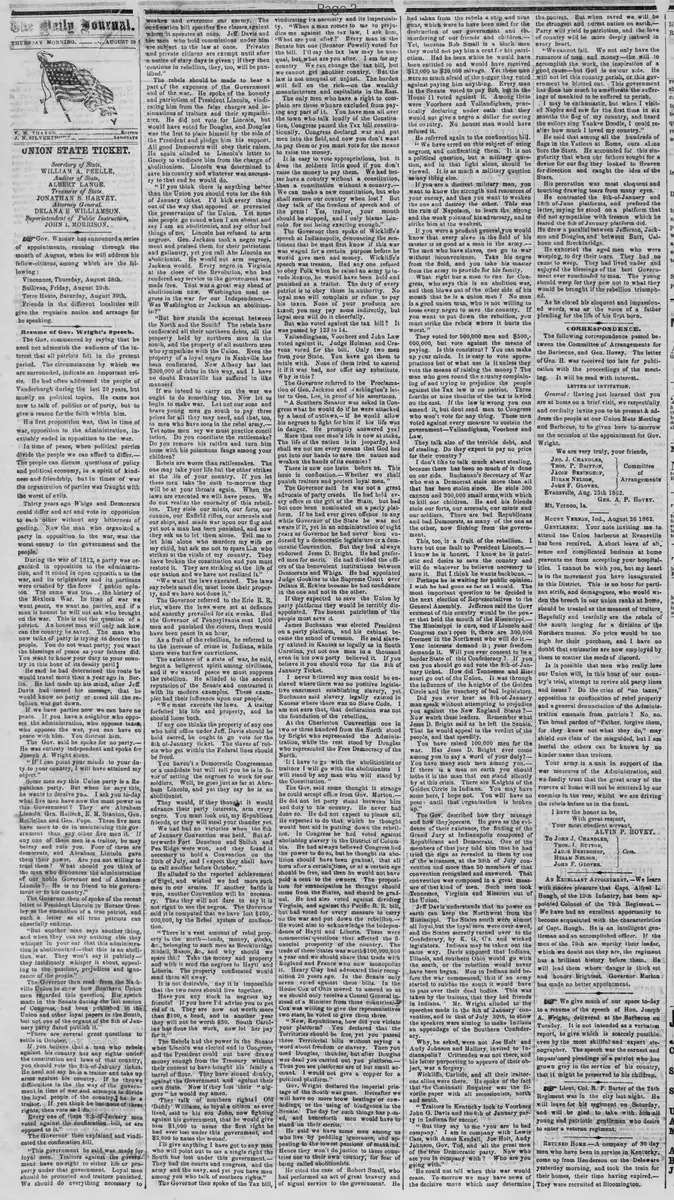
For Secretary of State,
WILLIAM A. PEELLE.
For Auditor of State,
ALBERT LANGE.
For Treasurer of State,
JONATHAN S. HARVEY.
For Attorney General,
DELANA E. WILLIAMSON.
For Superintendent of Public Instruction,
JOHN I. MORRISON.
Gov. Wright has announced a series of appointments, running through the month of August, when he will address his fellow-citizens, among which are the following:
Vincennes, Thursday, August 28th.
Sullivan, Friday, August 29th.
Terre Haute, Saturday, August 30th.
Friends in the different localities will give the requisite notice and arrange for the speaking.
Resume of Gov. Wright's Speech.
The Gov. commenced by saying that he need not admonish the audience of the interest that all patriots felt in the present period. The circumstances by which we are surrounded, indicate an important crisis. He had often addressed the people of Vanderburgh during the last 20 years, but mostly on political topics. He came not now to talk of politics or of party, but to give a reason for the faith within him.
His first proposition was, that in time of war, opposition to the administration, inevitably ended in opposition to the war. In time of peace, when political parties divide the people we can afford to differ. The people can discuss questions of policy and political economy, in a spirit of kindness and friendship, but in times of war the organization of parties was fraught with the worst of evils.
Thirty years ago Whigs and Democrats could differ and act and vote in opposition to each other without any bitterness of feeling. Now the man who organized a party in opposition to the war, was the worst enemy to the government and the people.
During the war of 1812, a party was organized in opposition to the administration, and it ended in open opposition to the war, and its originators and its partisans were crushed by the force of public opinion. The same was true in the history of the Mexican War. In time of war we want peace, we want no parties, and if a man is honest he will not ask who brought on the war. This is not the question of a patriot. An honest man will only ask how can the country be saved. The man who now talks of party is trying to deceive the people. You do not want party; you want the blessings of peace as your fathers did. You want to know your duty to your country in this hour of its deadly peril.
He said he had determined the route he would travel more than a year ago in Berlin. He had made up his mind, after Jeff Davis had issued his message, that he would know no party or creed till the rebellion was put down.
If we have parties now we can have no peace. If you have a neighbor who opposes the administration, who opposes taxes, who opposes the war, you can have no peace with him. You distrust him.
The Gov. said he spoke for no party. He was entirely independent and spoke for Joseph A. Wright alone.
"If I can point your minds to your duty to your country, I will have attained my object."
Some men say this Union party is a Republican party. But when he says this, he wants to deceive you. I ask you to-day what five men have now the most power in this Government? They are Abraham Lincoln, Gen. Halleck, E. M. Stanton, Gen. McClellan and Gen. Pope. These five men have more to do in maintaining this government than any other five men in it. If any one of these men is a traitor, he may betray and ruin you. Four of these are democrats, and Abraham Lincoln gave them their power. Are you not willing to trust them? What should you think of the man who denounces the administration of our noble Governor and of Abraham Lincoln? He is no friend to his government or to his country."
The Governor then spoke of the recent letter of President Lincoln to Horace Greeley as the emanation of a true patriot, and such a letter as all true patriots can cheerfully endorse.
"But another man says another thing, and when they can say nothing else they whisper in your ear that this administration is abolitionized-that this is an abolition war. They won't say it publicly- they insidiously whisper it about, appealing to the passions, prejudices and ignorance of the people."
The Governor then read from the Nashville Union to show how Southern Union men regarded this question. His speech made in the Senate during the last session of Congress, had been published in the Union and other loyal papers in the South, but not one of the organs of the 8th of January party dared publish it.
"There are several great questions to settle in October. If you believe that a man who rebels against his country has any rights under the constitution and laws of that country, you should vote the 8th-of-January ticket. He need not say he is a traitor and take up arms against his country. If he throws difficulties in the way of the government in time of war and attempts to divide the loyal people of the country, he is a traitor. If you think he has none of these rights, then vote as I do."
Every one of these 8th-of-January men voted against the confiscation bill, or are opposed to it."
The Governor then explained and vindicated the confiscation bill.
"This government he said was made for loyal men. Traitors against the government have no right to either life or property under that government. Loyal men should be protected and traitors punished. We should do everything necessary to weaken and overcome our enemy. The confiscation bill specifies five classes, against whom it operates at once. Jeff. Davis and the men who hold commissions under him are subject to the law at once. Privates and private citizens are exempt until after a notice of sixty days is given; if they then continue in rebellion, they, too, will be punished."
The rebels should be made to bear a part of the expenses of the Government and of the war. He spoke of the honesty and patriotism of President Lincoln, vindicating him from the false charges and insinuations of traitors and their sympathizers. He did not vote for Lincoln, but would have voted for Douglas, and Douglas was the first to place himself by the side of the President and pledge him his support.
All good Democrats will obey their rulers. He again alluded to Lincoln's letter to Greeley to vindicate him from the charge of abolitionism. Lincoln was determined to save his country and whatever was necessary to that end he would do.
"If you think there is anything better than the Union you should vote for the 8th of January ticket. I'd kick every thing out of the way that opposed or prevented the preservation of the Union. Yet some nice people go round when I am absent and say I am an abolitionist, and say other bad things of me. Lincoln has refused to arm negroes. Gen. Jackson took a negro regiment and praised them for their patriotism and gallantry, yet you call Abe Lincoln an abolitionist. He would not arm negroes, Jackson would. Every negro in Virginia at the close of the Revolution, who had rendered any service to the government was made free. That was a great way ahead of abolitionism now. Washington used negroes in the war for our Independence. Was Washington or Jackson an abolitionist?"
"But how stands the account between the North and the South? The rebels have confiscated all their northern debts, all the property held by northern men in the south, and the property of all southern men who sympathize with the Union. Even the property of a loyal negro in Nashville has been confiscated. New Albany has lost $300,000 of debts in this way, and I have no doubt Evansville has suffered in like manner. If we intend to carry on the war we ought to do something too. Now let us begin to make war. Let not our sons and brave young men go south to pay three prices for all they may need, and that, too, to men who have sons in the rebel army. Yet some men say we must practice conciliation. Do you conciliate the rattlesnake? Do you remove his rattles and turn him loose with his poisonous fangs among your children?
Rebels are worse than rattlesnakes. The one may take your life but the other strikes at the life of your country. If you let these men take the oath to-morrow they will be at your throats again. When the laws are executed we will have peace. We do not realize the enormity of this rebellion. They stole our mints, our forts, our cannon, our Enfield rifles, our arsenals and our ships, and made war upon our flag and yet not a man has been punished, and now they ask us to let them alone. Tell me to let him alone who murders my wife or my child, but ask me not to spare him who strikes at the vitals of my country. They have broken the constitution and you must restore it. They are striking at the life of our nation and we have not realized it."
"We want the laws executed. The laws say rebels must die; must lose their property, and we have not done it."
The Governor referred to the Erie R. R. riot, where the laws were set at defiance and anarchy prevailed for six weeks. Had the Governor of Pennsylvania sent 1,000 men and punished the rioters, there would have been peace in an hour.
As a fruit of the rebellion, he referred to the increase of crime in Indiana, while there were but few convictions.
The existence of a state of war, he said begot a belligerent spirit among civilians, and if we wanted peace we must suppress the rebellion. He alluded to the ancient reputation of the Senate and contrasted it with its modern examples. These examples had their influence upon our people.
"We must execute the laws. A traitor forfeited his life and property, and he should lose both. If any one thinks the property of any one who held office under Jeff. Davis should be held sacred, he ought to go vote for the 8th of-January ticket. The slaves of rebels who get within the Federal lines should be freed.
You haven't a Democratic Congressman or a candidate but will tell you he is in favor of setting the negroes to work for our soldiers. Well, he goes just as far as Abraham Lincoln, and yet they say he is an abolitionist.
They would, if they thought it would advance their party interests, arm every negro. You must look out, my Republican friends, or they will steal your thunder yet.
We had had no victories when the 8th of January Convention was held. But afterwards Fort Donelson and Shiloh and Pea Ridge were won, and they found it necessary to hold a Convention on the 30th of July, and I expect they shall have to call another before October."
He alluded to the reported achievement of Sigel, and wished we had more such men in our armies. If another battle is won, another Convention will be necessary. Then they will not dare to say it is not right to use the negroes. The Governor said it is computed that we have lost $400,000,000, by the Rebel system of confiscation.
"There is a vast amount of rebel property in the north-lands, money, stocks, &c., belonging to such men as Breckinridge, Slidell, Mason, &c., and why should we spare this? Take the money and property and with it send the negroes to Hayti and Liberia. The property confiscated would send them all away.
It is not desirable, nay it is impossible that the two races should live together. Have you any stock in negroes my friends? If you have I'd advise you to get rid of it. They are now not worth more than $100 a head, and in another year they will not be worth $50. South Carolina has done the work, now let her pay for it."
The Rebels had the power in the Senate when Lincoln was elected and in Congress, and the President could not have drawn money enough from the Treasury without their consent to have bought his family a barrel of flour. They have sinned doubly, against the Government and against their own State. Now if they lost their "niggers" he would say amen.
They talk of southern rights! Old 'Daddy' Williams, as loyal a citizen as ever lived, said to his son John, now fighting against his government, that he would give him $1,000 to name the first right he had ever lost under this government, and $2,000 to name the second.
I'll give anything I have got to any man who will point out to me a single right the South has lost under this government. They had the courts and congress, and the army and the navy, and yet you have men among you who talk of southern rights."
The Governor then spoke of the Tax bill vindicating its necessity and its impartiality. "When a man comes to me to prejudice me against the tax law, I ask him, What are you after?' Every man in the Senate but one (Senator Powell) voted for the bill. I'll say the tax law may be unequal, but what are you after. I am for my country. We can change the tax bill, but we cannot get another country. But the law is not unequal or unjust. The burden will fall on the rich-on the wealthy manufacturers and capitalists in the East. The only men who have a right to complain are those who are excluded from paying any part of it. You have men all over the town who talk loudly of the Constitution. Congress passed the Tax bill constitutionally. Congress declared war and put men into the field, and now you don't want to pay them or you must vote for the means to raise the money.
It is easy to vote appropriations, but it does the soldiers little good if you don't raise the money to pay them. We had better have a country without a constitution, than a constitution without a country. We can make a new constitution, but who shall restore our country when lost? But they talk of the freedom of speech and of the press! Yes, traitor, your mouth should be stopped, and I only blame Lincoln for not being exacting enough."
The Governor then spoke of Wickliffe's speech at Indianapolis, denouncing the sentiment that he must first know if this war was waged for a certain purpose before he would give men and money. Wickliffe's speech was treason. Had any one refused to obey Polk when he raised an army to invade Mexico, he would have been held and punished as a traitor. The duty of every patriot is to obey those in authority. No loyal man will complain or refuse to pay his taxes. None of your products are taxed; you may pay some indirectly, but loyal men will do it cheerfully.
But who voted against the tax bill? It was passed by 123 to 14. Vallandigham, Voorhees and John Law voted against it. Judge Holman and Cravens voted for the bill. Only two men from your State. You have got them to settle with. None of them tried to amend it if it was bad, nor offer any substitute. Why is this?
The Governor referred to the Proclamation of Gen. Jackson and Washington's letter to Gen. Lee, in proof of his assertions.
"A Southern Senator was asked in Congress what he would do if he were attacked by a band of outlaws,-if he would allow his negroes to fight for him if his life was in danger. He promptly answered yes!
More than one man's life is now at stake, The life of the nation is in jeopardy, and shall we not use every means that God has put into our hands to save the nation and weaken the hands of its enemies?
There is now one issue before us. This issue is confiscation. Whether we shall punish traitors and protect loyal men.
The Governor said he was not a great advocate of party creeds. He had held every office in the gift of the State, but had but once been nominated on a party platform. If he had ever given offence to any while Governor of the State he was not aware of it, yet in an administration of eight years as Governor he had never been endorsed by a democratic legislature or a democratic Convention. But they had always endorsed Jesse D. Bright. He had preferred men for merit. He had divided the offices of the benevolent institutions between Democrats and Whigs. He had appointed Judge Gookins to the Supreme Court over Delana R. Eckles because he had confidence in the one and not in the other.
If they expected to save the Union by party platforms they would be terribly disappointed. The honest patriotism of the people must save it.
James Buchanan was elected President on a party platform, and his cabinet became the school of treason. He said slavery existed in Kansas as legally as in South Carolina, yet not one man in a thousand even in his own party believed it. If you believe it you should vote for the 8th of January Ticket.
I never believed any man could be enslaved where there was no positive legislative enactment establishing slavery, yet Buchanan said slavery legally existed in Kansas where there was no Slave Code. I am not sure that that declaration was not the foundation of the rebellion.
At the Charleston Convention one in two or three hundred from the North stood by Bright who represented the Administration, while the rest stood by Douglas who represented the Free Democracy of the North.
If I have to go with the abolitionists or traitors I will go with the abolitionists. I will stand by any man who will stand by the Constitution.
The Gov. said some thought it strange he could accept office from Gov. Morton. He did not let party stand between him and duty to his country. He never had done so. He did not expect to please all. He expected to do that which he thought would best aid in putting down the rebellion. In Congress he had voted against abolishing slavery in the District of Columbia. He had always believed Congress had the power to do so, but he thought its abolition should have been gradual, that all born after a certain time, or at a certain age should be free, and then he would not have paid a cent to the owners. The proposition for emancipation he thought should come from the States, and should be gradual. He had also voted against dividing Virginia, and against the Pacific R. R. bill, but had voted for every measure to carry on the war and put down the rebellion. He voted also to acknowledge the independence of Hayti and Liberia. These were commercial questions that affected the financial prosperity of the country. The trade of these States was worth $100,000,000 a year and we should share that trade with England and France who now monopolize it. Henry Clay had advocated their recognition 20 years ago. In the Senate only seven voted against these bills. In the House Cox of Ohio moved to amend so as we should only receive a Consul General instead of a Minister from these countries. Cox was willing to give the representatives two stars, he voted to give them three.
"Now, Republicans, how did you violate your platform? You declared that the Territories should be free, yet you passed three Territorial bills without saying a word about freedom or slavery. Then you used Douglas's thunder, but after Douglas was dead you carried out your platform. Thus you see platforms are of but small account. I would not give a copper for a political platform."
Gov. Wright declared the imperial prestige of the South was gone. Hereafter we will have no more brow beatings or cow hidings, or the using of bludgeons in the Senate. The day for such things has passed, and henceforth men would have to stand on their merits.
He said we have some men among us who live by peddling ignorance, and appealing to the lowest passions of mankind. Hence they won't do justice to these countries nor to their own country, for fear of being called abolitionists.
He cited the case of Robert Small, who had performed an act of great bravery and of signal service to the government. He had taken from the rebels a ship and nine guns, which were to have been used for the destruction of our government and the murdering of our friends and children. Yet, because Bob Small is a black man they would not pay him a cent for his patriotism. Had he been white he would have been entitled to and would have received $13,000 to $20,000 salvage. Yet these men were so much afraid of the nigger they voted against paying him anything. Every man in the Senate voted to pay Bob, but in the House 11 voted against it. Among these were Voorhees and Vallandigham, practically declaring under oath that they would not give a negro a dollar for saving the country. No honest man would have refused it.
He referred again to the confiscation bill. "We have erred on this subject of using negroes, and confiscating them. It is not a political question, but a military question, and in that light alone, should be viewed. It is as much a military question as anything else.
If you are a discreet military man, you want to know the strength and resources of your enemy, and then you want to weaken the one and destroy the other. This was the rule of Napoleon, to learn the strong and the weak points of his adversary, and to strike him at the weakest.
If you were a prudent general, you would know that every slave in the field of his master is as good as a man in the army. The men who have slaves, can go to war without inconvenience. Take his negro from the field, and you take his master from the army to provide for his family.
What right has a man to run for Congress, who says this is an abolition war, and then blows out of the other side of his mouth that he is a union man? No man is a good union man, who is not willing to lose every negro to save the country. If you want to put down the rebellion, you must strike the rebels where it hurts the worst.
They voted for 500,000 men and $500,000,000, but vote against the means of paying. Is this consistent? You can make up your minds. It is easy to vote appropriations but of what use is it unless they vote the means of raising the money? The man who goes round the country complaining of and trying to prejudice the people against the Tax law is no patriot. Three fourths or nine tenths of the tax is levied on the east. If the law is wrong you can amend it, but dont send men to Congress who won't vote for any thing. These men voted against every measure to sustain the government-Vallandigham, Voorhees and Law.
They talk also of the terrible debt, and of stealing. Do they expect to pay no price for their country?
I don't like to talk much about stealing, because there has been so much of it done on our side. Buchanan's Secretary of War who was a Democrat stole more than all that has been stolen since. He stole 300 cannon and 300,000 small arms, with which to kill our children. He and his friends stole our forts, our arsenals, our mints and our soldiers. There are bad Republicans and bad Democrats, as many of the one as the other, now filching from the government.
This, too, is a fruit of the rebellion. I have but one fault to President Lincoln. I know he is honest. I know he is patriotic and desires to save the country and will do whatever he believes necessary to save it. But I think he wants backbone. Perhaps he is waiting for public opinion. I wish he had gone as far as I would. The most important question to be decided is the next election of Representatives to the General Assembly. Jefferson said the Government of this country would be the power that held the mouth of the Mississippi. The Mississippi is ours, and if Lincoln and Congress can't open it, there are 300,000 freemen in the Northwest who will do it. Your interests demand it; your freedom demands it. Will you ever consent to be a border State of this Confederacy? If you can you should go and vote the 8th-of-January ticket. How did Tennessee and Missouri go out of the Union. It was through the influence of the Knights of the Golden Circle and the treachery of bad legislators.
Did you ever hear an 8th-of-January man speak without attempting to prejudice you against the New England States ?
Now watch these leaders. Remember what Jesse D. Bright said as he left the Senate. That he would appeal to the verdict of the people, and that speedily.
You have raised 100,000 men for the war. Has Jesse D. Bright ever come among you to say a word of your duty? You have many such men among you. If there is a man on earth you should loathe it is the man that can stand silently by at this crisis. There are Knights of the Golden Circle in Indiana. You may have some here, I hope not. You will have no peace until that organization is broken up."
The Gov. described how they manage and how they operate. He gave as the evidence of their existence, the finding of the Grand Jury at Indianapolis composed of Republicans and Democrats. One of the members of that jury told him that he had tried the sign as revealed to them by one of the witnesses, at the 30th of July convention and more than 50 members of that convention recognised and answered. That convention was composed in a great measure of that kind of men. Such men took Tennessee, Virginia and Missouri out of the Union.
Jeff Davis understands that no power on earth can keep the Northwest from the Mississippi. The States south were almost all loyal, but the loyal men were over-awed, and the States secretly turned over to the Confederacy, by K. G. C's. and wicked legislators. Indiana may be taken out the same way. Davis supposed that Indiana, Illinois, and southern Ohio would go with the south, or the rebellion would never have been begun. Men in Indiana said before the war commenced, that if an army started to subdue the south it would have to pass over their dead bodies. This was taken by the traitors, that they had friends in Indiana. Mr. Wright alluded to the speeches made in the 8th of January convention, and in that of July 30th, to show the speakers were aiming to make Indiana an appendage of the Southern Confederacy.
Why, he asked, were not Joe Holt and Andy Johnson and Mallory invited to Indianapolis? Crittenden was not there, and his letter purporting to approve of their object, was a forgery. Wickliffe, Carlisle, and all their traitorous allies were there. He spoke of the fact that the Cincinnati Enquirer was the favorite paper with all secessionists, north and south.
"Traitors in Kentucky look to Voorhees, John G. Davis and the 8th of January party in Indiana for succor.
"But they say to me 'you are in bad company.' I am in company with Lewis Cass, with Amos Kendall, Joe Holt, Andy Johnson, Gov. Tod, and all the great men of the true Democratic party. Now who are you in company with? Who are you going with."
He could not tell when this war would cease. To-morrow we may have news of the decisive move which may determine the contest. But when saved we will be the strongest and purest nation on earth. Party will yield to patriotism, and the love of country will be more deeply imbued in every heart.
"We cannot fail. We not only have the resources of men and money-the will to accomplish the work, the inspiration of a good cause-but God is on our side. He will not let this country perish, or this government be blotted out. This government has done too much to ameliorate the sufferings of mankind to be suffered to perish.
I may be enthusiastic, but when I visited Naples and saw for the first time in six months the flag of my country, and heard the sailors sing Yankee Doodle, I could realize how much I loved my country."
He said that among all the hundreds of flags in the Vatican at Rome, ours alone bore the Stars. He accounted for this singularity that when our fathers sought for a device for our flag they looked to Heaven for direction and caught the idea of the Stars.
His peroration was most eloquent and touching drawing tears from many eyes. He contrasted the 8th-of-January and 18th of-June platforms, and preferred the latter, saying he stood on a platform that did not sympathise with treason which he feared the 8th of January platform did.
He drew a parallel between Jefferson, Jackson and Douglas, and between Burr, Calhoun and Breckinridge.
He exhorted the aged men who were weeping, to dry their tears. They had no cause to weep. They had lived under and enjoyed the blessings of the best Government ever vouchsafed to man. The young should weep for they knew not to what they would be brought if the rebellion triumphed.
As he closed his eloquent and impassioned words, was as the voice of a father pleading for the life of his first born.
What sub-type of article is it?
What themes does it cover?
What keywords are associated?
What entities or persons were involved?
Where did it happen?
Story Details
Key Persons
Location
Indiana, Vincennes, Sullivan, Terre Haute, Vanderburgh
Event Date
August 28th, 29th, 30th
Story Details
Announcement of Union State Ticket candidates and Gov. Wright's speaking schedule. Resume of Wright's speech advocating Union support, criticizing war opposition and 8th-of-January party, defending Lincoln administration, confiscation bill, tax law, and use of negroes in war efforts for military necessity.