Thank you for visiting SNEWPapers!
Sign up free
Editorial
January 28, 1925
The Dispatch News
Lexington, Lexington County, South Carolina
What is this article about?
Editorial emphasizing the role of habits in personal success and happiness, using the biography of Joseph Pulitzer's rise from immigrant poverty to media mogul through persistent reading and effort.
Clipping
OCR Quality
98%
Excellent
Full Text
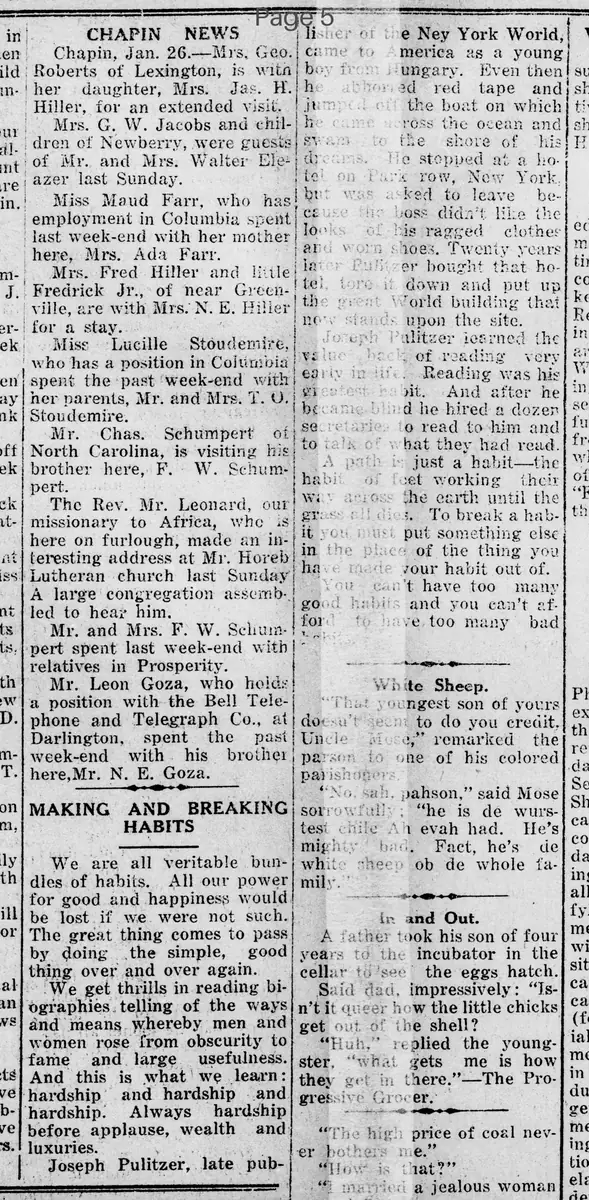
MAKING AND BREAKING HABITS
We are all veritable bundles of habits. All our power for good and happiness would be lost if we were not such. The great thing comes to pass by doing the simple, good thing over and over again.
We get thrills in reading biographies, telling of the ways and means whereby men and women rose from obscurity to fame and large usefulness. And this is what we learn: hardship and hardship and hardship. Always hardship before applause, wealth and luxuries.
Joseph Pulitzer, late publisher of the New York World, came to America as a young man from Hungary. Even then he hated red tape and missed the boat on which he was to cross the ocean and walked to the shore of his adopted land. He stopped at a cheap hotel on the Bowery, New York. The clerk refused to take his ragged clothes and shoes. Twenty years later he bought that hotel, tore it down and put up the World building that stands upon the site.
Pulitzer learned the joy of reading very early. Reading was his delight. And after he had made his fortune he hired a dozen readers to read to him and questioned them as to what they had read. It was just a habit--the habit of getting the best out of life. To form a habit, concentrate on the thing you want to do until the earth seems to turn the other way. To break a habit, put something else in its place--something that will crowd your habit out of your mind. You can't have too many good habits and you can't afford to have too many bad ones.
We are all veritable bundles of habits. All our power for good and happiness would be lost if we were not such. The great thing comes to pass by doing the simple, good thing over and over again.
We get thrills in reading biographies, telling of the ways and means whereby men and women rose from obscurity to fame and large usefulness. And this is what we learn: hardship and hardship and hardship. Always hardship before applause, wealth and luxuries.
Joseph Pulitzer, late publisher of the New York World, came to America as a young man from Hungary. Even then he hated red tape and missed the boat on which he was to cross the ocean and walked to the shore of his adopted land. He stopped at a cheap hotel on the Bowery, New York. The clerk refused to take his ragged clothes and shoes. Twenty years later he bought that hotel, tore it down and put up the World building that stands upon the site.
Pulitzer learned the joy of reading very early. Reading was his delight. And after he had made his fortune he hired a dozen readers to read to him and questioned them as to what they had read. It was just a habit--the habit of getting the best out of life. To form a habit, concentrate on the thing you want to do until the earth seems to turn the other way. To break a habit, put something else in its place--something that will crowd your habit out of your mind. You can't have too many good habits and you can't afford to have too many bad ones.
What sub-type of article is it?
Self Improvement
Personal Habits
What keywords are associated?
Habits
Self Improvement
Joseph Pulitzer
Biography
Success
Hardship
Reading
What entities or persons were involved?
Joseph Pulitzer
New York World
Editorial Details
Primary Topic
Making And Breaking Habits For Success
Stance / Tone
Encouraging And Motivational
Key Figures
Joseph Pulitzer
New York World
Key Arguments
Humans Are Bundles Of Habits Essential For Good And Happiness
Success Comes From Repeating Simple Good Actions
Biographies Show Hardship Precedes Fame And Wealth
Pulitzer Rose From Poverty Through Persistent Effort And Reading
Form Habits By Intense Concentration
Break Bad Habits By Replacing With Good Ones