Thank you for visiting SNEWPapers!
Sign up free
Story
September 12, 1869
The Morning Star And Catholic Messenger
New Orleans, Orleans County, Louisiana
What is this article about?
An essay advocating for early sensory and moral education in children, emphasizing the first year's importance, benefits of German-originated kindergartens, and parental responsibilities, while addressing deprived children.
Clipping
OCR Quality
95%
Excellent
Full Text
GENERAL MISCELLANY
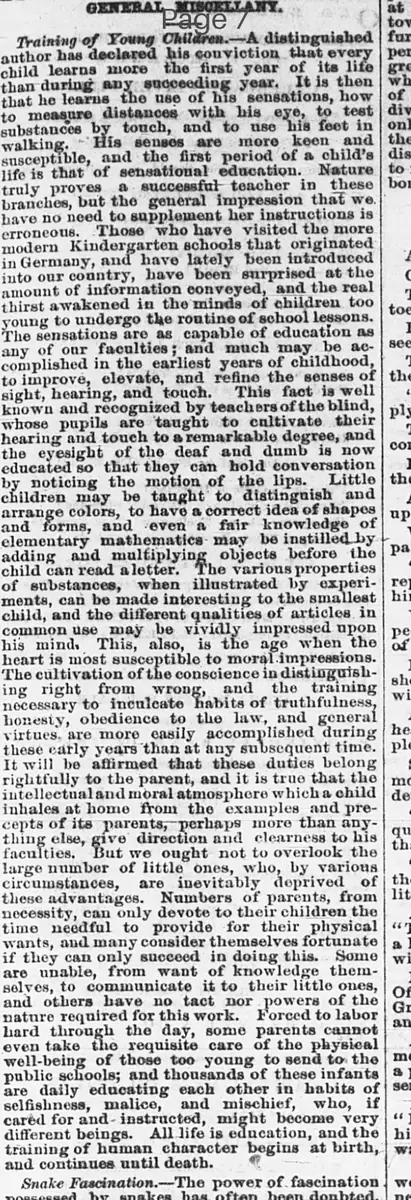
The author has declared his resolution that every child learns more in the first year of its life than during any succeeding year. It is then that he learns the use of his sensations, how to measure distances with his eye, to test substances by touch, and to use his foot in walking. His senses are more keen and susceptible, and the first period of a child's life is that of sensational education. Nature truly proves a successful teacher in these branches, but the general impression that we have no need to supplement her instructions is erroneous. Those who have visited the more modern Kindergarten schools that originated in Germany, and have lately been introduced into our country, have been surprised at the amount of information conveyed, and the real thirst awakened in the minds of children too young to undergo the routine of school lessons.
The sensations are as capable of education as any of our faculties; and much may be accomplished in the earliest years of childhood, to improve, elevate, and refine the senses of sight, hearing, and touch. This fact is well known and recognized by teachers of the blind, whose pupils are taught to cultivate their hearing and touch to a remarkable degree, and the eyesight of the deaf and dumb is now educated so that they can hold conversation by noticing the motion of the lips. Little children may be taught to distinguish and arrange colors, to have a correct idea of shapes and forms, and even a fair knowledge of elementary mathematics may be instilled by adding and multiplying objects before the child can read a letter. The various properties of substances, when illustrated by experiments, can be made interesting to the smallest child, and the different qualities of articles in common use may be vividly impressed upon his mind. This, also, is the age when the heart is most susceptible to moral impressions. The cultivation of the conscience in distinguishing right from wrong, and the training necessary to inculcate habits of truthfulness, honesty, obedience to the law, and general virtues, are more easily accomplished during those early years than at any subsequent time.
It will be affirmed that these duties belong rightfully to the parent, and it is true that the intellectual and moral atmosphere which a child inhales at home from the examples and precepts of its parents, perhaps more than anything else, give direction and clearness to his faculties. But we ought not to overlook the large number of little ones, who, by various circumstances, are inevitably deprived of these advantages. Numbers of parents, from necessity, can only devote to their children the time needful to provide for their physical wants, and many consider themselves fortunate if they can only succeed in doing this. Some are unable, from want of knowledge themselves, to communicate it to their little ones, and others have no tact nor powers of the nature required for this work. Forced to labor hard through the day, some parents cannot even take the requisite care of the physical well-being of those too young to send to the public schools; and thousands of these infants are daily educating each other in habits of selfishness, malice, and mischief, who, if cared for and instructed, might become very different beings. All life is education, and the training of human character begins at birth, and continues until death.
The author has declared his resolution that every child learns more in the first year of its life than during any succeeding year. It is then that he learns the use of his sensations, how to measure distances with his eye, to test substances by touch, and to use his foot in walking. His senses are more keen and susceptible, and the first period of a child's life is that of sensational education. Nature truly proves a successful teacher in these branches, but the general impression that we have no need to supplement her instructions is erroneous. Those who have visited the more modern Kindergarten schools that originated in Germany, and have lately been introduced into our country, have been surprised at the amount of information conveyed, and the real thirst awakened in the minds of children too young to undergo the routine of school lessons.
The sensations are as capable of education as any of our faculties; and much may be accomplished in the earliest years of childhood, to improve, elevate, and refine the senses of sight, hearing, and touch. This fact is well known and recognized by teachers of the blind, whose pupils are taught to cultivate their hearing and touch to a remarkable degree, and the eyesight of the deaf and dumb is now educated so that they can hold conversation by noticing the motion of the lips. Little children may be taught to distinguish and arrange colors, to have a correct idea of shapes and forms, and even a fair knowledge of elementary mathematics may be instilled by adding and multiplying objects before the child can read a letter. The various properties of substances, when illustrated by experiments, can be made interesting to the smallest child, and the different qualities of articles in common use may be vividly impressed upon his mind. This, also, is the age when the heart is most susceptible to moral impressions. The cultivation of the conscience in distinguishing right from wrong, and the training necessary to inculcate habits of truthfulness, honesty, obedience to the law, and general virtues, are more easily accomplished during those early years than at any subsequent time.
It will be affirmed that these duties belong rightfully to the parent, and it is true that the intellectual and moral atmosphere which a child inhales at home from the examples and precepts of its parents, perhaps more than anything else, give direction and clearness to his faculties. But we ought not to overlook the large number of little ones, who, by various circumstances, are inevitably deprived of these advantages. Numbers of parents, from necessity, can only devote to their children the time needful to provide for their physical wants, and many consider themselves fortunate if they can only succeed in doing this. Some are unable, from want of knowledge themselves, to communicate it to their little ones, and others have no tact nor powers of the nature required for this work. Forced to labor hard through the day, some parents cannot even take the requisite care of the physical well-being of those too young to send to the public schools; and thousands of these infants are daily educating each other in habits of selfishness, malice, and mischief, who, if cared for and instructed, might become very different beings. All life is education, and the training of human character begins at birth, and continues until death.
What sub-type of article is it?
Educational Essay
Child Development
What themes does it cover?
Moral Virtue
Family
What keywords are associated?
Early Childhood Education
Sensory Development
Moral Impressions
Kindergarten Schools
Parental Duties
Story Details
Story Details
The article argues that children learn most in their first year through sensations and that early education of senses and morals is crucial, highlighting kindergartens from Germany and the role of parents, while noting many children lack proper guidance.