Thank you for visiting SNEWPapers!
Sign up free
Literary
December 17, 1857
Litchfield Enquirer
Litchfield, Litchfield County, Connecticut
What is this article about?
An essay on the etymology of words such as 'miser,' 'passion,' 'kind,' 'prude,' 'pagan,' 'poltroon,' 'tariff,' and 'bigot,' drawing moral lessons about human failings, virtue, and historical contexts like Christianity's spread and cowardice in war.
Clipping
OCR Quality
88%
Good
Full Text
History of Words.
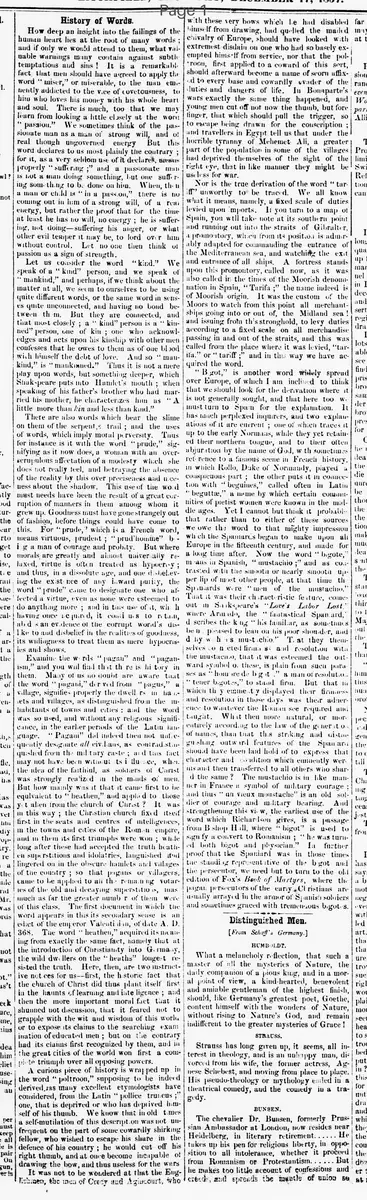
How deep an insight into the failings of the human heart lies at the root of many words; and if only we would attend to them, what valuable warnings many contain against subtle temptations and sins! It is a remarkable fact that men should have agreed to apply the word "miser," or miserable, to the man eminently addicted to the vice of covetousness, to him who loves his money with his whole heart and soul. There is much, too that we may learn from looking a little closely at the word "passion." We sometimes think of the passionate man as a man of strong will, and of real though ungoverned energy. But this word declares to us most plainly the contrary; for it, as a very seldom use of it declares, means properly "suffering;" and a passionate man is not a man doing something, but one suffering something to be done on him. When, thus a man or child is "in a passion," there is no coming out in him of a strong will, of a real energy, but rather the proof that for the time at least he has no will, no energy; he is suffering, not doing—suffering his anger, or whatever other evil temper it may be, to lord over him without control. Let no one then think of passion as a sign of strength.
Let us consider the word "kind." We speak of a "kind" person, and we speak of "mankind," and perhaps, if we think about the matter at all, we seem to ourselves to be using quite different words, or the same word in senses quite unconnected, and having no bond between them. But they are connected, and that most closely; a "kind" person is a "kinded" person, one of kin; one who acknowledges and acts upon his kinship with other men confesses that he owes to them as of one blood with himself the debt of love. And so "mankind," is "man-kinued." Thus it is not a mere play upon words, but something deeper, which Shakspeare puts into Hamlet's mouth; when speaking of his father's brother who had married his mother, he characterizes him as "A little more than kin and less than kind."
There are also words which bear the slime on them of the serpent's trail; and the uses of words which imply moral perversity. Thus for instance is it with the word "prude," signifying as it now does, a woman with an over-scrupulous affectation of a modesty which she does not really feel, and betraying the absence of the reality by this over preciseness and niceness about the shadow. This use of the word must needs have been the result of a great corruption of manners in them among whom it grew up. Goodness must have gone strangely out of fashion, before things could have come to this. For "prude," which is a French word, means virtuous, prudent; "prud'homme" being a man of courage and probity. But where morals are greatly and almost universally relaxed, virtue is often treated as hypocrisy; and thus, in a dissolute age, and one disbelieving the existence of any inward purity, the word "prude" came to designate one who affected a virtue, even as none were esteemed to do anything more; and in this use of it, which having once acquired, it could not return, and stands as an evidence of the corrupt world's dislike to and disbelief in the realities of goodness, its willingness to treat them as mere hypocrisies and shows.
Examine the words "pagan" and "paganism," and you will find that there is history in them. Many of us no doubt are aware that the word "pagani," derived from "pagus," a village, signifies properly the dwellers in habits and villages, as distinguished from the inhabitants of towns and cities: and the word was so used, and without any religious significance, in the earlier periods of the Latin language. "Pagan" did indeed then not unfrequently designate all civilians, as contradistinguished from the military caste; and thus fact may not have been without its influence, when the idea of the faithful, as soldiers of Christ was strongly realized in the minds of men. But how mainly was it that it came first to be equivalent to "heathen," and applied to those yet alien from the church of Christ? It was in this way; the Christian church fixed itself first in the seats and centres of intelligence, in the towns and cities of the Roman empire, and in them its first triumphs were won; while long after these had accepted the truth heathen superstitions and idolatries, languished and lingered on in the obscure hamlets and villages of the country; so that pagans or villagers, came to be applied to all the Roman remaining votaries of the old and decaying superstition, as much as far the greater number of them were of this class. The first document in which the word appears in this its secondary sense is an edict of the emperor Valentinian, of date A. D. 368. The word "heathen," acquired its meaning from exactly the same fact, namely that at the introduction of Christianity into Germany, the wild dwellers on the "heaths" longest resisted the truth. Here, then, are two instructive notices for us—first, the historic fact that the church of Christ did thus plant itself first in the haunts of learning and intelligence; and then the more important moral fact that it shunned not discussion, that it feared not to grapple with the wit and wisdom of this world or to expose its claims to the searching examination of educated men; but on the contrary had its claims first recognized by them, and in the great cities of the world won first a complete triumph over all opposing powers.
A curious piece of history is wrapped up in the word "poltroon," supposing to be indeed derived as many excellent etymologists have considered, from the Latin "pollex truncus;" one, that is deprived or who has deprived himself of his thumb. We know that in old times a self-mutilation of this description was not unfrequent on the part of some cowardly shirking fellow, who wished to escape his share in the defence of his country: he would cut off his right thumb, and at once become incapable of drawing the bow, and thus useless for the wars. It was not to be wondered at that the Englishmen, the men of Crecy and Agincourt, who with these very bows which he had disabled himself from drawing, had galled the mailed chivalry of Europe, should have looked with extremest disdain on one who had so basely exempted himself from service, nor that the poltroon, first applied to a coward of this sort, should afterward become a name of scorn affixed to every base and cowardly evader of the duties and dangers of life. In Bonaparte's wars exactly the same thing happened, and young men cut off not now the thumb, but fore finger, that which should pull the trigger, so to escape being drawn for the conscription; and travellers in Egypt tell us that under the horrible tyranny of Mehemet Ali, a greater part of the population in some of the villages had deprived themselves of the sight of the right eye, that in like manner they might be useless for war.
Nor is the true derivation of the word "tariff" unworthy to be traced. We all know what it means, namely, a fixed scale of duties levied upon imports. If you turn to a map of Spain, you will take note at its southern point and running out into the straits of Gibraltar, a promontory, which from its position is admirably adapted for commanding the entrance of the Mediterranean sea, and watching the exit and entrance of all ships. A fortress stands upon this promontory, called now, as it was also called in the times of the Moorish domination in Spain, "Tarifa;" the name indeed is of Moorish origin. It was the custom of the Moors to watch from this point all merchant-ships going into or out of, the Midland sea! and issuing from this stronghold, to levy duties according to a fixed scale on all merchandise passing in and out of the straits, and this was called from the place where it was levied, "tarita," or "tariff;" and in this way we have acquired the word.
"Bigot," is another word widely spread over Europe, of which I am inclined to think that we should look for the derivation where it is not generally sought, and that here too we must turn to Spain for the explanation. It has much perplexed inquirers, and two explanations of it are current; one of which traces it up to the early Normans, while they yet retained their northern tongue, and to their often abjuration by the name of God, with sometimes reference to a famous scene in French history, in which Rollo, Duke of Normandy, played a conspicuous part; the other puts it in connection with "beguines," called often in Latin "beguttæ," a name by which certain communities of pietist women were known in the middle ages. Yet I cannot but think it probable that rather than to either of these sources we owe the word to that mighty impression which the Spaniards began to make upon all Europe in the fifteenth century, and made for a long time after. Now the word "bigote," means in Spanish, "mustachio;" and as contrasted with the smooth or nearly smooth upper lip of most other people, at that time the Spaniards wore "men of the mustacho." That it was their characteristic feature, comes out in Shakspeare's "Lover's Labor Lost," where Armado, the "fantastical Spaniard," describes the king "his familiar, as sometimes he was pleased to lean on his poor shoulder, and dally with his mustachio." That they themselves connected firmness and resolution with the mustachio, that it was esteemed the outward symbol of these, is plain from such phrases as "hombre de bigote," a man of resolution. "tener bigotes," to stand firm. But that it which they eminently displayed their firmness and resolution in those days was their adherence to whatever the Roman see required and taught. What then more natural, or more entirely according to the law of the genesis of names, than that this striking and distinguishing outward features of the Spaniard should have been laid hold of to express that character and condition which eminently was his and then transferred to all others who shared the same? The mustachio is in like manner in France a symbol of military courage; and thus "un vieux moustache" is an old soldier or courage and military bearing. And strengthening this view, the earliest use of the word which Richardson gives, is a passage from Bishop Hall, where "bigot" is used to signify a convert to Romanism; "he was turned both bigot and physician." In further proof that the Spaniard was in those times the standing representative of the bigot and the persecutor, we need but to turn to the old edition of Fox's Book of Martyrs, where the pagan persecutors of the early Christians are usually arrayed in the armor of Spanish soldiers and sometimes graced with tremendous bigots.
How deep an insight into the failings of the human heart lies at the root of many words; and if only we would attend to them, what valuable warnings many contain against subtle temptations and sins! It is a remarkable fact that men should have agreed to apply the word "miser," or miserable, to the man eminently addicted to the vice of covetousness, to him who loves his money with his whole heart and soul. There is much, too that we may learn from looking a little closely at the word "passion." We sometimes think of the passionate man as a man of strong will, and of real though ungoverned energy. But this word declares to us most plainly the contrary; for it, as a very seldom use of it declares, means properly "suffering;" and a passionate man is not a man doing something, but one suffering something to be done on him. When, thus a man or child is "in a passion," there is no coming out in him of a strong will, of a real energy, but rather the proof that for the time at least he has no will, no energy; he is suffering, not doing—suffering his anger, or whatever other evil temper it may be, to lord over him without control. Let no one then think of passion as a sign of strength.
Let us consider the word "kind." We speak of a "kind" person, and we speak of "mankind," and perhaps, if we think about the matter at all, we seem to ourselves to be using quite different words, or the same word in senses quite unconnected, and having no bond between them. But they are connected, and that most closely; a "kind" person is a "kinded" person, one of kin; one who acknowledges and acts upon his kinship with other men confesses that he owes to them as of one blood with himself the debt of love. And so "mankind," is "man-kinued." Thus it is not a mere play upon words, but something deeper, which Shakspeare puts into Hamlet's mouth; when speaking of his father's brother who had married his mother, he characterizes him as "A little more than kin and less than kind."
There are also words which bear the slime on them of the serpent's trail; and the uses of words which imply moral perversity. Thus for instance is it with the word "prude," signifying as it now does, a woman with an over-scrupulous affectation of a modesty which she does not really feel, and betraying the absence of the reality by this over preciseness and niceness about the shadow. This use of the word must needs have been the result of a great corruption of manners in them among whom it grew up. Goodness must have gone strangely out of fashion, before things could have come to this. For "prude," which is a French word, means virtuous, prudent; "prud'homme" being a man of courage and probity. But where morals are greatly and almost universally relaxed, virtue is often treated as hypocrisy; and thus, in a dissolute age, and one disbelieving the existence of any inward purity, the word "prude" came to designate one who affected a virtue, even as none were esteemed to do anything more; and in this use of it, which having once acquired, it could not return, and stands as an evidence of the corrupt world's dislike to and disbelief in the realities of goodness, its willingness to treat them as mere hypocrisies and shows.
Examine the words "pagan" and "paganism," and you will find that there is history in them. Many of us no doubt are aware that the word "pagani," derived from "pagus," a village, signifies properly the dwellers in habits and villages, as distinguished from the inhabitants of towns and cities: and the word was so used, and without any religious significance, in the earlier periods of the Latin language. "Pagan" did indeed then not unfrequently designate all civilians, as contradistinguished from the military caste; and thus fact may not have been without its influence, when the idea of the faithful, as soldiers of Christ was strongly realized in the minds of men. But how mainly was it that it came first to be equivalent to "heathen," and applied to those yet alien from the church of Christ? It was in this way; the Christian church fixed itself first in the seats and centres of intelligence, in the towns and cities of the Roman empire, and in them its first triumphs were won; while long after these had accepted the truth heathen superstitions and idolatries, languished and lingered on in the obscure hamlets and villages of the country; so that pagans or villagers, came to be applied to all the Roman remaining votaries of the old and decaying superstition, as much as far the greater number of them were of this class. The first document in which the word appears in this its secondary sense is an edict of the emperor Valentinian, of date A. D. 368. The word "heathen," acquired its meaning from exactly the same fact, namely that at the introduction of Christianity into Germany, the wild dwellers on the "heaths" longest resisted the truth. Here, then, are two instructive notices for us—first, the historic fact that the church of Christ did thus plant itself first in the haunts of learning and intelligence; and then the more important moral fact that it shunned not discussion, that it feared not to grapple with the wit and wisdom of this world or to expose its claims to the searching examination of educated men; but on the contrary had its claims first recognized by them, and in the great cities of the world won first a complete triumph over all opposing powers.
A curious piece of history is wrapped up in the word "poltroon," supposing to be indeed derived as many excellent etymologists have considered, from the Latin "pollex truncus;" one, that is deprived or who has deprived himself of his thumb. We know that in old times a self-mutilation of this description was not unfrequent on the part of some cowardly shirking fellow, who wished to escape his share in the defence of his country: he would cut off his right thumb, and at once become incapable of drawing the bow, and thus useless for the wars. It was not to be wondered at that the Englishmen, the men of Crecy and Agincourt, who with these very bows which he had disabled himself from drawing, had galled the mailed chivalry of Europe, should have looked with extremest disdain on one who had so basely exempted himself from service, nor that the poltroon, first applied to a coward of this sort, should afterward become a name of scorn affixed to every base and cowardly evader of the duties and dangers of life. In Bonaparte's wars exactly the same thing happened, and young men cut off not now the thumb, but fore finger, that which should pull the trigger, so to escape being drawn for the conscription; and travellers in Egypt tell us that under the horrible tyranny of Mehemet Ali, a greater part of the population in some of the villages had deprived themselves of the sight of the right eye, that in like manner they might be useless for war.
Nor is the true derivation of the word "tariff" unworthy to be traced. We all know what it means, namely, a fixed scale of duties levied upon imports. If you turn to a map of Spain, you will take note at its southern point and running out into the straits of Gibraltar, a promontory, which from its position is admirably adapted for commanding the entrance of the Mediterranean sea, and watching the exit and entrance of all ships. A fortress stands upon this promontory, called now, as it was also called in the times of the Moorish domination in Spain, "Tarifa;" the name indeed is of Moorish origin. It was the custom of the Moors to watch from this point all merchant-ships going into or out of, the Midland sea! and issuing from this stronghold, to levy duties according to a fixed scale on all merchandise passing in and out of the straits, and this was called from the place where it was levied, "tarita," or "tariff;" and in this way we have acquired the word.
"Bigot," is another word widely spread over Europe, of which I am inclined to think that we should look for the derivation where it is not generally sought, and that here too we must turn to Spain for the explanation. It has much perplexed inquirers, and two explanations of it are current; one of which traces it up to the early Normans, while they yet retained their northern tongue, and to their often abjuration by the name of God, with sometimes reference to a famous scene in French history, in which Rollo, Duke of Normandy, played a conspicuous part; the other puts it in connection with "beguines," called often in Latin "beguttæ," a name by which certain communities of pietist women were known in the middle ages. Yet I cannot but think it probable that rather than to either of these sources we owe the word to that mighty impression which the Spaniards began to make upon all Europe in the fifteenth century, and made for a long time after. Now the word "bigote," means in Spanish, "mustachio;" and as contrasted with the smooth or nearly smooth upper lip of most other people, at that time the Spaniards wore "men of the mustacho." That it was their characteristic feature, comes out in Shakspeare's "Lover's Labor Lost," where Armado, the "fantastical Spaniard," describes the king "his familiar, as sometimes he was pleased to lean on his poor shoulder, and dally with his mustachio." That they themselves connected firmness and resolution with the mustachio, that it was esteemed the outward symbol of these, is plain from such phrases as "hombre de bigote," a man of resolution. "tener bigotes," to stand firm. But that it which they eminently displayed their firmness and resolution in those days was their adherence to whatever the Roman see required and taught. What then more natural, or more entirely according to the law of the genesis of names, than that this striking and distinguishing outward features of the Spaniard should have been laid hold of to express that character and condition which eminently was his and then transferred to all others who shared the same? The mustachio is in like manner in France a symbol of military courage; and thus "un vieux moustache" is an old soldier or courage and military bearing. And strengthening this view, the earliest use of the word which Richardson gives, is a passage from Bishop Hall, where "bigot" is used to signify a convert to Romanism; "he was turned both bigot and physician." In further proof that the Spaniard was in those times the standing representative of the bigot and the persecutor, we need but to turn to the old edition of Fox's Book of Martyrs, where the pagan persecutors of the early Christians are usually arrayed in the armor of Spanish soldiers and sometimes graced with tremendous bigots.
What sub-type of article is it?
Essay
What themes does it cover?
Moral Virtue
Religious
Social Manners
What keywords are associated?
Etymology
Word Origins
Moral Insights
Human Failings
Passion
Prude
Pagan
Poltroon
Tariff
Bigot
Literary Details
Title
History Of Words.
Subject
Etymology Revealing Moral And Historical Insights
Key Lines
A Passionate Man Is Not A Man Doing Something, But One Suffering Something To Be Done On Him.
A Little More Than Kin And Less Than Kind.
The Word "Prude" Came To Designate One Who Affected A Virtue, Even As None Were Esteemed To Do Anything More
The Christian Church Fixed Itself First In The Seats And Centres Of Intelligence, In The Towns And Cities Of The Roman Empire
The Poltroon, First Applied To A Coward Of This Sort, Should Afterward Become A Name Of Scorn Affixed To Every Base And Cowardly Evader