Thank you for visiting SNEWPapers!
Sign up free
Editorial
November 10, 1850
The New York Herald
New York, New York County, New York
What is this article about?
Editorial defends the 1850 Fugitive Slave Law's constitutionality, refutes Judge Johnson's and Wm. Jay's objections on commissioners' judicial powers, mocks abolitionists' arguments on habeas corpus and jury trials, and contrasts pro-union republicans against divisive abolition party. (248 characters)
Clipping
OCR Quality
95%
Excellent
Full Text
The Question of the Day,
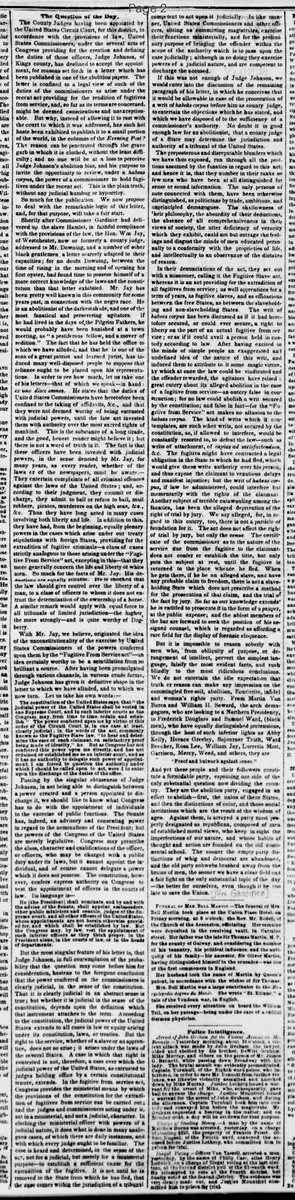
The County Judges having been appointed by the United States Circuit Court, for this district, in accordance with the provisions of law, United States Commissioners, under the several acts of Congress providing for the creation and defining the duties of those officers, Judge Johnson, of Kings county, has declined to accept the appointment, for reasons set forth in a letter which has been published in one of the abolition papers. The letter is confined to a legal view of such of the duties of the commissioners as arise under the recent act providing for the rendition of fugitives from service, and, so far as its terms are concerned, might be deemed conscientious and unexceptionable. But why, instead of allowing it to rest with the court to which it was addressed, has such hot haste been exhibited to publish it to a small portion of the world, in the columns of the Evening Post?
The reason can be penetrated through the grave garb in which it is clothed, without the least difficulty; and no one will be at a loss to perceive Judge Johnson's abolition bias, and his purpose to invite the opportunity to review, under a habeas corpus, the power of a commissioner to hold fugitives under the recent act. This is the plain truth without any judicial humbug or hypocrisy.
So much for the publication. We now propose to deal with the remarkable logic of this letter and, for that purpose, will take a fair start.
Shortly after Commissioner Gardiner had delivered up the slave Hamlet, in faithful compliance with the provisions of the law, the Hon. Wm Jay, of Westchester, now or formerly a county judge, addressed to Mr. Downing, and a number of other black gentlemen a letter scarcely adapted to their capacities; for no doubt Downing, between the time of rising in the morning and of opening his first oyster, had found time to possess himself of a more correct knowledge of the laws and the constitution than that letter exhibited. Mr. Jay has been pretty well known in this community for some years past, in connection with the negro race. He is an abolitionist of the darkest shade, and one of the most fanatical and persevering agitators. If he had lived in the days of the Pilgrim Fathers, he would probably have been banished at a town meeting, as "a pestiferous fellow, and a mover of sedition." The fact that he has held the office to which we have alluded, and that he is one of the sons of a great patriot and learned jurist, has induced many well-disposed people to suppose that reliance ought to be placed upon his representations. In order to see how much, let us take one of his letters—that of which we speak—in hand: ex uno disce omnes. He states that the duties of United States Commissioners have heretofore been confined to the taking of affidavits, &c., and that they were not deemed worthy of being entrusted with judicial powers, until the late act invested them with authority over the most sacred rights of mankind. This is the substance of a long tirade, and the good, honest reader might believe it: but there is not a word of truth in it. The fact is that these officers have been invested with judicial powers, in the sense denoted by Mr. Jay, for many years, as every reader, whether of the laws or of the newspapers, must be aware.— They entertain complaints of all criminal offences against the laws of the United States; and, according to their judgment, they commit or discharge, they admit to bail or refuse to bail, mail robbery, pirates, murderers on the high seas, &c., &c. Thus they have long acted in many cases involving both liberty and life. In addition to this, they have had, from the beginning, equally plenary powers in the cases which arise under our treaty stipulations with foreign States, providing for the extradition of fugitive criminals—a class of cases strictly analogous to those arising under the "Fugitive From Service" act, excepting in this—that they more generally concern the life and liberty of white men. So much for the facts of Mr. Jay. His deductions are equally reliable. He is shocked that the law should give control over the liberty of a man, to a class of officers to whom it does not entrust the determination of the ownership of a horse. A similar remark would apply with equal force to all tribunals of limited jurisdiction—the higher the more strongly—and is quite worthy of Dogberry.
With Mr. Jay, we believe, originated the idea of the unconstitutionality of the exercise by United States Commissioners of the powers conferred upon them by the "Fugitive From Service act"—an idea certainly worthy to be a scintillation from so brilliant a source. After having been promulgated through various channels, in various crude forms, Judge Johnson has given it definitive shape in the letter to which we have alluded, and to which we now turn. Let us take his own words:
The constitution of the United States says, that "the judicial power of the United States shall be vested in one Supreme Court, and in such inferior courts as the Congress may, from time to time, ordain and establish." The power conferred upon me by virtue of this order of the Circuit Court is, in one case at least, clearly judicial; in the words of the act, commonly known as the Fugitive Slave law, "to hear and determine the case of such claimant, on satisfactory proof being made of identity," &c. But as Congress has not conferred this power upon me directly, and has not ordained or established me as an inferior court, and as it has no authority to delegate such power of appointment, I am forced to question the authority under which I should be called upon to act, were I to enter upon the discharge of the duties of the office.
Passing by the singular obtuseness of Judge Johnson, in not being able to distinguish between a power created and a person appointed to discharge it, we should like to know what Congress has to do with the appointment of individuals to the exercise of public functions. The Senate has, indeed, an advisory and consenting power in regard to the nominations of the President; but the powers of the Congress of the United States are merely legislative. Congress may prescribe the class, character and qualifications of the officer, or officers, who may be charged with a public duty under its laws, but it cannot appoint the individual, and of course cannot delegate a power which it does not possess. The constitution, however, confers express authority on Congress to vest the appointment of officers in the courts of law. Its language is—
He [the President] shall nominate, and by and with the advice of the Senate, shall appoint ambassadors. other public ministers and consuls, judges of the Supreme court, and all other officers of the United States, whose appointments are not herein otherwise provided for, and which shall be established by law. But the Congress may, by law, vest the appointment of such inferior officers as they think proper, in the President alone, in the courts of law, or in the heads of departments.
But the most singular feature of his letter is, that Judge Johnson, in full contemplation of the probability that the question may come before him for consideration, hastens to the foregone conclusion that the power conferred on the commissioners is clearly judicial, in the sense of the constitution. That it is clearly judicial in an abstract sense is true; but whether it is judicial in the sense of the constitution, depends upon the definition which that instrument attaches to the term. According to the constitution, the judicial power of the United States extends to all cases in law or equity arising under its constitution, laws, or treaties. But the right to the service, whether of a slave or an apprentice, does not so arise; it arises under the laws of the several States. A case in which that right is contested is not, therefore, a case over which the judicial power of the United States, as entrusted to judges holding office by a certain constitutional tenure, extends. In the fugitive from service act, Congress provides the ministerial means by which the provisions of the constitution for the extradition of fugitives from service can be carried out: and the judges and commissioners acting under it, act in a ministerial, and not a judicial, character. In clothing the ministerial officer with powers of a judicial nature, it does what is done in many analogous cases, of which there are daily instances, and with which every judge ought to be familiar. The case is heard and determined, in the sense of the act, not for a judicial, but merely for a ministerial purpose—to establish a sufficient cause for the extradition of the fugitive. It is not until he is removed to the State from which he has fled, that the case comes within the jurisdiction of a tribunal competent to act upon it judicially. In like manner, United States Commissioners and other officers, sitting as committing magistrates, exercise their functions ministerially, and for the preliminary purpose of bringing the offender within the scope of the authority which is to pass upon the case judicially; although in so doing they exercise powers of a judicial nature, and are competent to discharge the accused.
If this was not enough of Judge Johnson, we would enter into the discussion of the remaining paragraph of his letter, in which he conceives that it would be allowable in case of the prosecution of a writ of habeas corpus before him as county judge, to entertain the objections which he has stated, and which we have disposed of to the sufficiency of a commissioner's authority. No doubt it is good enough law for an abolitionist, that a county judge of a State may determine the jurisdiction and authority of a tribunal of the United States.
The preposterous and disreputable blunders which we have thus exposed, run through all the positions assumed by the fanatics in regard to this act; and hence it is, that they number in their ranks so few men who have been at all distinguished for sense or sound information. The only persons of note connected with them, have been otherwise distinguished, as politicians by trade, ambitious, and unprincipled demagogues. The shallowness of their philosophy, the absurdity of their deductions, the absence of all comprehensiveness in their views of society, the utter deficiency of veracity which they exhibit, could not but outrage the feelings and disgust the minds of men educated personally to a conformity with the proprieties of life, and intellectually to an observance of the dictates of reason.
In their denunciations of the act, they set out with a misnomer, calling it the Fugitive Slave act, whereas it is an act providing for the extradition of all fugitives from service; as well apprentices for a term of years, as fugitive slaves, and as efficacious between the free States, as between the slaveholding and non-slaveholding States. The writ of habeas corpus has been discussed as if it had heretofore secured, or could ever secure, a right to liberty on the part of an actual fugitive from service; or as if it could avail a person held in custody according to law. After having excited in the minds of simple people an exaggerated and undefined idea of the nature of this writ, and induced them to attribute to it some magic virtue, by which at once the law could be vindicated and the offender rewarded, the agitators have raised a great outcry about its alleged abolition in the case of a fugitive from service—an outcry false in construction; for no law could abolish a writ secured by the constitution; and false in fact—for the "Fugitive from Service" act makes no allusion to the habeas corpus. The kind of writs which it contemplates, are such other writs, not secured by the constitution, as, if allowed to interfere, would be constantly resorted to, to defeat the law—such as writs of attachment, of capias ad satisfaciendum, &c. The fugitive might have contracted a legal obligation in the State to which he had fled, which would give these writs authority over his person, and thus expose the claimant to vexatious delays and manifest injustice; but the writ of habeas corpus, if law be administered, could interfere but momentarily with the rights of the claimant.
Another subject of terrible catawauling among the fanatics, has been the alleged deprivation of the right of trial by jury. We say alleged, for, in regard to this outcry, too, there is not a particle of foundation for it. The act does not affect the right of trial by jury, but only the venue. The certificate of the commissioner as to the nature of the service due from the fugitive to the claimant, does not confer or establish the title, but only puts the subject at rest, until the fugitive is returned to the place whence he fled. When he gets there, if he be an alleged slave, and have any probable claim to freedom, there is not a slaveholding State which does not prescribe a method for the prosecution of that claim, and the trial of the fact by jury. So far as our knowledge extends' he is entitled to prosecute it in the form of a pauper, at the public expense; and the ablest members of the bar are forward to seek the position of his assigned counsel, which is regarded as affording a rare field for the display of forensic eloquence.
But it is impossible to reason soberly with men who, 'from obliquity of purpose, or derangement of intellect, pervert the simplest language, falsify the most evident facts, and rush blindly to the most ridiculous conclusions.
We do not entertain the idle expectation that truth or reason can make any impression on the commingled free soil, abolition, Fourierite, infidel and woman's rights party. From Martin Van Buren and William H. Seward, the arch demagogues, who are looking to a Northern Presidency, to Frederick Douglass and Samuel Ward, (black men), who have equally distinguished pretensions, through the host of such inferior lights as Abby Kelly, Horace Greeley, Sojourner Truth, Ward Beecher, Rosa Lee, William Jay, Lucretia Mott. Garrison, Mercy, Weed, and others, they are "Proof and bulwark against sense."
And yet these people and their followers constitute a formidable party, espousing one side of the only substantial question now dividing the country. They are the abolition party, engaged in an effort to abolish—first, the union of these States, and then the distinctions of color, and those social institutions which are the result of the wisdom of ages. Against them, is arrayed a party most properly designated as republican, composed of men of established moral views, who keep in sight the imperfections of our nature, and whose habits of thought and action are founded on the old continental school. The sooner the empty party distinctions of whig and democrat are abandoned, and the old party cobwebs brushed away from the brains of men, the sooner we have a clear field and a fair fight on the only substantial topic of the day —the better for ourselves, even though it be too late to save the Union.
The County Judges having been appointed by the United States Circuit Court, for this district, in accordance with the provisions of law, United States Commissioners, under the several acts of Congress providing for the creation and defining the duties of those officers, Judge Johnson, of Kings county, has declined to accept the appointment, for reasons set forth in a letter which has been published in one of the abolition papers. The letter is confined to a legal view of such of the duties of the commissioners as arise under the recent act providing for the rendition of fugitives from service, and, so far as its terms are concerned, might be deemed conscientious and unexceptionable. But why, instead of allowing it to rest with the court to which it was addressed, has such hot haste been exhibited to publish it to a small portion of the world, in the columns of the Evening Post?
The reason can be penetrated through the grave garb in which it is clothed, without the least difficulty; and no one will be at a loss to perceive Judge Johnson's abolition bias, and his purpose to invite the opportunity to review, under a habeas corpus, the power of a commissioner to hold fugitives under the recent act. This is the plain truth without any judicial humbug or hypocrisy.
So much for the publication. We now propose to deal with the remarkable logic of this letter and, for that purpose, will take a fair start.
Shortly after Commissioner Gardiner had delivered up the slave Hamlet, in faithful compliance with the provisions of the law, the Hon. Wm Jay, of Westchester, now or formerly a county judge, addressed to Mr. Downing, and a number of other black gentlemen a letter scarcely adapted to their capacities; for no doubt Downing, between the time of rising in the morning and of opening his first oyster, had found time to possess himself of a more correct knowledge of the laws and the constitution than that letter exhibited. Mr. Jay has been pretty well known in this community for some years past, in connection with the negro race. He is an abolitionist of the darkest shade, and one of the most fanatical and persevering agitators. If he had lived in the days of the Pilgrim Fathers, he would probably have been banished at a town meeting, as "a pestiferous fellow, and a mover of sedition." The fact that he has held the office to which we have alluded, and that he is one of the sons of a great patriot and learned jurist, has induced many well-disposed people to suppose that reliance ought to be placed upon his representations. In order to see how much, let us take one of his letters—that of which we speak—in hand: ex uno disce omnes. He states that the duties of United States Commissioners have heretofore been confined to the taking of affidavits, &c., and that they were not deemed worthy of being entrusted with judicial powers, until the late act invested them with authority over the most sacred rights of mankind. This is the substance of a long tirade, and the good, honest reader might believe it: but there is not a word of truth in it. The fact is that these officers have been invested with judicial powers, in the sense denoted by Mr. Jay, for many years, as every reader, whether of the laws or of the newspapers, must be aware.— They entertain complaints of all criminal offences against the laws of the United States; and, according to their judgment, they commit or discharge, they admit to bail or refuse to bail, mail robbery, pirates, murderers on the high seas, &c., &c. Thus they have long acted in many cases involving both liberty and life. In addition to this, they have had, from the beginning, equally plenary powers in the cases which arise under our treaty stipulations with foreign States, providing for the extradition of fugitive criminals—a class of cases strictly analogous to those arising under the "Fugitive From Service" act, excepting in this—that they more generally concern the life and liberty of white men. So much for the facts of Mr. Jay. His deductions are equally reliable. He is shocked that the law should give control over the liberty of a man, to a class of officers to whom it does not entrust the determination of the ownership of a horse. A similar remark would apply with equal force to all tribunals of limited jurisdiction—the higher the more strongly—and is quite worthy of Dogberry.
With Mr. Jay, we believe, originated the idea of the unconstitutionality of the exercise by United States Commissioners of the powers conferred upon them by the "Fugitive From Service act"—an idea certainly worthy to be a scintillation from so brilliant a source. After having been promulgated through various channels, in various crude forms, Judge Johnson has given it definitive shape in the letter to which we have alluded, and to which we now turn. Let us take his own words:
The constitution of the United States says, that "the judicial power of the United States shall be vested in one Supreme Court, and in such inferior courts as the Congress may, from time to time, ordain and establish." The power conferred upon me by virtue of this order of the Circuit Court is, in one case at least, clearly judicial; in the words of the act, commonly known as the Fugitive Slave law, "to hear and determine the case of such claimant, on satisfactory proof being made of identity," &c. But as Congress has not conferred this power upon me directly, and has not ordained or established me as an inferior court, and as it has no authority to delegate such power of appointment, I am forced to question the authority under which I should be called upon to act, were I to enter upon the discharge of the duties of the office.
Passing by the singular obtuseness of Judge Johnson, in not being able to distinguish between a power created and a person appointed to discharge it, we should like to know what Congress has to do with the appointment of individuals to the exercise of public functions. The Senate has, indeed, an advisory and consenting power in regard to the nominations of the President; but the powers of the Congress of the United States are merely legislative. Congress may prescribe the class, character and qualifications of the officer, or officers, who may be charged with a public duty under its laws, but it cannot appoint the individual, and of course cannot delegate a power which it does not possess. The constitution, however, confers express authority on Congress to vest the appointment of officers in the courts of law. Its language is—
He [the President] shall nominate, and by and with the advice of the Senate, shall appoint ambassadors. other public ministers and consuls, judges of the Supreme court, and all other officers of the United States, whose appointments are not herein otherwise provided for, and which shall be established by law. But the Congress may, by law, vest the appointment of such inferior officers as they think proper, in the President alone, in the courts of law, or in the heads of departments.
But the most singular feature of his letter is, that Judge Johnson, in full contemplation of the probability that the question may come before him for consideration, hastens to the foregone conclusion that the power conferred on the commissioners is clearly judicial, in the sense of the constitution. That it is clearly judicial in an abstract sense is true; but whether it is judicial in the sense of the constitution, depends upon the definition which that instrument attaches to the term. According to the constitution, the judicial power of the United States extends to all cases in law or equity arising under its constitution, laws, or treaties. But the right to the service, whether of a slave or an apprentice, does not so arise; it arises under the laws of the several States. A case in which that right is contested is not, therefore, a case over which the judicial power of the United States, as entrusted to judges holding office by a certain constitutional tenure, extends. In the fugitive from service act, Congress provides the ministerial means by which the provisions of the constitution for the extradition of fugitives from service can be carried out: and the judges and commissioners acting under it, act in a ministerial, and not a judicial, character. In clothing the ministerial officer with powers of a judicial nature, it does what is done in many analogous cases, of which there are daily instances, and with which every judge ought to be familiar. The case is heard and determined, in the sense of the act, not for a judicial, but merely for a ministerial purpose—to establish a sufficient cause for the extradition of the fugitive. It is not until he is removed to the State from which he has fled, that the case comes within the jurisdiction of a tribunal competent to act upon it judicially. In like manner, United States Commissioners and other officers, sitting as committing magistrates, exercise their functions ministerially, and for the preliminary purpose of bringing the offender within the scope of the authority which is to pass upon the case judicially; although in so doing they exercise powers of a judicial nature, and are competent to discharge the accused.
If this was not enough of Judge Johnson, we would enter into the discussion of the remaining paragraph of his letter, in which he conceives that it would be allowable in case of the prosecution of a writ of habeas corpus before him as county judge, to entertain the objections which he has stated, and which we have disposed of to the sufficiency of a commissioner's authority. No doubt it is good enough law for an abolitionist, that a county judge of a State may determine the jurisdiction and authority of a tribunal of the United States.
The preposterous and disreputable blunders which we have thus exposed, run through all the positions assumed by the fanatics in regard to this act; and hence it is, that they number in their ranks so few men who have been at all distinguished for sense or sound information. The only persons of note connected with them, have been otherwise distinguished, as politicians by trade, ambitious, and unprincipled demagogues. The shallowness of their philosophy, the absurdity of their deductions, the absence of all comprehensiveness in their views of society, the utter deficiency of veracity which they exhibit, could not but outrage the feelings and disgust the minds of men educated personally to a conformity with the proprieties of life, and intellectually to an observance of the dictates of reason.
In their denunciations of the act, they set out with a misnomer, calling it the Fugitive Slave act, whereas it is an act providing for the extradition of all fugitives from service; as well apprentices for a term of years, as fugitive slaves, and as efficacious between the free States, as between the slaveholding and non-slaveholding States. The writ of habeas corpus has been discussed as if it had heretofore secured, or could ever secure, a right to liberty on the part of an actual fugitive from service; or as if it could avail a person held in custody according to law. After having excited in the minds of simple people an exaggerated and undefined idea of the nature of this writ, and induced them to attribute to it some magic virtue, by which at once the law could be vindicated and the offender rewarded, the agitators have raised a great outcry about its alleged abolition in the case of a fugitive from service—an outcry false in construction; for no law could abolish a writ secured by the constitution; and false in fact—for the "Fugitive from Service" act makes no allusion to the habeas corpus. The kind of writs which it contemplates, are such other writs, not secured by the constitution, as, if allowed to interfere, would be constantly resorted to, to defeat the law—such as writs of attachment, of capias ad satisfaciendum, &c. The fugitive might have contracted a legal obligation in the State to which he had fled, which would give these writs authority over his person, and thus expose the claimant to vexatious delays and manifest injustice; but the writ of habeas corpus, if law be administered, could interfere but momentarily with the rights of the claimant.
Another subject of terrible catawauling among the fanatics, has been the alleged deprivation of the right of trial by jury. We say alleged, for, in regard to this outcry, too, there is not a particle of foundation for it. The act does not affect the right of trial by jury, but only the venue. The certificate of the commissioner as to the nature of the service due from the fugitive to the claimant, does not confer or establish the title, but only puts the subject at rest, until the fugitive is returned to the place whence he fled. When he gets there, if he be an alleged slave, and have any probable claim to freedom, there is not a slaveholding State which does not prescribe a method for the prosecution of that claim, and the trial of the fact by jury. So far as our knowledge extends' he is entitled to prosecute it in the form of a pauper, at the public expense; and the ablest members of the bar are forward to seek the position of his assigned counsel, which is regarded as affording a rare field for the display of forensic eloquence.
But it is impossible to reason soberly with men who, 'from obliquity of purpose, or derangement of intellect, pervert the simplest language, falsify the most evident facts, and rush blindly to the most ridiculous conclusions.
We do not entertain the idle expectation that truth or reason can make any impression on the commingled free soil, abolition, Fourierite, infidel and woman's rights party. From Martin Van Buren and William H. Seward, the arch demagogues, who are looking to a Northern Presidency, to Frederick Douglass and Samuel Ward, (black men), who have equally distinguished pretensions, through the host of such inferior lights as Abby Kelly, Horace Greeley, Sojourner Truth, Ward Beecher, Rosa Lee, William Jay, Lucretia Mott. Garrison, Mercy, Weed, and others, they are "Proof and bulwark against sense."
And yet these people and their followers constitute a formidable party, espousing one side of the only substantial question now dividing the country. They are the abolition party, engaged in an effort to abolish—first, the union of these States, and then the distinctions of color, and those social institutions which are the result of the wisdom of ages. Against them, is arrayed a party most properly designated as republican, composed of men of established moral views, who keep in sight the imperfections of our nature, and whose habits of thought and action are founded on the old continental school. The sooner the empty party distinctions of whig and democrat are abandoned, and the old party cobwebs brushed away from the brains of men, the sooner we have a clear field and a fair fight on the only substantial topic of the day —the better for ourselves, even though it be too late to save the Union.
What sub-type of article is it?
Slavery Abolition
Constitutional
Partisan Politics
What keywords are associated?
Fugitive Slave Law
Abolitionists
Constitutional Power
Judicial Authority
Commissioners
Habeas Corpus
Jury Trial
What entities or persons were involved?
Judge Johnson
Wm Jay
Commissioner Gardiner
Martin Van Buren
William H. Seward
Frederick Douglass
Garrison
Editorial Details
Primary Topic
Defense Of Fugitive Slave Law Against Abolitionist Constitutional Challenges
Stance / Tone
Strongly Pro Law And Anti Abolitionist
Key Figures
Judge Johnson
Wm Jay
Commissioner Gardiner
Martin Van Buren
William H. Seward
Frederick Douglass
Garrison
Key Arguments
Commissioners Have Long Held Judicial Powers Over Life And Liberty In Criminal And Extradition Cases
Congress Can Vest Appointment Of Inferior Officers In Courts, Not Directly Appoint
Fugitive Slave Law Involves Ministerial, Not Judicial, Functions Under Constitution
Act Applies To All Fugitives From Service, Not Just Slaves
Habeas Corpus Not Abolished; Act Targets Other Interfering Writs
No Deprivation Of Jury Trial; Trial Occurs In State Of Origin