Thank you for visiting SNEWPapers!
Sign up free
Letter to Editor
June 15, 1870
Knoxville Weekly Chronicle
Knoxville, Knox County, Tennessee
What is this article about?
In this third letter, Col. John Baxter recounts his 1862 arrest in Memphis on suspicion of spying for Federals due to his anti-secession views, his imprisonment, diary excerpts reflecting on military oppression, and eventual release without investigation.
Clipping
OCR Quality
95%
Excellent
Full Text
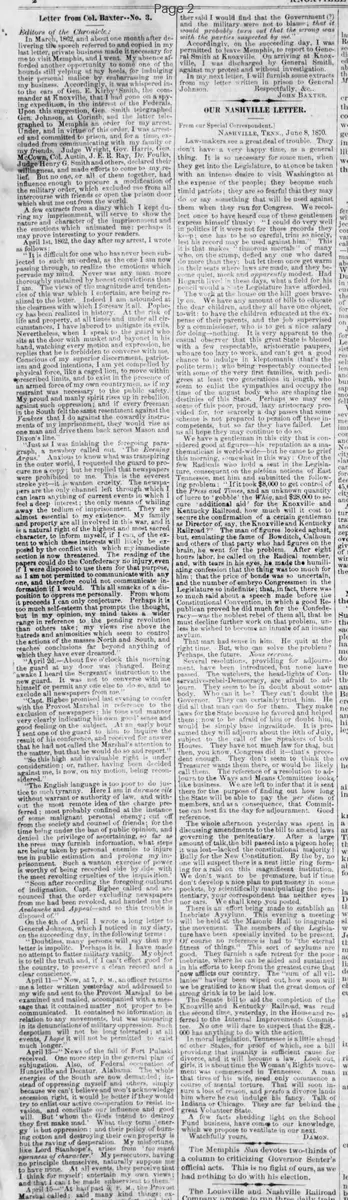
Letter from Col. Baxter--No. 3.
Editors of the Chronicle:
In March, 1862, and about one month after delivering the speech referred to and copied in my last letter, private business made it necessary for me to visit Memphis, and I went. My absence afforded another opportunity to some one of the hounds still yelping at my heels, for indulging their personal malice by embarrassing me in my business. Accordingly, it was whispered into the ears of Gen. E. Kirby Smith, the commander at Knoxville, that I had gone on a spying expedition, in the interest of the Federals. Upon this suggestion, Gen. Smith telegraphed Gen. Johnson, at Corinth, and the latter telegraphed to Memphis an order for my arrest. Under, and in virtue of this order, I was arrested and committed to prison, and for a time, excluded from communicating with my family or my friends. Judge Wright, Gov. Harris, Gen. McCown, Col. Austin, J. E. R. Ray, Dr. Foulks, Judge Henry G. Smith and others, declared their willingness, and made efforts to come to my relief. But no one, or all of them together, had influence enough to procure a modification of the military order, which excluded me from all intercourse with friends or open the prison door which shut me out from the world.
The nature and character of the imprisonment will serve to show the emotions which animated me during my imprisonment. A few extracts from a diary which I kept may prove interesting to your readers.
April 1st, 1862, the day after my arrest, I wrote as follows:
"It is difficult for one who has never been subjected to such an ordeal, as the one I am now passing through, to realize the emotions which pervade my mind. Never was any man more thoroughly sustained by honest convictions than I am. The views of the magnitude and tendencies of this war which I entertain, are being realized to the letter. Indeed I am astounded at the clearness with which I foresaw it all. Prophecy has been realized in history. At the risk of life and property, at all times and under all circumstances, I have labored to mitigate its evils. Nevertheless, when I speak to the guard who sits at the door with musket and bayonet in his hand, watching every motion and expression, he replies that he is forbidden to converse with me. Conscious of my superior discernment, patriotism and good intentions, I am yet compelled by prescribed limits, and to exist in the presence of physical force, like a caged lion, to move within an armed force of my own countrymen, as if my restraint was necessary to the public safety. My proud and manly spirit rises up in rebellion against such oppression; and if every freeman in the South felt the same resentment against the Yankees that I do against the cowardly instruments of my imprisonment, they would rise as one man and drive them back across Mason and Dixon's line."
"Just as I was finishing the foregoing paragraph, a newsboy called out. The Evening Argus.' Anxious to know what was transpiring in the outer world, I requested the guard to procure me a copy; but he replied that newspapers were prohibited to me. This is the severest stroke yet-it is wanton cruelty. The newspapers are the only channel left through which I can learn anything of current events in which I feel a deep interest; the only means of whiling away the tedium of imprisonment. They are almost essential to my existence. My family and property are all involved in this war, and it is a natural right of the highest and most sacred character, to inform myself, if I can, of the extent to which these interests will likely be exposed by the conflict with which my immediate section is now threatened. The reading of the papers could do the Confederacy no injury, even if I were disposed to use them for that purpose, as I am not permitted to communicate with any one, and therefore could not communicate information if I would. This all smacks of a disposition to oppress me personally. From whom it proceeds I can only conjecture. Perhaps it is too much self-esteem that prompts the thought, but in my opinion, my mind takes a wider range in reference to the pending revolution than others take; my views rise above the hatreds and animosities which seem to control the actions of the masses North and South, and reaches conclusions far beyond anything of which they have ever dreamed."
"April 2d.-About five o'clock this morning the guard at my door was changed. Being awake I heard the Sergeant's instruction to the new guard. It was not to converse with me himself or permit any one else to do so, and to exclude all newspapers from me."
"Capt. Bigbee promised last evening to confer with the Provost Marshal in reference to the exclusion of newspapers; his tone and manner very clearly indicating his own good sense and good feeling on the subject. At an early hour I sent one of the guard to him to inquire the result of his conference, and received for answer that he had not called the Marshal's attention to the matter, but that he would do so and report."
"So this high and invaluable right is under consideration; or, rather, having been decided against me, is now, on my motion, being reconsidered."
"The English language is too poor to do justice to such tyranny. Here I am in durance vile without warrant or authority of law, and without the most remote idea of the charge preferred; most probably confined at the instance of some malignant personal enemy: cut off from the society and counsel of friends; for the time being under the ban of public opinion, and denied the privilege of ascertaining, so far as the press may furnish information, what steps are being taken by personal enemies to injure me in public estimation and prolong my imprisonment. Such a wanton exercise of power is worthy of being recorded side by side with the most revolting cruelties of the inquisition."
"Soon after recording the foregoing outburst of indignation, Capt. Bigbee called and announced that the order excluding newspapers from me had been revoked, and handed me the Avalanche and Appeal-and so this trouble is disposed of."
On the 4th of April I wrote a long letter to General Johnson, which I noticed in my diary, on the succeeding day, in the following terms:
"Doubtless, many persons will say that my letter is impolitic. Perhaps it is. I have made no attempt to flatter military vanity. My object is to tell the truth and, if I can't effect good for the country, to preserve a clean record and a clear conscience.
April 11-"Now, at 7, P. M., an officer returns me a letter written yesterday and addressed to my wife and sent to the Provost Marshal to be examined and mailed, accompanied with a message that it contained matter not proper to be communicated. It contained no information in relation to any movements, but was unsparing in its denunciations of military oppression. Such despotism will not be long tolerated; at all events, I hope it will not be permitted to exist much longer."
April 13- News of the fall of Fort Pulaski received. One more step in the general plan of subjugation. Also, of Federal occupation of Huntsville and Decatur, Alabama: The whole energies of the South are now demanded: instead of oppressing myself and others, simply because we can't believe and won't acknowledge secession right, it would be better if they would try to enlist our active cooperation to resist invasion, and conciliate our influence and good will." But whom the gods intend to destroy they first make mad. This is but the raving of desperation. My misfortune, I think for myself; entertain my own views: and that I can't be made subservient to them."
ther said I would find that the Government (?) and the military were not to blame; that it would probably turn out that the wrong was with the parties suspected by me."
Accordingly, on the succeeding day, I was permitted to leave Memphis, to report to General Smith at Knoxville. On arriving at Knoxville, I was discharged by General Smith, against my protest and without investigation. In my next letter, I will furnish some extracts from my letter written in prison to General Johnson.
Respectfully, &c.,
John Baxter.
Editors of the Chronicle:
In March, 1862, and about one month after delivering the speech referred to and copied in my last letter, private business made it necessary for me to visit Memphis, and I went. My absence afforded another opportunity to some one of the hounds still yelping at my heels, for indulging their personal malice by embarrassing me in my business. Accordingly, it was whispered into the ears of Gen. E. Kirby Smith, the commander at Knoxville, that I had gone on a spying expedition, in the interest of the Federals. Upon this suggestion, Gen. Smith telegraphed Gen. Johnson, at Corinth, and the latter telegraphed to Memphis an order for my arrest. Under, and in virtue of this order, I was arrested and committed to prison, and for a time, excluded from communicating with my family or my friends. Judge Wright, Gov. Harris, Gen. McCown, Col. Austin, J. E. R. Ray, Dr. Foulks, Judge Henry G. Smith and others, declared their willingness, and made efforts to come to my relief. But no one, or all of them together, had influence enough to procure a modification of the military order, which excluded me from all intercourse with friends or open the prison door which shut me out from the world.
The nature and character of the imprisonment will serve to show the emotions which animated me during my imprisonment. A few extracts from a diary which I kept may prove interesting to your readers.
April 1st, 1862, the day after my arrest, I wrote as follows:
"It is difficult for one who has never been subjected to such an ordeal, as the one I am now passing through, to realize the emotions which pervade my mind. Never was any man more thoroughly sustained by honest convictions than I am. The views of the magnitude and tendencies of this war which I entertain, are being realized to the letter. Indeed I am astounded at the clearness with which I foresaw it all. Prophecy has been realized in history. At the risk of life and property, at all times and under all circumstances, I have labored to mitigate its evils. Nevertheless, when I speak to the guard who sits at the door with musket and bayonet in his hand, watching every motion and expression, he replies that he is forbidden to converse with me. Conscious of my superior discernment, patriotism and good intentions, I am yet compelled by prescribed limits, and to exist in the presence of physical force, like a caged lion, to move within an armed force of my own countrymen, as if my restraint was necessary to the public safety. My proud and manly spirit rises up in rebellion against such oppression; and if every freeman in the South felt the same resentment against the Yankees that I do against the cowardly instruments of my imprisonment, they would rise as one man and drive them back across Mason and Dixon's line."
"Just as I was finishing the foregoing paragraph, a newsboy called out. The Evening Argus.' Anxious to know what was transpiring in the outer world, I requested the guard to procure me a copy; but he replied that newspapers were prohibited to me. This is the severest stroke yet-it is wanton cruelty. The newspapers are the only channel left through which I can learn anything of current events in which I feel a deep interest; the only means of whiling away the tedium of imprisonment. They are almost essential to my existence. My family and property are all involved in this war, and it is a natural right of the highest and most sacred character, to inform myself, if I can, of the extent to which these interests will likely be exposed by the conflict with which my immediate section is now threatened. The reading of the papers could do the Confederacy no injury, even if I were disposed to use them for that purpose, as I am not permitted to communicate with any one, and therefore could not communicate information if I would. This all smacks of a disposition to oppress me personally. From whom it proceeds I can only conjecture. Perhaps it is too much self-esteem that prompts the thought, but in my opinion, my mind takes a wider range in reference to the pending revolution than others take; my views rise above the hatreds and animosities which seem to control the actions of the masses North and South, and reaches conclusions far beyond anything of which they have ever dreamed."
"April 2d.-About five o'clock this morning the guard at my door was changed. Being awake I heard the Sergeant's instruction to the new guard. It was not to converse with me himself or permit any one else to do so, and to exclude all newspapers from me."
"Capt. Bigbee promised last evening to confer with the Provost Marshal in reference to the exclusion of newspapers; his tone and manner very clearly indicating his own good sense and good feeling on the subject. At an early hour I sent one of the guard to him to inquire the result of his conference, and received for answer that he had not called the Marshal's attention to the matter, but that he would do so and report."
"So this high and invaluable right is under consideration; or, rather, having been decided against me, is now, on my motion, being reconsidered."
"The English language is too poor to do justice to such tyranny. Here I am in durance vile without warrant or authority of law, and without the most remote idea of the charge preferred; most probably confined at the instance of some malignant personal enemy: cut off from the society and counsel of friends; for the time being under the ban of public opinion, and denied the privilege of ascertaining, so far as the press may furnish information, what steps are being taken by personal enemies to injure me in public estimation and prolong my imprisonment. Such a wanton exercise of power is worthy of being recorded side by side with the most revolting cruelties of the inquisition."
"Soon after recording the foregoing outburst of indignation, Capt. Bigbee called and announced that the order excluding newspapers from me had been revoked, and handed me the Avalanche and Appeal-and so this trouble is disposed of."
On the 4th of April I wrote a long letter to General Johnson, which I noticed in my diary, on the succeeding day, in the following terms:
"Doubtless, many persons will say that my letter is impolitic. Perhaps it is. I have made no attempt to flatter military vanity. My object is to tell the truth and, if I can't effect good for the country, to preserve a clean record and a clear conscience.
April 11-"Now, at 7, P. M., an officer returns me a letter written yesterday and addressed to my wife and sent to the Provost Marshal to be examined and mailed, accompanied with a message that it contained matter not proper to be communicated. It contained no information in relation to any movements, but was unsparing in its denunciations of military oppression. Such despotism will not be long tolerated; at all events, I hope it will not be permitted to exist much longer."
April 13- News of the fall of Fort Pulaski received. One more step in the general plan of subjugation. Also, of Federal occupation of Huntsville and Decatur, Alabama: The whole energies of the South are now demanded: instead of oppressing myself and others, simply because we can't believe and won't acknowledge secession right, it would be better if they would try to enlist our active cooperation to resist invasion, and conciliate our influence and good will." But whom the gods intend to destroy they first make mad. This is but the raving of desperation. My misfortune, I think for myself; entertain my own views: and that I can't be made subservient to them."
ther said I would find that the Government (?) and the military were not to blame; that it would probably turn out that the wrong was with the parties suspected by me."
Accordingly, on the succeeding day, I was permitted to leave Memphis, to report to General Smith at Knoxville. On arriving at Knoxville, I was discharged by General Smith, against my protest and without investigation. In my next letter, I will furnish some extracts from my letter written in prison to General Johnson.
Respectfully, &c.,
John Baxter.
What sub-type of article is it?
Reflective
Historical
Political
What themes does it cover?
Military War
Politics
Constitutional Rights
What keywords are associated?
Civil War Imprisonment
Military Arrest
Unionist Opposition
Secession Criticism
Memphis 1862
Knoxville Discharge
Diary Extracts
What entities or persons were involved?
John Baxter
Editors Of The Chronicle
Letter to Editor Details
Author
John Baxter
Recipient
Editors Of The Chronicle
Main Argument
col. baxter describes his unjust arrest and imprisonment in memphis in march 1862 due to suspicions of union sympathies amid confederate military actions, using diary excerpts to illustrate the oppressive conditions and his resentment toward military tyranny during the civil war.
Notable Details
Arrest Ordered By Gen. E. Kirby Smith Via Gen. Johnson
Diary Entries From April 1 13, 1862
References To Fort Pulaski Fall And Federal Occupations
Denunciations Of Military Oppression And Secession
Revocation Of Newspaper Ban By Capt. Bigbee