Thank you for visiting SNEWPapers!
Sign up free
The Rhode Island American, And General Advertiser
Providence, Providence County, Rhode Island
What is this article about?
Article from New-York Evening Post explores the influence of diseased imagination on the body through three cases: a nobleman dying from a dream foretelling his death; a Jena student saved from self-fulfilling prophecy by Dr. Hufeland's intervention; and a farmer cursed to eternal cold, bedridden for 20 years until death.
Merged-components note: These two components continue the same literary article on 'Diseased Imagination' across pages, with sequential reading order and coherent text flow.
Clippings
1 of 2
OCR Quality
Full Text
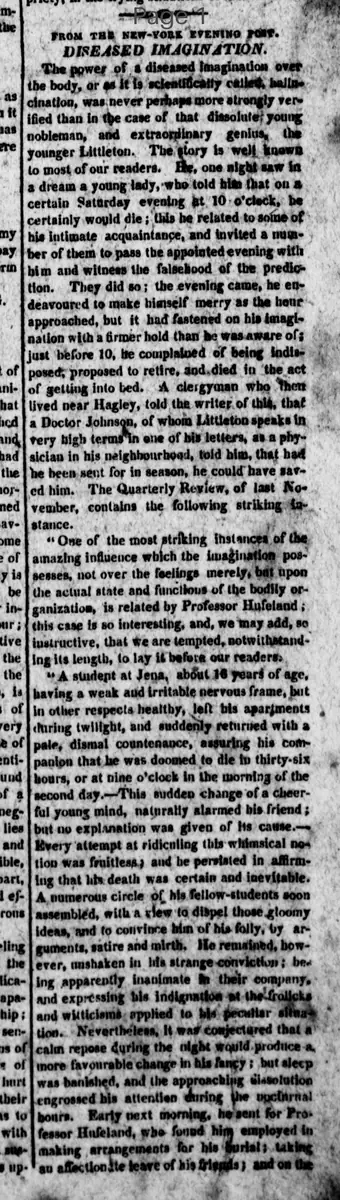
DISEASED IMAGINATION.
The power of a diseased imagination over the body, or as it is scientifically called hallucination, was never perhaps more strongly verified than in the case of that dissolute young nobleman, and extraordinary genius, the younger Littleton. The story is well known to most of our readers. He, one night saw in a dream a young lady, who told him that on a certain Saturday evening at 10 o'clock, he certainly would die; this he related to some of his intimate acquaintance, and invited a number of them to pass the appointed evening with him and witness the falsehood of the prediction. They did so; the evening came, he endeavoured to make himself merry as the hour approached, but it had fastened on his imagination with a firmer hold than he was aware of; just before 10, he complained of being indisposed, proposed to retire, and died in the act of getting into bed. A clergyman who then lived near Hagley, told the writer of this, that a Doctor Johnson, of whom Littleton speaks in very high terms in one of his letters, as a physician in his neighbourhood, told him, that had he been sent for in season, he could have saved him. The Quarterly Review, of last November, contains the following striking instance.
"One of the most striking instances of the amazing influence which the imagination possesses, not over the feelings merely but upon the actual state and functions of the bodily organization, is related by Professor Hueland; this case is so interesting, and, we may add, so instructive, that we are tempted, notwithstanding its length, to lay it before our readers.
" A student at Jena, about 16 years of age, having a weak and irritable nervous frame, but in other respects healthy, left his apartments during twilight, and suddenly returned with a pale, dismal countenance, assuring his companion that he was doomed to die in thirty-six hours, or at nine o'clock in the morning of the second day.--This sudden change of a cheerful young mind, naturally alarmed his friend; but no explanation was given of its cause.--Every attempt at ridiculing this whimsical notion was fruitless; and he persisted in affirming that his death was certain and inevitable. A numerous circle of his fellow-students soon assembled, with a view to dispel those gloomy ideas, and to convince him of his folly, by arguments, satire and mirth, He remained, however, unshaken in his strange conviction; being apparently inanimate in their company, and expressing his indignation at the frolicks and witticisms applied to his peculiar situation. -Nevertheless, it was conjectured that a calm repose during the night would produce a more favourable change in his fancy; but sleep was banished, and the approaching dissolution engrossed his attention during the nocturnal hours. Early next morning. he sent for Professor Hueland, who found him employed in making arrangements for his burial; taking an affectionate leave of his friends) and on the He was at the point of concluding a letter to his father: in which he announced the fatal catastrophe that was speedily to happen. After examining his condition of mind and body, the Professor could discover no remarkable deviation from his usual state of health, excepting a small contracted pulse, a pale countenance, dull or drowsy eyes, and cold extremities: these symptoms, however, sufficiently indicated a general spasmodic action of the nervous system, which also exerted its influence over the mental faculties. The most serious reasoning on the subject, and all the philosophical and medical eloquence of Dr. Hufeland, had not the desired effect: and though the student admitted that there might be no ostensible cause of death discoverable, yet this very circumstance was peculiar to his case; and such was his inexorable destiny, that he must die the next morning, without any visible morbid symptoms. In this dilemma, Dr. Hufeland proposed to treat him as a patient. Politeness induced the latter to accept of such offer, but he assured the physician, that medicines would not operate. As no time was to be lost, there being only 24 hours left for his life, Dr. Hufeland deemed proper to direct such remedies as prove powerful excitants, in order to rouse the vital energy of his pupil, and to relieve him from his captivated fancy. Hence he prescribed a strong emetic and purgative; ordered blisters to be applied to both calves of the legs, and at the same time stimulating clysters to be administered. Quietly submitting to the Doctor's treatment, he observed, that his body being already half a corpse, all means of recovering it would be in vain. Indeed, Dr. Hufeland was not a little surprised, on his repeating his visit in the evening, to learn that the emetic had but very little operated, and that the blisters had not even reddened the skin. The case became more serious; and the supposed victim of death began to triumph over the incredulity of the Professor and his friends. Thus circumstanced, Dr. Hufeland perceived, how deeply and destructively that mental spasm must have acted on the body, to produce a degree of insensibility from which the worst consequences might be apprehended. All the inquiries into the origin of this singular belief had hitherto been unsuccessful. Now only, he disclosed the secret to one of his intimate friends, namely, that on the preceding evening he had met with a white figure in the passage, which nodded to him, and, in the same moment, he heard a voice exclaiming—'The day after to-morrow, at nine o'clock in the morning, thou shalt die!'—He continued to settle his domestick affairs; made his will; minutely appointed his funeral; and even desired his friends to send for a clergyman; which request, however, was counteracted. Night appeared—and he began to compute the hours he had to live, till the ominous next morning. His anxiety evidently increased with the striking of every clock within hearing. Dr. Hufeland was not without apprehension, when he recollected instances in which mere imagination had produced melancholy effects—but, as every thing depended on procrastinating, or retarding that hour in which the event was predicted; and on appeasing the tempest of a perturbed imagination, till reason had again obtained the ascendancy, he resolved upon the following expedient: Having a complaisant patient, who refused not to take the remedies prescribed for him (because he seemed conscious of the superior agency of his mind over that of the body) Dr. Hufeland had recourse to laudanum, with the extract of hen-bane: twenty drops of the former, and two grains of the latter, were given to the youth, with such effect, that he fell into a profound sleep, from which he did not awake till eleven o'clock on the next morning. Thus, the prognosticated fatal hour elapsed; and his friends waiting to welcome the bashful patient, who had agreeably disappointed them, turned the whole affair into ridicule. The first question, however, after recovering from this artificial sleep, was—'What is the hour of the morning?'—On being informed that his presages had not been verified by experience, he assured the company that all these transactions appeared but a dream. After that time, being enjoyed a good state of health, and was completely cured of a morbid imagination.
Had this youth fallen into less sagacious hands, the event would, it is more than probable, have answered to the prediction; and the occurrence would have stood as irrefragable evidence of that creed which imagines that the times have not long since passed of individual and immediate communication between the world of sense and the world of spirit. How the fancy originated, it is difficult to say; but it is not less difficult to explain the phenomena of dreams.
In the Zoonomia, we meet with the following well authenticated tale, which has been versified by Mr. Wadsworth:
A young farmer in Warwickshire, finding his hedges broken, and the sticks carried away during a frosty season, determined to watch for the thief. He lay many cold hours under a hay-stack, and at length an old woman like a witch in a play, approached and began to pull up the hedge; he waited till she had tied her bottle of sticks, and was carrying them off, that he might convict her of the theft, and then springing from his concealment, he seized his prey with violent threats. After some altercation, in which her load was left upon the ground, she kneeled upon the bottle of sticks, and raising her arms to heaven, beneath the bright moon then at the full, spoke to the farmer, already shivering with cold, 'Heaven grant that thou mayest never know again the blessing to be warm!' He complained of cold all the next day, and wore an upper coat, and in a few days, another, and in a fortnight, took to his bed, always saying that nothing made him warm; he covered himself with very many blankets, and had a sieve over his face as he lay; and from this one insane idea he kept his bed above twenty years, or fear of the cold air, till at length—he died.
What sub-type of article is it?
What themes does it cover?
What keywords are associated?
Literary Details
Title
Diseased Imagination.
Subject
The Power Of A Diseased Imagination Over The Body
Form / Style
Prose Essay Recounting Medical Anecdotes
Key Lines