Thank you for visiting SNEWPapers!
Sign up free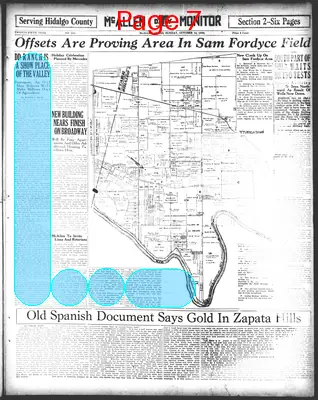
Mcallen Daily Monitor
Mcallen, Brownsville, Harlingen, Hidalgo County, Cameron County, Texas
What is this article about?
Oil magnate D. Davenport touts his 30,000-acre DD Ranch in Texas' Rio Grande Valley as a million-dollar agricultural success, growing hegira and beans without irrigation, raising cattle, horses, mules, poultry, and planning expansions amid optimism for ranching.
Clipping
OCR Quality
Full Text
A SHOW PLACE
OF THE VALLEY
Davenport, An Oil
Man, Believes Will
Make Millions Out
Of Agriculture.
By RALPH G. BRAY
"I'm going to make a million dol-
lars in the Valley."
That statement came from the
mouth of D. Davenport, big oil
man, who has probably the larg-
est lease acreage in Starr and Hi-
dalgo county of any one
But, and this will surprise you.
he was not talking about oil, but
agriculture.
"Yes, sir. You can tell the folks
that, and I'm ready to prove it."
continued the big rancher, whose
expansive acres thirty-five miles
northwest of Mission has already
become known as a show place.
Mr. Davenport's enthusiasm sur-
prised me considerably, in fact I
was skeptical to quite an extent
So I suggested that he give me
some concrete facts to go by and
a little proof of how he was go-
ing about the business of making
a million dollars in the agriculture
of the Valley
Bear in mind that Mr. Davenport
is, as far as we in the Valley are
concerned, primarily an oil man.
and also bear in mind that his
problems would seem to be doubly
complex, in that his ranch is all
far from the irrigated area.
I had been hearing a lot about
the Double D ranch, so last Sun-
day I decided to see what it look-
ed like. Stretching for a half dozen
miles or so on the rolling brush
lands that extend from Hidalgo
over into Starr counties, his place
despite lack of irrigation offers
rich farming possibilities.
When I asked Mr. Davenport
(the boys all call him D) what
he did for moisture, he laughed
and suggested that we get in his
car and drive through some of the
fields. One field of about 200 acres
contained the finest hegira that
I have seen. It was nearly as high
as a man's head and well head-
ed out. Mr. Davenport reminded
me that six months before that
field was in high brush. Hegira
is considered one of the best stock
feeds to be had.
"We prefer hegira because the
stock eat it all whereas with milo
maize or kaffir corn they leave a
lot of the stalk. We expect to put
in another hundred acres or two,"
Mr. Davenport said.
From the hegira field we drove
over and saw beans that were
eight inches high, and other crops
that are coming along fine, des-
p ite the fact that the middle of
October was approaching. Wright
Wilson, the burly foreman, whose
travelling exploits have taken him
into the wilds of Canada and
Alaska, but who now thinks that
the Valley is the only place on
earth to live, keeps a weather eye
on the crops, but his biggest charge
is the livestock on the ranch and
that is the larger part of this ar-
ticle that I am about to come to
Mr. Davenport has about 800
head of cattle, many of which are
pure bred Herefords. He is con-
stantly building up the quality of
his herd with fine bulls, and al-
though the cattle market, like the
many other markets has not been
conducive to an optimistic outlook
on the future of ranching, Davenport
and Wilson have some right
on their side and outlook
Eight hundred head of cattle is
a job in itself, but Mr. Wilson has
300 head of horses, many of them
very fine saddle animals to look
after, and horse is one of the more
promising, to my mind, fields in
which this big oil man who prefers
the life on the range, is engaged
On this ranch are three large lakes as
fine as the better ones to be found
in Missouri. Mr. Davenport believes
that there is always going to be
a good market for good mules and
those are the kind that he is rais-
ing on his ranch.
Besides the mule business he is
also keeping an eye on the pony
business or saddle horse business.
He has one of the finest saddle
type stallions to be found in this
part of Texas, and some of the
horses I saw, give evidence to the
fact that Mr. Davenport knows
horse flesh as well as oil sand.
But that wasn't all the live stock
I saw. For instance, there were
two or three hundred head of
turkeys, and several hundred head
of chickens, and when we arrived
at the ranch house it looked like
there were that many head of old
time Missouri coon dogs, but Mr.
Wilson explained that there were
just a dozen or so around the place.
The turkeys and chickens are
given free rein through the hegira
fields, and a great high woven
wire fence keeps out the coyotes,
and there are probably plenty of
them out there.
The barns and fences are made
with a view to permanency. All
of the corner posts are sunk in
concrete, and as evidence of this
brand of thrift was the general
appearance of cleanliness that pre-
vailed.
Mr. Davenport has plans
for
clearing several hundred acres ad-
joining the present ranch house,
which is not far from the center
of the thirty thousand acre pasture.
The small, but spic and span
ranchhouse is soon to be supple-
mented with a large and comfort-
able ranch home, which will be
grac ed by the new mistress of the
ranch, Mrs. Davenport, who, until
a couple of weeks ago, was Mrs.
Provine.
Mr. Davenport believes that the
Valley is an oil country, but he
also believes that it is an agri-
cultural paradise, and he is set-
ting out to prove it in a big way.
What sub-type of article is it?
What themes does it cover?
What keywords are associated?
What entities or persons were involved?
Where did it happen?
Story Details
Key Persons
Location
Dd Ranch, Thirty Five Miles Northwest Of Mission, Starr And Hidalgo Counties, Texas Valley
Event Date
Approaching Middle Of October
Story Details
D. Davenport, an oil man, enthusiastically promotes his DD Ranch as a successful agricultural venture without irrigation, featuring high-yield hegira fields, beans, 800 head of Hereford cattle, 300 horses including saddle stock and mules, turkeys, chickens, and plans for expansion and a new ranch house.