Thank you for visiting SNEWPapers!
Sign up free
Daily Yellowstone Journal
Miles City, Custer County, Montana
What is this article about?
Report claims 6,000 of Marquis de Mores' sheep died from poison by enemies in Dakota's Little Missouri Bad Lands, tied to O'Donnell's killing last year. Refutation attributes deaths to fall-clipped Merino breed shipped late and unadapted to snowy ranges; long-wooled sheep thrive.
Clipping
OCR Quality
Full Text
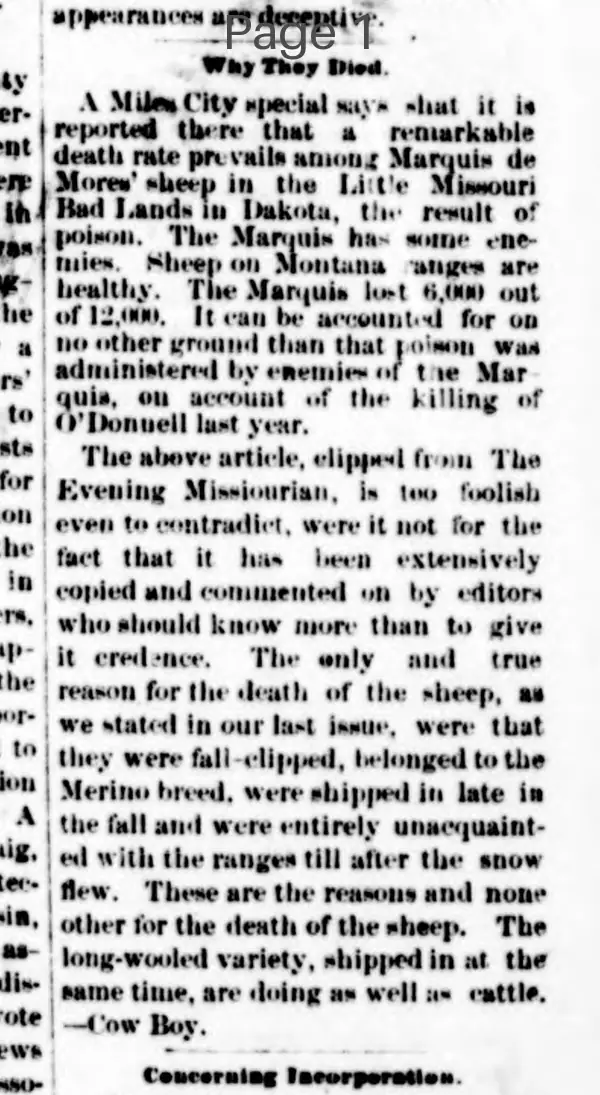
A Miles City special says that it is reported there that a remarkable death rate prevails among Marquis de Mores' sheep in the Little Missouri Bad Lands in Dakota, the result of poison. The Marquis has some enemies. Sheep on Montana ranges are healthy. The Marquis lost 6,000 out of 12,000. It can be accounted for on no other ground than that poison was administered by enemies of the Marquis, on account of the killing of O'Donnell last year.
The above article, clipped from The Evening Missourian, is too foolish even to contradict, were it not for the fact that it has been extensively copied and commented on by editors who should know more than to give it credence. The only and true reason for the death of the sheep, as we stated in our last issue, were that they were fall-clipped, belonged to the Merino breed, were shipped in late in the fall and were entirely unacquainted with the ranges till after the snow fell. These are the reasons and none other for the death of the sheep. The long-wooled variety, shipped in at the same time, are doing as well as cattle.
-Cow Boy.
What sub-type of article is it?
What keywords are associated?
What entities or persons were involved?
Where did it happen?
Domestic News Details
Primary Location
Little Missouri Bad Lands In Dakota
Key Persons
Outcome
the marquis lost 6,000 out of 12,000 sheep.
Event Details
A Miles City special reports a remarkable death rate among Marquis de Mores' sheep due to poison administered by enemies, linked to the killing of O'Donnell last year. Sheep on Montana ranges are healthy. The report is refuted as foolish; true reasons are that the sheep were fall-clipped, Merino breed, shipped late in fall, and unacquainted with ranges after snow fell. Long-wooled variety shipped at the same time are doing well.