Thank you for visiting SNEWPapers!
Sign up free
Story
November 28, 1876
Public Ledger
Memphis, Shelby County, Tennessee
What is this article about?
A commentary critiquing the exaggerated, imprecise language ('gushing') used by young women in social interactions, exemplified by casual conversations, and advising more thoughtful speech to preserve language integrity.
Clipping
OCR Quality
98%
Excellent
Full Text
Gushing in Social Life
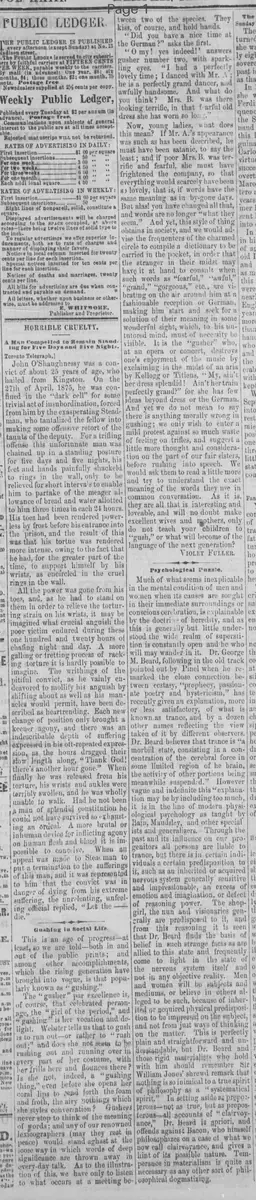
This is an age of progress—at least, so we are told—both in and out of the public prints; and among other accomplishments, which the rising generation have brought into vogue, is that popularly known as "gushing."
The "gusher" par excellence is, of course, that celebrated personage, the "girl of the period," and "gushing" is her vocation and delight. Webster tells us that to gush is to run out—or rather to "rush out;" and does she not seem to be rushing out and running over in every part of her costume, with her frills here and flounces there? Is she not, indeed, a "gushing thing," even before she opens her coral lips to rend forth the foam and froth, the airy nothings which she styles conversation? Gushers never stop to think of the meaning of words; and any of our renowned lexicographers (may they rest in peace) would stand aghast at the loose way in which words of deep significance are thrown away in every-day talk. As to the illustration of this, we have only to listen to what occurs at a meeting between two of the species. They kiss, of course, and hold hands. "Did you have a nice time at the German?" asks the first. "O my! yes indeed!" answers gusher number two, with sparkling eyes. "I had a perfectly lovely time: I danced with Mr. A.; he is a perfectly grand dancer, and awfully handsome. And what do you think? Mrs. B. was there looking terrific, in that fearful old dress she has worn so long."
Now, young ladies, what does this mean? If Mr. A.'s appearance was such as has been described, he must have been satanic, to say the least; and if poor Mrs. B. was terrific and fearful, she must have frightened the company, so that everything would scarcely have been so lovely, that is, if words have the same meaning as in by-gone days. But alas! you have changed all that, and words are no longer "what they seem." And yet, this style of thing obtains in society, and we would advise the frequenters of the charmed circle to compile a dictionary to be carried in the pocket, in order that the stranger in their midst may have it at hand to consult when such words as "fearful," "awful," "grand," "gorgeous," etc., are vibrating on the air around him at a fashionable reception or German, making him start and seek for a solution of their meaning in some wonderful sight, which, to his untutored mind, must of necessity be visible. It is the "gusher" who, at an opera or concert, destroys one's enjoyment of the music by exclaiming in the midst of an aria by Kellogg or Tietjens, "My, ain't her dress splendid! Ain't her train perfectly grand?" for she has few ideas beyond dress or the German. And yet we do not mean to say there is anything morally wrong in gushing; we only wish to enter a mild protest against so much waste of feeling on trifles, and suggest a little more thought and consideration on the part of our fair sisters, before rushing into speech. We would ask them to read a little more and try to understand the exact meaning of the words they use in common conversation. As it is, they are all that is interesting and loveable, and will no doubt make excellent wives and mothers, only do not teach your children to "gush," or what will become of the language of the next generation?
VIOLET FULLER
This is an age of progress—at least, so we are told—both in and out of the public prints; and among other accomplishments, which the rising generation have brought into vogue, is that popularly known as "gushing."
The "gusher" par excellence is, of course, that celebrated personage, the "girl of the period," and "gushing" is her vocation and delight. Webster tells us that to gush is to run out—or rather to "rush out;" and does she not seem to be rushing out and running over in every part of her costume, with her frills here and flounces there? Is she not, indeed, a "gushing thing," even before she opens her coral lips to rend forth the foam and froth, the airy nothings which she styles conversation? Gushers never stop to think of the meaning of words; and any of our renowned lexicographers (may they rest in peace) would stand aghast at the loose way in which words of deep significance are thrown away in every-day talk. As to the illustration of this, we have only to listen to what occurs at a meeting between two of the species. They kiss, of course, and hold hands. "Did you have a nice time at the German?" asks the first. "O my! yes indeed!" answers gusher number two, with sparkling eyes. "I had a perfectly lovely time: I danced with Mr. A.; he is a perfectly grand dancer, and awfully handsome. And what do you think? Mrs. B. was there looking terrific, in that fearful old dress she has worn so long."
Now, young ladies, what does this mean? If Mr. A.'s appearance was such as has been described, he must have been satanic, to say the least; and if poor Mrs. B. was terrific and fearful, she must have frightened the company, so that everything would scarcely have been so lovely, that is, if words have the same meaning as in by-gone days. But alas! you have changed all that, and words are no longer "what they seem." And yet, this style of thing obtains in society, and we would advise the frequenters of the charmed circle to compile a dictionary to be carried in the pocket, in order that the stranger in their midst may have it at hand to consult when such words as "fearful," "awful," "grand," "gorgeous," etc., are vibrating on the air around him at a fashionable reception or German, making him start and seek for a solution of their meaning in some wonderful sight, which, to his untutored mind, must of necessity be visible. It is the "gusher" who, at an opera or concert, destroys one's enjoyment of the music by exclaiming in the midst of an aria by Kellogg or Tietjens, "My, ain't her dress splendid! Ain't her train perfectly grand?" for she has few ideas beyond dress or the German. And yet we do not mean to say there is anything morally wrong in gushing; we only wish to enter a mild protest against so much waste of feeling on trifles, and suggest a little more thought and consideration on the part of our fair sisters, before rushing into speech. We would ask them to read a little more and try to understand the exact meaning of the words they use in common conversation. As it is, they are all that is interesting and loveable, and will no doubt make excellent wives and mothers, only do not teach your children to "gush," or what will become of the language of the next generation?
VIOLET FULLER
What sub-type of article is it?
Curiosity
What themes does it cover?
Social Manners
Moral Virtue
What keywords are associated?
Gushing
Social Manners
Language Misuse
Young Women
Exaggerated Speech
Victorian Society
What entities or persons were involved?
Girl Of The Period
Violet Fuller
Story Details
Key Persons
Girl Of The Period
Violet Fuller
Story Details
Critique of 'gushing' as exaggerated speech among young women, illustrated by social exchanges misusing words like 'awful' and 'grand' positively, urging precise language to avoid corrupting future generations.