Thank you for visiting SNEWPapers!
Sign up free
The New Hampshire Gazette
Portsmouth, Rockingham County, New Hampshire
What is this article about?
Detailed report on U.S. Congressional proceedings from January 12 to 29, 1837, covering debates and votes on the Tariff bill, Texas independence recognition, expunging resolutions (passed 24-19), public lands sales, education aid, slavery petitions and gag rules, Michigan state admission, and other bills in Senate and House.
Merged-components note: These two components form a continuous report on congressional proceedings, split across columns on page 2; merging based on sequential reading order and topic continuity.
Clipping
OCR Quality
Full Text
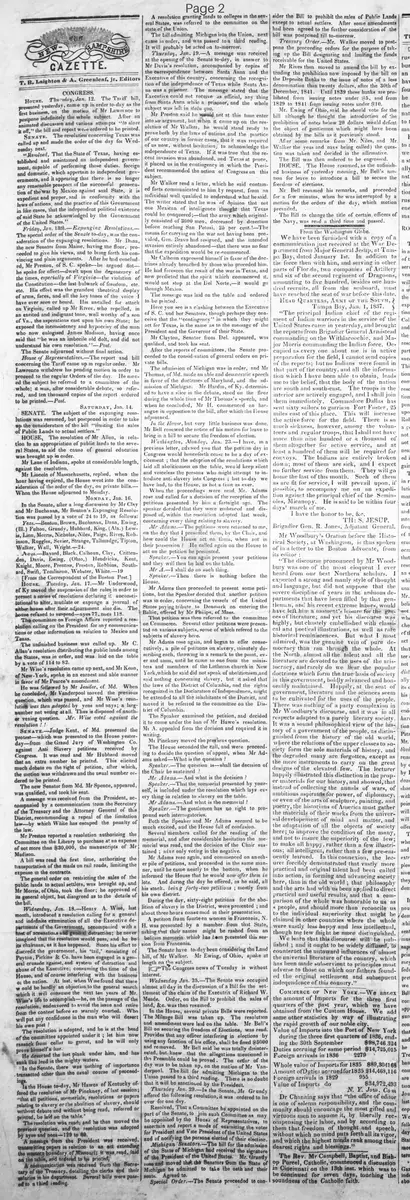
CONGRESS.
Thursday, Jan. 12. The Tariff bill, presented yesterday, came up in order to-day as the first business, on the motion of Mr Lawrence to postpone indefinitely the whole subject. After an animated discussion and various attempts 'to shake it off,' the bill and report were ordered to be printed.
Senate. The resolution concerning Texas was called up and made the order of the day for Wednesday next.
"Resolved, That the State of Texas, having established and maintained an independent government, capable of performing those duties, foreign and domestic, which appertain to independent governments, and it appearing that there is no longer any reasonable prospect of the successful prosecution of the war by Mexico against said State, it is expedient and proper, and in conformity with the laws of nations, and the practice of this Government in like cases, that the independent political existence of said State be acknowledged by the Government of the United States."
Friday, Jan. 13th.—Expunging Resolutions.—The special order of the Senate to-day, was the consideration of the expunging resolutions. Mr Dana, the new Senator from Maine, having the floor, proceeded to give his views, and to bring forth his convincing and plain arguments. After he had concluded, Mr Preston, of S. C. spoke—he argued not—he spoke for effect—dwelt upon the degeneracy of the times, especially of Virginia—the violation of the Constitution—the last bulwark of freedom, etc. etc. His effort was the grandest theatrical display of arms, faces, and all the key tones of the voice I have ever seen or heard. His uncalled for attack on Virginia, called up Mr Rives, who repelled, in an excited and indignant tone, well worthy of a son of Va., the aspersions cast upon his own State; he exposed the inconsistency and hypocrisy of the man who now eulogised James Madison, having once said that "he was an imbecile old dolt, and did not understand his own resolution."—Post.
The Senate adjourned without final action.
House of Representatives.—The report and bill concerning the Tariff came up in regular order. Mr Lawrence withdrew his pending motion in order to proceed to the regular Orders of the day. He moved the subject be referred to a committee of the whole; it was, after considerable debate, so referred, and ten thousand copies of the report ordered to be printed.—Post.
SATURDAY, Jan. 14.
SENATE. The subject of the expunging resolutions was resumed, but postponed in order to take up the consideration of the bill limiting the sales of Public Lands to actual settlers.
HOUSE. The resolution of Mr Allen, in relation to an appropriation of public lands to the several States, to aid the cause of general education was brought up in order.
Mr Lane of Indiana, spoke at considerable length, against the resolution.
Mr Lincoln of Massachusetts, replied, when the hour having expired, the House went into the consideration of the order of the day, on private bills.—
When the House adjourned to Monday.
MONDAY, Jan. 16.
In the Senate, after a long discussion by Mr Clay and Mr Buchanan, Mr Benton's Expunging Resolution was passed by a vote of 24 to 19, as follows:
Yeas.—Benton, Brown, Buchanan, Dana, Ewing, (Ill.) Fulton, Grundy, Hubbard, King, (Ala.) Lewis, Linn, Morris, Nicholas, Niles, Paige, Rives, Robinson, Ruggles, Sevier, Strange, Tallmadge, Tipton, Walker, Wall, Wright.—24.
Nays.—Bayard, Black, Calhoun, Clay, Crittenden, Davis, Ewing, (Ohio,) Hendricks, Kent, Knight, Moore, Prentiss, Preston, Robbins, Southard, Swift, Tomlinson, Webster, White.—19
[From the Correspondent of the Boston Post.]
HOUSE. Tuesday, Jan. 17.—Mr Underwood, of Ky moved the suspension of the rules in order to present a series of resolutions declaring it unconstitutional to alter, mutilate or expunge a journal of either house after their adjournment sine die. The house refused to suspend—ayes 77, noes 115.
The committee on Foreign Affairs reported a resolution calling on the President for any communications or other information in relation to Mexico and Texas.
The unfinished business was called up. Mr C. Allan's resolution distributing the public lands among the States, was in order, and was laid on the table by a vote of 114 to 82.
Mr Wise's resolution came up next, and Mr Keon, of New-York, spoke in an earnest and able manner in favor of Mr Pearce's amendment.
He was followed by Mr Jenifer, of Md. When he concluded, Mr Vanderpool moved the previous question, which was passed, and Mr Wise's resolution was then adopted by yeas and nays; a large number not voting at all. Thus is disposed of another vexing question. Mr. Wise voted against the resolution ! !
SENATE.—Judge Kent, of Md. presented the protest—which was presented to the House yesterday—from the Grand Jury of Washington Co. against Anti Slavery petitions received by Congress. It was read and Mr Hubbard moved that an extra number be printed. This elicited much debate on the right of petition, after which, the motion was withdrawn and the usual number ordered to be printed.
The new Senator from Md. Mr Spence, appeared was qualified, and took his seat.
A message was received from the President, accompanied by a communication from the Secretary of the Treasury and the Attorney General of this District, recommending a repeal of the limitation law by which White has escaped the penalty of the law.
Mr Preston reported a resolution authorizing the Committee on the Library to purchase at an expense of not more than $30,000, the manuscripts of Mr Madison.
A bill was read the first time, authorizing the transportation of the mails on rail roads, limiting the expense in the contracts.
The general order on restricting the sales of the public lands to actual settlers, was brought up, and Mr Morris, of Ohio, took the floor; he approved of its general object, but disagreed as to the details of the bill.
Wednesday, Jan. 18.—Henry A. Wise, last month, introduced a resolution calling for a general and indefinite examination of all the Executive departments of the Government, accompanied with a host of accusations and general detraction; he never imagined that the resolution would pass, and he be its chairman, as it has happened. Since his effort to discredit the government, his 'tail,' consisting of Peyton, Pickens & Co. have been engaged in a general crusade against, and system of detraction and abuse of the Executive; consuming the time of the House, and of course interfering with the business of the nation. At last, when Wise found that there would be hardly an objection to the general search which it will consume the next ten years of Mr. Wise's life to accomplish—he, on the passage of the resolution, endeavored to avoid the issue and retire from the contest before so warmly courted. Who will put any confidence in the man who will desert his own post ?
The resolution is adopted, and he is at the head of the committee appointed under it ; let him now ransack from cellar to garret, and he will only prove himself a liar.
He deserted the last plank under him, and has sunk like lead in the mighty waters.
In the Senate, there was nothing of importance transacted other than the usual course of proceedings.
In the House to-day, Mr Hawes of Kentucky offered the resolution of Mr Pinckney, of last session; that all petitions, memorials, resolutions or papers relating to slavery or the abolition of slavery, should without debate and without being read, referred or printed, be laid on the table.
The resolution was read; and he then moved the previous question, and the resolution was adopted by ayes and noes—129 to 69.
A message from the President was received, transmitting papers in relation to an act extending the western boundary of Missouri: it was read, laid on the table, and ordered to be printed,
A communication was received from the Secretary of the Treasury, detailing the clerks and their salaries in his department. Several bills were passed to a third reading.
A resolution granting lands to colleges in the several States, was referred to the committee on the state of the Union.
The bill admitting Michigan into the Union, next came in order, and was passed to a third reading It will probably be acted on to-morrow.
Thursday, Jan. 19.—A message was received at the opening of the Senate to-day, in answer to Mr Davis's resolution, accompanied by copies of the correspondence between Santa Anna and the Executive of this country, concerning the recognition of the independence of Texas while Santa Anna was a prisoner. The message stated that the Executive could not receive as official, any thing from Santa Anna while a prisoner, and the whole subject was left in statu quo.
Mr Preston said he would not at this time enter into an argument, but when it come up on the resolution of Mr Walker, he would stand ready to prove both by the laws of nations and the practice of our country in former cases, that it was required of us now, without hesitation, to acknowledge the independence of Texas. If it was true that the recent invasion was abandoned, and Texas at peace, it placed us in the contingency in which the President recommended the action of Congress on this subject.
Mr Walker read a letter, which he said contained facts communicated to him by request, from an individual well qualified to understand what he said.
The writer stated that he was of opinion that not one Mexican of intelligence thought that Texas could be conquered; that the army which originally consisted of 3000 men, decreased by desertion before reaching San Potosi, 25 per cent.!—The means for carrying on the war not having been provided, Gen. Bravo had resigned, and the intended invasion entirely abandoned—that there was no fear that the expedition would be re-commenced.
Mr Calhoun expressed himself in favor of the doctrines already broached by those who preceded him.
He had foreseen the result of the war in Texas, and now predicted that the spirit which commenced it, would not stop at the Del Norte,—it would go through Mexico.
The message was laid on the table and ordered to be printed.
Here you see is a clashing between the Executive of S. C. and her Senators, though perhaps they conceive that the "contingency" in which they might act for Texas, is the same as to the message of the President and the Governor of their State.
Mr Clayton, Senator from Del. appeared, was qualified, and took his seat.
After the reports of committees, the Senate proceeded to the consideration of general orders on private bills.
The admission of Michigan was in order, and Mr Thomas, of Md. made an able and democratic speech in favor of the doctrines of Maryland, and the admission of Michigan. Mr Hardin, of Ky. determined to have a slice in the debate, stood on the floor during the whole time of Mr Thomas's speech, and when he concluded, Mr H. commenced an harangue in opposition to the bill, after which the House adjourned.
In the House, but very little business was done.
Mr Bell renewed the notice of his motion for leave to bring in a bill to secure the freedom of election.
Washington, Monday, Jan. 23.—I have, in a previous letter, advised you that the petition day in Congress would henceforth cease to be a day of excitement ; that the adoption of the resolutions which laid all abolitionism on the table, would keep silent and voiceless the persons who might attempt to introduce anti-slavery into Congress ; but to-day we have had, to the House, as hot a time as ever.
When the proceedings were read Mr. Adams rose and called for a decision of the reception of the petitions presented by him a fortnight ago. The speaker decided that they were embraced and disposed of, within the resolution adopted last week, concerning every thing relating to slavery.
Mr Adams.—The petitions were returned to me. on the day that I presented them, by the Chair, and how could the House act on them, when not in their possession ? He called again on the House to act on the petition he presented.
Speaker.—You can again present your petitions and they will then be laid on the table.
Mr A.—I shall do no such thing.
Speaker.—Then there is nothing before the House.
Mr Adams then proceeded to present some petitions, but the Speaker decided that another petition was in order, concerning the vessels of the United States paying tribute to Denmark on entering the Baltic, offered by Mr Philips, of Mass.
That petition was then referred to the committee on Commerce. Several other petitions were presented on various subjects, some of which referred to the subjects of slavery here.
Mr Adams rose again, and began to offer consecutively, a pile of petitions on slavery, minutely describing each, throwing in a remark to the point, ever and anon, until he came to one from the ministers and members of the Lutheran church in New York, which he said did not speak of abolitionism, and said nothing concerning slavery, but it asked that the laws of the District of Columbia, and the rights recognized in the Declaration of Independence, might be extended to all the inhabitants of the District, and moved it be referred to the committee on the District of Columbia.
The Speaker examined the petition, and decided it to come under the ban of Mr Hawes's resolution.
Mr. A. appealed from the decision and required it in writing.
Mr Pinckney moved the previous question.
The House seconded the call, and were proceeding to decide the question of appeal, when Mr Adams asked—What is the question?
Speaker.—The question is—shall the decision of the Chair be sustained ?
Mr Adams.—And what is the decision ?
Speaker.—That the memorial presented by yourself, is included under the resolution which lays every thing in relation to slavery on the table.
Mr Adams.—And what is the memorial?
Speaker.—The gentlemen has no right to propound such interrogatories.
Both the Speaker and Mr Adams seemed to be much excited, and the House full of confusion.
Several members called for the reading of the memorial, and after considerable hesitation the memorial was read, and the decision of the Chair sustained ; nine only voting in the negative.
Mr Adams rose again, and commenced on another pile of petitions, and proceeded in the same manner, until he came nearly to the bottom, when he informed the House that he would now offer them in lots. And during the day he offered, as he said, all his stock. being forty-two petitions ; mostly from his own district.
During the day, sixty-eight petitions for the abolition of slavery in the District, were presented ; and about three hours consumed in their presentation.
A petition from fourteen women in Franconia, N. H. was presented by a member from that State, asking that their names might be erased from an abolition memorial which has been presented this session from Franconia.
The Senate have to-day been considering the Land bill, of Mr Walker. Mr Ewing, of Ohio, spoke at length on the subject.
The Congress news of Tuesday is without interest.
Wednesday Jan. 25.—The Senate was occupied almost all day in the discussion of a Bill for the settlement of the claim of the Executrix of Richard W. Meade. Order, on the Bill to prohibit the sales of land, &c. was then resumed.
In the House, several private Bills were reported.
The Mileage Bill was taken up. The resolution and amendment were laid on the table. Mr Bell's Bill on securing the freedom of Elections, was read.
Provides that any officer interfering in elections by using any function of his office, shall be fined $5000 and removed, Mr Bell said he was totally disinterested, but knew that the allegations mentioned in the Preamble could be proved. The order of the day was to be taken up, on the motion of Mr Vanderpool. The Bill for admitting Michigan to the Union passed to a third reading. There is no doubt that it will be sanctioned by the President.
Thursday Jan. 29.—In the Senate, Mr Grundy offered the following resolution, it was ordered to lie over for one day.
Resolved, That a Committee be appointed on the part of the Senate, to join such Committee as may be appointed by the House of Representatives, to ascertain and report a mode of examining the votes for President and Vice President of the United States and of notifying the persons elected of their election.
Michigan Senators.—The bill for the admission of the State of Michigan had received the signature of the President of the United States. Mr. Grundy rose and moved that the Senators from the State of Michigan be admitted to take the oath and their seats. Agreed to.
Special Order,—The Senate proceeded to consider the Bill to prohibit the sales of Public Lands except to actual settlers. After some amendments had been agreed to the further consideration of the bill was postponed till to-morrow.
Treasury Order.—Mr. Walker moved to postpone the proceeding orders for the purpose of taking up the Bill designating and limiting the funds receivable for the United States.
Mr Rives then moved to amend the bill by extending the prohibition now imposed by the bill on the Deposite Banks to the issue of notes of a less denomination than twenty dollars, after the 30th of December, 1841. Until 1839 these banks are prohibited from issuing notes under $5, and from 1839 to 1841 from issuing notes under $10.
Mr. Ewing of Ohio, said he should vote for the bill although he thought the introduction of the prohibition of notes below 20 dollars would defeat the object of gentlemen which might have been obtained by the bills as it previously stood.
After some remarks from Mr. Niles, and Mr Walker the yeas and nays being called) the question was taken and decided in the affirmative.
The Bill was then ordered to be engrossed.
HOUSE. The House resumed, as the unfinished business of yesterday morning, Mr Bell's motion for leave to introduce a bill to secure the freedom of elections.
Mr Bell resumed his remarks, and proceeded for a few minutes, when he was interrupted by motion for the orders of the day, which motion prevailed,
The Bill to change the title of certain officers of the Navy, was read a third time and passed.
What sub-type of article is it?
What keywords are associated?
What entities or persons were involved?
Where did it happen?
Domestic News Details
Primary Location
Washington
Event Date
January 12 29, 1837
Key Persons
Outcome
expunging resolution passed in senate 24-19; pinckney's slavery gag resolution adopted in house 129-69; michigan admission bill passed and signed by president; various other bills referred, printed, or postponed.
Event Details
Chronological account of U.S. Senate and House proceedings including debates on Tariff bill (printed and referred), Texas independence resolution (set for discussion), expunging resolutions (debated and passed), public lands sales limitation (discussed and amended), education land grants (debated), slavery petitions (presented amid controversy, subject to gag rule), Michigan statehood (bill passed), and miscellaneous resolutions on elections, executive examination, and banking.