Thank you for visiting SNEWPapers!
Sign up free
Story
December 2, 1854
The Perrysburg Journal
Perrysburg, Wood County, Ohio
What is this article about?
The new emigrant ship New Era wrecked on Long Island on Monday night during its first voyage, killing over 260 of 427 aboard due to officers' negligence. Vivid accounts describe horrific scenes of frozen bodies on the deck amid waves.
Clipping
OCR Quality
98%
Excellent
Full Text
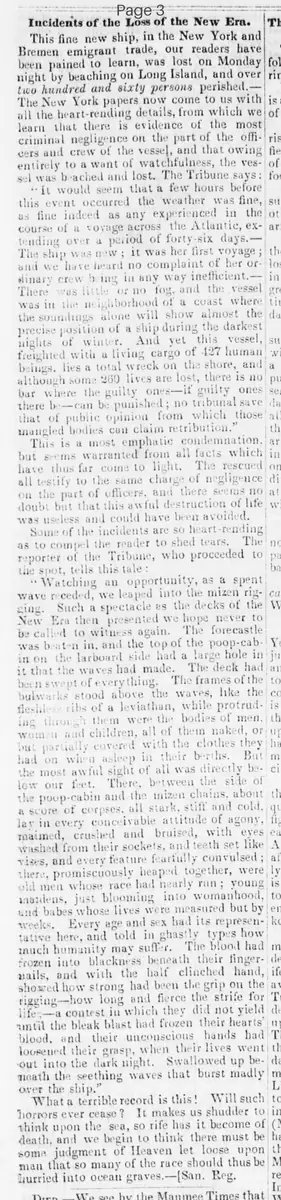
Incidents of the Loss of the New Era.
This fine new ship, in the New York and Bremen emigrant trade, our readers have been pained to learn, was lost on Monday night by beaching on Long Island, and over two hundred and sixty persons perished.
The New York papers now come to us with all the heart-rending details, from which we learn that there is evidence of the most criminal negligence on the part of the officers and crew of the vessel, and that owing entirely to a want of watchfulness, the vessel was beached and lost. The Tribune says:
It would seem that a few hours before this event occurred the weather was fine, as fine indeed as any experienced in the course of a voyage across the Atlantic, extending over a period of forty-six days.
The ship was new; it was her first voyage; and we have heard no complaint of her ordinary crew being in any way inefficient.
There was little or no fog, and the vessel was in the neighborhood of a coast where the soundings alone will show almost the precise position of a ship during the darkest nights of winter. And yet this vessel, freighted with a living cargo of 427 human beings, lies a total wreck on the shore, and although some 260 lives are lost, there is no bar where the guilty ones—if guilty ones there be—can be punished; no tribunal save that of public opinion from which those mangled bodies can claim retribution.
This is a most emphatic condemnation, but seems warranted from all facts which have thus far come to light. The rescued all testify to the same charge of negligence on the part of officers, and there seems no doubt but that this awful destruction of life was useless and could have been avoided.
Some of the incidents are so heart-rending as to compel the reader to shed tears. The reporter of the Tribune, who proceeded to the spot, tells this tale:
Watching an opportunity, as a spent wave receded, we leaped into the mizen rigging. Such a spectacle as the decks of the New Era then presented we hope never to be called to witness again. The forecastle was beaten in, and the top of the poop-cabin on the larboard side had a large hole in it that the waves had made. The deck had been swept of everything. The frames of the bulwarks stood above the waves, like the fleshless ribs of a leviathan, while protruding through them were the bodies of men, women and children, all of them naked, or but partially covered with the clothes they had on when asleep in their berths. But the most awful sight of all was directly below our feet. There, between the side of the poop-cabin and the mizen chains, about a score of corpses, all stark, stiff and cold, lay in every conceivable attitude of agony, maimed, crushed and bruised, with eyes washed from their sockets, and teeth set like vises, and every feature fearfully convulsed: there, promiscuously heaped together, were old men whose race had nearly run; young maidens, just blooming into womanhood, and babes whose lives were measured but by weeks. Every age and sex had its representative here, and told in ghastly types how much humanity may suffer. The blood had frozen into blackness beneath their finger-nails, and with the half clinched hand, showed how strong had been the grip on the rigging—how long and fierce the strife for life,—a contest in which they did not yield until the bleak blast had frozen their hearts' blood, and their unconscious hands had loosened their grasp, when their lives went out into the dark night. Swallowed up beneath the seething waves that burst madly over the ship.
What a terrible record is this! Will such horrors ever cease? It makes us shudder to think upon the sea, so rife has it become of death, and we begin to think there must be some judgment of Heaven let loose upon man that so many of the race should thus be hurried into ocean graves.—[San. Reg.
This fine new ship, in the New York and Bremen emigrant trade, our readers have been pained to learn, was lost on Monday night by beaching on Long Island, and over two hundred and sixty persons perished.
The New York papers now come to us with all the heart-rending details, from which we learn that there is evidence of the most criminal negligence on the part of the officers and crew of the vessel, and that owing entirely to a want of watchfulness, the vessel was beached and lost. The Tribune says:
It would seem that a few hours before this event occurred the weather was fine, as fine indeed as any experienced in the course of a voyage across the Atlantic, extending over a period of forty-six days.
The ship was new; it was her first voyage; and we have heard no complaint of her ordinary crew being in any way inefficient.
There was little or no fog, and the vessel was in the neighborhood of a coast where the soundings alone will show almost the precise position of a ship during the darkest nights of winter. And yet this vessel, freighted with a living cargo of 427 human beings, lies a total wreck on the shore, and although some 260 lives are lost, there is no bar where the guilty ones—if guilty ones there be—can be punished; no tribunal save that of public opinion from which those mangled bodies can claim retribution.
This is a most emphatic condemnation, but seems warranted from all facts which have thus far come to light. The rescued all testify to the same charge of negligence on the part of officers, and there seems no doubt but that this awful destruction of life was useless and could have been avoided.
Some of the incidents are so heart-rending as to compel the reader to shed tears. The reporter of the Tribune, who proceeded to the spot, tells this tale:
Watching an opportunity, as a spent wave receded, we leaped into the mizen rigging. Such a spectacle as the decks of the New Era then presented we hope never to be called to witness again. The forecastle was beaten in, and the top of the poop-cabin on the larboard side had a large hole in it that the waves had made. The deck had been swept of everything. The frames of the bulwarks stood above the waves, like the fleshless ribs of a leviathan, while protruding through them were the bodies of men, women and children, all of them naked, or but partially covered with the clothes they had on when asleep in their berths. But the most awful sight of all was directly below our feet. There, between the side of the poop-cabin and the mizen chains, about a score of corpses, all stark, stiff and cold, lay in every conceivable attitude of agony, maimed, crushed and bruised, with eyes washed from their sockets, and teeth set like vises, and every feature fearfully convulsed: there, promiscuously heaped together, were old men whose race had nearly run; young maidens, just blooming into womanhood, and babes whose lives were measured but by weeks. Every age and sex had its representative here, and told in ghastly types how much humanity may suffer. The blood had frozen into blackness beneath their finger-nails, and with the half clinched hand, showed how strong had been the grip on the rigging—how long and fierce the strife for life,—a contest in which they did not yield until the bleak blast had frozen their hearts' blood, and their unconscious hands had loosened their grasp, when their lives went out into the dark night. Swallowed up beneath the seething waves that burst madly over the ship.
What a terrible record is this! Will such horrors ever cease? It makes us shudder to think upon the sea, so rife has it become of death, and we begin to think there must be some judgment of Heaven let loose upon man that so many of the race should thus be hurried into ocean graves.—[San. Reg.
What sub-type of article is it?
Disaster
Tragedy
Survival
What themes does it cover?
Catastrophe
Misfortune
Tragedy
What keywords are associated?
Shipwreck
New Era
Long Island
Negligence
Emigrant Disaster
Passenger Deaths
Where did it happen?
Long Island
Story Details
Location
Long Island
Event Date
Monday Night
Story Details
The New Era, a new emigrant ship on its first voyage from New York to Bremen, beached on Long Island due to officers' negligence despite fine weather and clear conditions, resulting in over 260 deaths out of 427 aboard. Rescued survivors and reporters describe heart-rending scenes of frozen, mangled bodies on the wrecked deck.