Thank you for visiting SNEWPapers!
Sign up free
The Virginia Gazette
Richmond, Williamsburg, Richmond County, Virginia
What is this article about?
In a heated newspaper exchange, 'The Country Gentleman' defends the establishment of an American Episcopate in colonial Virginia, arguing it promotes Christian practice through confirmation and oversight without hazard, while refuting 'The Country Clergyman's' misrepresentations, inconsistencies, and apparent dissenting sympathies.
Merged-components note: Continuation of the same letter to the editor debating an American Episcopate and related religious topics, spanning pages 1 and 2 in sequential reading order.
Clippings
1 of 2
OCR Quality
Full Text
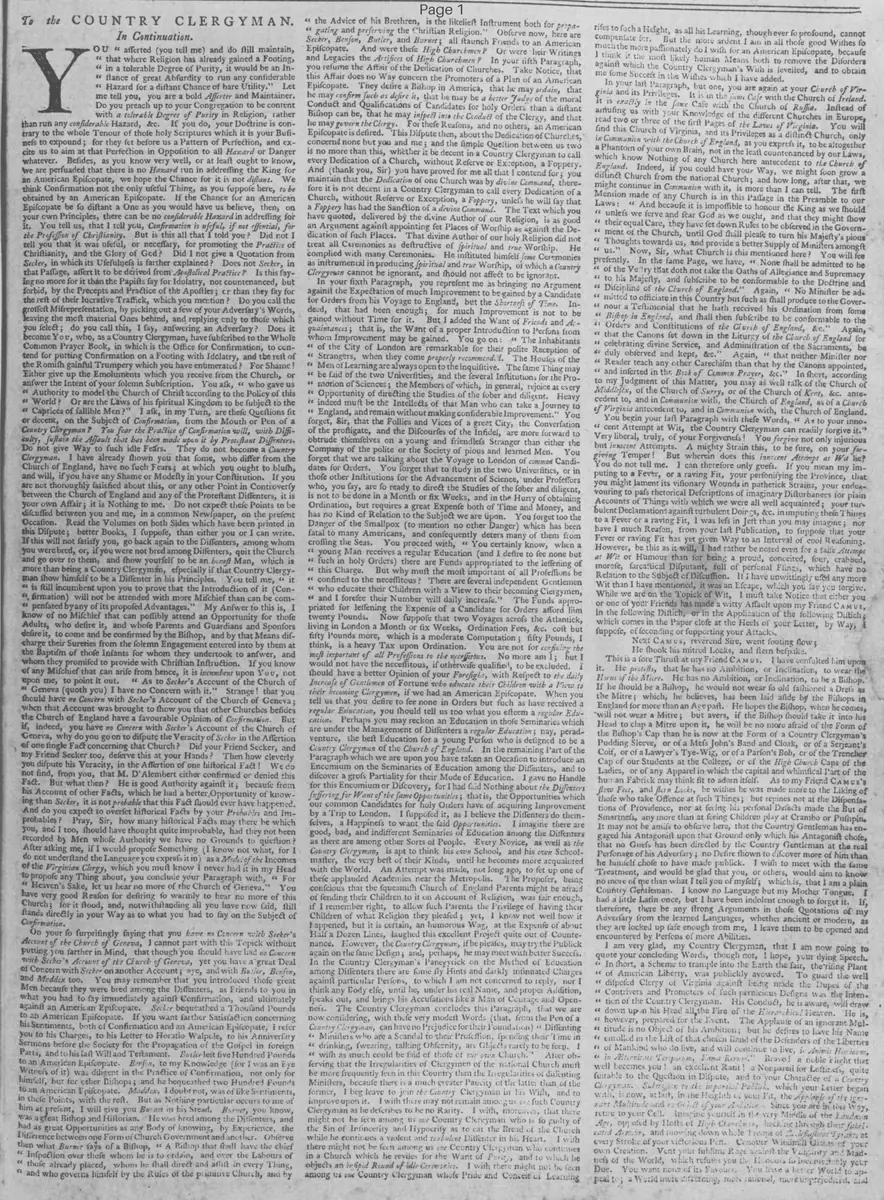
"that where Religion has already gained a Footing,
"in a tolerable Degree of Purity, it would be an In-
"stance of great Absurdity to run any considerable
"Hazard for a distant Chance of bare Utility."
Let
me tell you, you are a bold Asserter and Maintainer.
Do you preach up to your Congregation to be content
with a tolerable Degree of Purity in Religion, rather
than run any considerable Hazard, &c. If you do, your Doctrine is con-
trary to the whole Tenour of those holy Scriptures which it is your Business
to expound; for they set before us a Pattern of Perfection, and ex-
cite us to aim at that Perfection in Opposition to all Hazard or Danger
whatever. Besides, as you know very well, or at least ought to know,
we are persuaded that there is no Hazard run in addressing the King for
an American Episcopate, we hope the Chance for it is not distant. We
think Confirmation not the only useful Thing, as you suppose here, to be
obtained by an American Episcopate. If the Chance for an American
Episcopate be so distant a One as you would have us believe, then, on
your own Principles, there can be no considerable Hazard in addressing for
it. You tell us, that I tell you, Confirmation is useful, if not essential, for
the Profession of Christianity. But is this all that I told you? Did not I
tell you that it was useful, or necessary, for promoting the Practice of
Christianity, and the Glory of God? Did I not give a Quotation from
Secker, in which its Usefulness is farther explained? Does not Secker, in
that Passage, assert it to be derived from Apostolical Practice? Is this a-
ying no more for it than the Papists say for Idolatry, not countenanced, but
forbid, by the Precepts and Practice of the Apostles; or than they say for
the rest of their lucrative Traffick, which you mention? Do you call the
grossest Misrepresentation, by picking out a few of your Adversary's Words,
leaving the most material Ones behind, and replying only to those which
you select; do you call this, I say, answering an Adversary? Does it
become You, who, as a Country Clergyman, have subscribed to the Whole
Common Prayer Book, in which is the Office for Confirmation, to con-
tend for putting Confirmation on a Footing with Idolatry, and the rest of
the Romish gainful Trumpery which you have enumerated? For Shame!
Either give up the Emoluments which you receive from the Church, or
answer the Intent of your solemn Subscription. You ask, "who gave us
"Authority to model the Church of Christ according to the Policy of this
"World? Or are the Laws of his spiritual Kingdom to be subject to the
"Caprices of fallible Men?" I ask, in my Turn, are these Questions fit
or decent, on the Subject of Confirmation, from the Mouth or Pen of a
Country Clergyman? You fear the Practice of Confirmation will, with Diffi-
culty, sustain the Assault that has been made upon it by Protestant Dissenters.
Do not give Way to such idle Fears. They do not become a Country
Clergyman. I have already shown you that some, who differ from the
Church of England, have no such Fears; at which you ought to blush,
and will, if you have any Shame or Modesty in your Constitution. If you
are not thoroughly satisfied about this, or any other Point in Controversy
between the Church of England and any of the Protestant Dissenters, it is
your own Affair; it is Nothing to me. Do not expect these Points to be
discussed between you and me, in a common Newspaper, on the present
Occasion. Read the Volumes on both Sides which have been printed in
this Dispute; better Books, I suppose, than either you or I can write.
If this will not satisfy you, go back again to the Dissenters, among whom
you were bred, or, if you were not bred among Dissenters, quit the Church
and go over to them, and show yourself to be an honest Man, which is
more than being a Country Clergyman, especially if that Country Clergy-
man show himself to be a Dissenter in his Principles. You tell me," it
"is still incumbent upon you to prove that the Introduction of it (Con-
"firmation) will not be attended with more Mischief than can be com-
"pensated by any of its proposed Advantages." My Answer to this is, I
know of no Mischief that can possibly attend an Opportunity for those
Adults, who desire it, and whose Parents and Guardians and Sponsors
desire it, to come and be confirmed by the Bishop, and by that Means dis-
charge their Sureties from the solemn Engagement entered into by them at
the Baptism of those Infants for whom they undertook to answer, and
whom they promised to provide with Christian Instruction. If you know
of any Mischief that can arise from hence, it is incumbent upon You, not
upon me, to point it out. "As to Secker's Account of the Church of
Geneva (quoth you) I have no Concern with it." Strange! that you
should have no Concern with Secker's Account of the Church of Geneva;
when that Account was brought to show you that other Churches besides
the Church of England have a favourable Opinion of Confirmation. But
if, indeed, you have no Concern with Secker's Account of the Church of
Geneva, why do you go on to dispute the Veracity of Secker in the Assertion
of one single Fact concerning that Church? Did your Friend Secker, and
my Friend Secker too, deserve this at your Hands? Then how cleverly
you dispute his Veracity, in the Assertion of one historical Fact! We do
not find, from you, that M. D'Alembert either confirmed or denied this
Fact. But what then? He is good Authority against it; because from
his Account of other Facts, which he had a better Opportunity of know-
ing than Secker, it is not probable that this Fact should ever have happened.
And do you expect to overturn historical Facts by your Probables and Im-
probables? Pray, Sir, how many historical Facts may there be which
you, and I too, should have thought quite improbable, had they not been
recorded by Men whose Authority we have no Grounds to question?
After asking me, if I would propose Something (I know not what, for I
do not understand the Language you express it in) as a Model of the Incomes
of the Virginian Clergy, which you must know I never had it in my Head
to propose any Thing about, you conclude your Paragraph with, "For
"Heaven's Sake, let us hear no more of the Church of Geneva." You
have very good Reason for desiring so warmly to hear no more of this
Church; for it stood, and, notwithstanding all you have now said, still
stands directly in your Way as to what you had to say on the Subject of
Confirmation.
On your so surprisingly saying that you have no Concern with Secker's
Account of the Church of Geneva, I cannot part with this Topick without
putting you farther in Mind, that though you should have had no Concern
with Secker's Account of the Church of Geneva, yet you have a great Deal
of Concern with Secker on another Account; aye, and with Butler, Benson,
and Maddox too. You may remember that you introduced those great
Men because they were bred among the Dissenters, as Friends to you in
what you had to say immediately against Confirmation, and ultimately
against an American Episcopate. Secker bequeathed a Thousand Pounds
to an American Episcopate. If you want further Satisfaction concerning
his Sentiments, both of Confirmation and an American Episcopate, I refer
you to his Charges, to his Letter to Horatio Walpole, to his Anniversary
Sermons before the Society for the Propagation of the Gospel in foreign
Parts, and to his last Will and Testament. Butler left five Hundred Pounds
to an American Episcopate. Benson, to my Knowledge (for I was an Eye
Witness of it) was diligent in the Practice of Confirmation, not only for
himself, but for other Bishops; and he bequeathed two Hundred Pounds
to an American Episcopate. Maddox, I doubt not, was of like Sentiments,
in these Points, with the rest. But as Nothing particular occurs to me of
him at present, I will give you Burnet in his Stead. Burnet, you know,
was a great Bishop and Historian. He was bred among the Dissenters, and
had as great Opportunities as any Body of knowing, by Experience, the
Difference between one Form of Church Government and another. Observe
then what Burnet says of a Bishop, "A Bishop that shall have the chief
"Inspection over those whom he is to ordain, and over the Labours of
"those already placed, whom he shall direct and assist in every Thing,
"and who governs himself by the Rules of the primitive Church, and by
"the Advice of his Brethren, is the likeliest Instrument both for propa-
gating and preserving the Christian Religion." Observe now, here are
Secker, Benson, Butler, and Burnet; all staunch Friends to an American
Episcopate. And were these High Churchmen? Or were their Writings
and Legacies the Artifices of High Churchmen? In your fifth Paragraph,
you resume the Affair of the Dedication of Churches. Take Notice, that
this Affair does no Way concern the Promoters of a Plan of an American
Episcopate. They desire a Bishop in America, that he may ordain, that
he may confirm such as desire it, that he may be a better Judge of the moral
Conduct and Qualifications of Candidates for holy Orders than a distant
Bishop can be, that he may inspect into the Conduct of the Clergy, and that
he may govern the Clergy. For these Reasons, and no others, an American
Episcopate is desired. This Dispute then, about the Dedication of Churches,
concerns none but you and me; and the simple Question between us two
is no more than this, whether it be decent in a Country Clergyman to call
every Dedication of a Church, without Reserve or Exception, a Foppery.
And (thank you, Sir) you have proved for me all that I contend for; you
maintain that the Dedication of one Church was by divine Command, there-
fore it is not decent in a Country Clergyman to call every Dedication of a
Church, without Reserve or Exception, a Foppery, unless he will say that
a Foppery has had the Sanction of a divine Command. The Text which you
have quoted, delivered by the divine Author of our Religion, is as good
an Argument against appointing set Places of Worship as against the De-
dication of such Places. That divine Author of our holy Religion did not
treat all Ceremonies as destructive of spiritual and true Worship. He
complied with many Ceremonies. He instituted himself Some Ceremonies
as instrumental in producing spiritual and true Worship, of which a Country
Clergyman cannot be ignorant, and should not affect to be ignorant.
In your sixth Paragraph, you represent me as bringing no Argument
against the Expectation of much Improvement to be gained by a Candidate
for Orders from his Voyage to England, but the Shortness of Time. In-
stead, that had been enough; for much Improvement is not to be
gained without Time for it. But I added the Want of Friends and Ac-
quaintances; that is, the Want of a proper Introduction to Persons from
whom Improvement may be gained. You go on: "The Inhabitants
"of the City of London are remarkable for their polite Reception of
"Strangers, when they come properly recommended. The Houses of the
"Men of Learning are always open to the inquisitive. The same Thing may
"be said of the two Universities, and the several Institutions for the Pro-
"motion of Sciences; the Members of which, in general, rejoice at every
"Opportunity of directing the Studies of the sober and diligent. Heavy
"indeed must be the Intellects of that Man who can take a Journey to
"England, and remain without making considerable Improvement." You
forget, Sir, that the Follies and Vices of a great City, the Conversation
of the profligate, and the Discourses of the Infidel, are more forward to
obtrude themselves on a young and friendless Stranger than either the
Company of the polite or the Society of pious and learned Men. You
forget that we are talking about the Voyage to London of common Candi-
dates for Orders. You forget that to study in the two Universities, or in
those other Institutions for the Advancement of Science, under Professors
who, you say, are so ready to direct the Studies of the sober and diligent,
is not to be done in a Month or six Weeks, and in the Hurry of obtaining
Ordination, but requires a great Expense both of Time and Money, and
has no Kind of Relation to the Subject we are upon. You forget too the
Danger of the Smallpox (to mention no other Danger) which has been
fatal to many Americans, and consequently deters many of them from
crossing the Seas. You proceed with, "You certainly know, when a
"young Man receives a regular Education (and I desire to see none but
"such in holy Orders) there are Funds appropriated to the lessening of
"this Charge. But why must the most important of all Professions be
"confined to the necessitous? There are several independent Gentlemen
"who educate their Children with a View to their becoming Clergymen,
"and I foresee their Number will daily increase." The Funds appro-
priated for lessening the Expense of a Candidate for Orders afford him
twenty Pounds. Now suppose that two Voyages across the Atlantick,
living in London a Month or six Weeks, Ordination Fees, &c. cost but
fifty Pounds more, which is a moderate Computation; fifty Pounds, I
think, is a heavy Tax upon Ordination. You are not for confining the
most important of all Professions to the necessitous. No more am I; but I
would not have the necessitous, if otherwise qualified, to be excluded. I
should have a better Opinion of your Foresight, with Respect to the daily
Increase of Gentlemen of Fortune who educate their Children with a View to
their becoming Clergymen, if we had an American Episcopate. When you
tell us that you desire to see none in Orders but such as have received a
regular Education, you should tell us too what you esteem a regular Edu-
cation. Perhaps you may reckon an Education in those Seminaries which
are under the Management of Dissenters a regular Education; nay, perad-
venture, the best Education for a young Person who is designed to be a
Country Clergyman of the Church of England. In the remaining Part of the
Paragraph which we are upon you have taken an Occasion to introduce an
Encomium on the Seminaries of Education among the Dissenters, and to
discover a gross Partiality for their Mode of Education. I gave no Handle
for this Encomium or Discovery, for I had said Nothing about the Dissenters
suffering for Want of the same Opportunities; that is, the Opportunities which
our common Candidates for holy Orders have of acquiring Improvement
by a Trip to London. I supposed it, as I believe the Dissenters do them-
selves, a Happiness to want the said Opportunities. I imagine there are
good, bad, and indifferent Seminaries of Education among the Dissenters
as there are among other Sorts of People. Every Novice, as well as the
Country Clergyman, is apt to think his own School, and his own School-
master, the very best of their Kinds, until he becomes more acquainted
with the World. An Attempt was made, not long ago, to set up one of
these applauded Academies near the Metropolis. The Proposer, being
conscious that the squeamish Church of England Parents might be afraid
of sending their Children to it on Account of Religion, was fair enough,
if I remember right, to allow such Parents the Privilege of having their
Children of what Religion they pleased; yet, I know not well how it
happened, but it is certain, an humorous Wag, at the Expense of about
Half a Dozen Lines, laughed this excellent Project quite out of Counte-
nance. However, the Country Clergyman, if he pleases, may try the Publick
again on the same Design; and, perhaps, he may meet with better Success.
In the Country Clergyman's Panegyrick on the Method of Education
among Dissenters there are some sly Hints and darkly insinuated Charges
against particular Persons, to which I am not concerned to reply, nor I
think any Body else, until he, under his real Name, and proper Addition,
speaks out, and brings his Accusations like a Man of Courage and Open-
ness. The Country Clergyman concludes this Paragraph, that we are
now considering, with these very modest Words (that, from the Pen of a
Country Clergyman, can have no Prejudice for their Foundation) "Dissenting
Ministers who are a Scandal to their Profession, spending their Time in
"drinking, swearing, talking Obscenity, or Objects rarely to be seen
"with as much could be said of those of our own Church. After ob-
serving that the Irregularities of Clergymen of the national Church must
be more frequently seen in this Country than the Irregularities of Dissenting
Ministers, because there is a much greater Paucity of the latter than of the
former, I beg leave to join the Country Clergyman in his Wish, and to
improve upon it. I wish there may not remain among us such Country
Clergyman as he describes to be no Rarity. I wish, moreover, that there
might not be seen among us one Country Clergyman who is so guilty of
the Sin of Insincerity and Hypocrisy as to eat the Bread of the Church
while he continues a violent and stark whole-hearted Dissenter in his Heart. I wish
there might not be seen among us one Country Clergyman who continues
in a Church which he reviles for the Want of Power and to which he
objects an insipid Round of idle Ceremonies. I wish there might not be seen
among us one Country Clergyman whose Pride and Conceit of Learning
rises to such a Height, as all his Learning, though ever so profound, cannot
compensate for. But the more ardent I am in all those good Wishes so
much the more passionately do I wish for an American Episcopate, because
I think it the most likely human Means both to remove the Disorders
against which the Country Clergyman's Wish is levelled, and to obtain
me some Success in the Wishes which I have added.
In your last Paragraph, but one, you are again at your Church of Vir-
ginia and its Privileges. It is in the same Case with the Church of Ireland.
It is exactly in the same Case with the Church of Russia. Instead of
amusing us with your Knowledge of the different Churches in Europe,
read two or three of the first Pages of the Laws of Virginia. You will
find this Church of Virginia, and its Privileges as a distinct Church, only
in Communion with the Church of England, as you express it, to be altogether
a Phantom of your own Brain, not in the least countenanced by our Laws,
which know Nothing of any Church here antecedent to the Church of
England. Indeed, if you could have your Way, we might soon grow a
distinct Church from the national Church; and how long, after that, we
might continue in Communion with it, is more than I can tell. The first
Mention made of any Church is in this Passage in the Preamble to our
Laws: "And because it is impossible to honour the King as we should
"unless we serve and fear God as we ought, and that they might show
"their equal Care, they have set down Rules to be observed in the Govern-
"ment of the Church, until God shall please to turn his Majesty's pious
"Thoughts towards us, and provide a better Supply of Ministers amongst
"us." Now, Sir, what Church is this mentioned here? You will see
presently. In the same Page, we have, "None shall be admitted to be
"of the Vestry that doth not take the Oaths of Allegiance and Supremacy
"to his Majesty, and subscribe to be conformable to the Doctrine and
"Discipline of the Church of England." Again, "No Minister be ad-
"mitted to officiate in this Country but such as shall produce to the Gover-
"nour a Testimonial that he hath received his Ordination from some
"Bishop in England, and shall then subscribe to be conformable to the
"Orders and Constitutions of the Church of England, &c." Again,
"that the Canons set down in the Liturgy of the Church of England for
"celebrating divine Service, and Administration of the Sacraments, be
"duly observed and kept, &c." Again, "that neither Minister nor
"Reader teach any other Catechism than that by the Canons appointed,
"and inserted in the Book of Common Prayer, &c." In short, according
to my Judgment of this Matter, you may as well talk of the Church of
Middlesex, of the Church of Surrey, or of the Church of Kent, &c. ante-
cedent to, and in Communion with, the Church of England, as of a Church
of Virginia antecedent to, and in Communion with, the Church of England.
You begin your last Paragraph with these Words, "As to your inno-
"cent Attempt at Wit, the Country Clergyman can readily forgive it."
Very liberal, truly, of your Forgiveness! You forgive not only injurious
but innocent Attempts. A mighty Strain this, to be sure, on your for-
giving Temper! But wherein does this innocent Attempt at Wit lie?
You do not tell me. I can therefore only guess. If you mean my im-
puting to a Fever, or a raving Fit, your personifying the Province, that
you might lament its visionary Wounds in pathetick Strains, your tur-
bulent Declamations against turbulent Doings, &c. in imputing these Things
to a Fever or a raving Fit, I was less in Jest than you may imagine; nor
have I much Reason, from your last Publication, to suppose that your
Fever or raving Fit has yet given Way to an Interval of cool Reasoning.
However, be this as it will, I had rather be noted even for a false Attempt
at Wit or Humour than for being a proud, conceited, sour, crabbed,
morose, sarcistical Disputant, full of personal Flings, which have no
Relation to the Subject of Discussion. If I have unwittingly used any more
Wit than I have mentioned, it was an Escape, which you say you forgive.
While we are on the Topick of Wit, I must take Notice that either you
or one of your Friends has made a witty Assault upon my Friend CA M U S,
in the following Distich, or in the Application of the following Distich:
which comes in the Paper close at the Heels of your Letter, by Way,
suppose, of seconding or supporting your Attacks.
Next CA M U S, reverend Sire, went footing slow
He shook his mitred Locks, and stern bespake.
This is a sore Thrust at my Friend C A M U S. I have consulted him upon
it. He protests, that he has no Ambition, or Inclination, to wear the
Horns of the Mitre. He has no Ambition, or Inclination, to be a Bishop.
If he should be a Bishop, he would not wear so old fashioned a Dress as
the Mitre; which, he believes, has been laid aside by the Bishops in
England for more than an Age past. He hopes the Bishop, when he comes,
will not wear a Mitre; but avers, if the Bishop should take it into his
Head to clap a Mitre upon it, he will be no more afraid of the Form of
the Bishop's Cap than he is now at the Form of a Country Clergyman's
Pudding Sleeve, or of a Mess John's Band and Cloak, or of a Serjeant's
Coif, or of a Lawyer's Tye-Wig, or of a Parson's Bob, or of the Trencher
Cap of our Students at the College, or of the High Church Caps of the
Ladies, or of any Apparel in which the capital and whimsical Part of the
human Fabrick may think fit to adorn itself. As to my Friend CA M U S's
slow Feet, and stern Locks, he wishes he was made more to the Liking of
those who take Offence at such Things; but repines not at the Dispenfa-
tions of Providence, nor at seeing his personal Defects made the Butt of
Smartness, any more than at seeing Children play at Crambo or Pushpin.
It may not be amiss to observe here, that the Country Gentleman has en-
gaged his Antagonist upon that Ground only which his Antagonist chose,
that no Guess has been directed by the Country Gentleman at the real
Personage of his Adversary; no Desire shown to discover more of him than
he himself chose to have made publick. I wish to meet with the same
Treatment, and would be glad that you, or others, would aim to know
no more of me than what I tell you of myself; which is, that I am a plain
Country Gentleman. I know no Language but my Mother Tongue. I
had a little Latin once, but I have been indolent enough to forget it. If,
therefore, there be any strong Arguments in those Quotations of my
Adversary from the learned Languages, whether ancient or modern, as
they are locked up safe enough from me, I leave them to be opened and
encountered by Persons of more Abilities.
I am very glad, my Country Clergyman, that I am now going to
quote your concluding Words, though not, I hope, your dying Speech.
In short, a Scheme to trample into the Earth the fair, thriving Plant
of American Liberty, was publickly avowed. To guard the well
disposed Clergy of Virginia against being made the Dupes of the
Contrivers and Promoters of such pernicious Designs was the Inten-
tion of the Country Clergyman. His Conduct, he is aware, will draw
down upon his Head all the Fire of the Hierarchical Heaven. He is,
however, prepared for the Event. The Applause of an ignorant Mul-
titude is no Object of his Ambition; but he desires to have his Name
enrolled in the List of that chosen Band of the Defenders of the Liberties
of Mankind who do live, and will continue to live, in Armis Har inim,
in Eternitate Temporum, laud Rerum. Bravo! a noble Knight that
well becomes you! "an excellent Rant! a Nonpareil for Lotir es, quite
suitable to the Question in Dispute, and to your Character of a Country
Clergyman. Submission to the impartial Publick, which your Letter began
with, is now, at last, in the Height of your Wit, the applause of the igno-
rant Multitude and its Object of your Ambition. Since you are in this Way,
retire to your Cell. Imagine yourself in the very Middle of the London
Age, opposed by Hosts of High Churchmen, hacking through their fabri-
cated Armour, and mowing down whole Troops of Lutheran Tyrants at
every Stroke of your victorious Pen. Conquer Windmill Giants of your
own Creation. Vent your sublime Rage against the Vulgarity and Mad-
ness of the World, which refuses you the Honours so inepitably your
Due. You want none of its Favours. You have a better World to ap-
peal to; a World more discerning, more laudable, more unprejudiced, and
Better to judge of your Sentiments, in your own Breast. Scorn to be beholden to any other World than that which you carry about with you. Rank Prophecies to you, Crown your Brows with Laurels, and place your Name in just Rank, among those of the most distinguished Persons ever the Earth beheld, in your Cell, which is the Empire of the World to You. And in this Disposition I leave you to the Care of abler Physicians, since all my Applications, I find, do but make you grow madder and madder. Whether your Malady originate in your Mind or your Body. I will not, on more advised Consideration, be too positive. I hope the latter. and I wish you better Health. Accept my departing Bow, full of the most submissive Respect. Farewell.
From the humblest of your Highness's Slaves,
The COUNTRY GENTLEMAN
What sub-type of article is it?
What themes does it cover?
What keywords are associated?
What entities or persons were involved?
Letter to Editor Details
Author
The Country Gentleman
Recipient
The Country Clergyman
Main Argument
the proposal for an american episcopate involves no significant hazard and offers substantial benefits, including confirmation to promote christian practice and episcopal oversight; the country clergyman's opposition misrepresents facts, reveals dissenting sympathies, and contradicts his church subscription.
Notable Details