Thank you for visiting SNEWPapers!
Sign up free
Editorial
October 15, 1847
The Daily Union
Washington, District Of Columbia
What is this article about?
Editorial criticizes Whig Party proposals during the Mexican-American War, particularly their suggestions to accept the Nueces River as Texas's boundary instead of the Rio Grande, arguing it would mutilate Texas and dishonor the U.S. Defends Democratic positions and Gen. Taylor's actions.
Clipping
OCR Quality
95%
Excellent
Full Text
CITY OF WASHINGTON,
FRIDAY NIGHT, OCT. 16, 1847.
Proposed Mutilation of the State of Texas by the Whigs.
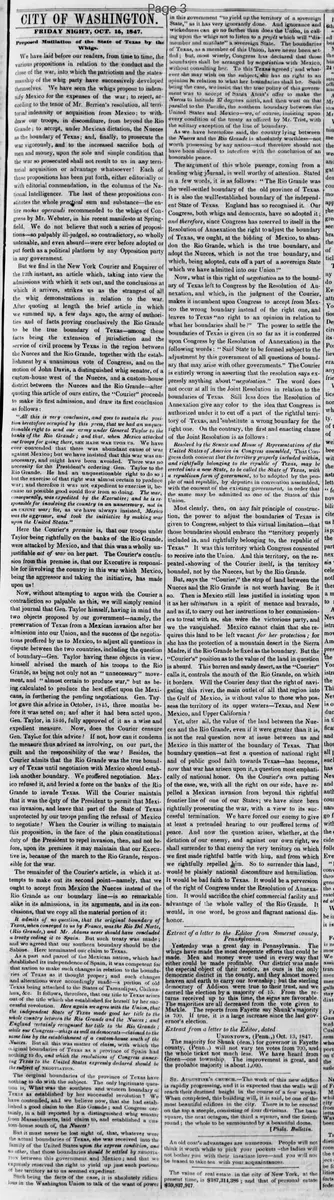
Various propositions in relation to the conduct and the close of the war, into which the patriotism and the statesmanship of the whig party have successively developed themselves. We have seen the whigs propose to indemnify Mexico for the expenses of the war; to reject, according to the tenor of Mr. Berrien's resolution, all territorial indemnity or acquisition from Mexico; to withdraw our troops, in discomfiture, from beyond the Rio Grande; to accept, under Mexican dictation, the Nueces as the boundary of Texas; and, finally, to prosecute the war vigorously, and to the increased sacrifice both of men and money, upon the sole and simple condition that the war so prosecuted shall not result to us in any territorial acquisition or advantage whatsoever! Each of these propositions has been put forth, either editorially or with editorial commendation, in the columns of the National Intelligencer. The last of these propositions constitutes the whole practical sum and substance—the entire modus operandi recommended to the whigs of Congress by Mr. Webster, in his recent manifesto at Springfield. We do not believe that such a series of propositions so palpably ill-judged, so contradictory, so wholly put forth as a political platform by any Opposition party in any government.
But we find in the New York Courier and Enquirer of the 12th instant, an article which, taking into view the admissions with which it sets out, and the conclusions at which it arrives, strikes us as the strangest of all the whig demonstrations in relation to the war. After quoting at length the brief article in which we summed up, a few days ago, the array of authorities and of facts proving conclusively the Rio Grande to be the true boundary of Texas—among these facts being the extension of jurisdiction and the service of civil process by Texas in the region between the Nueces and the Rio Grande, together with the establishment by a unanimous vote of Congress, and on the motion of John Davis, a distinguished whig senator, of a custom-house west of the Nueces, and a custom-house district between the Nueces and the Rio Grande—after quoting this article of ours entire, the "Courier" proceeds to make its first admission, and draw its first conclusion as follows:
"All this is very conclusive, and goes to sustain the position heretofore occupied by this press, that we had an unquestionable right to send our army under General Taylor to the banks of the Rio Grande; and that, when Mexico attacked our troops for going there, SHE MADE WAR UPON US. We have ever contended that there was abundant cause of war against Mexico; but we have insisted that this war was unnecessary, and might have been avoided. There was no necessity for the President's ordering Gen. Taylor to the Rio Grande. He had an unquestionable right to do so; but the exercise of that right was almost certain to produce war; and therefore it was not expedient to exercise it, because no possible good could flow from so doing. The war, consequently, was expedited by the Executive; and he is responsible for involving the country in an unnecessary, not in an unjust war; for, as we have always insisted, Mexico was the aggressor, and took the initiative by making war upon the United States."
Here the Courier's premise is, that our troops under Taylor being rightfully on the banks of the Rio Grande, were attacked by Mexico, and that this was a wholly unjustifiable act of war on her part. The Courier's conclusion from this premise is, that our Executive is responsible for involving the country in this war which Mexico, being the aggressor and taking the initiative, has made upon us!
Now, without attempting to argue with the Courier a contradiction so palpable as this, we will simply remind that journal that Gen. Taylor himself, having in mind the two objects proposed by our government—namely, the preservation of Texas from a Mexican invasion after her admission into our Union, and the success of the negotiations proffered by us to Mexico, to adjust all questions in dispute between the two countries, including the question of boundary—Gen. Taylor having these objects in view, himself advised the march of his troops to the Rio Grande, as being not only not an "unnecessary" movement, and "almost certain to produce war," but as being calculated to produce the best effect upon the Mexicans, in furthering the pending negotiations. Gen. Taylor gave this advice in October, 1845, three months before it was acted on; and after it had been acted upon, Gen. Taylor, in 1846, fully approved of it as a wise and expedient measure. Now, does the Courier censure Gen. Taylor for this advice? If not, how can it condemn the measure thus advised as involving, on our part, the guilt and the responsibility of the war? Besides, the Courier admits that the Rio Grande was the true boundary of Texas until negotiation with Mexico should establish another boundary. We proffered negotiation. Mexico refused it, and levied a force on the banks of the Rio Grande to invade Texas. Will the Courier maintain that it was the duty of the President to permit that Mexican invasion, and leave that part of the State of Texas unprotected by our troops pending the refusal of Mexico to negotiate? When the Courier is willing to maintain this proposition, in the face of the plain constitutional duty of the President to repel invasion, then, and not before, upon its premises it may maintain that our Executive is, because of the march to the Rio Grande, responsible for the war.
The remainder of the Courier's article, in which it attempts to make out its second point—namely, that we ought to accept from Mexico the Nueces instead of the Rio Grande as our boundary line—is so remarkable alike in its admissions, in its arguments, and in its conclusions, that we copy all the material portion of it:
It admits of no question, that the original boundary of Texas, when conveyed to us by France, was the Rio Del Norte, (Rio Grande,) and Mr. Adams never should have concluded a treaty ceding it to Spain. But such treaty was made; and we agreed that our southern boundary should be the Sabine. Here terminated our claim to Texas. As a part and parcel of the Mexican nation, which had established its independence of Spain, it was competent for that nation to make such changes in relation to the boundaries of Texas as it thought proper; and such changes and alterations were accordingly made—a portion of old Texas being attached to the States of Tamaulipas, Chihuahua, &c. It follows, therefore, that our title to Texas arises out of the title which she established for herself by her successful revolution. Here again we agree with the Union, that the independent State of Texas made good her title to the whole country between the Rio Grande and the Nueces; and England certainly recognised her title to the Rio Grande; while our Congress—whigs as well as democrats—claimed to the same line by the establishment of a custom-house south of the Nueces. But all this was matter of claim, with which the original boundaries of Texas as a province of Spain had nothing to do, and which the resolutions of Congress annexing Texas to the United States expressly declared should be the subject of NEGOTIATION.
The original boundaries of the province of Texas have nothing to do with the subject. The only legitimate question is, What was the southern and western boundary of Texas as established by her successful revolution? We have contended, and we believe now, that she had established a good claim to the Rio Grande; and Congress certainly, in a bill reported by a distinguished whig senator from Massachusetts, laid claim to, and established a custom-house south of, the Nueces! But it must never be lost sight of, that, whatever were the actual boundaries of Texas, she was received into the family of the United States upon the express condition, and no other, that those boundaries should be settled by negotiation between this government and Mexico; and that we expressly reserved the right to yield up just such portions of her territory as to us seemed expedient.
Such being the facts of the case, it is absolutely ridiculous in the Washington Union to talk of the want of power in this government "to yield up the territory of a sovereign State," as it has very ignorantly done. And ignorance and wickedness can go no farther than does the Union, in calling upon the whigs not to listen to a project which will "dis-member and mutilate" a sovereign State. The boundaries of Texas, as a member of this Union, have never been settled; but, most wisely, Congress has declared that those boundaries shall be arranged by negotiation with Mexico, without consulting her. To this Texas agreed; and whatever she may wish on the subject, she has no right to an opinion in relation to what her boundaries shall be. Such being the case, we insist that the true policy of this government was to accept of Santa Anna's offer to make the Nueces to latitude 37 degrees north, and then west on that parallel to the Pacific, the southern boundary between the United States and Mexico—we, of course, insisting upon every condition of the treaty as offered by Mr. Trist, with the solitary exception of the line of boundary.
As we have heretofore said, the country lying between the Nueces and the Rio Grande is absolutely worthless—not worth possessing by any nation—and therefore should not have been allowed to interfere with the conclusion of an honorable peace.
The argument of this whole passage, coming from a leading whig journal, is well worthy of attention. Stated in a few words, it is as follows: "The Rio Grande was the well-settled boundary of the old province of Texas. It is also the well-established boundary of the independent State of Texas. England has so recognised it. Our Congress, both whigs and democrats, have so adopted it: and therefore, since Congress has reserved to itself in the Resolution of Annexation the right to adjust the boundary of Texas, we ought, at the bidding of Mexico, to abandon the Rio Grande, which is the true boundary, and adopt the Nueces, which is not the true boundary, and which, being adopted, cuts off a part of a sovereign State which we have admitted into our Union!"
Now, what is this right of negotiation as to the boundary of Texas left to Congress by the Resolution of Annexation, and which, in the judgment of the Courier makes it incumbent upon Congress to accept from Mexico the wrong boundary instead of the right one, and leaves to Texas "no right to an opinion in relation to what her boundaries shall be?" The power to settle the boundaries of Texas is given (in so far as it is conferred upon Congress by the Resolution of Annexation) in the following words: "Said State to be formed subject to the adjustment by this government of all questions of boundary that may arise with other governments." The Courier is entirely wrong in asserting that the resolution says expressly anything about "negotiation." The word does not occur at all in the Joint Resolution in relation to the boundaries of Texas. Still less does the Resolution of Annexation give any color to the idea that Congress is authorized under it to cut off a part of the rightful territory of Texas, and substitute a wrong boundary for the right one. On the contrary, the first and enacting clause of the Joint Resolution is as follows:
Resolved by the Senate and House of Representatives of the United States of America in Congress assembled, That Congress doth consent that the territory properly included within, and rightfully belonging to the republic of Texas, may be erected into a new State, to be called the State of Texas, with a republican form of government, to be adopted by the people of said republic, by deputies in convention assembled, with the consent of the existing government, in order that the same may be admitted as one of the States of this Union.
Most clearly, then, on any fair principle of construction, the power to adjust the boundaries of Texas is given to Congress, subject to this virtual limitation—that those boundaries should embrace the "territory properly included in, and rightfully belonging to, the republic of Texas." It was this territory which Congress consented to receive into the Union. And this territory, on the repeated showing of the Courier itself, is the territory bounded, not by the Nueces, but by the Rio Grande.
But, says the "Courier," the strip of land between the Nueces and the Rio Grande is not worth having. Be it so. Then is Mexico still less justified in insisting upon it as her ultimatum in a spirit of menace and bravado, and as if, to carry out her instructions to her commissioners to treat with us, she were the victorious party, and we the vanquished. Mexico cannot claim that she requires this land to be left vacant for her protection; for she has the protection of a mountain desert in the Sierra Madre, if the Rio Grande be fixed as the boundary. But the "Courier's" position as to the value of the land in question is absurd. This barren and sandy desert, as the "Courier" calls it, controls the mouth of the Rio Grande, on which it borders. Will the Courier deny that the right of navigating this river, the main outlet of all that region into the Gulf of Mexico, is without value to those who possess the territory of its upper waters—Texas, and New Mexico, and Upper California?
Yet, after all, the value of the land between the Nueces and the Rio Grande, even if it were greater than it is, is not the real question now at issue between us and Mexico in this matter of the boundary of Texas. That boundary question—at first a question of national right and of public good faith towards Texas—has become, now that war has arisen upon it, a question most emphatically of national honor. On the Courier's own putting of the case, we, with all the right on our side, have repelled a Mexican invasion from beyond this rightful frontier line of one of our States; we have since been rightfully prosecuting the war, with a view to its successful termination. We have forced our enemy to give at least a pretended hearing to our proffered terms of peace. And now the question arises, whether, at the dictation of our enemy, and against our own right, we shall surrender to that enemy the very territory on which we first made rightful battle with him, and from which we rightfully repelled him. So to surrender this land, would be plainly national discomfiture and humiliation. It would be bad faith to Texas. It would be a perversion of the right of Congress under the Resolution of Annexation. It would sacrifice the chief commercial facility and advantage of the whole valley of the Rio Grande. It would, in one word, be gross and flagrant national dishonor.
FRIDAY NIGHT, OCT. 16, 1847.
Proposed Mutilation of the State of Texas by the Whigs.
Various propositions in relation to the conduct and the close of the war, into which the patriotism and the statesmanship of the whig party have successively developed themselves. We have seen the whigs propose to indemnify Mexico for the expenses of the war; to reject, according to the tenor of Mr. Berrien's resolution, all territorial indemnity or acquisition from Mexico; to withdraw our troops, in discomfiture, from beyond the Rio Grande; to accept, under Mexican dictation, the Nueces as the boundary of Texas; and, finally, to prosecute the war vigorously, and to the increased sacrifice both of men and money, upon the sole and simple condition that the war so prosecuted shall not result to us in any territorial acquisition or advantage whatsoever! Each of these propositions has been put forth, either editorially or with editorial commendation, in the columns of the National Intelligencer. The last of these propositions constitutes the whole practical sum and substance—the entire modus operandi recommended to the whigs of Congress by Mr. Webster, in his recent manifesto at Springfield. We do not believe that such a series of propositions so palpably ill-judged, so contradictory, so wholly put forth as a political platform by any Opposition party in any government.
But we find in the New York Courier and Enquirer of the 12th instant, an article which, taking into view the admissions with which it sets out, and the conclusions at which it arrives, strikes us as the strangest of all the whig demonstrations in relation to the war. After quoting at length the brief article in which we summed up, a few days ago, the array of authorities and of facts proving conclusively the Rio Grande to be the true boundary of Texas—among these facts being the extension of jurisdiction and the service of civil process by Texas in the region between the Nueces and the Rio Grande, together with the establishment by a unanimous vote of Congress, and on the motion of John Davis, a distinguished whig senator, of a custom-house west of the Nueces, and a custom-house district between the Nueces and the Rio Grande—after quoting this article of ours entire, the "Courier" proceeds to make its first admission, and draw its first conclusion as follows:
"All this is very conclusive, and goes to sustain the position heretofore occupied by this press, that we had an unquestionable right to send our army under General Taylor to the banks of the Rio Grande; and that, when Mexico attacked our troops for going there, SHE MADE WAR UPON US. We have ever contended that there was abundant cause of war against Mexico; but we have insisted that this war was unnecessary, and might have been avoided. There was no necessity for the President's ordering Gen. Taylor to the Rio Grande. He had an unquestionable right to do so; but the exercise of that right was almost certain to produce war; and therefore it was not expedient to exercise it, because no possible good could flow from so doing. The war, consequently, was expedited by the Executive; and he is responsible for involving the country in an unnecessary, not in an unjust war; for, as we have always insisted, Mexico was the aggressor, and took the initiative by making war upon the United States."
Here the Courier's premise is, that our troops under Taylor being rightfully on the banks of the Rio Grande, were attacked by Mexico, and that this was a wholly unjustifiable act of war on her part. The Courier's conclusion from this premise is, that our Executive is responsible for involving the country in this war which Mexico, being the aggressor and taking the initiative, has made upon us!
Now, without attempting to argue with the Courier a contradiction so palpable as this, we will simply remind that journal that Gen. Taylor himself, having in mind the two objects proposed by our government—namely, the preservation of Texas from a Mexican invasion after her admission into our Union, and the success of the negotiations proffered by us to Mexico, to adjust all questions in dispute between the two countries, including the question of boundary—Gen. Taylor having these objects in view, himself advised the march of his troops to the Rio Grande, as being not only not an "unnecessary" movement, and "almost certain to produce war," but as being calculated to produce the best effect upon the Mexicans, in furthering the pending negotiations. Gen. Taylor gave this advice in October, 1845, three months before it was acted on; and after it had been acted upon, Gen. Taylor, in 1846, fully approved of it as a wise and expedient measure. Now, does the Courier censure Gen. Taylor for this advice? If not, how can it condemn the measure thus advised as involving, on our part, the guilt and the responsibility of the war? Besides, the Courier admits that the Rio Grande was the true boundary of Texas until negotiation with Mexico should establish another boundary. We proffered negotiation. Mexico refused it, and levied a force on the banks of the Rio Grande to invade Texas. Will the Courier maintain that it was the duty of the President to permit that Mexican invasion, and leave that part of the State of Texas unprotected by our troops pending the refusal of Mexico to negotiate? When the Courier is willing to maintain this proposition, in the face of the plain constitutional duty of the President to repel invasion, then, and not before, upon its premises it may maintain that our Executive is, because of the march to the Rio Grande, responsible for the war.
The remainder of the Courier's article, in which it attempts to make out its second point—namely, that we ought to accept from Mexico the Nueces instead of the Rio Grande as our boundary line—is so remarkable alike in its admissions, in its arguments, and in its conclusions, that we copy all the material portion of it:
It admits of no question, that the original boundary of Texas, when conveyed to us by France, was the Rio Del Norte, (Rio Grande,) and Mr. Adams never should have concluded a treaty ceding it to Spain. But such treaty was made; and we agreed that our southern boundary should be the Sabine. Here terminated our claim to Texas. As a part and parcel of the Mexican nation, which had established its independence of Spain, it was competent for that nation to make such changes in relation to the boundaries of Texas as it thought proper; and such changes and alterations were accordingly made—a portion of old Texas being attached to the States of Tamaulipas, Chihuahua, &c. It follows, therefore, that our title to Texas arises out of the title which she established for herself by her successful revolution. Here again we agree with the Union, that the independent State of Texas made good her title to the whole country between the Rio Grande and the Nueces; and England certainly recognised her title to the Rio Grande; while our Congress—whigs as well as democrats—claimed to the same line by the establishment of a custom-house south of the Nueces. But all this was matter of claim, with which the original boundaries of Texas as a province of Spain had nothing to do, and which the resolutions of Congress annexing Texas to the United States expressly declared should be the subject of NEGOTIATION.
The original boundaries of the province of Texas have nothing to do with the subject. The only legitimate question is, What was the southern and western boundary of Texas as established by her successful revolution? We have contended, and we believe now, that she had established a good claim to the Rio Grande; and Congress certainly, in a bill reported by a distinguished whig senator from Massachusetts, laid claim to, and established a custom-house south of, the Nueces! But it must never be lost sight of, that, whatever were the actual boundaries of Texas, she was received into the family of the United States upon the express condition, and no other, that those boundaries should be settled by negotiation between this government and Mexico; and that we expressly reserved the right to yield up just such portions of her territory as to us seemed expedient.
Such being the facts of the case, it is absolutely ridiculous in the Washington Union to talk of the want of power in this government "to yield up the territory of a sovereign State," as it has very ignorantly done. And ignorance and wickedness can go no farther than does the Union, in calling upon the whigs not to listen to a project which will "dis-member and mutilate" a sovereign State. The boundaries of Texas, as a member of this Union, have never been settled; but, most wisely, Congress has declared that those boundaries shall be arranged by negotiation with Mexico, without consulting her. To this Texas agreed; and whatever she may wish on the subject, she has no right to an opinion in relation to what her boundaries shall be. Such being the case, we insist that the true policy of this government was to accept of Santa Anna's offer to make the Nueces to latitude 37 degrees north, and then west on that parallel to the Pacific, the southern boundary between the United States and Mexico—we, of course, insisting upon every condition of the treaty as offered by Mr. Trist, with the solitary exception of the line of boundary.
As we have heretofore said, the country lying between the Nueces and the Rio Grande is absolutely worthless—not worth possessing by any nation—and therefore should not have been allowed to interfere with the conclusion of an honorable peace.
The argument of this whole passage, coming from a leading whig journal, is well worthy of attention. Stated in a few words, it is as follows: "The Rio Grande was the well-settled boundary of the old province of Texas. It is also the well-established boundary of the independent State of Texas. England has so recognised it. Our Congress, both whigs and democrats, have so adopted it: and therefore, since Congress has reserved to itself in the Resolution of Annexation the right to adjust the boundary of Texas, we ought, at the bidding of Mexico, to abandon the Rio Grande, which is the true boundary, and adopt the Nueces, which is not the true boundary, and which, being adopted, cuts off a part of a sovereign State which we have admitted into our Union!"
Now, what is this right of negotiation as to the boundary of Texas left to Congress by the Resolution of Annexation, and which, in the judgment of the Courier makes it incumbent upon Congress to accept from Mexico the wrong boundary instead of the right one, and leaves to Texas "no right to an opinion in relation to what her boundaries shall be?" The power to settle the boundaries of Texas is given (in so far as it is conferred upon Congress by the Resolution of Annexation) in the following words: "Said State to be formed subject to the adjustment by this government of all questions of boundary that may arise with other governments." The Courier is entirely wrong in asserting that the resolution says expressly anything about "negotiation." The word does not occur at all in the Joint Resolution in relation to the boundaries of Texas. Still less does the Resolution of Annexation give any color to the idea that Congress is authorized under it to cut off a part of the rightful territory of Texas, and substitute a wrong boundary for the right one. On the contrary, the first and enacting clause of the Joint Resolution is as follows:
Resolved by the Senate and House of Representatives of the United States of America in Congress assembled, That Congress doth consent that the territory properly included within, and rightfully belonging to the republic of Texas, may be erected into a new State, to be called the State of Texas, with a republican form of government, to be adopted by the people of said republic, by deputies in convention assembled, with the consent of the existing government, in order that the same may be admitted as one of the States of this Union.
Most clearly, then, on any fair principle of construction, the power to adjust the boundaries of Texas is given to Congress, subject to this virtual limitation—that those boundaries should embrace the "territory properly included in, and rightfully belonging to, the republic of Texas." It was this territory which Congress consented to receive into the Union. And this territory, on the repeated showing of the Courier itself, is the territory bounded, not by the Nueces, but by the Rio Grande.
But, says the "Courier," the strip of land between the Nueces and the Rio Grande is not worth having. Be it so. Then is Mexico still less justified in insisting upon it as her ultimatum in a spirit of menace and bravado, and as if, to carry out her instructions to her commissioners to treat with us, she were the victorious party, and we the vanquished. Mexico cannot claim that she requires this land to be left vacant for her protection; for she has the protection of a mountain desert in the Sierra Madre, if the Rio Grande be fixed as the boundary. But the "Courier's" position as to the value of the land in question is absurd. This barren and sandy desert, as the "Courier" calls it, controls the mouth of the Rio Grande, on which it borders. Will the Courier deny that the right of navigating this river, the main outlet of all that region into the Gulf of Mexico, is without value to those who possess the territory of its upper waters—Texas, and New Mexico, and Upper California?
Yet, after all, the value of the land between the Nueces and the Rio Grande, even if it were greater than it is, is not the real question now at issue between us and Mexico in this matter of the boundary of Texas. That boundary question—at first a question of national right and of public good faith towards Texas—has become, now that war has arisen upon it, a question most emphatically of national honor. On the Courier's own putting of the case, we, with all the right on our side, have repelled a Mexican invasion from beyond this rightful frontier line of one of our States; we have since been rightfully prosecuting the war, with a view to its successful termination. We have forced our enemy to give at least a pretended hearing to our proffered terms of peace. And now the question arises, whether, at the dictation of our enemy, and against our own right, we shall surrender to that enemy the very territory on which we first made rightful battle with him, and from which we rightfully repelled him. So to surrender this land, would be plainly national discomfiture and humiliation. It would be bad faith to Texas. It would be a perversion of the right of Congress under the Resolution of Annexation. It would sacrifice the chief commercial facility and advantage of the whole valley of the Rio Grande. It would, in one word, be gross and flagrant national dishonor.
What sub-type of article is it?
Partisan Politics
War Or Peace
Foreign Affairs
What keywords are associated?
Texas Boundary
Mexican War
Whig Proposals
Rio Grande
Nueces River
Annexation Resolution
National Honor
What entities or persons were involved?
Whig Party
National Intelligencer
Daniel Webster
Gen. Zachary Taylor
Mexico
Texas
President Polk
New York Courier And Enquirer
John Davis
Santa Anna
Nicholas Trist
Editorial Details
Primary Topic
Criticism Of Whig Proposals To Accept Nueces As Texas Boundary In Mexican War
Stance / Tone
Strongly Anti Whig, Pro Rio Grande Boundary, Defense Of U.S. Honor
Key Figures
Whig Party
National Intelligencer
Daniel Webster
Gen. Zachary Taylor
Mexico
Texas
President Polk
New York Courier And Enquirer
John Davis
Santa Anna
Nicholas Trist
Key Arguments
Whig Propositions On War Are Contradictory And Ill Judged
Rio Grande Is True Texas Boundary, Recognized By Facts And Congress
Gen. Taylor Advised March To Rio Grande For Protection And Negotiations
Accepting Nueces Would Mutilate Texas And Dishonor U.S.
Annexation Resolution Limits Boundary Adjustment To Rightful Territory
Land Between Nueces And Rio Grande Has Strategic Value For Navigation