Thank you for visiting SNEWPapers!
Sign up free
Letter to Editor
July 1, 1823
American Watchman And Delaware Advertiser
Wilmington, New Castle County, Delaware
What is this article about?
A subscriber writes to Mr. Porter of the Christian Repository, criticizing the ongoing scriptural debate between Paul and Amicus as futile circular reasoning that disgraces Christianity. He argues that relying solely on scripture to interpret scripture is a vulgar error and promises to suggest a better method.
Clipping
OCR Quality
98%
Excellent
Full Text
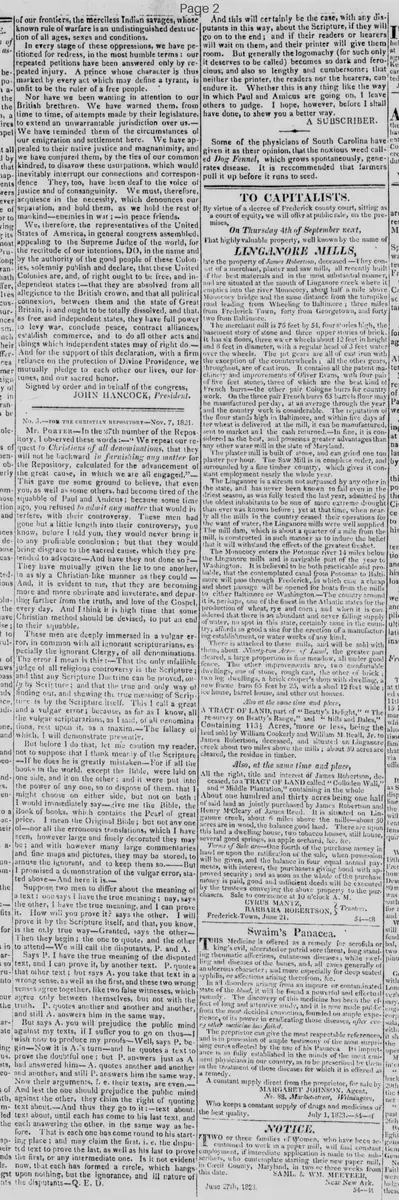
NO. 3.—FOR THE CHRISTIAN REPOSITORY—NOV. 7, 1821.
Mr. Porter—In the 27th number of the Repository, I observed these words:—“We repeat our request to Christians of all denominations, that they will not be backward in furnishing any matter for the Repository, calculated for the advancement of the great cause, in which we are all engaged.”
This gave me some ground to believe, that even you, as well as some others, had become tired of the squabble of Paul and Amicus; because some time ago, you refused to admit any matter that would interfere with their controversy. These men had gone but a little length into their controversy, you know, before I told you, they would never bring it to any profitable conclusion; but that they would bring disgrace to the sacred cause, which they pretended to advocate—And have they not done so?—
They have mutually given the lie to one another, in as sly a Christian-like manner as they could—And, it is evident to me, that they are becoming more and more obstinate and inveterate, and departing farther from the truth, and love of the Gospel, every day. And I think it is high time that some Christian method should be devised, to put an end to their squabble.
These men are deeply immersed in a vulgar error, in common with all ignorant scripturarians, especially the ignorant Clergy, of all denominations.
The error I mean is this:—That the only infallible judge of all religious controversy is the Scripture; and that any Scripture Doctrine can be proved, only by Scripture; and that the true and only way of finding out, and shewing the true meaning of Scripture is by the Scripture itself. This I call a great and a vulgar error; because, as far as I know, all the vulgar scripturarians, as I said, of all denominations, rest upon it, as a maxim.—The fallacy of which, I will demonstrate presently.
But before I do that, let me caution my reader not to suppose that I think meanly of the Scripture—if he does he is greatly mistaken—For if all the books in the world, except the Bible, were laid on one side, and it on the other; and it were put into the power of any one, so to dispose of them, that I might choose on either side, but not on both; I would immediately say—give me the Bible, the Book of books, which contains the Pearl of great price. I mean the Original Bible; but not any one of—nor all the erroneous translations, which I have seen, however large and finely decorated they may be; and with however many large commentaries and fine maps and pictures, they may be stored, to amuse the ignorant, and to keep them so.—But I promised a demonstration of the vulgar error, stated above—And here it is.—
Suppose two men to differ about the meaning of a text; one says I have the true meaning; nay, says the other, I have the true meaning, and I can prove it. How will you prove it? says the other. I will prove it by the Scripture itself, and that, you know, is the only true way—Granted, says the other—Then they begin; the one to quote, and the other to attend—We will call the disputants, P. and A.
Says P. I have the true meaning of the disputed text, and I can prove it, by another text. P. quotes that other text; but says A. you take that text in a wrong sense, as well as the first, and these two wrong senses agree together, like two false witnesses, which agree only between themselves, but not with the truth. P. quotes another and another and another, and still A. answers him in the same way.
But says A. you will prejudice the public mind against my texts, if I suffer you to go on thus—I wish now to produce my proofs—Well, says P. begin—Now it is A.'s turn—and he quotes a text to prove the doubtful one; but P. answers just as A. had answered him—A. quotes another and another and another, and still P. answers him the same way.
Now their arguments, i. e. their texts, are even.—And lest the one should prejudice the public mind against the other, they claim the right of quoting text about.—And thus they go to it:—text about. text about, until each has come to his last text, and each answering the other, in the same way as before. That is each one has come round to his starting place; and may claim the first, i. e. the disputed text to prove the last, as well as his last to prove the first, or any intermediate one. Is it not evident now, that each has formed a circle, which hangs upon nothing, but the ignorance, and ill nature of the disputants—Q. E. D.
And this will certainly be the case, with any disputants in this way, about the Scripture, if they will go on to the end: and if their readers or hearers will wait on them, and their printer will give them room. But generally the logomachy (for such only it deserves to be called) becomes so dark and ferocious; and also so lengthy and cumbersome; that neither the printer, the readers nor the hearers, can endure it. Whether this is any thing like the way in which Paul and Amicus are going on, I leave others to judge. I hope, however, before I shall have done, to shew you a better way.
A SUBSCRIBER.
Mr. Porter—In the 27th number of the Repository, I observed these words:—“We repeat our request to Christians of all denominations, that they will not be backward in furnishing any matter for the Repository, calculated for the advancement of the great cause, in which we are all engaged.”
This gave me some ground to believe, that even you, as well as some others, had become tired of the squabble of Paul and Amicus; because some time ago, you refused to admit any matter that would interfere with their controversy. These men had gone but a little length into their controversy, you know, before I told you, they would never bring it to any profitable conclusion; but that they would bring disgrace to the sacred cause, which they pretended to advocate—And have they not done so?—
They have mutually given the lie to one another, in as sly a Christian-like manner as they could—And, it is evident to me, that they are becoming more and more obstinate and inveterate, and departing farther from the truth, and love of the Gospel, every day. And I think it is high time that some Christian method should be devised, to put an end to their squabble.
These men are deeply immersed in a vulgar error, in common with all ignorant scripturarians, especially the ignorant Clergy, of all denominations.
The error I mean is this:—That the only infallible judge of all religious controversy is the Scripture; and that any Scripture Doctrine can be proved, only by Scripture; and that the true and only way of finding out, and shewing the true meaning of Scripture is by the Scripture itself. This I call a great and a vulgar error; because, as far as I know, all the vulgar scripturarians, as I said, of all denominations, rest upon it, as a maxim.—The fallacy of which, I will demonstrate presently.
But before I do that, let me caution my reader not to suppose that I think meanly of the Scripture—if he does he is greatly mistaken—For if all the books in the world, except the Bible, were laid on one side, and it on the other; and it were put into the power of any one, so to dispose of them, that I might choose on either side, but not on both; I would immediately say—give me the Bible, the Book of books, which contains the Pearl of great price. I mean the Original Bible; but not any one of—nor all the erroneous translations, which I have seen, however large and finely decorated they may be; and with however many large commentaries and fine maps and pictures, they may be stored, to amuse the ignorant, and to keep them so.—But I promised a demonstration of the vulgar error, stated above—And here it is.—
Suppose two men to differ about the meaning of a text; one says I have the true meaning; nay, says the other, I have the true meaning, and I can prove it. How will you prove it? says the other. I will prove it by the Scripture itself, and that, you know, is the only true way—Granted, says the other—Then they begin; the one to quote, and the other to attend—We will call the disputants, P. and A.
Says P. I have the true meaning of the disputed text, and I can prove it, by another text. P. quotes that other text; but says A. you take that text in a wrong sense, as well as the first, and these two wrong senses agree together, like two false witnesses, which agree only between themselves, but not with the truth. P. quotes another and another and another, and still A. answers him in the same way.
But says A. you will prejudice the public mind against my texts, if I suffer you to go on thus—I wish now to produce my proofs—Well, says P. begin—Now it is A.'s turn—and he quotes a text to prove the doubtful one; but P. answers just as A. had answered him—A. quotes another and another and another, and still P. answers him the same way.
Now their arguments, i. e. their texts, are even.—And lest the one should prejudice the public mind against the other, they claim the right of quoting text about.—And thus they go to it:—text about. text about, until each has come to his last text, and each answering the other, in the same way as before. That is each one has come round to his starting place; and may claim the first, i. e. the disputed text to prove the last, as well as his last to prove the first, or any intermediate one. Is it not evident now, that each has formed a circle, which hangs upon nothing, but the ignorance, and ill nature of the disputants—Q. E. D.
And this will certainly be the case, with any disputants in this way, about the Scripture, if they will go on to the end: and if their readers or hearers will wait on them, and their printer will give them room. But generally the logomachy (for such only it deserves to be called) becomes so dark and ferocious; and also so lengthy and cumbersome; that neither the printer, the readers nor the hearers, can endure it. Whether this is any thing like the way in which Paul and Amicus are going on, I leave others to judge. I hope, however, before I shall have done, to shew you a better way.
A SUBSCRIBER.
What sub-type of article is it?
Persuasive
Philosophical
Religious
What themes does it cover?
Religion
Morality
What keywords are associated?
Scripture Interpretation
Religious Controversy
Paul And Amicus
Christian Repository
Circular Reasoning
Vulgar Error
Bible Translations
What entities or persons were involved?
A Subscriber
Mr. Porter
Letter to Editor Details
Author
A Subscriber
Recipient
Mr. Porter
Main Argument
the method of resolving religious controversies solely by interpreting scripture with other scriptures leads to circular, futile arguments that disgrace christianity, as demonstrated in the debate between paul and amicus; a better way is needed.
Notable Details
Critique Of Paul And Amicus Controversy
Hypothetical Dispute Between P. And A.
High Praise For The Original Bible Over Translations
Demonstration Of Circular Reasoning With Q.E.D.
Term 'Logomachy' For Futile Word Battles