Thank you for visiting SNEWPapers!
Sign up free
Constitutional Whig
Richmond, Virginia
What is this article about?
A severe hurricane struck Jamaica on August 7, devastating Kingston harbor with sunk vessels and over 20,000 in damages, killing at least 30 people including on the brig George the 4th and sloop Perseverance. Widespread destruction to buildings, crops, and infrastructure in parishes like St. Andrews, Clarendon, and Morant Bay.
Clipping
OCR Quality
Full Text
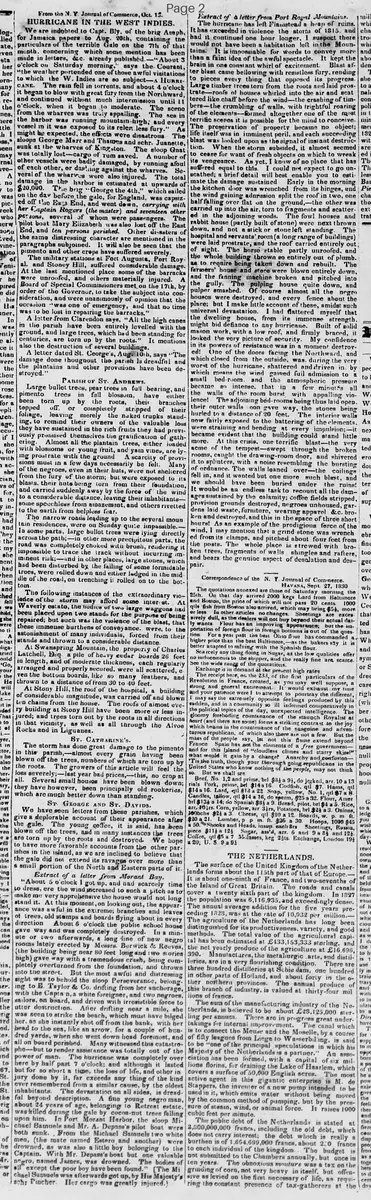
The scene from the wharves was truly appalling. The sea in the harbor was running mountain-high; and every vessel in it was exposed to its relentless fury."
As might be expected, the effects were disastrous. The sloops George Marr and Thames and schr. Juanette, sunk at the wharves of Kingston. The sloop Gnat was totally lost--cargo of rum saved. A number of other vessels were badly damaged, by running afoul of each other, or dashing against the wharves. Several of the wharves were also injured. The total damage in the harbor is estimated at upwards of 20,000. The brig George the 4th, which sailed on the day before the gale, for England, was capsized off the East End, and went down, carrying with her Captain Rogers (the master) and seventeen other persons, several of whom were passengers. The pilot boat Mary Elizabeth was also lost off the East End, and ten persons perished. Other disasters of the same distressing character are mentioned in the paragraphs subjoined. It will also be seen that the pimento and other crops have suffered severely.
The military stations at Fort Augusta, Port Royal, and Stony Hill, suffered considerable damage. At the last mentioned place some of the barracks were unroofed, and others materially injured. A Board of Special Commissioners met on the 17th, by order of the Governor, to take the subject into consideration, and were unanimously of opinion that the occasion was one of emergency, and that no time was to be lost in repairing the barracks."
A letter from Clarendon says, "All the high canes in the parish have been entirely levelled with the ground, and large trees, which had been standing for centuries, are torn up by the roots." It mentions also the destruction of several buildings.
A letter dated St. George's, Aug. 10th, says "The damage done throughout the parish is dreadful and the plantains and other provisions have been destroyed."
PARISH OF ST. ANDREWS.
Large bullet trees, pear trees in full bearing, and pimento trees in full blossom, have either been torn up by the roots, their branches topped off, or completely stripped of their foliage, leaving merely the naked trunks standing, to remind their owners of the valuable loss they have sustained in the rich fruits they had previously promised themselves the gratification of gathering. Almost all the plantain trees, either loaded with blossoms or young fruit, and yam vines, are lying prostrate with the ground. A scarcity of provisions must in a few days necessarily be felt. Many of the negroes, even in their huts, were not sheltered from the fury of the storm; but were exposed to its blasts, their huts being torn from their foundation, and carried suddenly away by the force of the wind to a considerable distance, leaving their inhabitants--some speechless from amazement, and others rivetted to the earth from helpless fear.
The narrow roads leading up to the several mountain residences, were on Sunday quite impassible.--In some parts, large bullet trees were lying directly across the path;--in other more precipitous parts, the road was completely choked with brush, rendering it impossible to trace the track without incurring imminent risk;--and in other places, large stones, which had been disturbed by the falling of some formidable trees, were rolled down and either lodged in the middle of the road, or trenching it rolled on to the bottom.
The following instances of the extraordinary violence of the storm may afford some interest. At Waverly estate, the bodies of two large waggons had been placed upon two stands for the purpose of being repaired; but such was the violence of the blast, that these immense burthens of conveyance were, to the astonishment of many individuals, forced from their stands and thrown to a considerable distance.
At Swanspring Mountain, the property of Charles Latchell, Esq. a pile of heavy cedar boards 26 feet in length, and of moderate thickness, each regularly arranged and properly secured, were all scattered, even the bottom boards, like so many feathers, and thrown to a distance of from 30 to 40 feet.
At Stony Hill, the roof of the hospital, a building of considerable magnitude, was carried off and blown ten chains from the house. The roofs of almost every building at Stony Hill have been more or less injured; and trees torn out by the roots in all directions in that vicinity, as well as all through the Alboe Rocks and in Liguanea.
The storm has done great damage to the pimento in this parish,--almost every grain having blown off the trees, numbers of which are torn up by the roots. The growers of this article will feel the loss severely;--last year bad prices,--this, no crop at all. Several small houses have been blown down; they have however, been principally old rookeries, which are much better down than standing.
ST. GEORGE AND ST. DAVID'S.
We have seen letters from these parishes, which give a deplorable account of their appearance after the gale. The young coffee, it is said, has been blown off the trees, and in many instances the trees are torn up by the roots and destroyed. We hope to have more favorable accounts from the other parishes in the island, as we are inclined to believe that the gale did not extend its ravages over more than a small portion of the North and Eastern parts of it.
Extract of a letter from Morant Bay.
"About 5 o'clock I got up, and had scarcely time to dress, ere the wind increased to such a pitch as to make me very apprehensive the house would not long stand it. At this moment, on looking out, the appearance was awful in the extreme; branches and leaves of trees, old stamps and boards flying about in every direction. About 6 o'clock the public school house gave way and was completely destroyed. In a minute or two afterwards, a long line of new negro rooms lately erected by Messrs. Berwick & Reeves, (the building being near 80 feet long and two stories high) gave way with a tremendous crash, being completely overturned from the foundation, and thrown into the street. But the most awful and distressing sight was to behold the sloop Perseverance, belonging to E. Taylor & Co. drifting from her anchorage, with the Captain, a white foreigner, and two negroes, sailors, on board, and driven with irresistible force to utter destruction. After drifting near a mile, she was seen to strike the beach, which must have bilged her, as she instantly shot off from the bank, with her head to the sea, like an arrow, for a couple of hundred yards, when she went down head foremost, and all on board perished. Many witnessed this catastrophe--but to render assistance was totally out of the power of man. The hurricane was completely over here by half past 7 o'clock; and although it lasted but for so short a time, the loss of life, and other injury done by it, far exceeds any thing of the kind ever remembered from a similar cause, by the oldest inhabitants. The devastation on all sides, is dreadful beyond description. A fine young negro man, about 24 years of age, belonging to Retreat estate, was killed during the gale by cocoa-nut trees falling upon him. In Port Morant Harbor, the sloop Michael Samuels and Mr. A. Depass's pilot boat were both sunk. From the Michael Samuels two white men, (the mate named Estero and another) were drowned, as was also a little boy belonging to the Captain. With Mr. Depass's boat but one valuable negro, named James, was drowned. The bodies of all except the poor boy have been found." [The Michael Samuels was afterwards got up, by His Majesty's schr. Pincher. Her cargo was greatly injured.]
Extract of a letter from Port Royal Mountains.
The hurricane has left Flamstead a heap of ruins. It has exceeded in violence the storm of 1815. and had it continued one hour longer, I suspect there would not have been a habitation left in the Mountains. It is impossible for words to convey more than a faint idea of the awful spectacle. It kept the brain in one constant whirl of excitement. Blast after blast came bellowing with resistless fury, rending to pieces every thing that opposed its progress. Large timber trees torn from the roots and laid prostrate--roofs of houses whirled into the air and scattered like chaff before the wind--the crashing of timbers--the crumbling of walls, with frightful roaring of the elements--formed altogether one of the most terrific scenes it is possible for the mind to conceive.
The preservation of property became no object; life itself was in imminent peril, and each succeeding blast was looked upon as the signal of instant destruction. When the storm subsided, it almost seemed to cease for want of fresh objects on which to wreak its vengeance. As yet, I know of no place that has suffered equal to this. I could not expect to go unscathed; a brief detail will best enable you to estimate the damage sustained. Early in the morning the kitchen door was wrenched from its hinges, and the wind gaining admission split the roof in two, one half falling over flat on the ground,--the other was carried up into the air, torn to fragments and scattered in the adjoining woods. The fowl houses and rabbit house (partly built of stone) were next thrown down, and not a stick or stone left standing. The hospital and servants' room (a long range of buildings) were laid prostrate, and the roof carried entirely out of sight. The horse stable partly unroofed, and the whole building thrown so entirely out of plumb, as to require being taken down and rebuilt. The farmers' house and store were blown entirely down, and the fanning machine broken and pitched into the gully: The pulping house quite down, and pulper smashed. Of course almost all the negro houses were destroyed. and every fence about the place; but I make little account of these, amidst such universal devastation. I had flattered myself that the dwelling house, from its immense strength, might bid defiance to any hurricane. Built of solid mason work, with a low roof, and firmly braced, it looked the very picture of security. My confidence in its powers of resistance was in a moment destroyed! One of the doors facing the Northward, and which closed from the outside, was, during the very worst of the hurricane, shattered and driven in. by which means the wind gained full admission to a small bed-room. and the atmospheric pressure became so intense. that in a few minutes all the walls of the room burst with appalling violence! The adjoining bed-rooms being thus laid open. their outer walls soon gave way, the stones being hurled to a distance of 20 feet. The interior walls now fairly exposed to the battering of the elements. were straining and bending at every impulsion;--it became evident that the building could stand little more.
At this crisis, one terrific blast--the very acme of the tempest--swept through the broken rooms, caught the drawing-room door, and shivered it to splinters, with a noise resembling the bursting of ordnance. The walls leaned over--the ceilings fell in, and it wanted but one more such blast, and we should have been buried under the ruins!
It would be an endless task to recount all the damages sustained by the calamity; Coffee fields stripped, provision grounds destroyed, negroes unhoused, gardens laid waste, furniture, wearing apparel &c. broken and destroyed, and this in the space of three short hours! As an example of the prodigious force of the wind, I may mention that a grind stone was wrenched from its clamps, and pitched about four feet from the posts. The whole place is strewed with broken trees, fragments of walls shingles and rafters, and bears the genuine aspect of desolation and despair.
What sub-type of article is it?
What keywords are associated?
What entities or persons were involved?
Where did it happen?
Foreign News Details
Primary Location
Jamaica
Event Date
7th Of August
Key Persons
Outcome
sloops george marr, thames, schr. juanette, sloop gnat sunk; brig george the 4th capsized with captain rogers and 17 others lost; pilot boat mary elizabeth lost with 10 perished; sloop perseverance sunk with captain, white foreigner, two negroes; two white men and boy from sloop michael samuels drowned; one negro james from mr. a. depass's pilot boat drowned; one negro man killed by falling trees; total harbor damage over 20,000; severe crop losses including pimento, coffee, plantains; numerous buildings, barracks, roads damaged or destroyed.
Event Details
A hurricane struck Jamaica on August 7, beginning around 3-4 AM with torrential rain and fierce winds from the north until 11 AM. In Kingston harbor, seas ran high, sinking several vessels and damaging others and wharves. Reports from parishes including Clarendon, St. George's, St. Andrews, St. George and St. David's, Morant Bay, and Port Royal Mountains detail leveled crops, uprooted trees, destroyed buildings, impassable roads, and loss of life. Military stations at Fort Augusta, Port Royal, Stony Hill damaged; board of commissioners ordered repairs. Devastation exceeded 1815 storm in some areas.