Thank you for visiting SNEWPapers!
Sign up free
The Virginia Gazette
Richmond, Williamsburg, Richmond County, Virginia
What is this article about?
Boston newspaper reports on letters from London detailing British reactions to colonial unrest, including parliamentary debates on Boston's proceedings, troop arrivals, and refusal to repeal revenue laws, emphasizing support for government authority.
Clipping
OCR Quality
Full Text
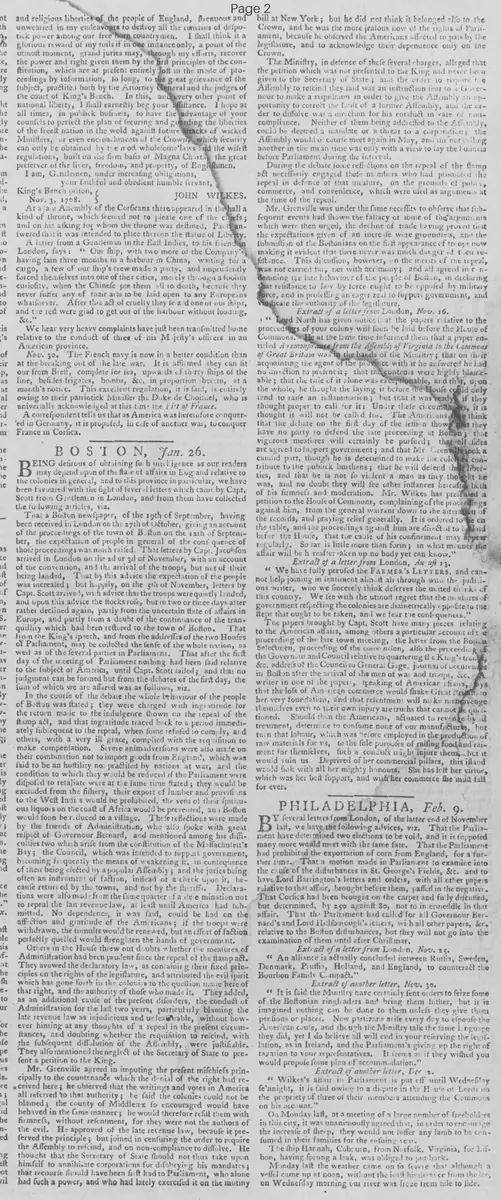
Being desirous of obtaining such intelligence as our readers may depend upon of the late state of affairs in England relative to the colonies in general, and to this province in particular, we have been favoured with the sight of several letters which came by Capt. Scott from Gentlemen in London, and from them have collected the following articles, viz.
That a Boston newspaper, of the 19th of September, having been received in London on the 27th of October, giving an account of the proceedings of the town of Boston on the 11th of September, the expectation of people in general of the consequence of those proceedings was much raised. That letters by Capt. Jacobson arrived in London on the 2d or 3d of November, with an account of the convention, and the arrival of the troops, but not of their being landed. That by this advice the expectation of the people was increased; but happily, on the 5th of November, letters by Capt. Scott arrived, with advice that the troops were quietly landed, and upon this advice the stocks rose, but in two or three days after rather declined again, partly from the uncertain state of affairs in Europe, and partly from a doubt of the continuance of the tranquillity which had been restored to the town of Boston. That from the King's speech, and from the address of the two Houses of Parliament, may be collected the sense of the whole nation, as well as of the several parties in Parliament. That after the first day of the meeting of Parliament nothing had been said relative to the subject of America, until Capt. Scott sailed; and that no judgment can be formed but from the debates of the first day, the sum of which we are assured was as follows, viz.
In the course of the debate the whole behaviour of the people of Boston was stated; they were charged with ingratitude for the return made to the indulgence shown on the repeal of the stamp act, and that ingratitude traced back to a period immediately subsequent to the repeal, when some refused to comply, and others, with a very ill grace, complied with the requisition to make compensation. Severe animadversions were also made on their combination not to import goods from England, which was said to be an hostility not practised by nations at war, and the condition to which they would be reduced if the Parliament were disposed to retaliate were at the same time stated; they would be excluded from the fishery, their export of lumber and provisions to the West Indies would be prohibited, the vent of their spirituous liquors on the coast of Africa would be prevented, and Boston would soon be reduced to a village. These reflections were made by the friends of Administration, who also spoke with great respect of Governor Bernard, and mentioned among his difficulties two which arise from the constitution of the Massachusetts Bay; the Council, which was intended to support government, becoming frequently the means of weakening it, in consequence of their being elected by a popular Assembly; and the juries being often an instrument of faction, instead of a check upon it, because returned by the towns, and not by the sheriffs. Declarations were also made from the same quarter of a determination not to repeal the last revenue law, at least until America had submitted. No dependence, it was said, could be had on the affection and gratitude of the Americans; if the troops were withdrawn, the tumults would be renewed, but an effort of faction perfectly quelled would strengthen the hands of government.
Others in the House threw out doubts whether the measures of Administration had been prudent since the repeal of the stamp act. They avowed the declaratory law, as containing their fixed principles on the rights of the legislature, and attributed the evil spirit which has gone forth in the colonies to the question made here of that right, and the authority of those who made it. They added, as an additional cause of the present disorders, the conduct of Administration for the last two years, particularly blaming the late revenue law as injudicious and unseasonable, without however hinting at any thoughts of a repeal in the present circumstances, and doubting whether the requisition to rescind, with the subsequent dissolution of the Assembly, were justifiable. They also mentioned the neglect of the Secretary of State to present a petition to the King.
Mr. Grenville agreed in imputing the present mischiefs principally to the countenance which the denial of the right had received here; he observed that the writings and votes in America all referred to that authority; he said the colonies could not be blamed; the county of Middlesex so encouraged would have behaved in the same manner; he would therefore resist them with firmness, without resentment, for they were not the authors of the evil. He approved of the late revenue law, because it preserved the principle; but joined in censuring the order to require the Assembly to rescind, and on non-compliance to dissolve. He thought that the Secretary of State should not thus take upon himself to annihilate corporations for disobeying his mandates; that recourse should have been first had to Parliament, who alone had such a power, and who had lately exercised it on the mutiny bill at New York; but he did not think it belonged also to the Crown, and he was the more jealous now of the rights of Parliament, because he observed the Americans affected to pass by the legislature, and to acknowledge their dependence only on the Crown.
The Ministry, in defence of these several charges, alleged that the petition which was not presented to the King had never been given to the Secretary of State; and the order to require the Assembly to rescind they laid was an instruction sent to Governor to make a requisition in order to give the Assembly an opportunity to correct the fault of a former Assembly, and the order to dissolve was a direction for his conduct in case of non-compliance. Neither of them being addressed to the Assembly, could be deemed a mandate or a threat to a corporation; the Assembly would of course meet again in May, and the not choosing another in the mean time was only with a view to lay the matters before Parliament during the interval.
During the debate some reflections on the repeal of the stamp act necessarily engaged those members who had promoted the repeal in defence of that measure, on the grounds of policy, commerce, and convenience, which were used as arguments at the time of the repeal.
Mr. Grenville was under the same necessity to observe that subsequent events had shown the fallacy of some of the arguments which were then urged, the decline of trade having proved that the expectations given of an increase were groundless, and the submission of the Bostonians on the first appearance of troops now making it evident that there never was much danger of their resistance. This discussion, however, on the merits of the repeal, was not carried far, nor with acrimony; and all agreed in condemning the late behaviour of the people of Boston, in declaring that resistance to law by force ought to be opposed by military force, and in professing an eager zeal to support government, and vindicate the authority of the legislature.
What sub-type of article is it?
What keywords are associated?
What entities or persons were involved?
Where did it happen?
Domestic News Details
Primary Location
London
Event Date
October November
Key Persons
Outcome
parliamentary consensus to oppose resistance with military force, no repeal of revenue law until submission, support for government authority.
Event Details
Letters from London detail British public and parliamentary reactions to Boston's unrest, troop landing, and debates on colonial ingratitude, non-importation, constitutional issues, and defense of revenue laws and administrative actions.