Thank you for visiting SNEWPapers!
Sign up free
Virginia Free Press
Charles Town, Jefferson County, West Virginia
What is this article about?
A letter from 'One of the Committee' rebuts 'Mechanic's' defenses of Federalism in the Free Press, arguing that Washington, Jefferson, Henry, and Jackson were not Federalists; refutes claims on bank charters, tariffs, veto power, and Whig policies; criticizes Whig inconsistencies and historical misrepresentations.
Merged-components note: These components form a single continuous letter to the editor that spans pages 1 and 2, with the text flowing directly from one to the next. The third component was incorrectly labeled as 'story' but is part of the same letter.
Clippings
1 of 2
OCR Quality
Full Text
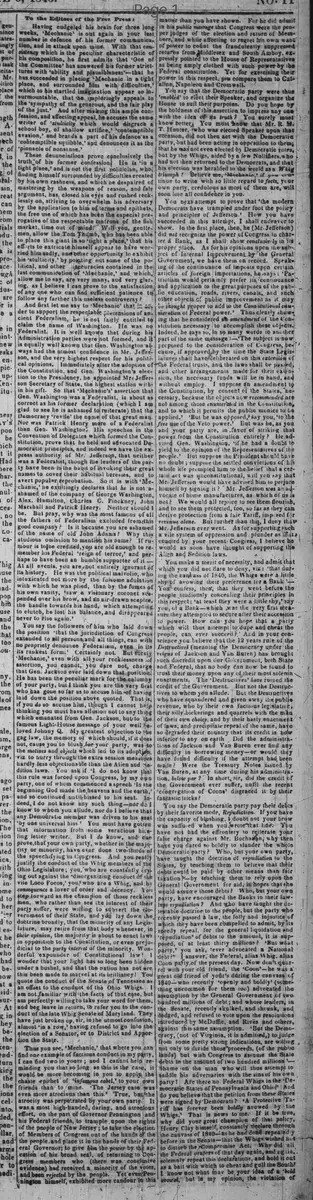
Having cudgelled his brain for three long weeks, 'Mechanic' is out again in your last number in defence of his former communication, and in attack upon mine. With that consistency which is the peculiar characteristic of his composition, he first admits that 'One of the Committee' has answered his former strictures with 'ability and plausibleness'—that he has succeeded in placing Mechanic, in a tight place, and surrounded him with difficulties, which to his startled imagination appear so insurmountable, that he imploringly appeals to the 'sympathy of the generous, and the fair play of the just.' And after making this ample confession, and affecting appeal, he accuses the same writer of stulticity which would disgrace a school boy, of shallow artifice 'contemptible evasion,' and brands a part of his defence as a 'contemptible squibble,' and denounces it as the 'pinnacle of nonsense.'
These denunciations prove conclusively the truth of his former confession He is in a tight place, and is not the first politician, who finding himself surrounded by difficulties created by his own rashness, and which he despaired of mastering by the weapons of reason, and fair argument, has, closed his eyes and rushed recklessly on, striving to overwhelm his adversary by the application to him of terms and epithets, the free use of which has been the especial prerogative of the respectable matrons of the fish market, time out of mind. Will you, gentlemen, allow the Tom Thumb, who has been able to place this giant in so tight a place, that his efforts to extricate himself appear to have worried him sadly, one other opportunity to exhibit his 'stulticity,' by pointing out some of the political, and other inaccuracies contained in the last communication of 'Mechanic,' and, which, allow me to say, are very many, and very glaring, as I believe I can prove to the satisfaction of any one who can find sufficient patience to follow any farther this useless controversy?
And first let me say to 'Mechanic' that in order to support the respectable pretensions of ancient Federalism, he is not fairly entitled to claim the name of Washington. He was no Federalist. It is well known that during his Administration parties were not formed, and it is equally well known that Gen. Washington always had the utmost confidence in Mr. Jefferson, and the very highest respect for his political opinions. Immediately after the adoption of the Constitution, and Gen. Washington's election to the Presidency, he appointed Mr. Jefferson Secretary of State, the highest station within his gift. So that 'Mechanic's' assertion that Gen. Washington was a Federalist, is about as correct as his former declaration (which I am glad to see he is ashamed to reiterate) that the Democracy revile the name of that great man
Nor was Patrick Henry more of a Federalist than Gen. Washington. His speeches in the Convention of Delegates which formed the Constitution, prove that he held and advocated Democratic principles, and indeed we have the express authority of Mr. Jefferson, that neither was a Federalist, though the leaders of the party have been in the habit of invoking their great names to cover their habitual heresies, and to avert popular reprobation. So it is with 'Mechanic,' he exultingly declares that he is not ashamed of the company of George Washington, Alex. Hamilton, Charles C. Pinckney, John Marshall and Patrick Henry. Neither should I. But pray, why was the most famous of all the fathers of Federalism excluded from this good company? Is it because you are ashamed of the name of old John Adams? Why this studious omission to mention his name? If rumour is to be credited, you are old enough to remember his Federal 'reign of terror,' and perhaps to have been an humble supporter of it— At all events, you are not entirely ignorant of its history. He was the political malvolio, who intoxicated not more by the fulsome adulation with which he was plied, than by the fumes of his own vanity, saw a visionary coronet suspended over his brow, and an air-drawn sceptre, the handle towards his hand, which attempting to clutch, he lost his balance, and disappeared never to rise again.
You say the followers of him who laid down the position 'that the jurisdiction of Congress extended to all persons and all things, can with no propriety denounce Federalism, even in its rankest form! Certainly not. But surely 'Mechanic,' even with all your recklessness of assertion, you cannot, you dare not, charge that Gen. Jackson ever laid down that position. He has been the peculiar mark for the calumny of your party, but I think you are the very first who has gone so far as to accuse him of having laid down the position above quoted. That is, if you do so accuse him, though I cannot help thinking you must have allusion not to any thing which emanated from Gen. Jackson, but to the famous Light-House message of your well remembered Johnny Q. My greatest objection to the gag law, the memory of which should, if it does not, cause you to blush for your party, was to the motives and objects which led to its adoption. -viz. to hurry through the extra session measures hardly less objectionable than the Alien and Sedition laws. - You ask if 'I do not know that this rule was forced upon Congress, by my own party, one of whom commenced a speech 'In the beginning God made the heavens and the earth, and so continued until—hissed to his seat. Indeed, I do not know any such thing—nor do I know to whom you allude, nor do I believe that any Democratic member was driven to his seat 'by one universal hiss.' You must have gotten that information from some veracious hissing letter writer. But I do know, and can prove, that your own party, whether in the majority or minority, have ever done two-thirds of the speechifying in Congress. And you really justify the conduct of the Whig members of the Ohio Legislature; you, who are constantly crying out against the 'disorganizing conduct of the vile Loco Focos,' you, who are a Whig, and by consequence a lover of order and decency. You step forward as the champion of those reckless men, who rather than see the interest of their party suffer, were willing to subvert the Government of their State, and you lay down the doctrine broadly, that the minority of any Legislature, may retire from that body whenever, in their opinion, the majority is about to enact laws in opposition to the Constitution, or even prejudicial to the party interest of the minority. Wonderful expounder of Constitutional Law! I wonder that your light has so long been hidden under a bushel, and that the nation has not ere this been made to marvel at its brilliancy! You quote the conduct of the Senate of Tennessee as an offset to the conduct of the Ohio Whigs. I am not familiar with the facts of that case, but am perfectly willing to take your word for them, and beg leave in return, to refer you to the conduct of the late Whig Senate of Maryland. They have just broken up, sir, in the utmost confusion, almost 'in a row,' having refused to go into the election of a Senator, or to District and Apportion the State.
Thus you see, 'Mechanic,' that where you can find one example of factious conduct in my party, I can find two in yours; and I cannot help reminding you that so long as this is the case, it would be more becoming in you to apply the chaste epithet of 'infamous cabal,' to your own friends than to mine. The Jersey case was even more atrocious than this. True, but the atrocity was perpetrated by your own party. It was a most high-handed, daring, and atrocious effort, on the part of Governor Pennington and his Federal friends, to trample upon the rights of the people of New Jersey; to take the election of Members of Congress out of the hands of the people, and place it in the hands of their Federal Governor; to give him the power by the application of his broad seal, of returning to Congress members who (there was conclusive evidence) had received a minority of the votes, and been rejected by the people. Yet even Pennington himself, exhibited more candor in this matter than you have shown. 'For he did admit
in his public message that Congress were the proper judges of the election and return of Members, and while affecting to regret his own want of power to count the fraudulently suppressed returns from Middlesex and South Amboy, expressly pointed to the House of Representatives as being amply clothed with such power by the Federal constitution. Yet for exercising their power in this respect, you compare them to Catherine, Napoleon and Cromwell.
You say that the Democratic party were thus enabled to elect their Speaker, and organize the House to suit their purposes. Do you hope by the boldness of this assertion to impress any one with the idea of its truth? You surely must know better. You must know that Mr. R. M. T. Hunter, who was elected Speaker upon that occasion, did not then act with the Democratic party, but had been acting in opposition to them that he was not even elected by Democratic votes, but by the Whigs, aided by a few Nullifiers, who had not then returned to the Democrats, and that his election was heralded to the world as a Whig triumph! Believe me, 'Mechanic,' if you continue to write with so little regard to facts, your own party, credulous as most of them are, will soon lose all confidence in you.
You next attempt to prove that 'the modern Democrats have trampled under foot the policy and principles of Jefferson.' How you have succeeded in this attempt, I shall endeavor to show. In the first place, then, he (Mr. Jefferson) did not recognize the power of Congress to charter a Bank, as I shall show conclusively in its proper place. As for his opinions upon the subject of Internal Improvement by the General Government, we have them on record. Speaking of the continuance of imposts upon certain articles of foreign importations, he says: 'Patriotism would certainly prefer its continuance and application to the great purposes of the public education, roads, rivers, canals, and such other objects of public improvement as it may be thought proper to add to the Constitutional enumeration of Federal power.' Thus clearly showing that he considered an amendment of the Constitution necessary to accomplish these objects. Indeed, he says so, in so many words in another part of the same message: "The subject is now proposed to the consideration of Congress, because, if approved by the time the State Legislatures shall have deliberated on this extension of the Federal trusts, and the laws shall be passed and other arrangements made for their completion, the necessary funds will be in hand, and without employment. I suppose an amendment to the Constitution, by consent of the States, necessary, because the objects now recommended are not among those enumerated in the Constitution and to which it permits the public monies to be applied.' 'But he was opposed, say you, 'to the free use of the Veto power.' But was he, as you and your party are, in favor of striking that power from the Constitution entirely? He advised Gen. Washington, 'if he had a doubt to yield to the opinion of the Representatives of the people.' But suppose the President should have no doubt; suppose the settled convictions of his whole life prompted him to the belief that a certain act was unconstitutional, will you say that Mr. Jefferson would have advised him to perjure himself by signing it? Mr. Jefferson was an advocate of home manufactures, as who of us is not? We would all rejoice to see them flourish, and to see them protected, too, so far as they can derive protection from a fair Tariff, imposed for revenue alone. But further than this, I deny that Mr. Jefferson ever went. As for supporting such a vile system of oppression and plunder as that enacted by your recent Congress, I believe he would as soon have thought of supporting the Alien and Sedition laws.
' You make a merit of necessity, and admit that which you did not dare to deny, viz: 'that during the canvass of 1840, the Whigs were a little shy of avowing their preference for a Bank You confess, then, that they went before the people studiously concealing their principles in this respect; 'at least they were a little shy,' say you, of a Bank—which was the very first measure they attempted to secure after their accession to power. How can you hope that a party which will thus attempt to dupe and cheat the people, can ever succeed? And in your conscience you believe that the 12 years rule of the Destructive (meaning the Democracy under the reigns of Jackson and Van Buren) has brought such discredit upon our Government, both State and Federal, that no body can now be found to trust their money upon any of their most solemn enactments. The 'Destructives' have ruined the credit of the Government. But not the Destructives to whom you allude. But the Destructives who have squandered and given away the public revenue, who by their own factious legislation their silly bickerings and quarrels with the man of their own choice; and by their hasty enactment of laws, and precipitate repeal of the same, have so degraded their country that its credit is now inferior to any on earth Did the administrations of Jackson and Van Buren ever find any difficulty in borrowing money—or would they have found difficulty if the attempt had been made? Were the Treasury Notes issued by Van Buren, at any time during his administration, below par?" In short, sir, did the credit of the Government ever suffer, until the recent 'congregation of Coons' disgraced it by their fantastic tricks?
You say the Democratic party pay their debts by their favorite mode, Repudiation. If you have the capacity of blushing, I doubt not your brow was suffused when you wrote that line. You have not had the effrontery to reiterate your false charge against Mr. Buchanan, why then have you dared so boldly to slander the whole Democratic party? Who, but your own party, have taught the doctrine of repudiation to the States, by teaching them to believe that their debts could be paid by other means than fair taxation?—by teaching them to rely upon the General Government for aid, in hopes that she would assume those debts? Who, but your own party, have encouraged the Banks in their lawless repudiation? And who have taught the detestable doctrine to the people, but the party who recently passed a law, the folly and injustice of which they have been compelled to admit, by its speedy repeal, for the general liquidation and 'repudiation' of debts to the amount, it is supposed, of at least thirty millions? But what party,' you ask, ever advocated a National debt?" I answer, the Federal, alias Whig, alias Coon party, of the present day. Now don't quarrel with your old friend, the 'Coon'—he was a great old friend of yours during the canvass of 1840—who recently 'openly and boldly' (something uncommon for them too) advocated the assumption by the General Government of two hundred millions of debt; and whose leaders, in the Senate, recently skulked, and shrunk, and dodged, and refused to vote upon the resolutions introduced by McDuffie, and Rives and others, against this same assumption. But the Democracy, (not of Virginia, it is admitted, ) to judge from some pretty strong indications, are willing not only to divide those proceeds, (of the public lands) but wish Congress to assume the State debts to the amount of two hundred millions'— Shame on the man who will thus attempt to saddle his adversaries with the sins of his own party! Are there no Federal Whigs in the Democratic States of Pennsylvania and Ohio? And do you believe that the petition from these States were signed by 'Democrats? A Protective Tariff has forever been boldly avowed by the Whigs. That is news to me If it be true, why did your great champion of that policy, Henry Clay himself, constantly declare through the canvass of 1840—as he had done repeatedly before in the Senate—that the Whigs wished not to disturb the Compromise Act. Why did all the Federal orators of that day again, and again, solemnly repeat this declaration, and hold it out as a bait with which to cheat and gull the South? I know not what may be your idea of a bold avowal,' but its my opinion, tho violation of
that promise, so solemnly made by your leaders, has stamped the character of your party with fraud and duplicity, which will stick to it like the poisoned shirt of Nessus; will cleave to it, even to the end of time. You say this writer says, the Whigs have taken up this Bank of Pennsylvania, and ask how? when? I will tell you when. When this same Bank succeeded by bribery and corruption, in procuring its charter from the Legislature of Pennsylvania, almost every Federal press in the Union rang with the notes of triumph. It was proclaimed from Maine to Georgia, as a grand Federal conquest over the old Romans, the destructive, the vile Loco Focos. The praises of Nicholas Biddle were chanted afresh by thousands of his devoted worshippers, and his famous declaration 'that the Bank was as efficient for all useful purposes as before,' was sung with rapturous applause by his blind adherents. Have you forgotten this, sir? Is your memory upon this occasion as accommodating, as upon some others? Or will you put a bold face upon the matter, and deny it flatly? The tears of many a widow and orphan will testify against you, that this rotten institution instead of being robbed by the democracy was engaged during its brief existence in a system of plunder and robbing unparalleled. It is one of the peculiarities of your party, that when the tools with which they worked became worn out and worthless in their hands, they discard them, and cast them aside to rot upon the dung hill. So has it been with this Bank. Your party bribed it into existence—stood by, supported, and praised it, until it broke in your hands and then you tore off the flimsy veil, exposed its rottenness to the public gaze, and denounced it as an instrument of the Democracy. I cannot excuse your 'Extra Session,' because I cannot see that there was any necessity for it. You say it was to provide funds to carry on the operations of Government. And pray, what funds did it provide, or attempt to provide? Do you call the giving away of the proceeds of the Public Lands, providing funds to carry on the Government? Or would your Bank Bill have had that effect, or your Bankrupt Bill? Or what method did you resort to which did succeed in accomplishing that object? You voted at least three millions of appropriations over and above the sum which had been deemed sufficient for the current year, by the extravagant administration of Mr. Van Buren, to carry on the Government, and indeed as even extravagant, according to the speeches and recorded votes of the active leaders of the Whig party in the then House of Representatives. What contemptible hypocrisy! Mr. Van Buren's Extra Session was called under very different circumstances. The Banks, then the depositories of the public money, had suspended specie payments, and panic and distress pervaded the whole country, and the public debtors were unable to meet their bonds. The Government was thus deprived of almost every resource. Because I could not justify the unwarrantable act of extravagance which bestowed a gratuity of $25,000 upon Gen. Harrison's widow, you affect great indignation, and will not trust yourself to reply, lest you should use unbecoming language. It is a pity you should be exposed to so severe a trial, though there can be little danger, I should think, that one who writes with so much elegance and dignity as 'Mechanic,' should be betrayed into the excess of 'unbecoming language,' even though he should accuse his adversary of effrontery and 'stulticity.' Next follows your enumeration of the expenditures of Mr. Van Buren's administration. To this borrowed statement it is sufficient to oppose the full refutation given to it on the floor of the Senate of the U. S. by Mr. Woodbury and others. That is to be found published in the columns of the National Intelligencer, or in the Globe. Read it, and cease your attempt to revive an exploded calumny. You say, 'what may be the expenses of Mr. Tyler's administration you do not know, you have no doubt that they will be large, for he will not co-operate with the Whigs in Congress, hardly in any measure of importance.' Do you suppose any intelligent person so ignorant of the recorded fact that Mr. Tyler has signed every Appropriation bill which the Whig Congress passed? Or do you consider the Bankrupt bill, the Tariff bill, the Distribution bill, and the bill making the donation to Harrison's widow, and all the other Appropriation bills passed by your Congress, and signed by your President, (Tyler) as measures of no importance? Was not this 'co-operation?' What way you? Your brother Whigs will read you out of church, if you thus disparage their legislation, without rendering a reason. And now for the Constitutional power to establish a Bank. You insist upon it that Mr. Jefferson, Madison, Monroe and Jackson, all admitted this power in the Constitution. I deny that either of them ever admitted it. Now, such being the issue between us, let us to the proof. Your holding the affirmative should have established clearly and conclusively that position. Have you done so? Let us begin with Mr. Jefferson: He opposed the incorporation of the First Bank of the United States, and then used the following powerful language: 'I consider the foundation of the Constitution as laid on the ground, that all powers not delegated to the United States by the Constitution, nor prohibited by it to the States, are reserved to the States, or the people. To take a single step beyond the boundaries thus specially drawn around the power of Congress, is to take possession of a boundless field of power no longer susceptible of definition. The incorporation of a Bank, and other powers assumed by this bill, have not in my opinion been delegated to the United States by the Constitution. It is known that the very power now proposed as a means was rejected as an end by the Convention which framed the Constitution. A proposition was made to them to authorize Congress to open canals, and an amendatory one to empower them to Incorporate, but the whole was rejected, and one of the reasons urged in debate was, that they would have power to create Banks.' Now, what think you of that opinion of Mr. Jefferson? Have you ever seen that argument fairly answered, or will you condescend to answer it yourself? Mr. Madison took the very same ground in opposition to the same Bank. He wound up one of the most masterly arguments ever made by any man, against the power of Congress to incorporate a Bank, with the following conclusions: 'It appeared on the whole (Mr. Madison concluded) that the power exercised by the bill, was condemned by the silence of the Constitution; was condemned by the rule of interpretation arising out of the Constitution; was condemned by its tendency to destroy the main characteristic of the Constitution; was condemned by the exposition of the friends of the Constitution, whilst depending before the public; was condemned by the apparent intentions of the parties which ratified the Constitution; was condemned by the explanatory amendments proposed by Congress themselves to the Constitution, and he hoped it would receive its final condemnation by the vote of this House.' Will you, after reading this, still claim Mr. Madison as one of your Bank advocates? Mr. Madison, in his Veto Message of 1816, admits that he had not changed and become a convert to the opinion that the Constitution, as he understood it, conferred upon Congress power to establish a Bank. He, on the contrary, expressly placed his sanction to its exercise upon the ground that previous Congresses and the Supreme Court had declared the power to exist, and that the people had acquiesced therein. But you insist that Mr. Jefferson admitted the power of Congress to charter a Bank, because he signed the bill establishing an Office in the city of New Orleans. Now, am I to attribute this reiterated assertion of yours, to ignorance or to a want of candour? I had rather believe you ignorant, than deceitful. It is more creditable and therefore I will inform you that the charter of the then existing Bank of the United States expressly gave to the corporation the right of establishing offices within the States. Here is the provision— It shall be lawful for the Directors of the Bank to establish Offices wheresoever they shall think fit within the United States, for the purposes of discount and deposit only.' Now, I say, the Constitutional question was not presented to Mr. Jefferson by the bill establishing an Office at New Orleans. If there ever was such a bill, which I have been unable to discover, the charter of the Bank with all the powers it contained, had been granted by Congress, and was then a portion of the law of the land. Now, why should Mr. Jefferson have refused to sign a bill meant merely to extend the operations of an existing law, which he had no agency in passing, and under which the corporation held vested rights according to the federal doctrine which it was incompetent for the Government to violate? When he, as the Executive, was bound to see that law faithfully executed. He exercised not the power in conjunction with Congress of passing a new law, but only that of extending the existing law, to a newly acquired portion of the Union. He was not called upon to do the act itself, but simply to widen the sphere of its operation. He did not sign a Bank charter: that had been done by his predecessor. He only signed a bill that did not require any new exercise of Constitutional power to give it force. And the Office when established, derived its source from an existing law, the 23d Section of the existing charter before created. And when, pray, did Mr. Monroe advocate the power of Congress to establish a Bank? You have not condescended to inform us. And I am not ashamed to confess that if he ever was an advocate of that power, I am ignorant of it. And Jackson, too, you say, was an advocate. You will not take the acts of his whole life upon this subject: his war with the great monster;— nor his recent letter to Col. Benton, adding 'that you would not have much confidence in any thing which had passed between the fingers of that distinguished gentleman, and that One of the Committee knows to what I allude.' Yes I do know that you allude with much apparent pleasure, to a foul, infamous calumny, invented by some tool of your party for political effect. I ask again, have you proved that these men, or any of them were the advocates of the power of Congress to establish a Bank? I maintain that you have not. And no greater tribute could possibly be paid to the memory of those great Republicans, than these frequent attempts to misrepresent on the one hand, and the deceitful praise of their admitted policy and opinions on the other, which is daily extorted from modern Federalists. These great Statesmen have rendered themselves the immortal favorites of the people, and your party knowing this, do not hesitate in public to bestow upon them the most fulsome adulation, whilst in private, as I have frequently heard them, they speak in the most contemptuous manner of them, and almost every act of their lives. The next glaring misstatement which meets my observation is contained in the following words: 'Next an attempt is made to disparage and degrade the Supreme Court.' With the communication which you were criticising full before your eyes, it is matter of extreme astonishment to me how you could have permitted that sentence to have escaped from your pen. If you had set out with the fixed determination of discrediting your own composition you could not have done so more effectually than by penning such a sentence as the above. The language which I used in speaking of the Supreme Court was this—'The men themselves who occupied the Bench were entitled to all respect, and especially he who was chief among them, and chief among all the men of his day, for professional ability, unambitious worth, and incorruptible integrity. His authority is indeed of great weight. God forbid that I should speak lightly of it.' I was particularly careful to draw a distinction between the members of the Supreme Court and the federal party of that day, who were afterwards driven with scorn and disgrace from the service of the people. And now, sir, where is the attempt to disparage and degrade the Supreme Court? And what confidence will the public hereafter have in any thing you shall write, when they have here such a specimen of your candor and fairness? You say 'One of the Committee' speaks of the politics of Judges. 'This is a most detestable doctrine.' What doctrine? Oh thou Solomon of scribblers! What doctrine is so 'detestable? To speak of the politics of a Judge is a doctrine, is it? Verily, verily, some honest descendant of the animal which spake unto Balaam must have been your preceptor when you studied the definition of words! I fully concur with you in the merited compliment which you have bestowed upon the Judge of this District, and yet I cannot prevent the suspicion from intruding itself upon my mind, that you are one of those Whig admirers of that gentleman and profound Judge, who refused through disreputable party motives to sign the recommendation gotten up in behalf of one of the most distinguished ornaments of our bar, when he received his appointment! If your withers are unwrung, you may smile at this, but if you be the galled jade, which I suspect you to be, you must needs wince. ONE OF THE COMMITTEE [CONCLUSION IN OUR NEXT.]
What sub-type of article is it?
What themes does it cover?
What keywords are associated?
What entities or persons were involved?
Letter to Editor Details
Author
One Of The Committee
Recipient
To The Editors Of The Free Press.
Main Argument
'one of the committee' refutes 'mechanic's' claims that historical figures like washington, jefferson, madison, monroe, and jackson supported federalist policies such as the national bank, arguing they opposed unconstitutional expansions of federal power and criticizing whig inconsistencies on tariffs, repudiation, and legislative conduct.
Notable Details