Thank you for visiting SNEWPapers!
Sign up free
Literary
December 15, 1872
Nashville Union And American
Nashville, Davidson County, Tennessee
What is this article about?
Essay on the romantic lives of historical figures: Jean-Jacques Rousseau's loves from Madame de Warens to Therese Levasseur; Mirabeau's appeal despite ugliness; Goethe's serial infatuations culminating in marriage to Christiane Vulpius, emphasizing his enjoyment of love's pleasures.
Clipping
OCR Quality
95%
Excellent
Full Text
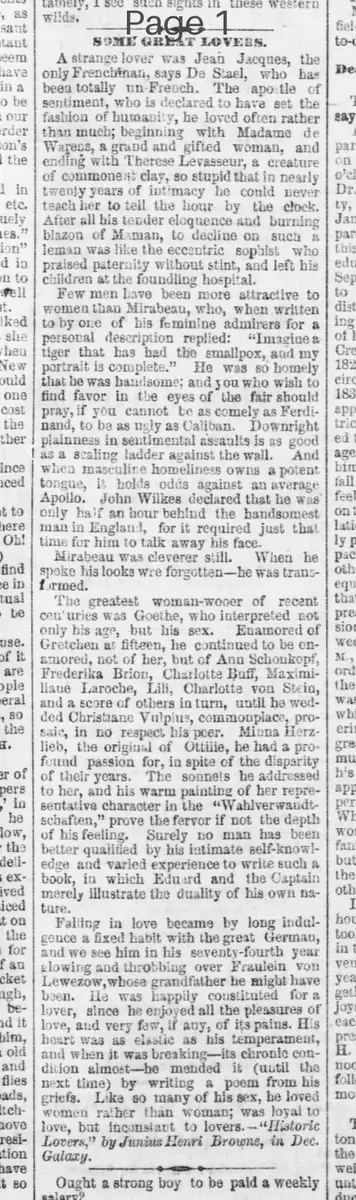
SOME GREAT LOVERS.
A strange lover was Jean Jacques, the only Frenchman, says De Stael, who has been totally un-French. The apostle of sentiment, who is declared to have set the fashion of humanity, he loved often rather than much; beginning with Madame de Warens, a grand and gifted woman, and ending with Therese Levasseur, a creature of commonest clay, so stupid that in nearly twenty years of intimacy he could never teach her to tell the hour by the clock. After all his tender eloquence and burning blazon of Maman, to decline on such a leman was like the eccentric sophist who praised paternity without stint, and left his children at the foundling hospital.
Few men have been more attractive to women than Mirabeau, who, when written to by one of his feminine admirers for a personal description replied: 'Imagine a tiger that has had the smallpox, and my portrait is complete.' He was so homely that he was handsome; and you who wish to find favor in the eyes of the fair should pray, if you cannot be as comely as Ferdinand, to be as ugly as Caliban. Downright plainness in sentimental assaults is as good as a scaling ladder against the wall. And when masculine homeliness owns a potent tongue, it holds odds against an average Apollo. John Wilkes declared that he was only half an hour behind the handsomest man in England, for it required just that time for him to talk away his face.
Mirabeau was cleverer still. When he spoke his looks were forgotten—he was transformed.
The greatest woman-wooer of recent centuries was Goethe, who interpreted not only his age, but his sex. Enamored of Gretchen at fifteen, he continued to be enamored, not of her, but of Ann Schoukopf, Frederika Brion, Charlotte Buff, Maximiliane Laroche, Lili, Charlotte von Stein, and a score of others in turn, until he wedded Christiane Vulpius, commonplace, prosaic, in no respect his peer. Minna Herzlieb, the original of Ottilie, he had a profound passion for, in spite of the disparity of their years. The sonnets he addressed to her, and his warm painting of her representative character in the 'Wahlverwandtschaften,' prove the fervor if not the depth of his feeling. Surely no man has been better qualified by his intimate self-knowledge and varied experience to write such a book, in which Eduard and the Captain merely illustrate the duality of his own nature.
Falling in love became by long indulgence a fixed habit with the great German, and we see him in his seventy-fourth year glowing and throbbing over Fraulein von Lewezow, whose grandfather he might have been. He was happily constituted for a lover, since he enjoyed all the pleasures of love, and very few, if any, of its pains. His heart was as elastic as his temperament, and when it was breaking—its chronic condition almost—he mended it (until the next time) by writing a poem from his griefs. Like so many of his sex, he loved women rather than woman; was loyal to love, but inconstant to lovers.—'Historic Lovers,' by Junius Henri Browne, in Dec. Galaxy.
A strange lover was Jean Jacques, the only Frenchman, says De Stael, who has been totally un-French. The apostle of sentiment, who is declared to have set the fashion of humanity, he loved often rather than much; beginning with Madame de Warens, a grand and gifted woman, and ending with Therese Levasseur, a creature of commonest clay, so stupid that in nearly twenty years of intimacy he could never teach her to tell the hour by the clock. After all his tender eloquence and burning blazon of Maman, to decline on such a leman was like the eccentric sophist who praised paternity without stint, and left his children at the foundling hospital.
Few men have been more attractive to women than Mirabeau, who, when written to by one of his feminine admirers for a personal description replied: 'Imagine a tiger that has had the smallpox, and my portrait is complete.' He was so homely that he was handsome; and you who wish to find favor in the eyes of the fair should pray, if you cannot be as comely as Ferdinand, to be as ugly as Caliban. Downright plainness in sentimental assaults is as good as a scaling ladder against the wall. And when masculine homeliness owns a potent tongue, it holds odds against an average Apollo. John Wilkes declared that he was only half an hour behind the handsomest man in England, for it required just that time for him to talk away his face.
Mirabeau was cleverer still. When he spoke his looks were forgotten—he was transformed.
The greatest woman-wooer of recent centuries was Goethe, who interpreted not only his age, but his sex. Enamored of Gretchen at fifteen, he continued to be enamored, not of her, but of Ann Schoukopf, Frederika Brion, Charlotte Buff, Maximiliane Laroche, Lili, Charlotte von Stein, and a score of others in turn, until he wedded Christiane Vulpius, commonplace, prosaic, in no respect his peer. Minna Herzlieb, the original of Ottilie, he had a profound passion for, in spite of the disparity of their years. The sonnets he addressed to her, and his warm painting of her representative character in the 'Wahlverwandtschaften,' prove the fervor if not the depth of his feeling. Surely no man has been better qualified by his intimate self-knowledge and varied experience to write such a book, in which Eduard and the Captain merely illustrate the duality of his own nature.
Falling in love became by long indulgence a fixed habit with the great German, and we see him in his seventy-fourth year glowing and throbbing over Fraulein von Lewezow, whose grandfather he might have been. He was happily constituted for a lover, since he enjoyed all the pleasures of love, and very few, if any, of its pains. His heart was as elastic as his temperament, and when it was breaking—its chronic condition almost—he mended it (until the next time) by writing a poem from his griefs. Like so many of his sex, he loved women rather than woman; was loyal to love, but inconstant to lovers.—'Historic Lovers,' by Junius Henri Browne, in Dec. Galaxy.
What sub-type of article is it?
Essay
What themes does it cover?
Love Romance
What keywords are associated?
Great Lovers
Rousseau
Mirabeau
Goethe
Romantic Affairs
Biographical Essay
What entities or persons were involved?
By Junius Henri Browne, In Dec. Galaxy.
Literary Details
Title
Some Great Lovers.
Author
By Junius Henri Browne, In Dec. Galaxy.
Subject
Historic Lovers
Key Lines
Imagine A Tiger That Has Had The Smallpox, And My Portrait Is Complete.
He Loved Women Rather Than Woman; Was Loyal To Love, But Inconstant To Lovers.