Thank you for visiting SNEWPapers!
Sign up free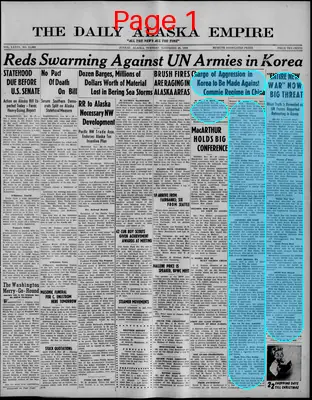
The Daily Alaska Empire
Juneau, Juneau County, Alaska
What is this article about?
On November 28, the US charged Communist China with aggression in Korea at the UN Security Council, urging withdrawal of Chinese troops and adoption of a resolution assuring peace and Korean independence, amid Soviet veto threats.
Clipping
OCR Quality
Full Text
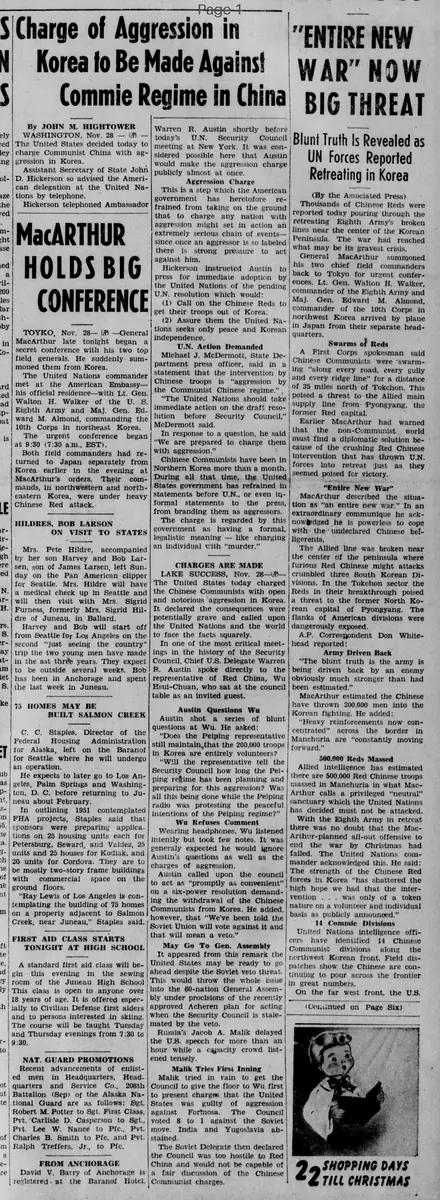
By JOHN M. HIGHTOWER
WASHINGTON, NOV. 28 - (P) - The United States decided today to charge Communist China with aggression in Korea.
Assistant Secretary of State John D. Hickerson so advised the American delegation at the United Nations by telephone.
Hickerson telephoned Ambassador Warren R. Austin shortly before today's U.N. Security Council meeting at New York. It was considered possible here that Austin would make the aggression charge publicly almost at once.
Aggression Charge
This is a step which the American government has heretofore refrained from taking on the ground that to charge any nation with aggression might set in action an extremely serious chain of events-since once an aggressor is so labeled there is strong pressure to act against him.
Hickerson instructed Austin to press for immediate adoption by the United Nations of the pending U.N. resolution which would:
(1) Call on the Chinese Reds to get their troops out of Korea.
(2) Assure them the United Nations seeks only peace and Korean independence.
U.N. Action Demanded
Michael J. McDermott, State Department press officer, said in a statement that the intervention by Chinese troops is "aggression by the Communist Chinese regime."
"The United Nations should take immediate action on the draft resolution before Security Council," McDermott said.
In response to a question, he said "We are prepared to charge them with aggression."
Chinese Communists have been in Northern Korea more than a month. During all that time, the United States government has refrained in statements before U.N., or even informal statements to the press, from branding them as aggressors.
The charge is regarded by this government as having a formal, legalistic meaning - like charging an individual with "murder."
CHARGES ARE MADE
LAKE SUCCESS, NOV. 28-IP- The United States today charged the Chinese Communists with open and notorious 'aggression in Korea.
It declared the consequences were potentially grave and called upon the United Nations and the world to face the facts squarely.
In one of the most critical meetings in the history of the Security Council, Chief U.S. Delegate Warren R. Austin spoke directly to the representative of Red China, Wu Hsui-Chuan, who sat at the council table as an invited guest.
Austin Questions Wu
Austin shot a series of blunt questions at Wu. He asked:
"Does the Peiping representative still maintain that the 200,000 troops in Korea are entirely volunteers?
"Will the representative tell the Security Council how long the Peiping regime has been planning and preparing for this aggression? Was all this being done while the Peiping radio was protesting the peaceful intentions of the Peiping regime?"
Wu Refuses Comment
Wearing headphones, Wu listened intently but took few notes. It was generally expected he would ignore Austin's questions as well as the charges of aggression.
Austin called upon the council to act as "promptly as convenient" on a six-power resolution demanding the withdrawal of the Chinese Communists from Korea. He added, however, that "We've been told the Soviet Union will vote against it and that will mean a veto."
May Go To Gen. Assembly
It appeared from this remark the United States may be ready to go ahead despite the Soviet veto threat.
This would throw the whole issue into the 60-nation General Assembly under provisions of the recently approved Acheson plan for acting when the Security Council is stalemated by the veto.
Russia's Jacob A. Malik delayed the U.S. speech for more than an hour while a capacity crowd listened tensely.
Malik Tries First Inning
Malik tried in vain to get the Council to give the floor to Wu first to present charges that the United States was guilty of aggression against Formosa. The Council voted 8 to 1 against the Soviet move. India and Yugoslavia abstained.
The Soviet Delegate then declared the Council was too hostile to Red China and would not be capable of a fair discussion of the Chinese Communist charges.
What sub-type of article is it?
What keywords are associated?
What entities or persons were involved?
Where did it happen?
Foreign News Details
Primary Location
Korea
Event Date
Nov. 28
Key Persons
Outcome
us charges china with aggression; urges un resolution for chinese troop withdrawal from korea; soviet veto expected, potentially moving issue to general assembly.
Event Details
The United States, via Ambassador Warren R. Austin at the UN Security Council, charged Communist China with aggression in Korea due to their troop intervention. Austin questioned Chinese representative Wu Hsui-Chuan on the troops and planning. The US pushed for a resolution demanding withdrawal of Chinese forces and assuring peace. Soviet delegate Jacob A. Malik attempted to prioritize Chinese counter-charges but was overruled.