Thank you for visiting SNEWPapers!
Sign up free
Sistersville Daily Oil Review
Sistersville, Tyler County, West Virginia
What is this article about?
Historical account of Confederate General Robert E. Lee's advance into Pennsylvania during the Gettysburg Campaign, June 15-19, 1863, featuring Jenkins' cavalry raid on Chambersburg, Ewell's victory at Winchester, and Union-Confederate cavalry clashes at Aldie, Middleburg, and Upperville.
Merged-components note: Merging image component into the historical story on Lee's advance to Gettysburg, as the image bounding box spatially overlaps with the story text bounding box.
Clipping
OCR Quality
Full Text
[Copyright, 1903, by G. L. Kilmer.]
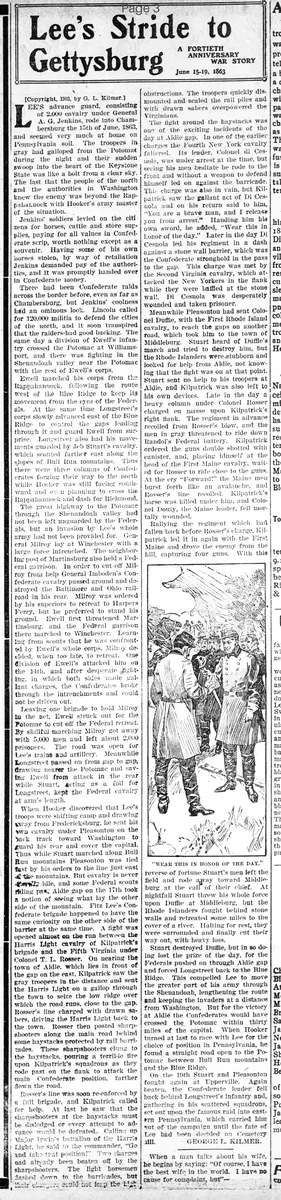
Lee's advance guard, consisting of 2,000 cavalry under General A. G. Jenkins, rode into Chambersburg the 15th of June, 1863, and seemed very much at home on Pennsylvania soil. The troopers in gray had galloped from the Potomac during the night and their sudden swoop into the heart of the Keystone State was like a bolt from a clear sky.
The last that the people of the north and the authorities in Washington knew the enemy was beyond the Rappahannock with Hooker's army master of the situation. Jenkins' soldiers levied on the citizens for horses, cattle and store supplies, paying for all values in Confederate scrip, worth nothing except as a souvenir. Having some of his own horses stolen, by way of retaliation Jenkins demanded pay of the authorities, and it was promptly handed over in Confederate money.
There had been Confederate raids across the border before, even as far as Chambersburg, but Jenkins' coolness had an ominous look. Lincoln called for 120,000 militia to defend the cities of the north, and it soon transpired that the raiders had good backing. The same day a division of Ewell's infantry crossed the Potomac at Williamsport, and there was fighting in the Shenandoah valley near the Potomac with the rest of Ewell's corps.
Ewell marched his corps from the Rappahannock, following the route west of the Blue Ridge to keep its movement from the eyes of the Federals. At the same time Longstreet's corps slowly advanced east of the Blue Ridge to control the gaps leading through it and guard Ewell from surprise. Longstreet also had his movements guarded by Jeb Stuart's cavalry, which scouted farther east along the slopes of Bull Run mountains. Thus there were three columns of Confederates forging their way to the north while Hooker was still facing southward and even planning to cross the Rappahannock and dash for Richmond.
The great highway to the Potomac through the Shenandoah valley had not been left unguarded by the Federals, but an invasion by Lee's whole army had not been provided for. General Milroy lay at Winchester with a large force intrenched. The neighboring post of Martinsburg also held a Federal garrison. In order to cut off Milroy from help General Imboden's Confederate cavalry passed around and destroyed the Baltimore and Ohio railroad in his rear. Milroy was ordered by his superiors to retreat to Harper's Ferry, but he preferred to stand his ground. Ewell first threatened Martinsburg, and the Federal garrison there marched to Winchester. Learning from scouts that he was confronted by Ewell's whole corps, Milroy decided, when too late, to retreat. One division of Ewell's attacked him on the 14th, and after desperate fighting, in which both sides made gallant charges, the Confederates broke through the intrenchments and could not be driven out.
Leaving one brigade to hold Milroy in the net, Ewell struck out for the Potomac to cut off the Federal retreat. By skillful marching Milroy got away with 5,000 men and left about 2,000 prisoners. The road was open for Lee's trains and artillery. Meanwhile Longstreet passed on from gap to gap, drawing nearer the Potomac and saving Ewell from attack in the rear while Stuart, acting as a foil for Longstreet, kept the Federal cavalry at arm's length.
When Hooker discovered that Lee's troops were shifting camp and drawing away from Fredericksburg, he sent his own cavalry under Pleasonton on the back track toward Washington to guard his rear and cover the capital. Thus while Stuart marched along Bull Run mountains Pleasonton was tied fast by his orders to the line just east of the mountains. But cavalry is never out of action or idle, and some Federal scouts riding past Aldie gap on the 17th took a notion of seeing what lay the other side of the mountain. Fitz Lee's Confederate brigade happened to have the same curiosity on the other side of the barrier at the same time. A fight was opened almost on the run between the Harris Light cavalry of Kilpatrick's brigade and the Fifth Virginia under Colonel T. L. Rosser. On nearing the town of Aldie, which lies in front of the gap on the east, Kilpatrick saw the gray troopers in the distance and sent the Harris Light on a gallop through the town to seize the low ridge over which the road runs, close to the gap.
Rosser's line charged with drawn sabers, driving the Harris Light back to the town. Rosser then posted sharpshooters along the main road behind some haystacks protected by rail barricades. These sharpshooters clung to the haystacks, pouring a terrible fire upon Kilpatrick's squadrons as they rode past on the flank to attack the main Confederate position, farther down the road.
Rosser's line was soon re-enforced by a full brigade, and Kilpatrick called for help. At last he saw that the sharpshooters at the haystacks must be dislodged or every attempt to advance would be defeated. Calling up Major Irwin's battalion of the Harris Light, he said to the commander, "Go and take that position!" Two charges had already been beaten off by the sharpshooters. The light horsemen dashed down to the barricades, but their horses could not leap the obstructions. The troopers quickly dismounted and scaled the rail piles and with drawn sabers overpowered the Virginians.
The fight around the haystacks was one of the exciting incidents of the day at Aldie gap. In one of the earlier charges the Fourth New York cavalry faltered. Its leader, Colonel di Cesnola, was under arrest at the time, but seeing his men hesitate he rode to the front and without a weapon to defend himself led on against the barricade. This charge was also in vain, but Kilpatrick saw the gallant act of Di Cesnola and on his return said to him, "You are a brave man, and I release you from arrest." Handing him his own sword, he added, "Wear this in honor of the day." Later in the day Di Cesnola led his regiment in a dash against a stone wall barrier, which was the Confederate stronghold in the pass to the gap. This charge was met by the Second Virginia cavalry, which attacked the New Yorkers in the flank while they were baffled at the stone wall. Di Cesnola was desperately wounded and taken prisoner.
Meanwhile Pleasonton had sent Colonel Duffie, with the First Rhode Island cavalry, to reach the gaps on another road, which took him to the town of Middleburg. Stuart heard of Duffie's march and tried to destroy him, but the Rhode Islanders were stubborn and looked for help from Aldie, not knowing that the fight was on at that point. Stuart sent no help to his troopers at Aldie, and Kilpatrick was also left to his own devices. Late in the day a heavy column under Colonel Rosser charged en masse upon Kilpatrick's right flank. The regiment in advance recoiled from Rosser's blow, and the men in gray threatened to ride down Randol's Federal battery. Kilpatrick ordered the guns double shotted with canister, and, placing himself at the head of the First Maine cavalry, waited for Rosser to ride close to the guns.
At the cry "Forward!" the Maine men burst forth like an avalanche, and Rosser's line recoiled. Kilpatrick's horse was killed under him, and Colonel Douty, the Maine leader, fell mortally wounded. Rallying the regiment which had fallen back before Rosser's charge, Kilpatrick led it in again with the First Maine and drove the enemy from the hill, capturing four guns. With this reverse of fortune Stuart's men left the field and rode away toward Middleburg at the call of their chief. At nightfall Stuart threw his whole force upon Duffie at Middleburg, but the Rhode Islanders fought behind stone walls and retreated some miles to the cover of a river. Halting for rest, they were surrounded and finally cut their way out, with heavy loss.
Stuart destroyed Duffie, but in so doing lost the prize of the day, for the Federals pushed on through Aldie gap and forced Longstreet back to the Blue Ridge. This compelled Lee to move the greater part of his army through the Shenandoah, lengthening the route and keeping the invaders at a distance from Washington. But for the victory at Aldie the Confederates would have crossed the Potomac within thirty miles of the capital. When Hooker turned at last to race with Lee for the choice of position in Pennsylvania, he found a straight road open to the Potomac between Bull Run mountains and the Blue Ridge.
On the 19th Stuart and Pleasonton fought again at Upperville. Again beaten, the Confederate leader fell back behind Longstreet's infantry and, gathering in his scattered squadrons, set out upon the famous raid into eastern Pennsylvania, which carried him out of the campaign until the fate of Lee had been decided on Cemetery Hill.
GEORGE L. KILMER.
What sub-type of article is it?
What themes does it cover?
What keywords are associated?
What entities or persons were involved?
Where did it happen?
Story Details
Key Persons
Location
Pennsylvania, Shenandoah Valley, Chambersburg, Winchester, Aldie, Middleburg, Upperville
Event Date
June 15 19, 1863
Story Details
Confederate forces under Lee advance into Pennsylvania; Jenkins raids Chambersburg; Ewell defeats Milroy at Winchester; cavalry battles at Aldie and Upperville result in Union victories that delay Lee's advance toward Washington.