Thank you for visiting SNEWPapers!
Sign up free
The Dayton Citizen
Dayton, Montgomery County, Ohio
What is this article about?
Chester J. Gray's analysis to Ohio Senate highlights severe employment discrimination against Negro workers, who face higher unemployment, restrictive jobs, and longer benefit periods amid 1949 economic decline. Legislators consider solutions with pending FEPC bill.
Merged-components note: Merged continuation of the analysis of labor problems facing Negroes in Ohio.
Clipping
OCR Quality
Full Text
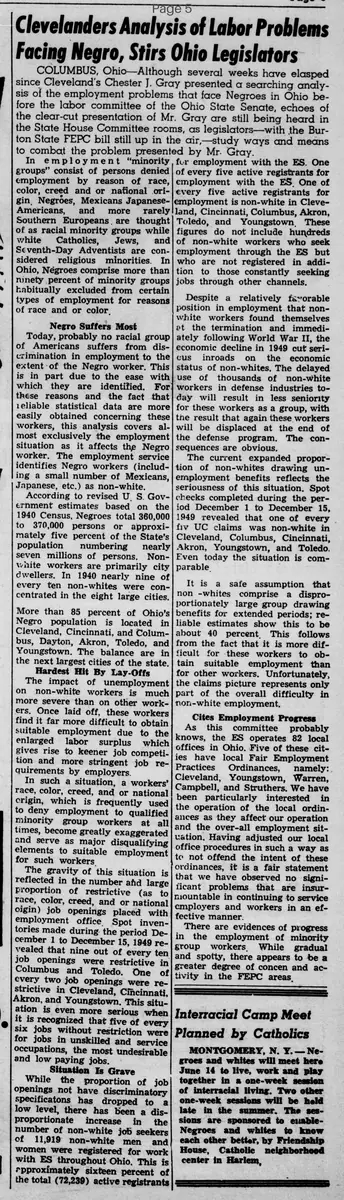
Negro, Stirs Ohio Legislators
COLUMBUS, Ohio--Although several weeks have elapsed since Cleveland's Chester J. Gray presented a searching analysis of the employment problems that face Negroes in Ohio before the labor committee of the Ohio State Senate, echoes of the clear-cut presentation of Mr. Gray are still being heard in the State House Committee rooms, as legislators--with the Burton State FEPC bill still up in the air,--study ways and means to combat the problem presented by Mr. Gray.
In employment "minority groups" consist of persons denied employment by reason of race, color, creed and or national origin, Negroes. Mexicans Japanese-Americans, and more rarely Southern Europeans, are thought of as racial minority groups while white Catholics, Jews, and Seventh-Day Adventists are considered religious minorities. In Ohio, Negroes comprise more than ninety percent of minority groups habitually excluded from certain types of employment for reasons of race and or color.
Negro Suffers Most
Today, probably no racial group of Americans suffers from discrimination in employment to the extent of the Negro worker. This is in part due to the ease with which they are identified. For these reasons and the fact that reliable statistical data are more easily obtained concerning these workers, this analysis covers almost exclusively the employment situation as it affects the Negro worker. The employment service identifies Negro workers (including a small number of Mexicans, Japanese. etc.) as non-white. According to revised U S. Government estimates based on the 1940 Census, Negroes total 360,000 to 370,000 persons or approximately five percent of the State's population numbering nearly seven millions of persons. Non-white workers are primarily city dwellers. In 1940 nearly nine of every ten non-whites were concentrated in the eight large cities. More than 85 percent of Ohio's Negro population is located in Cleveland. Cincinnati, and Columbus, Dayton, Akron. Toledo, and Youngstown. The balance are in the next largest cities of the state.
Hardest Hit By Lay-Offs
The impact of unemployment on non-white workers is much more severe than on other workers. Once laid off. these workers find it far more difficult to obtain suitable employment due to the enlarged labor surplus which gives rise to keener job competition and more stringent job requirements by employers. In such a situation, a workers' race, color, creed, and or national origin, which is frequently used to deny employment to qualified minority group workers at all times, become greatly exaggerated and serve as major disqualifying elements to suitable employment for such workers The gravity of this situation is reflected in the number and large proportion of restrictive (as to race, color, creed. and or national origin) job openings placed with employment office. Spot inventories made during the period December 1 to December 15, 1949 revealed that nine out of every ten job openings were restrictive in Columbus and Toledo. One of every two job openings were restrictive in Cleveland, Cincinnati, Akron, and Youngstown. This situation is even more serious when it is recognized that five of every six jobs without restriction were for jobs in unskilled and service occupations, the most undesirable and low paying jobs.
Situation Is Grave
While the proportion of job openings not have discriminatory specifications has dropped to a low level, there has been a disproportionate increase in the number of non-white job seekers of 11,919 non-white men and women were registered for work with ES throughout Ohio. This is approximately sixteen percent of the total (72,239) active registrants
for employment with the ES. One of every five active registrants for employment is non-white in Cleveland, Cincinnati, Columbus, Akron, Toledo. and Youngstown, These figures do not include hundreds of non-white workers who seek employment through the ES but who are not registered in addition to those constantly seeking jobs through other channels. Despite a relatively favorable position in employment that non-white workers found themselves at the termination and immediately following World War II, the economic decline in 1949 cut serious inroads on the economic status of non-whites. The delayed use of thousands of non-white workers in defense industries today will result in less seniority for these workers as a group, with the result that again these workers will be displaced at the end of the defense program. The consequences are obvious. The current expanded proportion of non-whites drawing unemployment benefits reflects the seriousness of this situation. Spot checks completed during the period December 1 to December 15, 1949 revealed that one of every five UC claims was non-white in Cleveland, Columbus, Cincinnati Akron, Youngstown, and Toledo. Even today the situation is comparable It is a safe assumption that non -whites comprise a disproportionately large group drawing benefits for extended periods; reliable estimates show this to be about 40 percent This follows from the fact that it is more difficult for these workers to obtain suitable employment than for other workers. Unfortunately, the claims picture represents only part of the overall difficulty in non-white employment.
Cites Employment Progress
As this committee probably knows, the ES operates 82 local offices in Ohio. Five of these cities have local Fair Employment Practices Ordinances, namely: Cleveland, Youngstown, Warren, Campbell, and Struthers. We have been particularly interested in the operation of the local ordinances as they affect our operation and the over-all employment situation. Having adjusted our local office procedures in such a way as to not offend the intent of these ordinances, it is a fair statement that we have observed no significant problems that are insurmountable in continuing to service employers and workers in an effective manner. There are evidences of progress in the employment of minority group workers. While gradual and spotty, there appears to be a greater degree of concern and activity in the FEPC areas.
What sub-type of article is it?
What themes does it cover?
What keywords are associated?
What entities or persons were involved?
Where did it happen?
Story Details
Key Persons
Location
Ohio, Particularly Cleveland, Columbus, Cincinnati, Dayton, Akron, Toledo, Youngstown
Event Date
1949 1950
Story Details
Chester J. Gray presents analysis to Ohio Senate labor committee on employment discrimination against Negroes, who comprise 90% of minority groups excluded from jobs. Non-whites face severe unemployment impacts, with restrictive job openings and disproportionate benefit claims. Progress noted in cities with FEPC ordinances.